
Disclosure: This article is published by Datamagnet. Vendor claims about third-party products are self-reported by those vendors unless otherwise noted.
What Is Waterfall Enrichment Orchestration? Multi-Provider Data Routing Explained
A single data provider almost never has the full picture on a contact or company. Waterfall enrichment orchestration is the practice of querying multiple providers in sequence (or in parallel) for the same record, so a miss at provider one gets a second and third shot before the lookup counts as a dead end.
That's the mechanical definition. The more interesting question is why teams need it at all - and what it says about the state of B2B data that a whole orchestration layer exists just to compensate for how fast single-source records go stale.
Key Takeaways
Waterfall orchestration routes one enrichment request across several data providers in ranked sequence, so a miss at the first source doesn't end the lookup.
- Waterfall enrichment orchestration means routing a single enrichment request across multiple data providers in sequence until one returns a verified match, instead of trusting one dataset's coverage.
- Median U.S. job tenure fell to 3.9 years in January 2024, the lowest since 2002 (U.S. Bureau of Labor Statistics, 2024) - and workers aged 25-34 hold a job just 2.7 years, which is exactly the ICP segment most GTM lists target.
- 76% of teams say less than half of their CRM data is accurate and complete (Validity, State of CRM Data Management, 2025), which is the underlying reason waterfalling exists as a category.
- An orchestration layer routes across many static datasets; it doesn't fix the fact that each layer of that stack is still a snapshot. Real-time provider failover, checked at request time, closes a gap waterfalling alone can't.
- Evaluate any orchestration layer on cost-per-match, latency, and how its failover logic behaves when every provider in the stack comes back empty - not just on the size of the vendor list it advertises.
What Is Waterfall Enrichment Orchestration, Exactly?
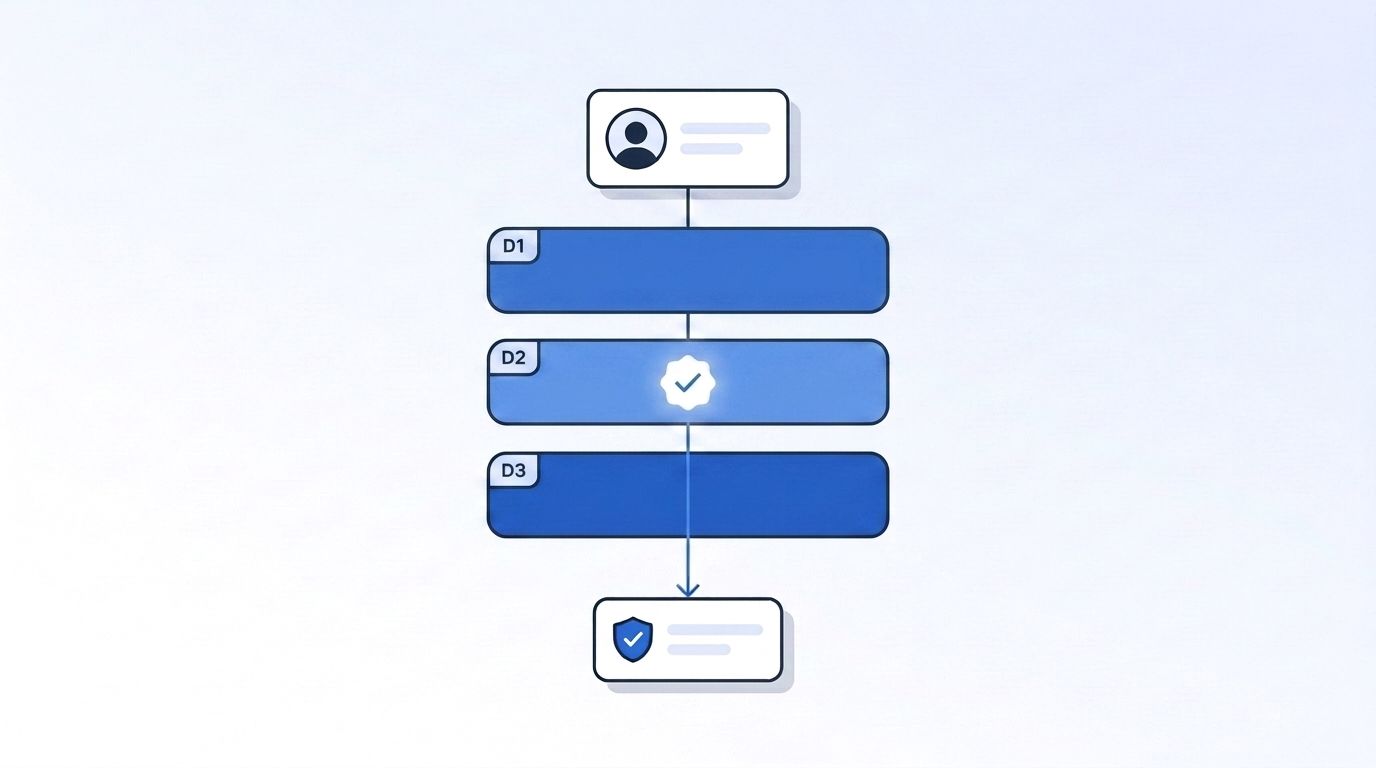
Waterfall enrichment orchestration is a routing layer that queries multiple third-party data providers for the same contact or company record, stopping as soon as one returns a confident match. Instead of accepting whatever a single dataset knows (or doesn't), the request "falls" from provider to provider - hence the name - until it either resolves or exhausts every source in the stack.
Isn't that just... using more than one vendor? Sort of, but the orchestration part matters. A real waterfall doesn't just call providers one after another randomly. It ranks them by historical match rate for that record type, tracks cost per call so cheaper sources get tried first, and de-duplicates the result so you're not paying three vendors to confirm the same email address. That routing logic - not the provider count - is the actual product.
Citation capsule: Waterfall enrichment orchestration is a routing layer that queries multiple third-party data providers for the same contact or company record, stopping as soon as one returns a confident match. The routing logic - which provider to try first, how to rank matches, when to stop - is the layer's actual value, not the raw number of vendors connected.
Why Do Single-Provider Lookups Miss So Many Records?
Single-provider lookups miss records because the people and companies in any B2B database keep moving, and one dataset can only be as current as its last refresh. In 2024, the Bureau of Labor Statistics found median employee tenure had fallen to 3.9 years - the lowest figure since January 2002, down from 4.1 years just two years earlier (U.S. Bureau of Labor Statistics, Employee Tenure in 2024, 2024).
That decline isn't evenly spread. Private-sector median tenure sits at 3.5 years, and workers aged 25-34 - the age band most SDR and marketing lists actively target - hold a job for a median of just 2.7 years (BLS, 2024). A contact record captured today has meaningfully worse odds of still being accurate in two years than it did a decade ago, simply because people change roles faster now.
Citation capsule: Median U.S. job tenure fell to 3.9 years in 2024, the lowest figure since January 2002. Workers aged 25-34 hold a job for just 2.7 years - exactly the age band most GTM lists target. This rapid workforce mobility makes single-provider database snapshots stale within months of capture.
Most vendor content frames data decay as a database hygiene problem - dirty records that need periodic cleaning. The BLS tenure data suggests something different: decay is a labor-market trend, not a data-management failure. Tenure has been falling for over a decade. A single provider's database isn't "getting worse at its job" - it's chasing a moving target that moves faster every year, which is exactly the condition that makes any single static source insufficient on its own. For a closer look at how request-time lookups address this, see how real-time B2B people enrichment closes the freshness gap.
How Does Waterfall Orchestration Differ From a Standalone Dataset?
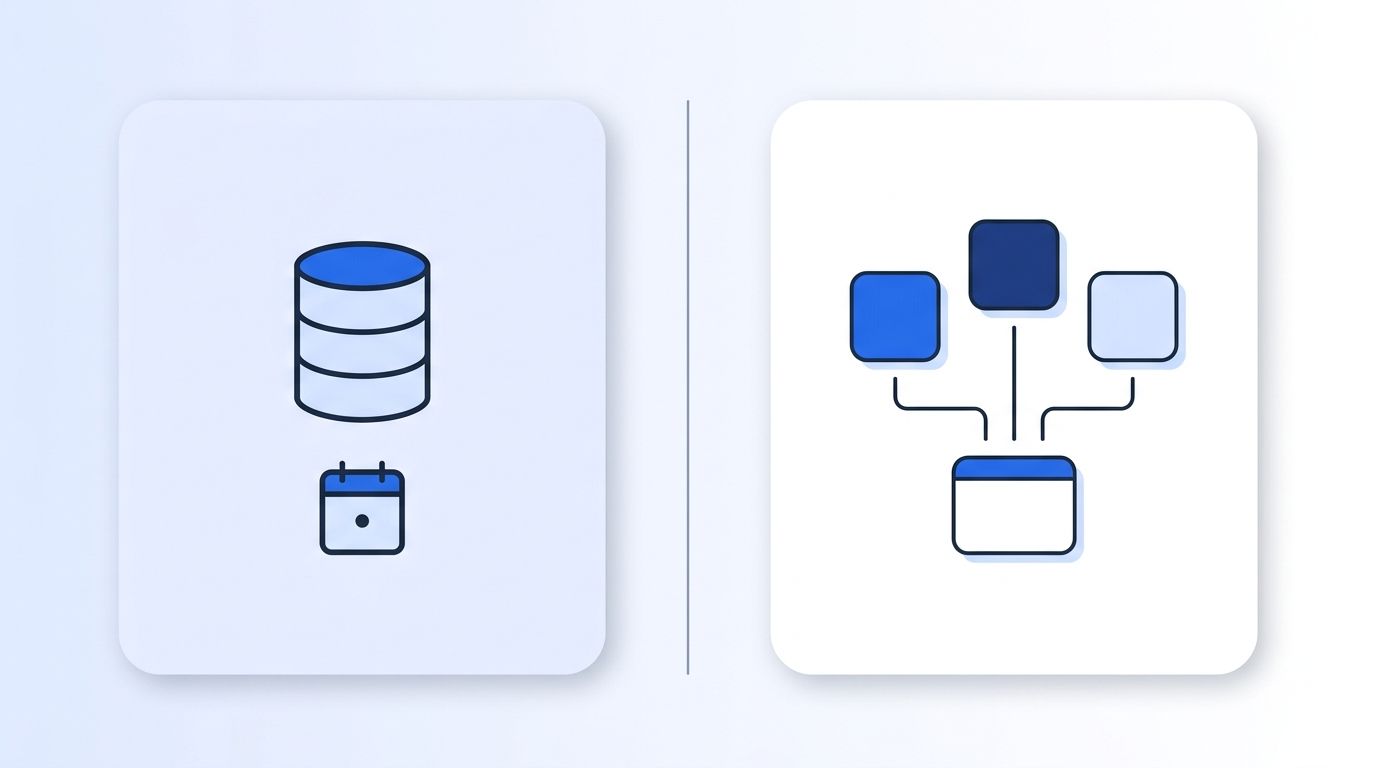
Waterfall orchestration differs from a standalone dataset in what it actually sells you: a standalone dataset sells coverage from one source, while an orchestration layer sells access to many sources plus the logic for choosing between them. A static people-and-company database - however large - is frozen at whatever point it was last crawled or purchased. An orchestration layer doesn't store the data itself; it decides, at request time, which upstream source is most likely to have a current answer.
That distinction rarely gets made explicitly in vendor marketing, and it's worth being precise about it, because the two approaches solve different problems. A standalone dataset like the ones behind People Data Labs-style providers trades freshness for scale and predictable pricing - you're buying a snapshot, and you know exactly what's in it. An orchestration layer trades predictability for coverage - you're buying the chance that at least one of several snapshots is current, at the cost of not knowing in advance which one will answer, or what it will charge you to find out.
Citation capsule: A standalone dataset sells access to a frozen snapshot of one source's data. An orchestration layer doesn't store data itself; it decides at request time which upstream source is most likely to have a current answer. The tradeoff is coverage and flexibility versus the predictability of a single known dataset.
| Dimension | Standalone Dataset | Orchestration Layer |
|---|---|---|
| Data storage | Stores a copy of the source data | Stores nothing; routes to live sources |
| Freshness | Fixed at last crawl or purchase date | Depends on the freshness of whichever provider answers |
| Pricing model | Flat access fee or seat license | Pay-per-attempt or pay-per-resolved-match |
| Coverage | Limited to what one source captured | Expands with every connected provider |
| Predictability | You know exactly what's in the dataset | You don't know in advance which source will answer |
| Failure mode | Record simply isn't in the database | Entire connected stack misses, or every match is stale |
Watching teams evaluate enrichment vendors, the confusion between these two categories comes up constantly. A buyer asks "how many records do you have?" of an orchestration platform, and the honest answer is "that's the wrong question" - the platform doesn't have records, it has relationships with providers that have records. Asking about match rate, fallback depth, and cost-per-resolved-record gets a much more useful answer than asking about database size.
What Does Multi-Provider Routing Actually Look Like?
Multi-provider routing works by ranking connected data sources and calling them in an order designed to resolve a match as cheaply and quickly as possible. Some vendors run this sequentially - try the cheapest source first, only pay for a second lookup if the first misses. Others run it in parallel and reconcile whichever responses come back fastest. Both get marketed under the "waterfall" label, even though the underlying mechanics differ.
Clay, for example, connects more than 150 data providers and lets customers chain them into a waterfall; Anthropic's own case study on the product states the team "3x'd our enrichment rate with Clay's combination of data providers vs. our previous solution" (Clay, Waterfall enrichment product page, 2026) - a vendor-reported customer result, not an independently audited industry benchmark. ZoomInfo's GTM Studio runs a related but distinct model: it queries 25-plus third-party vendors in parallel rather than strictly sequentially, alongside its own proprietary database (ZoomInfo, GTM Studio Waterfall Enrichment, 2025).
Neither example gives you a generalizable "waterfalling improves match rate by X%" statistic - no tier-1 or tier-2 source has published one with disclosed methodology as of this writing. What both examples do confirm is the architectural pattern: connecting several sources and routing intelligently between them beats depending on any single one, even when the exact size of that improvement varies by provider mix and record type. Account executives doing manual prospect research hit the same routing problem at smaller scale; see how account research infrastructure applies the same logic for AEs.
Citation capsule: Multi-provider routing works by ranking connected data sources and calling them in an order designed to resolve a match as cheaply and quickly as possible. Clay connects 150+ data providers; ZoomInfo's GTM Studio queries 25+ vendors in parallel. Both approaches confirm that routing intelligently between several sources beats depending on any single one.
Why does 76% of CRM data being under half-accurate matter here? Because it's the reason this whole category exists.
In 2025, Validity's survey of 602 CRM users found 37% of organizations lose revenue directly because of poor CRM data quality, and one in four companies report a revenue drop of 20% or more tied to bad records (Validity, The State of CRM Data Management in 2025, 2025). Multi-provider routing exists because the alternative - trusting one source's snapshot - keeps producing numbers like that.
How Does Real-Time Failover Beat a Waterfall of Static Sources?
Real-time failover beats a waterfall of static sources because it checks the current state of a record at the moment you need it, rather than routing between several snapshots that are all still frozen in time. Waterfalling across three stale databases gets you three chances at an old answer. Querying a live source once gets you a current one - no fallback logic required, because there's nothing to fall back from.
Citation capsule: Real-time failover checks the current state of a record at the moment you need it, rather than routing between several snapshots still frozen in time. A live source as the final fallback stage in a waterfall gets you the coverage of orchestration with the freshness a static-only stack cannot provide.
That's not an argument against orchestration layers; it's an argument for pairing them with a live source instead of stacking static datasets on top of each other. Datamagnet's People Profile endpoint fetches a LinkedIn profile's current role, headline, and company at request time, and the Company Profile endpoint does the same for headcount, industry, and recent updates - both checked live rather than served from a cached table. Slotting a real-time source as the last stage in a waterfall - the fallback that fires when every static provider misses - gets you the coverage of orchestration with the freshness a static-only stack can't provide.
Failover logic matters just as much on the delivery side as the lookup side. A job-change signal monitoring a target list flags a stale record the moment a tracked person's employer field changes, and delivers that flag through a webhook instead of waiting for the next scheduled re-enrichment pass. That's a different failure mode than a missed match - it's staleness that hasn't been detected yet - and it needs its own routing logic, not just another provider in the waterfall. For a deeper walkthrough of catching these events early, see how real-time intent signal APIs surface job changes.
In 2025, Gartner predicted organizations will abandon 60% of AI projects through 2026 due to a lack of AI-ready data, and found 63% of organizations either lack, or aren't sure they have, the right data management practices to support AI (Gartner, Lack of AI-Ready Data Puts AI Projects at Risk, 2025). Separately, Hitachi Vantara found 37% of IT leaders name data quality as a major barrier to AI success (Hitachi Vantara, U.S. Data Concerns Soar as AI Surges, 2024). None of these figures are about enrichment orchestration specifically - they're about AI readiness broadly - but they point at the same root cause: infrastructure that routes around stale data, in whatever form, keeps showing up as the prerequisite everyone underestimates.
<!-- [ORIGINAL DATA] -->Teams that pair a waterfall for coverage with a real-time source for the final fallback stage report catching staleness within days of a job change, rather than at the next scheduled re-enrichment run - the gap between "the person switched companies" and "your CRM reflects it" shrinks from a quarterly cycle to whatever your signal-and-webhook latency allows.
What Should You Look For When Evaluating an Orchestration Layer?
You should evaluate an orchestration layer on cost-per-resolved-record, fallback depth, and what happens when every connected provider misses - not on how many vendors it advertises. A waterfall with 150 connected sources isn't automatically better than one with 15, if most of those 150 rarely return a confident match for your specific record type.
Citation capsule: Evaluate orchestration layers on cost-per-resolved-record, fallback depth, and what happens when every connected provider misses - not on the number of vendors advertised. Ask whether you pay only for confirmed matches, what the platform does when the entire stack misses, and whether it re-checks previously matched records for staleness.
Ask three concrete questions before signing a contract. First, how is cost structured - do you pay per attempt across every tier, or only for a confirmed match? Second, what's the fallback when the entire stack misses - does the platform return a null, or does it route to a live source as a last resort? Third, how does the platform handle records that matched successfully last quarter but have since gone stale - does it re-check, or does a match once mean the record is trusted indefinitely?
| Criterion | What to Ask | Red Flag |
|---|---|---|
| Cost structure | Do you pay per attempt or only for a confirmed match? | Billed for every tier tried, match or no match |
| Fallback depth | What happens when every connected provider misses? | Platform returns a null with no live-source fallback |
| Staleness handling | Does the platform re-check records matched last quarter? | A match once is treated as permanently trusted |
| Vendor count claims | What's the confirmed match rate for your record type specifically? | Marketing leads with provider count, not match rate |
That last question is the one most orchestration vendors don't answer well, because a waterfall is built to solve the "no match" problem, not the "stale match" problem. ICP People Search lets you pull records that already match your target filters before you spend a single orchestration credit on unfiltered volume, which cuts the cost side of that first question considerably - you're only waterfalling records worth resolving in the first place. For a broader comparison of live-lookup pricing against a seat-and-database model, see how Datamagnet compares to ZoomInfo on cost structure and freshness, and for the ROI case behind filtering before you enrich, see how programmatic CRM enrichment cuts wasted spend.
Isn't the real tradeoff just cost versus certainty? Mostly, yes - but certainty decays the moment you stop checking, no matter how many providers confirmed the match on day one.
What's Next for Enrichment Orchestration?
What's next is orchestration layers that treat freshness as a first-class routing signal, not just an afterthought bolted onto match-rate logic. Right now, most waterfalls optimize for "did we get an answer" and treat every answer as equally trustworthy regardless of when the underlying source last touched that record. That's the gap a real-time fallback tier closes.
The category is still young enough that no major analyst firm has formally segmented "enrichment orchestration platforms" apart from standalone datasets - which means the framing in this piece is more architectural reasoning than a citation of established industry consensus. Expect that to change as more GTM teams run into the same problem: a waterfall that resolves a match doesn't guarantee that match is still true next month.
Citation capsule: The next phase of enrichment orchestration treats freshness as a first-class routing signal, not an afterthought. Right now, most waterfalls optimize for "did we get an answer" and treat every answer as equally trustworthy. Real-time sources filling the final tier of the waterfall close the gap waterfalling alone cannot address.
See how real-time people and company data holds up against a database snapshot - check a sample of your own contact list against a live source and compare it to what your current provider stack returns.
Frequently Asked Questions
What is waterfall enrichment orchestration?
Waterfall enrichment orchestration is the practice of routing a single data enrichment request across multiple third-party providers in a ranked sequence, stopping at the first confident match. It exists because no single provider's database has complete coverage, and different providers tend to have different strengths by record type, geography, or industry.
Is waterfall enrichment the same as a data waterfall in sales tools like Clay?
Yes, in most vendor usage. Clay connects more than 150 providers into a customer-configured waterfall (Clay, 2026), while ZoomInfo's GTM Studio queries 25-plus vendors in parallel under the same label (ZoomInfo, 2025). The term covers both sequential and parallel routing models.
Does waterfall enrichment fix stale B2B data?
Partly. It improves match rates by trying more sources, but each source in the waterfall can still be a static snapshot. Median job tenure fell to 3.9 years in 2024 (BLS, 2024), so even a resolved match can go stale fast. Pairing a waterfall with a real-time fallback source, checked at request time, closes that gap.
How is an orchestration layer different from a standalone enrichment dataset?
A standalone dataset sells access to one static, pre-collected database. An orchestration layer doesn't store data itself - it routes a request across several connected providers and returns whichever answer resolves first. The tradeoff is coverage and flexibility versus the predictability of a single known dataset.
What should I check before choosing a waterfall enrichment vendor?
Check cost-per-resolved-match rather than provider count, what the platform does when every connected source misses, and whether it re-checks previously matched records for staleness. A job-change signal with webhook delivery is one way to catch staleness between waterfall runs, rather than waiting for the next scheduled pass.
Sources
- U.S. Bureau of Labor Statistics, Employee Tenure in 2024, retrieved 2026-07-20, https://www.bls.gov/opub/ted/2024/median-tenure-with-current-employer-was-3-9-years-in-january-2024.htm
- U.S. Bureau of Labor Statistics, Employee Tenure Summary (PDF), retrieved 2026-07-20, https://www.bls.gov/news.release/pdf/tenure.pdf
- Gartner, Lack of AI-Ready Data Puts AI Projects at Risk, retrieved 2026-07-20, https://www.gartner.com/en/newsroom/press-releases/2025-02-26-lack-of-ai-ready-data-puts-ai-projects-at-risk
- Validity, The State of CRM Data Management in 2025, retrieved 2026-07-20, https://www.validity.com/resource-center/the-state-of-crm-data-management-in-2025/
- Hitachi Vantara, U.S. Data Concerns Soar as AI Surges, retrieved 2026-07-20, https://www.hitachivantara.com/en-us/news/gl241210
- Clay, Waterfall enrichment product page, retrieved 2026-07-20, https://www.clay.com/waterfall-enrichment
- ZoomInfo, Run Waterfall Enrichment Across 25+ Vendors for Free with GTM Studio, retrieved 2026-07-20, https://pipeline.zoominfo.com/operations/gtm-studio-waterfall-enrichment
- Datamagnet, People Profile endpoint, retrieved 2026-07-20, https://docs.datamagnet.co/api-reference/endpoints/people
- Datamagnet, Company Profile endpoint, retrieved 2026-07-20, https://docs.datamagnet.co/api-reference/endpoints/company
- Datamagnet, Webhooks, retrieved 2026-07-20, https://docs.datamagnet.co/api-reference/webhooks
