
Disclosure: This article is published by Datamagnet. Vendor claims are self-reported unless otherwise noted.
Skill Decay Signals: When a Candidate's Listed Skills Stop Matching Their Work
How long does a listed skill actually stay true? Not nearly as long as it used to. Skill half-life has shrunk from roughly 10 years four decades ago to about 4 years today. For AI and other fast-moving digital-technology skills, it can be as short as 2 years (Forbes, citing Stanford lecturer and Workera CEO Kian Katanforoosh, April 2024). In January 2025, the World Economic Forum projected that 39% of workers' core skills will change by 2030. Skill lists don't move that fast. Actual, current work does.
Key Takeaways
- In January 2025, the World Economic Forum projected that 39% of core job skills will change by 2030 (World Economic Forum, Future of Jobs Report 2025) — a lot of profiles are quietly drifting out of date right now.
- Skill half-life has compressed from about 10 years four decades ago to roughly 4 years today, and as little as 2 years for AI and digital-technology skills (Forbes, 2024).
- Only 36% of organizations qualify as "career development champions," even though 91% of L&D professionals say continuous learning matters more than ever (LinkedIn Learning, 2025 Workplace Learning Report) — a gap that lets stale skill tags go unchecked.
- Behavioral signals — recent posts, role changes, project activity — verify whether a listed skill is still true today, not just true when it was typed in.

What Is Skill Decay, and Why Is It Accelerating?
In January 2025, the World Economic Forum's Future of Jobs Report found that employers expect 39% of workers' core skills to change by 2030 (World Economic Forum, Future of Jobs Report 2025). That's down from 44% in the 2023 edition of the same report — a sign the pace of disruption has eased slightly. It's still close to two in five skills, though. And it's what employers themselves expect, not a worst-case estimate.
Skill decay is what happens between that survey and your sourcing search. A candidate lists "SQL" or "paid social" in 2023. By 2026, the tools, platforms, or scope behind that label may have shifted enough that the tag no longer describes their day-to-day work. That shift isn't gradual for every skill, either. Skill half-life — how long a skill stays professionally relevant before it needs a refresh — has compressed fast. Katanforoosh estimates it's gone from roughly 10 years four decades ago to about 4 years today. For AI and other fast-moving digital-technology skills specifically, half-life can shrink to as little as 2 years (Forbes, April 2024).
<!-- [UNIQUE INSIGHT] -->IBM's Institute for Business Value sorts skills by exactly how fast they decay. "Perishable" skills — most specific technical and software-tool skills — carry a half-life under 2.5 years. "Semi-durable" skills, broader technical knowledge, run 2.5 to 7.5 years. Only "durable" skills, mostly mindsets and leadership capability, hold value past 7.5 years (IBM Institute for Business Value, 2024). A skill tag on a resume never tells you which bucket it falls into.
Notice the direction of that shift. A skill that used to stay relevant for a decade might now need refreshing every two to four years. If your sourcing filters treat a listed skill as a permanent fact, you're building on a number that's actively shrinking under you.
Why Do Listed Skills Stop Matching Actual Work?
The tools behind a skill tag change faster than most people update their profile. In Stack Overflow's 2025 Developer Survey, 69% of developers said they'd spent time in the past year learning a new coding language or technique (Stack Overflow, 2025 Developer Survey). That's proof the skills underneath a job title keep shifting even when the label on a LinkedIn profile doesn't.
<!-- [UNIQUE INSIGHT] -->Skill lists on LinkedIn, resumes, and ATS records are self-reported and additive by default. People rarely go back and prune a skill they've outgrown or stopped practicing — new skills get added, old ones just sit there. The result is profiles that accumulate skill tags the way a junk drawer accumulates old chargers: technically still in there, no longer relevant to what's happening now.
A candidate who moved from hands-on SQL work into a management role two years ago is unlikely to prune "SQL" from their profile. That's true even if they haven't written a query since. That's a false positive waiting to happen the moment a sourcer filters on "SQL" and assumes current proficiency.
Even a skill that's genuinely still in use can mean something different year to year. Python usage rose 7 percentage points among developers between 2024 and 2025. Framework adoption shifted just as fast — FastAPI usage climbed to 15.1% and Next.js to 21.5% in the same window (Stack Overflow, 2025 Developer Survey: Technology). A "Python" tag from 2023 and a "Python" tag from 2026 don't necessarily describe the same day-to-day work.
What Does Sourcing on Stale Skill Signals Actually Cost?
Sourcing on outdated skill tags isn't a harmless inefficiency — it shows up directly in cost and lost time. A landmark McKinsey Global Institute analysis estimated that up to 375 million workers worldwide — about 14% of the global workforce — may need to switch occupations by 2030 because of automation (McKinsey Global Institute). That's a 2017 finding, but it's still the standard reference point in 2025 and 2026 workforce coverage. At that scale, a sourcing filter built on static skill tags is fighting a workforce that's already shifting underneath it.
<!-- [UNIQUE INSIGHT] -->This is where a static skill filter actively works against you. A sourcer searching for "current" expertise in a fast-moving skill is really searching for a snapshot that may be years old, filtered as if it were live. You end up with two failure modes at once: false positives, stale skills that read as current, and false negatives, genuinely current people whose profile just hasn't caught up.
The financial stakes are real. SHRM's 2025 Recruiting/Talent Acquisition Benchmarking Report put average cost-per-hire at $5,475 for non-executive roles and $35,879 for executive roles — up 21% since 2022 (SHRM, 2025 Recruiting/Talent Acquisition Benchmarking Report, 2025). A bad hire compounds that: a long-standing SHRM and DOL benchmark puts the cost at 30% to 50% of that employee's first-year salary. A mis-hire driven by a stale skill signal doesn't just cost that number once — it costs it again when you have to re-source the role.
For teams verifying whether a candidate's current experience actually matches a role, DataMagnet's Person Profile endpoint pulls structured LinkedIn data — current role, tenure, and job history — at request time. You're comparing against what's on the profile right now, not a cached snapshot from months ago.
What Do Behavioral Skill-Decay Signals Actually Look Like?
A listed skill tells you what a candidate typed in once. A behavioral signal tells you what they're doing lately, and that's a much better proxy for whether a skill claim still holds up. Four signals do most of the work here: recent post and comment activity, job or title changes, project or company shifts, and new certifications timed against a role change.
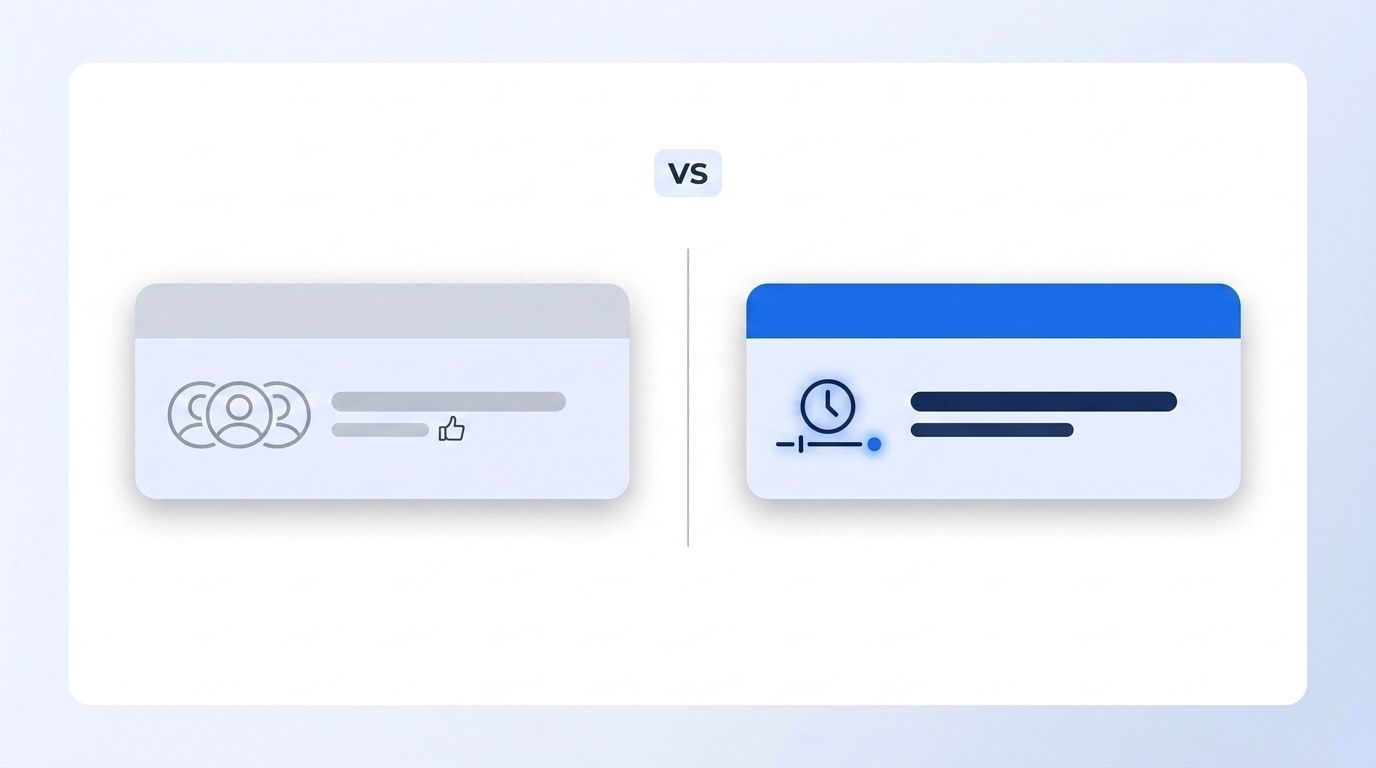
<!-- [UNIQUE INSIGHT] -->Endorsements deserve a specific caution here. LinkedIn's endorsement feature runs on peer clicks, not verified work history — a colleague can endorse "Python" for someone in five seconds without ever seeing their code. That makes endorsements a weak, reciprocal signal rather than proof of current skill. Behavioral activity — what someone is actually posting about or working on right now — is a more honest read than how many people clicked a button next to a skill tag.
Recency is the throughline across all four signals. A candidate who posted about a migration project last month sends a stronger "current skill" signal. Compare that to a profile still listing a skill from a role they left in 2023. DataMagnet's Person Activity endpoint surfaces a member's recent posts, comments, and shares. That's a more direct read on what someone is actually doing than a skills list that hasn't been touched in years.
Job changes are another strong tell. Someone who just moved into a role that requires a skill they never listed is worth a second look — the skill likely predates the listing. DataMagnet's Person Engagement Signal can monitor specific profiles for exactly this kind of activity change, flagging when someone starts posting or engaging differently than before.
Skills-Based Sourcing Teams Verify Currency, Not Just Presence
How much are organizations actually investing in keeping skills current? Not enough, according to LinkedIn Learning's 2025 Workplace Learning Report. 91% of L&D professionals agree continuous learning is more important than ever for career success. Yet only 36% of organizations qualify as "career development champions" (LinkedIn Learning, 2025 Workplace Learning Report).
That gap matters for sourcing. As of 2025, 68% of employees say learning helps them adapt to change, up 4 points year-over-year (LinkedIn Learning, 2025 Workplace Learning Report). That means the appetite to keep skills current already exists on the employee side. But if fewer than 4 in 10 organizations are structured to support that, a lot of current skill development never makes it onto a resume or LinkedIn profile. Isn't that exactly the gap a skill-currency check needs to close?
Verifying which candidates in a large pool have both the right title history and the right seniority takes structured search, not manual scrolling. DataMagnet's ICP People Search endpoint filters candidates by job title, seniority, function, and company, and its People Search DB endpoint searches DataMagnet's own database of previously enriched profiles — both useful starting points before you layer on behavioral verification.
How Do You Build a Skill-Currency Check Into Your Sourcing Workflow?
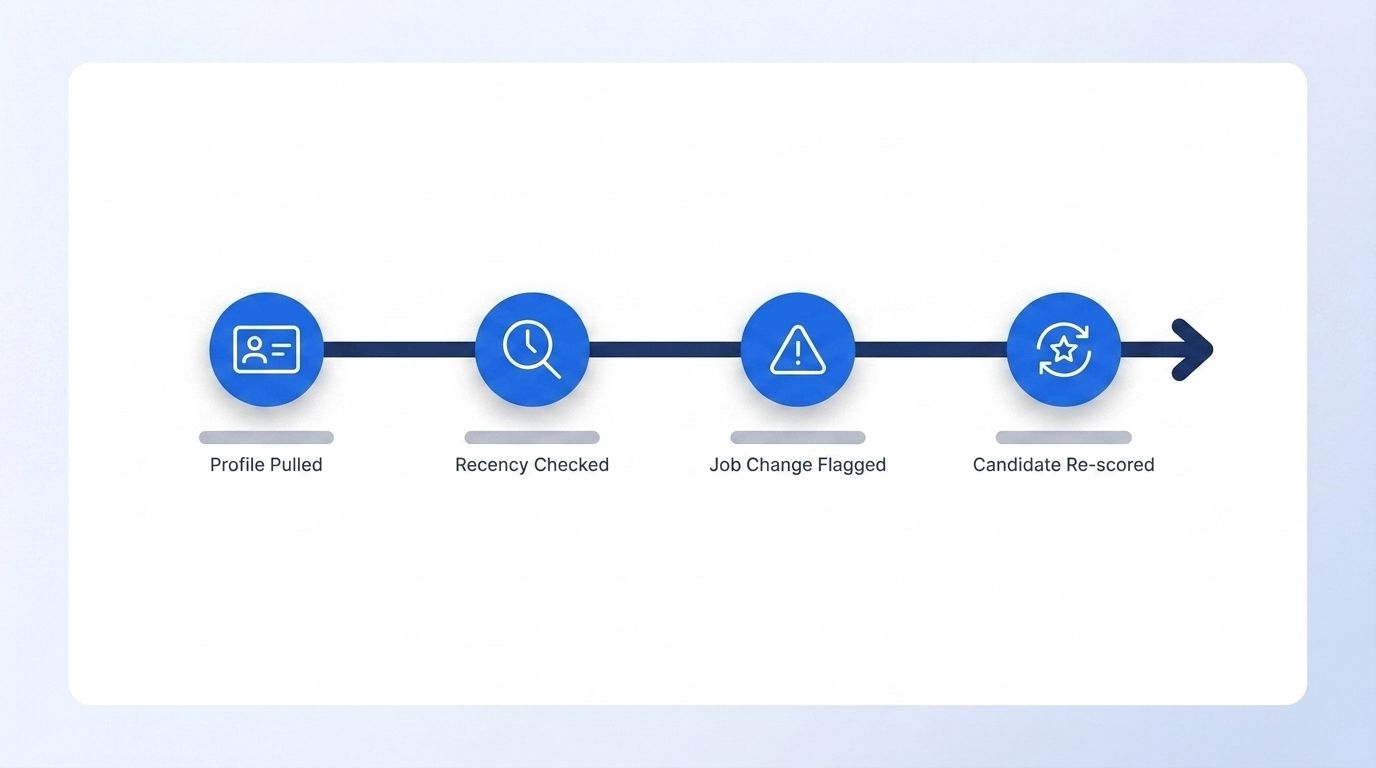
A skill-currency check doesn't need to be complicated. It needs to run before a candidate is shortlisted, not after an interview reveals the gap. Start by pulling the candidate's current role, tenure, and job history against the skill you're filtering for. A mismatch between "3 years in this title" and "skill added last month" is worth a second look either way.
Next, layer in recency. Has the candidate posted, commented, or engaged with content related to the skill in the last six months? A completely quiet profile isn't necessarily a stale one, but paired with an old skill-add date, it's a reasonable flag to verify before you invest recruiter time.
Finally, treat job changes as a trigger, not a one-time check. Someone who just moved companies or roles is worth re-screening for skills they may not have listed yet. DataMagnet's Champion Tracker cookbook walks through monitoring job-change signals for exactly this kind of ongoing re-verification, and the same pattern applies whether you're tracking champions or re-sourcing a pipeline. For teams building this into a broader recruiting intelligence workflow, the goal is the same: treat skill data as a stream that needs refreshing, not a field you check once.
Frequently Asked Questions
What is skill decay in recruiting?
Skill decay describes the gap between a skill listed on a candidate's profile or resume and what they're actually doing day-to-day. The World Economic Forum expects 39% of core job skills to change by 2030 (WEF, Future of Jobs Report 2025). Skill half-life for fast-moving technical skills can be as short as 2 years (Forbes, 2024) — meaning a skill listed a few years ago may no longer reflect current work.
How can sourcing teams detect stale skill claims?
Look past the skill tag to behavioral signals: recent posts and comments, job or title changes, and the timing of new activity relative to when a skill was added. DataMagnet's Person Activity endpoint and Person Engagement Signal surface exactly these kinds of recency signals for verification.
Are LinkedIn skill endorsements a reliable currency signal?
Not on their own. Endorsements rely on peer clicks rather than verified work history, so a connection can endorse a skill without direct knowledge of current proficiency. Treat endorsements as a weak, reciprocal signal and prioritize recent activity and job history changes instead when judging whether a skill claim still holds up.
Does skill half-life differ by type of skill?
Yes. IBM's Institute for Business Value classifies skills by how fast they decay: "perishable" skills, mostly specific technical and software tools, carry a half-life under 2.5 years. "Semi-durable" skills, broader technical knowledge, run 2.5 to 7.5 years. Only "durable" skills — mindsets and leadership capability — hold value past 7.5 years (IBM Institute for Business Value, 2024). A resume rarely tells you which bucket a listed skill falls into.
The Skill List Is a Snapshot, Not a Live Feed
Listed skills answer "what did this person once claim?" Behavioral signals answer "what is this person doing now?" Skill half-life keeps compressing: roughly 10 years to about 4 years overall, and as little as 2 years for AI and digital-technology skills. That gap between the two answers only gets more expensive to ignore. The World Economic Forum's 39%-by-2030 projection is the scale of the problem; a candidate's actual last six months of activity is the fix.
Build skill-currency checks into your sourcing workflow before the shortlist, not after a bad hire. Pull current role and tenure data, check recent activity, and treat job changes as a re-verification trigger rather than a one-time filter. For sourcing teams ready to layer behavioral verification onto skill search, DataMagnet's LinkedIn People API is a reasonable next stop. It turns a LinkedIn URL into structured, current profile data at request time, with 10 free credits to test the difference between a listed skill and a live one.
Sources
- World Economic Forum, Future of Jobs Report 2025, retrieved 2026-08-21, https://www.weforum.org/publications/the-future-of-jobs-report-2025/in-full/3-skills-outlook/
- Forbes, AI Puts The Squeeze On The Shrinking Half-Life Of Skills, retrieved 2026-08-21, https://www.forbes.com/sites/joemckendrick/2024/04/30/ai-puts-the-squeeze-on-the-shrinking-half-life-of-skills/
- IBM Institute for Business Value, Embracing the Future of HR by Becoming an AI-First Enterprise, retrieved 2026-08-21, https://www.ibm.com/think/insights/embracing-future-of-hr-ai-first-enterprise
- Stack Overflow, 2025 Developer Survey, retrieved 2026-08-21, https://survey.stackoverflow.co/2025/
- Stack Overflow, 2025 Developer Survey: Technology, retrieved 2026-08-21, https://survey.stackoverflow.co/2025/technology
- LinkedIn Learning, 2025 Workplace Learning Report, retrieved 2026-08-21, https://business.linkedin.com/learn/resources/workplace-learning-report
- SHRM, 2025 Recruiting/Talent Acquisition Benchmarking Report, retrieved 2026-08-21, https://www.shrm.org/topics-tools/research/2025-recruiting-benchmarking
- McKinsey Global Institute, Jobs Lost, Jobs Gained: Workforce Transitions in a Time of Automation (2017 analysis, still cited in 2025-2026 workforce coverage), retrieved 2026-08-21, https://www.mckinsey.com/industries/public-sector/our-insights/the-upskilling-imperative-required-at-scale-for-the-future-of-work
