
Disclosure: Datamagnet publishes this article. Product capabilities described below are based on public documentation, retrieved 2026-07-21.
How to Build a Signal-Based Lead Scoring Model From Scratch
Your CRM says a lead is "hot" because they downloaded a whitepaper eight months ago. Meanwhile, the VP who just got promoted, just raised a funding round, and just posted about your exact pain point sits in your database with a score of zero. That's the gap signal-based lead scoring closes.
In 2026, 94% of B2B buying groups rank a preferred vendor before they ever talk to a sales rep, and they buy from that early pick 77% of the time (6sense, 2025 Buyer Experience Report). A scoring model built on job title and company size alone can't catch that window. This guide walks through building a signal-based model from scratch - what signals to track, how to weight them, and how to route the score into action before the buyer moves on.
TL;DR
- 94% of B2B buying groups pick a preferred vendor before contacting sales, and buy from that pick 77% of the time (6sense, 2025) - static scoring misses this window entirely.
- Accounts approached through active buying-trigger signals (job changes, funding, exec hires) convert at a 36.8% win rate versus 19% for average cold outreach (Champify Impact Report, 2025).
- Build the model in four layers: signal collection, signal weighting, score decay, and automated routing - skipping any one layer breaks the model.
- Speed matters as much as accuracy. Instant routing after a trigger event nearly doubles conversion versus standard follow-up timing (Chili Piper, 2025 Benchmark Report).
- Start with two or three signal types you can act on reliably, not twelve you can't operationalize.

What Is Signal-Based Lead Scoring?
Signal-based lead scoring is a model that ranks leads by real-time buying behavior - job changes, content engagement, funding events, hiring surges - instead of static attributes like title or company size. It answers a different question than traditional scoring: not "does this person fit our ICP?" but "is this person showing evidence of buying right now?"
The distinction matters because fit and intent are separate variables. A lead can match your ideal customer profile perfectly and still be a year away from evaluating vendors. A signal-based model layers intent on top of fit, so the leads that rise to the top are both qualified and actively in motion.
Citation capsule: Signal-based lead scoring ranks accounts and contacts by observable buying behavior - a new executive hire, a funding announcement, a spike in LinkedIn engagement - rather than by static firmographic attributes alone. It answers whether a lead is in-market now, which is the variable traditional scoring can't measure.
Why Do Traditional, Demographic-Only Scoring Models Fail?
Traditional scoring fails because it measures fit at a single point in time and never updates until someone manually re-scores the record. Gartner's research on the modern B2B buying journey found that buyers spend roughly 17% of their total purchase time meeting with potential suppliers - the other 80%-plus happens self-directed, researching and building consensus before a rep is ever looped in (Gartner, The New B2B Buying Journey).
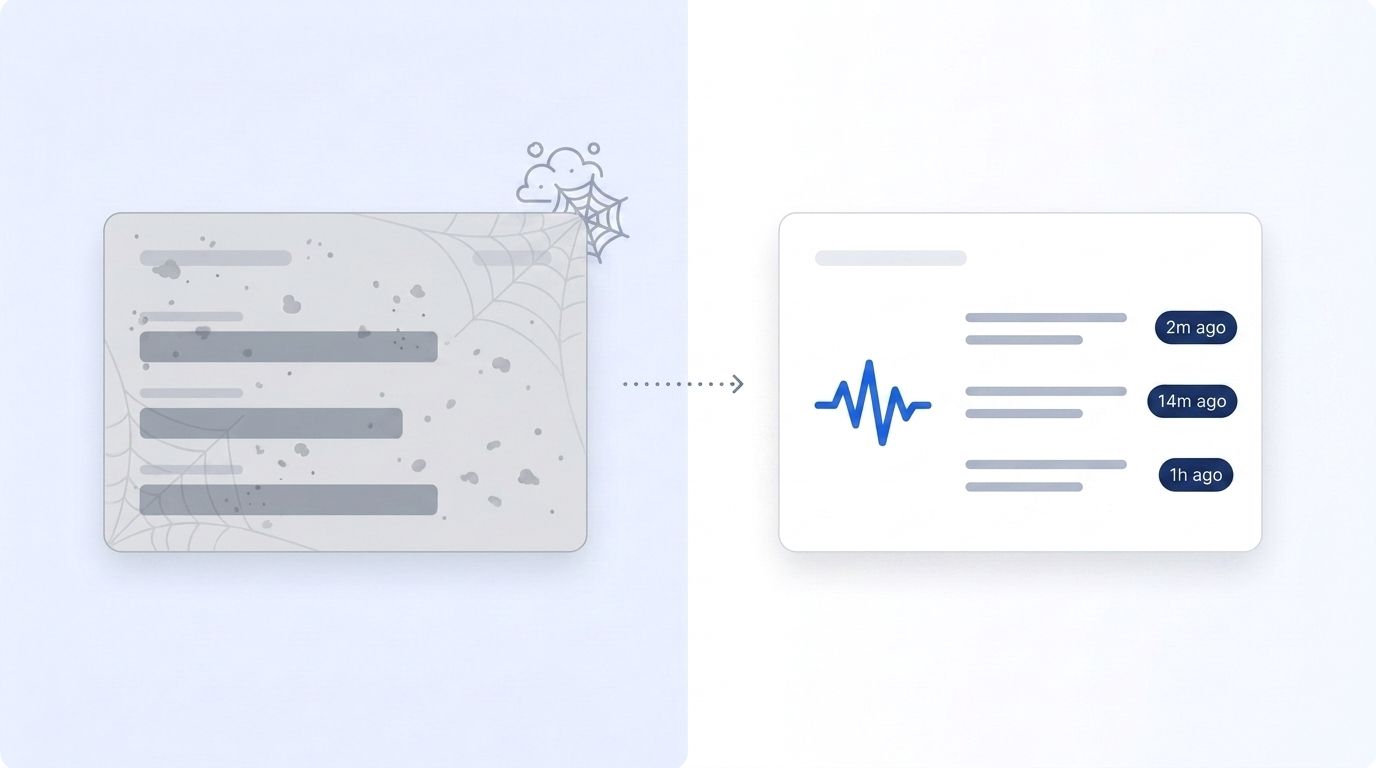
A static score assigned when a lead first enters your CRM - "VP, 500-person company, downloaded a case study" - tells you nothing about what that person is doing this week. As of 2026, most of the buying journey happens invisibly to a demographic-only model, which means the highest-scoring lead in your CRM might already be three vendor meetings deep with a competitor.
<!-- [UNIQUE INSIGHT] -->Most teams treat lead scoring as a one-time classification: score the lead, file it, move on. That framing is backwards. A lead's real-time state is what determines whether outreach lands, so a scoring model that doesn't refresh itself is really just a snapshot of a moment that's already passed.
What Signals Should You Track First?
Track job changes, engagement signals, and company-level trigger events first, because these three carry the strongest documented link to buying intent. New executive hires create a measurable spike in the likelihood that a company evaluates new vendors within the role-transition window - Champify's 2025 Impact Report found a roughly 5x increase in vendor-evaluation likelihood tied to new-hire signals (Champify Impact Report, 2025).
Here's a practical starting set, roughly in priority order:
- Job-change signals - A target contact or champion moves to a new company. New hires re-evaluate their tech stack, and they bring vendor preferences with them.
- Company engagement signals - Someone at a target account likes, comments on, or shares a company's LinkedIn posts, indicating active research or awareness.
- Person engagement signals - A named decision-maker engages with your content, your competitors' content, or category-relevant posts.
- Keyword engagement signals - Posts and comments mentioning specific pain points, competitor names, or product categories your solution addresses.
- Funding and headcount events - A funding round or a hiring surge in a relevant department (e.g., sales ops hiring after a Series B) signals new budget.
Datamagnet's signal monitors can track all five categories directly - a job-change signal watches for role transitions, a company engagement signal surfaces leads who engage with a target company's posts, and a keyword engagement signal catches mentions of your category across LinkedIn.
Isn't it strange that most CRMs can tell you a contact's job title from three years ago but nothing about what they posted last week? That's the gap these signal types close.
How Do You Build the Model, Step by Step?
You build the model in four layers - collection, weighting, decay, and routing - and each layer has to work before the next one is useful. Skipping weighting means every signal counts equally, which drowns strong signals in noise. Skipping decay means a signal from six months ago still scores as if it happened yesterday.
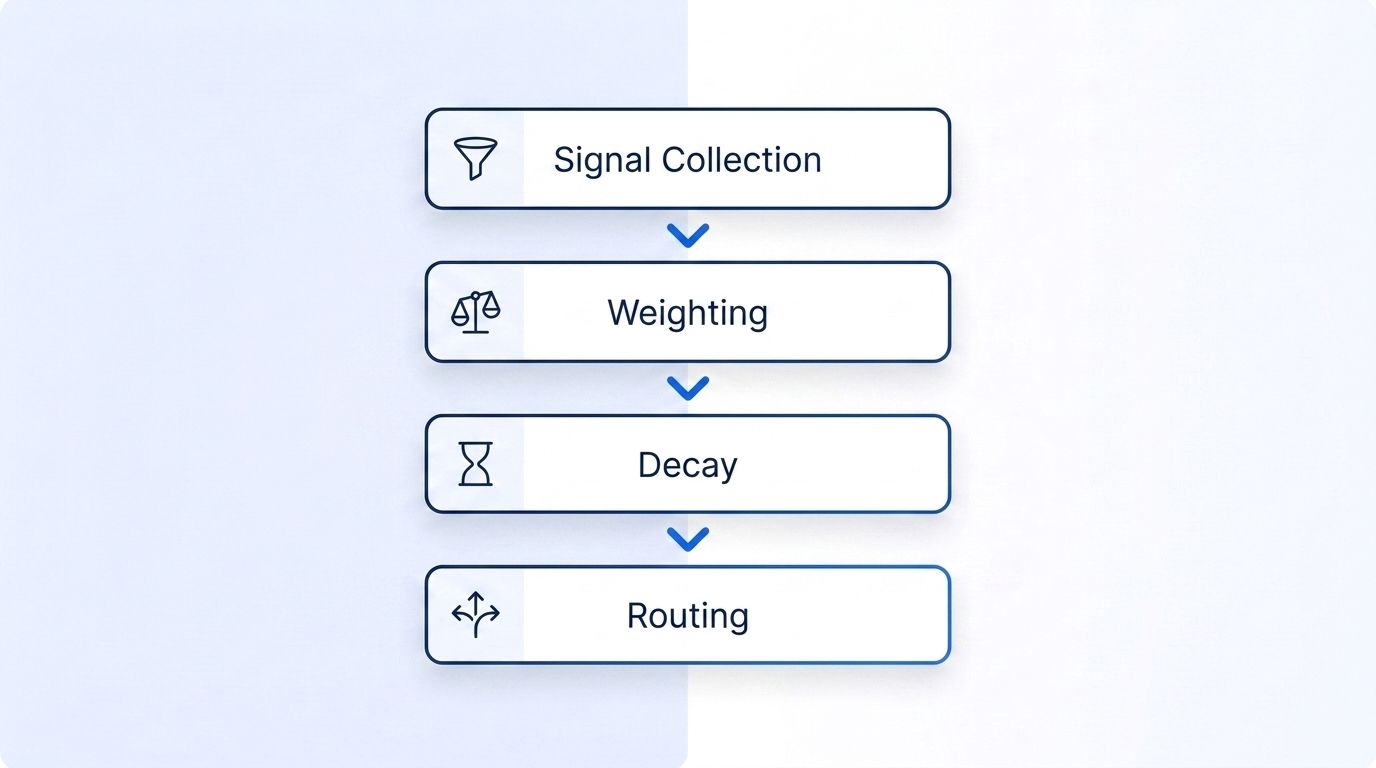
Step 1: Define your signal inventory. Pick the signal types from the list above that map to your actual sales motion. A PLG company probably cares more about product engagement signals; an enterprise sales team probably weights executive job changes and funding events higher.
Step 2: Assign base point values. Give each signal type a raw point value based on how directly it correlates with buying intent in your own closed-won data. If you don't have enough closed-won history yet, start with the documented pattern that trigger-based outreach - job changes, funding, exec hires - converts at a 36.8% win rate versus 19% for average cold outreach (Champify Impact Report, 2025), and weight trigger signals roughly double a generic engagement signal.
Step 3: Layer fit on top of intent. Multiply or gate the signal score by ICP fit - job title, seniority, company size, industry - so a strong signal from a poor-fit account doesn't outrank a moderate signal from a perfect-fit one. Datamagnet's ICP People Search and ICP Company Search endpoints let you filter for fit using plain-language values - job title, seniority, headcount, industry - before layering signal scores on top.
Step 4: Build in decay. A job-change signal from last week should outscore an identical signal from four months ago. Apply a decreasing multiplier over time (for example, full weight for 14 days, half weight through day 45, then near-zero) so the score reflects current intent, not historical intent.
<!-- [PERSONAL EXPERIENCE] -->Watching teams launch a signal-based model for the first time is a familiar pattern: they add every signal type available on day one, the score becomes noisy, and reps stop trusting it within a month. The models that stick start with two or three high-confidence signal types and expand only after reps prove they'll act on what the score already surfaces.
How Do You Weight and Combine Multiple Signals?
Weight signals by how strongly each type correlates with conversion, and combine them additively rather than picking a single "winning" signal per lead. When demand programs align multiple signal types together instead of running them separately, engagement runs 93% higher, leads per account increase 21%, and accounts are 1.6x more likely to be at decision stage (INFUSE + G2, Demand Gen Report, 2026).
A simple combined-score formula looks like this:
Lead Score = (Signal A weight × decay multiplier)
           + (Signal B weight × decay multiplier)
           + (Signal C weight × decay multiplier)
           × ICP fit multiplier
The categories with the strongest independent research behind them - job changes, funding events, and engagement signals - are also the ones third-party analyst coverage treats as a maturing product category in their own right. Forrester's Q1 2025 Wave on intent data providers named several dedicated vendors in the space, which is a reasonable signal that "intent as a scored input" isn't a fringe tactic anymore.
Citation capsule: Combining signal types instead of relying on one delivers a measurable lift - demand programs aligned across multiple buyer signals generated 93% higher engagement and 21% more leads per account than single-signal activation, according to a 2026 analysis of over 240,000 accounts. Weighting and combining, not picking one "best" signal, is what makes a model reliable.
For a deeper technical walkthrough of job-change signal detection, see our guide to real-time intent signal APIs for job changes.
How Do You Route and Act on High-Signal Leads Fast?
You route high-signal leads by delivering the score change the moment it happens, not on the next scheduled sync. Letting a prospect book a meeting instantly after a trigger event nearly doubles conversion - Chili Piper's analysis of 4 million form submissions found a 66.7% meeting-booked rate with instant response versus 30% under standard follow-up timing (Chili Piper, 2025 Benchmark Report).
Speed compounds with signal freshness. Widely-cited speed-to-lead research puts a rep roughly 21x more likely to qualify a lead contacted within 5 minutes versus 30 minutes later - an older benchmark, but one still referenced across 2025 industry write-ups because the underlying mechanic (attention decays fast) hasn't changed. A signal-based score that sits in a dashboard until Monday's pipeline review defeats its own purpose.
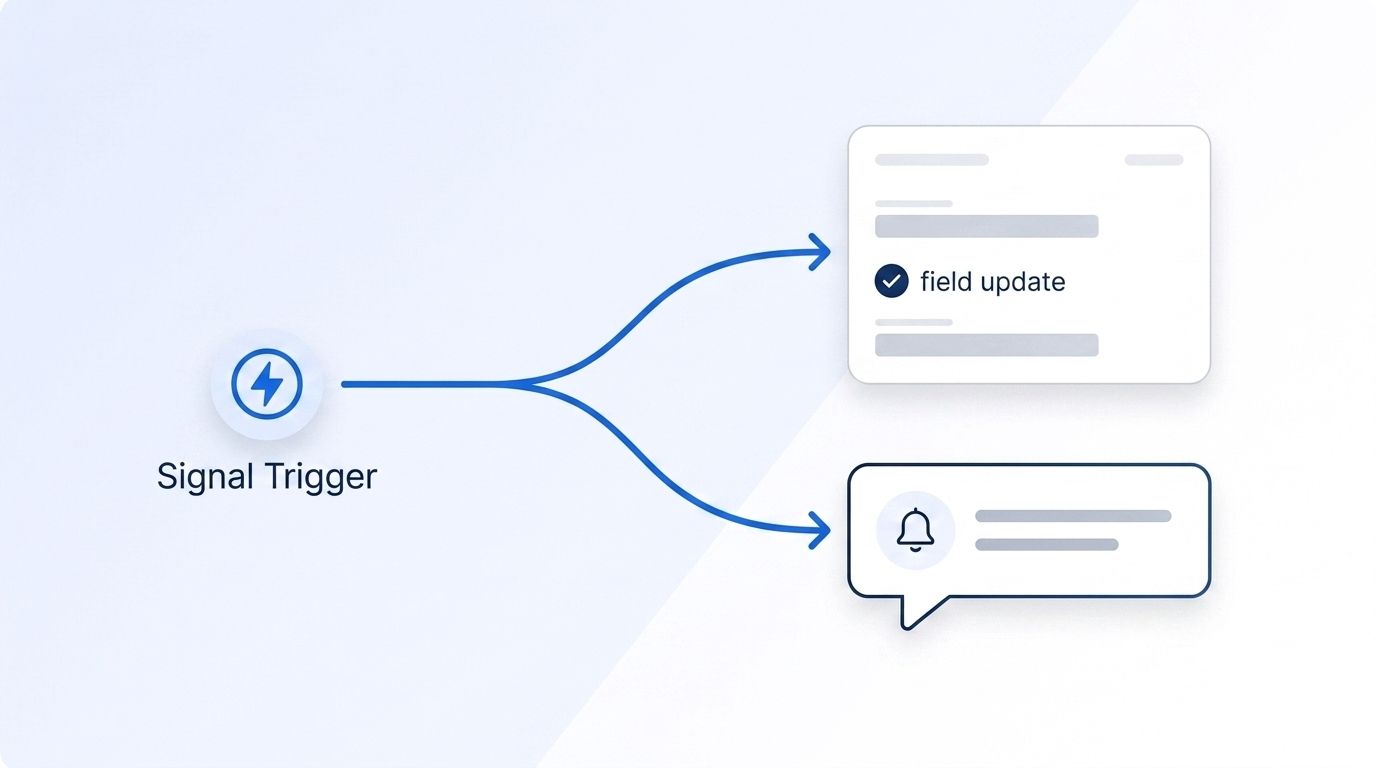
Route the score through automation, not a person checking a dashboard. Datamagnet delivers signal events through webhooks, so a job-change or engagement trigger can push straight into a CRM field update or a Slack alert the moment it fires. Datamagnet's Champion Tracker cookbook shows this pattern applied to re-engaging champions who change jobs, and the VIP Engagement Radar cookbook applies the same instant-routing logic to executive-level engagement signals.
A ZoomInfo customer case study on intent-driven marketing reported an 84% increase in MQLs and a 26% increase in opportunity rate after shifting from static list-building to signal-triggered outreach - directionally consistent with the speed-and-relevance argument above, though it's a single vendor-published example rather than an independent study.
What Mistakes Break a Signal-Based Model?
The most common mistake is tracking too many signal types before you've built the muscle to act on any of them. A model with twelve signal categories and no automated routing just produces a longer list nobody works. Start narrow, prove the routing works end-to-end, then expand signal coverage.
The second mistake is skipping decay. Without a time-based multiplier, a six-month-old job-change signal scores the same as one from yesterday, and reps quickly learn to ignore the score because half of what it surfaces is stale. The third is scoring intent without gating on fit - a loud signal from an account with 12 employees and no budget authority still isn't a qualified lead, no matter how active they are on LinkedIn.
For more on how enriched account data supports scoring accuracy, see our guide to account research infrastructure for AEs.
Start Building Your Signal-Based Model This Week
A signal-based lead scoring model beats a static one because it measures what buyers are actually doing, not what they looked like when they first entered your CRM. Start with two or three high-confidence signal types - job changes and engagement are the easiest to justify with current data - layer in ICP fit, build in decay, and route the output through a webhook instead of a dashboard nobody checks. See how real-time signal monitoring works and test it against your own target account list this week.
Frequently Asked Questions
What is signal-based lead scoring?
Signal-based lead scoring ranks leads using real-time behavioral and event data - job changes, content engagement, funding rounds, hiring activity - instead of static firmographic attributes alone. It measures whether a lead is showing active buying intent right now, which fit-only scoring can't capture.
How is signal-based scoring different from predictive lead scoring?
Predictive scoring typically models fit and historical conversion patterns using machine learning on closed-won data. Signal-based scoring adds a real-time layer on top - tracking live events like a job change or engagement spike - so the score reflects what's happening this week, not just what usually predicts a good customer.
What buying signals should a lead scoring model track first?
Start with job-change signals and engagement signals, since both carry documented links to conversion - trigger-based outreach converts at a 36.8% win rate versus 19% for average cold outreach (Champify Impact Report, 2025). Add funding and keyword-engagement signals once routing is proven.
How often should a signal-based scoring model be recalculated?
Continuously, through automated triggers rather than a scheduled batch job. A model that only updates weekly misses the window where 94% of buyers have already ranked a preferred vendor before contacting sales (6sense, 2025). Webhook-delivered signals let the score update the moment an event fires.
Can you build signal-based lead scoring without a data science team?
Yes. A rules-based weighted model - signal type, base points, decay multiplier, ICP fit gate - requires no machine learning to start and can outperform a static scorecard immediately. Teams typically layer in predictive modeling later, once enough closed-won data exists to train weights instead of estimating them.
Sources
- 6sense, 2025 Buyer Experience Report, retrieved 2026-07-21, https://6sense.com/newsroom/the-timeline-for-influencing-b2b-buyers-is-shrinking-insights-from-6senses-2025-buyer-experience-report/
- Gartner, The New B2B Buying Journey (via Demand Gen Report), retrieved 2026-07-21, https://www.demandgenreport.com/industry-news/80-of-b2b-buyers-initiate-first-contact-once-theyre-70-through-their-buying-journey/48394/
- Demand Gen Report / INFUSE + G2, Study Finds Demand Programs Aligned With Buyer Signals Deliver 93% More Engagement, retrieved 2026-07-21, https://www.demandgenreport.com/industry-news/news-brief/study-finds-demand-programs-aligned-with-buyer-signals-deliver-93-more-engagement/53422
- Chili Piper, 2025 Benchmark Report on Demo Form Conversion Rates, retrieved 2026-07-21, https://www.chilipiper.com/post/form-conversion-rate-benchmark-report
- Champify, Champify Impact Report 2025, retrieved 2026-07-21, https://23850949.fs1.hubspotusercontent-na1.net/hubfs/23850949/Champify%20Impact%20Report%20-%202025.pdf
- ZoomInfo Pipeline, Intent Data Signals That Matter, retrieved 2026-07-21, https://pipeline.zoominfo.com/sales/intent-data-signals-that-matter
- Datamagnet, Signal API documentation, retrieved 2026-07-21, https://docs.datamagnet.co/api-reference/endpoints/signal-create
- Datamagnet, Webhooks, retrieved 2026-07-21, https://docs.datamagnet.co/api-reference/webhooks
