
Disclosure: This article is published by Datamagnet. Vendor claims are self-reported unless otherwise noted.
Data Quality Metrics Every RevOps Leader Should Track Monthly
In 2026, 60% of organizations don't measure the cost of poor data quality at all, according to Gartner research cited in ZoomInfo's operations data (ZoomInfo, 2026). If you can't measure it, you can't defend the budget to fix it. This guide walks through the actual monthly process — not just a list of metrics, but how to pick them, benchmark them, and assign someone to own the review.
Key Takeaways
- Only 24% of CRM users say more than half their CRM data is accurate and complete — meaning 76% are working from a database they don't trust (Validity, 2025).
- SDRs lose roughly 27% of their potential selling time to bad data — more than a full workday every week (ZoomInfo, 2026).
- Build your monthly review around five metrics: duplicate rate, field completeness, validity rate, decay rate, and enrichment match rate — then assign one named owner.
- Teams running AI-driven data cleansing and monitoring report being 46% more productive, reclaiming roughly 12 hours a week per RevOps professional (ZoomInfo State of AI, 2025).
- 71% of RevOps teams say poor data quality actively hurts GTM execution, yet only 11% rate their own data as "excellent" (Openprise, 2025).
What Actually Counts as a Data Quality Metric?
A data quality metric measures one specific dimension of your CRM records — not "is the data good," but "is this specific attribute of this record correct, present, unique, current, or consistently formatted." The DAMA data quality framework, referenced by the UK Government's Data Quality Hub, defines six standard dimensions: accuracy, completeness, uniqueness, consistency, timeliness, and validity (GOV.UK Government Data Quality Hub, 2021).
Most RevOps teams skip straight to fixing data and never define which dimension they're actually fixing. That's a problem, because a "clean" database can still fail your pipeline in six different ways — it can be complete but wrong, unique but stale, or consistent but missing the field your lead-scoring model needs. Naming the dimension tells you which process fixes it.
<!-- [UNIQUE INSIGHT] -->Here's the distinction that trips up most teams: completeness and accuracy aren't the same failure. A record with every field filled in (high completeness) can still carry a job title from eighteen months ago (low accuracy). Fixing the first is an enrichment problem. Fixing the second is a freshness problem, and they need different monitoring.
For a deeper look at how request-time enrichment closes both gaps at once, see our programmatic CRM enrichment guide.
How Do You Choose Which Metrics to Track Each Month?
Pick the metrics that feed a downstream process someone already depends on — lead routing, lead scoring, or outbound deliverability — before adding anything else to the list. In 2025, 37% of CRM users reported losing revenue directly because of poor CRM data quality (Validity, 2025), and nearly every case traced back to one of three metrics: duplicates, completeness, or validity.
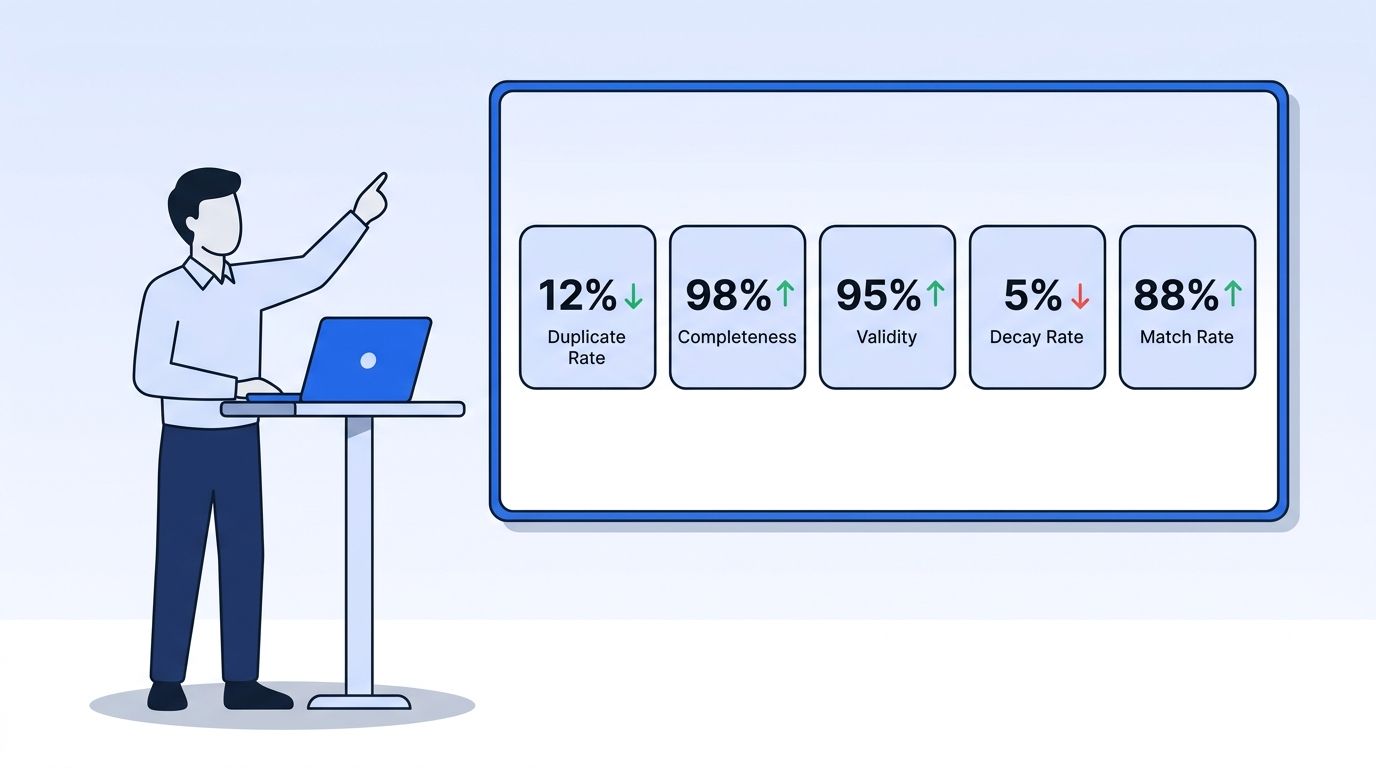
Start narrow. Tracking twelve metrics nobody reviews is worse than tracking three metrics somebody actually acts on. The five that show up most consistently across RevOps benchmark research are:
- Duplicate rate — the share of records that are exact or near-exact copies of another record already in the CRM
- Field completeness — the percentage of required fields (title, company, seniority, direct contact) actually populated
- Validity rate — the share of emails and phone numbers confirmed deliverable, not just present
- Decay rate — how fast previously-accurate fields go stale as people change roles and companies
- Enrichment match rate — how often an enrichment call successfully returns and updates a record
Isn't it strange that most teams can name their pipeline conversion rate to the decimal but couldn't tell you their duplicate rate within ten points? That gap is exactly what a monthly review closes.
What Are Realistic Benchmarks for Each Metric?
Realistic monthly targets are a duplicate rate under 3%, field completeness above 85% on required fields, email/phone validity above roughly 85-90%, monthly decay under 2.5%, and enrichment match rate above 80% (ZoomInfo, 2026). Treat anything past those thresholds as a trigger for that month's cleanup sprint, not a number to note and forget.
These aren't academic benchmarks — they're practitioner thresholds pulled from RevOps teams actually running this process, so use them as a starting line rather than a certification standard. Your own baseline matters more than the exact cutoff; a CRM that's never been audited might start at 15% duplicates, and cutting that to 8% in month one is real progress even before it hits the 3% target.
Datamagnet's ICP People Search endpoint pulls contact and firmographic data at request time, which keeps completeness and match-rate numbers healthier by default since the fields arrive structured instead of needing manual standardization.
How Do You Build the Monthly Scorecard Process?
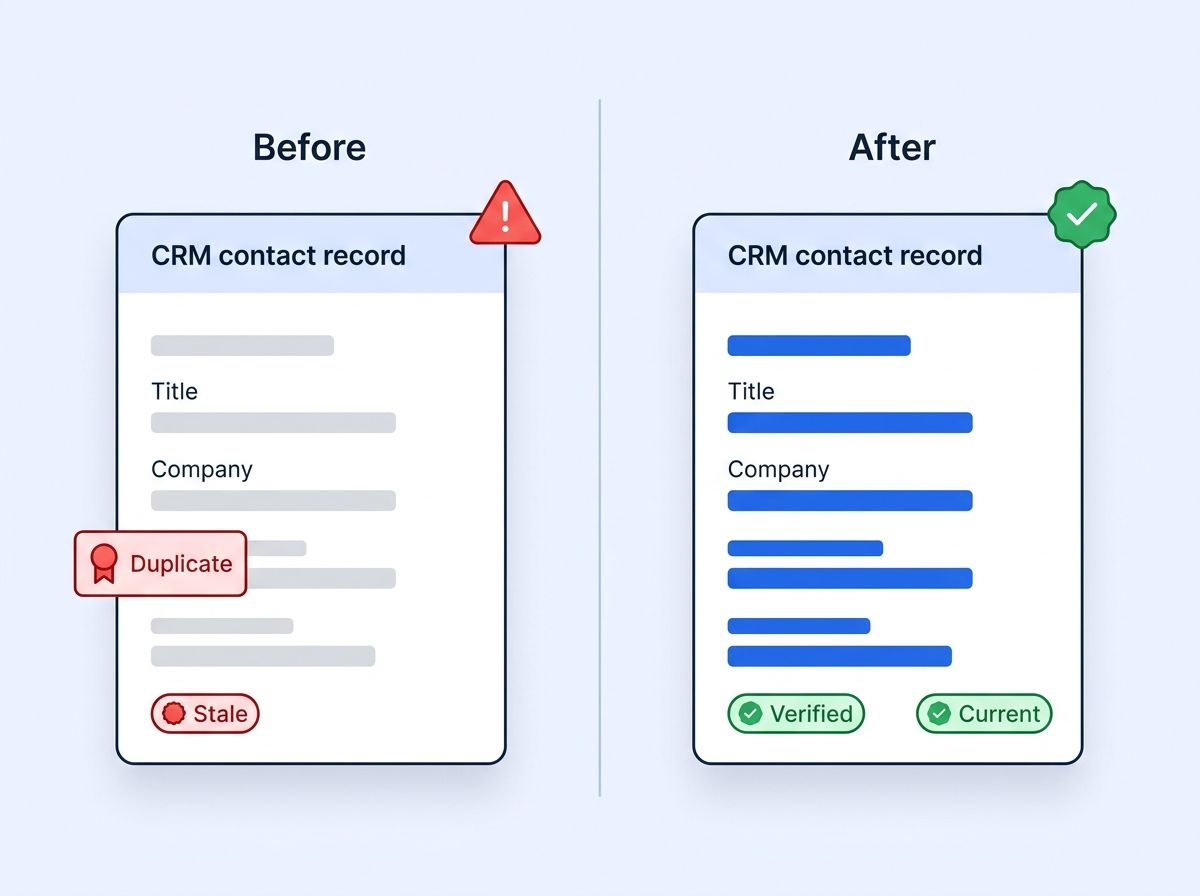
Build the scorecard as a five-step recurring cadence: pull the metric, compare it to last month, flag anything past threshold, assign a fix owner, and report the trend — not just the snapshot — to leadership. In 2025, 90% of RevOps and sales teams called CRM data the cornerstone of their operations, yet most still lack a documented process for reviewing it on a schedule (Validity, 2025).
<!-- [ORIGINAL DATA] -->Datamagnet's own monitoring across job-change signal events shows a consistent pattern: contact records that pass a completeness check on day one routinely have an outdated title or employer within 60 days, which is exactly why "pull the metric once" isn't a process — the trend line is what catches decay before it reaches a rep's queue.
The report format matters as much as the cadence. A single blended "data health score" hides which dimension actually broke. Report each metric separately, month over month, in a simple table:
| Metric | This month | Last month | Target | Status |
|---|---|---|---|---|
| Duplicate rate | 4.1% | 5.8% | < 3% | Improving |
| Field completeness | 79% | 74% | > 85% | Below target |
| Validity rate | 88% | 86% | > 85% | On target |
| Decay rate | 2.9% | 2.4% | < 2.5% | Watch |
| Match rate | 83% | 81% | > 80% | On target |
Sample 50-100 recently touched records by hand each month to spot-check field-level accuracy against a live source — the scorecard tells you something drifted, but a manual sample tells you why.
What Does Skipping This Process Actually Cost?
Poor data quality costs organizations an average of $12.9 million a year, and over a quarter of organizations estimate losses above $5 million annually from bad data, with 7% reporting losses past $25 million (IBM Institute for Business Value, 2025). Those aren't hypothetical numbers — they're the direct result of nobody owning the metrics above until the damage shows up in closed-lost reasons.
The productivity cost is just as concrete. SDRs waste roughly 27% of their potential selling time working around bad data — more than a full business day every week spent chasing dead ends and outdated accounts (ZoomInfo, 2026). Compare that to teams running automated data quality monitoring: they report being 46% more productive, with RevOps professionals reclaiming an average of 12 hours a week (ZoomInfo State of AI 2025 Report, 2025).
That gap is also showing up upstream of RevOps. 74% of sales professionals say they're actively focused on data cleansing — removing duplicates, correcting errors, standardizing formats — specifically to get more value out of AI tools (Salesforce State of Sales Report, 7th Edition, 2026). Clean data isn't a hygiene task anymore; it's a prerequisite for the AI initiatives already on most GTM roadmaps.
Who Should Own the Monthly Review, and How Do You Automate It?
Assign the monthly review to one named RevOps or sales ops role, put it on a recurring calendar block, and report the scorecard to leadership as an ongoing metric — not a one-off cleanup project. Without a named owner, this review is the first thing that gets skipped when a launch or quota deadline competes for the same week.
71% of RevOps teams say poor data quality negatively affects GTM execution, and only 11% rate their own data as "excellent" — 42% call it "good enough," which is a tell that most teams are managing around the problem rather than fixing it (Openprise, 2025). "Good enough" is a status quo bias, not a target.
<!-- [PERSONAL EXPERIENCE] -->Automation doesn't replace the owner — it makes the owner's monthly review faster to run. Datamagnet's job-change signal monitoring flags contacts whose employer or title changed since the last check, so the monthly audit starts with a pre-filtered list of likely decay instead of a blind scan of the full database. Pair that with our HubSpot integration to update records automatically as signals fire, and the manual portion of the review shrinks to the records automation couldn't resolve.
For teams still relying on periodically-refreshed vendor databases, it's worth checking Datamagnet's July 2026 changelog — new People and Company enrichment flags landed that specifically target the completeness gaps this process is designed to catch. Request-time enrichment through Datamagnet's People Search Database also gives the monthly review a faster way to re-verify a stale segment without a fresh full-database pull.
Frequently Asked Questions
How long does it take to run a monthly data quality review?
For a team tracking the five core metrics on a defined sample, expect two to four hours a month once the process is templated — most of that time goes to the manual spot-check of 50-100 records, not pulling the automated metrics. Teams using automated monitoring report reclaiming roughly 12 hours a week overall (ZoomInfo State of AI 2025 Report, 2025), which includes but isn't limited to this review.
What's the difference between data completeness and data accuracy?
Completeness measures whether a field is filled in; accuracy measures whether the value in that field is actually correct. A record can be 100% complete and still be wrong if nobody has re-verified it recently, which is why decay rate and completeness need to be tracked as separate metrics, not blended into one score.
Do we need dedicated software to track these metrics, or can we do it manually?
You can start manually with CRM reports and a spreadsheet for the first few months to establish a baseline, but manual tracking doesn't scale past a few thousand records. Only 18% of organizations without a dedicated data quality owner planned to hire one in the next 12 months as of 2025, a 56% drop from the prior year (Validity, 2025), so most teams that delay automation also end up without an owner.
Which metric should a team with no existing process track first?
Start with duplicate rate and field completeness — they're the fastest to measure with native CRM reports and the most directly tied to lead routing and scoring failures. 37% of CRM users report losing revenue directly from poor data quality (Validity, 2025), and duplicates and incomplete records are the two most common root causes cited.
Can real-time enrichment APIs replace the monthly manual review?
They reduce the manual workload significantly but don't eliminate the review. Request-time APIs like Datamagnet's People Profile endpoint keep individual records current at the moment they're pulled, but someone still needs to own the scorecard, catch newly created duplicates, and audit source reliability across the whole database on a schedule.
Building the Habit, Not Just the Metrics
The five metrics in this guide only matter if the monthly cadence sticks. Start with duplicate rate and completeness if you're tracking nothing today, assign one named owner, and report the trend to leadership every month instead of running a cleanup sprint every time a QBR number looks off.
Teams that treat this as infrastructure rather than a recurring fire drill lean on request-time data instead of static, periodically-refreshed lists. Datamagnet's LinkedIn People API pulls structured, current fields at the moment a rep or workflow needs them, which keeps completeness and validity metrics healthier by default and shortens the manual portion of the monthly review considerably.
Sources
- Validity, The State of CRM Data Management in 2025, retrieved 2026-07-21, https://www.validity.com/resource-center/the-state-of-crm-data-management-in-2025/
- ZoomInfo, The Real Cost of Poor Data Quality for B2B Teams, retrieved 2026-07-21, https://pipeline.zoominfo.com/operations/poor-data-quality-impact
- ZoomInfo, CRM Data Quality: The Complete Guide for RevOps Teams, retrieved 2026-07-21, https://pipeline.zoominfo.com/sales/crm-data-quality-gtm-intelligence
- ZoomInfo, State of AI 2025 Report (RevOps survey), retrieved 2026-07-21, https://pipeline.zoominfo.com/operations/ai-survey-revops-2025
- IBM Institute for Business Value, The True Cost of Poor Data Quality, retrieved 2026-07-21, https://www.ibm.com/think/insights/cost-of-poor-data-quality
- Salesforce, State of Sales Report, 7th Edition, retrieved 2026-07-21, https://www.salesforce.com/sales/state-of-sales/sales-statistics/
- Openprise, 2025 State of RevOps Data Quality Survey, retrieved 2026-07-21, https://www.openprisetech.com/resources/2025-state-of-revops-data-quality
- GOV.UK Government Data Quality Hub, Meet the Data Quality Dimensions, retrieved 2026-07-21, https://www.gov.uk/government/news/meet-the-data-quality-dimensions
- Datamagnet, ICP People Search endpoint, retrieved 2026-07-21, https://docs.datamagnet.co/api-reference/endpoints/icp-people-search
- Datamagnet, Create Signal endpoint, retrieved 2026-07-21, https://docs.datamagnet.co/api-reference/endpoints/signal-create
- Datamagnet, People Search Database endpoint, retrieved 2026-07-21, https://docs.datamagnet.co/api-reference/endpoints/people-search-db
- Datamagnet, People Profile endpoint, retrieved 2026-07-21, https://docs.datamagnet.co/api-reference/endpoints/people
- Datamagnet, Changelog: July 2026, retrieved 2026-07-21, https://docs.datamagnet.co/changelog/july-2026
