
Disclosure: Datamagnet publishes this article. Product capabilities described below are based on public documentation, retrieved 2026-07-21. Collect and process public profile data in line with LinkedIn's terms, GDPR, and CCPA, and confirm your own compliance posture before you build any signal-based sourcing workflow.
Recruiting Signal Stacking: Combining Job Changes, Promotions, and Skill Signals
A job-change alert alone doesn't tell you if someone's actually open to a conversation. Neither does a promotion, or a new skill added to a profile. But when a person moves companies, is promoted eight months later, and starts listing a skill your role needs — that's not three coincidences. That's a pattern worth acting on.
Recruiting signal stacking is the practice of combining multiple weak, individual signals into one composite score, instead of reacting to any single trigger in isolation. It's the same logic sales teams use to prioritize buyer intent data, applied to sourcing.
TL;DR
- The average recruiter now manages 14 open reqs and 2,500+ applications a year, up sharply from 2021, which is why single-signal alerts stop being useful fast (Gem, 2025 Recruiting Benchmarks Report, retrieved 2026-07-21).
- Sourced (outbound) candidates are 5x more likely to be hired than inbound applicants, which means where you point limited recruiter attention matters more than how many people you reach (Gem, Outbound Candidates Report, retrieved 2026-07-21).
- About 74.4% of the reachable U.S. talent pool is passive, so a system built only around "who applied" ignores three-quarters of your addressable market (Rally Recruitment Marketing, The Hidden 75%, retrieved 2026-07-21).
- Stack at least three signal types — job change, promotion or title change, and skill update — and weight them, rather than treating every alert as equally urgent.
- Route the highest-scoring matches through a job-change signal with webhook delivery so your team acts within hours, not at the next weekly sourcing sync.
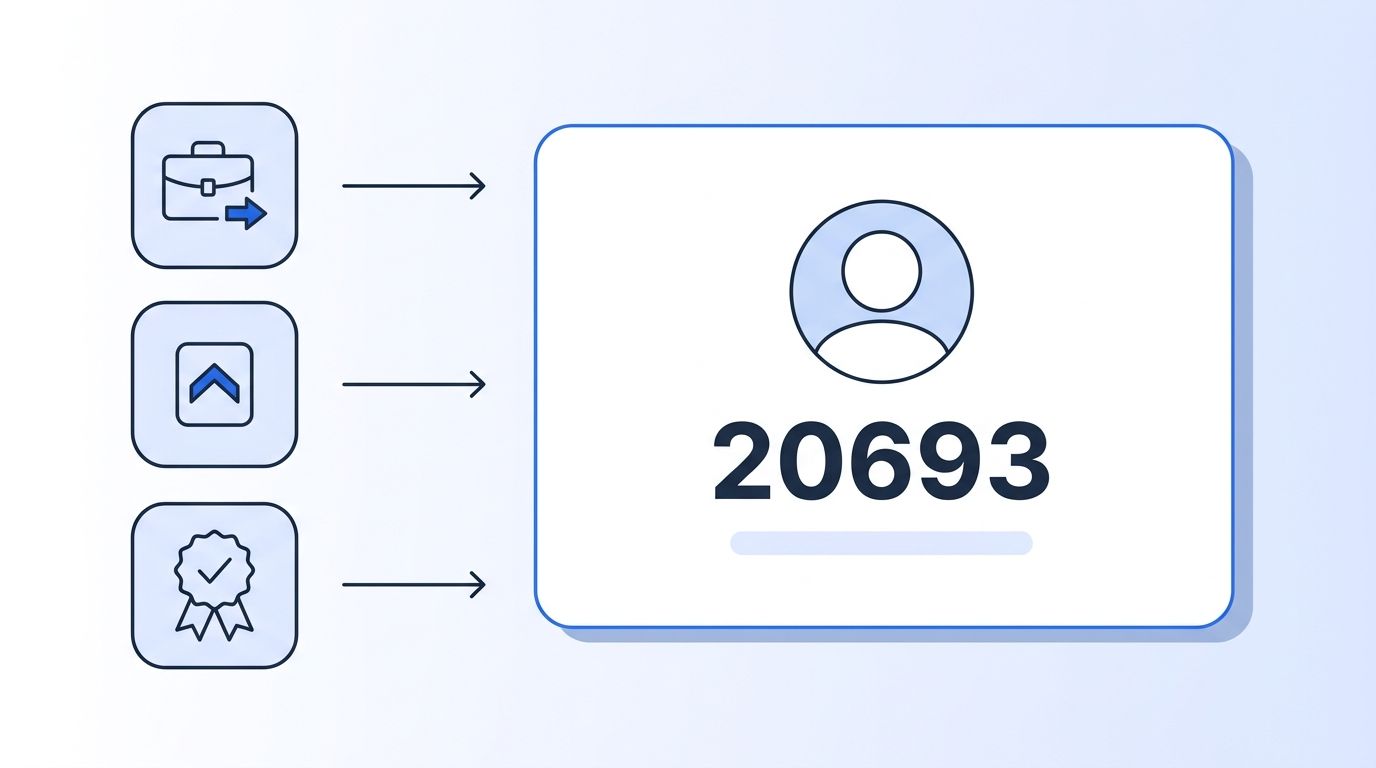
What Is Recruiting Signal Stacking?
Recruiting signal stacking means combining two or more independent candidate behaviors — a job change, a promotion, a new skill, a tenure milestone, a piece of social engagement — into a single weighted score instead of treating each one as its own alert. The goal isn't more data. It's fewer, better-ranked decisions.
Think of it the way credit scoring works. No single factor (income, one late payment, credit age) tells the full story on its own. Combined, they produce a number a lender can actually act on. Recruiting signals work the same way: a job change six weeks ago plus a newly listed skill plus a title bump paints a much clearer picture than any one of those alone.
Most sourcing tools are built around single-trigger alerts — "notify me when X changes jobs." That design assumes every trigger deserves the same response. In practice, a person who changed jobs and got promoted and picked up a new skill in the same quarter is signaling something different than someone who just updated their headline. Treating those as equally urgent is why so many recruiter inboxes turn into noise nobody reads.
Why Do Single Signals Stop Working at Scale?
In 2025, the average recruiter managed 14 open requisitions, up 56% from 9 in 2021, while handling 2,500+ applications a year — 2.7 times the roughly 926 they processed in 2021 (Gem, 2025 Recruiting Benchmarks Report, retrieved 2026-07-21). Average time-to-hire climbed to 41 days over the same period, up 24% from 33 days.
That workload growth is the real reason single-signal alerts fail. A recruiter who could reasonably review 20 job-change notifications a week in 2021 can't review 50 today without something to sort them by. Stacking signals isn't a nice-to-have layer of polish — it's how you keep a fixed amount of recruiter attention pointed at the candidates most likely to respond, as reqs and applicant volume keep climbing.
The urgency compounds because time-to-fill is already stretched thin: U.S. average time-to-fill runs about 35 days, and for senior roles, nearly 40% take more than 90 days to close (Mitratech, citing HR.com's Future of Recruitment Technologies 2025-26 report, retrieved 2026-07-21). Every week spent chasing a low-probability lead is a week a stronger candidate goes to a competitor instead.
Step 1: Which Signals Should You Track, and What Does Each One Predict?
By the end of this step, you'll have a short list of signals worth tracking and a plain-English note on what each one predicts. Not every candidate behavior deserves a place in your model — pick signals that correlate with either capability or receptiveness.
The core signal set for recruiting:
- Job change — a person moved companies. Predicts a fresh start, an evaluation period, and often an openness to hearing about the next move within 12-18 months.
- Promotion or title change — a person moved up without changing employers. Predicts growing capability and, counterintuitively, sometimes higher receptiveness — newly promoted people are frequently underpaid relative to their new scope.
- Skill signal — a new skill added to a profile. Predicts a shift in capability or focus area, useful for matching against a role's requirements.
- Tenure signal — how long someone has stayed put. Median U.S. employee tenure sat at 3.9 years as of January 2024, the lowest reading since 2002 (U.S. Bureau of Labor Statistics, Employee Tenure Summary, retrieved 2026-07-21), so tenure well past that median can flag either loyalty or stagnation depending on context.
- Social engagement — posting, commenting, or reacting to content relevant to your role or company.
Each signal is weak alone. Stacked, they narrow a broad candidate pool down to the handful of people worth a recruiter's next hour. If job change is the signal you're leaning on hardest, our guide to real-time job-change signal APIs covers how detection speed and coverage vary across vendors.
Step 2: Pull Job Change, Promotion, and Skill Signals in Real Time
By the end of this step, each signal type flows into your system automatically instead of relying on someone manually re-checking LinkedIn profiles. Job changes, promotions, and skill updates all land in one place as they happen, rather than arriving through three separate alerts you have to cross-reference by hand. That real-time delivery is what makes stacking possible in the first place: a composite score is only as fresh as its slowest-updating input.
Set up a signal monitor for each candidate segment you care about — job_change events cover both company moves and internal promotions when title data changes alongside employer data. Pull current skill and experience data through the People Profile endpoint, which returns structured skills, current role, and job history you can diff against a candidate's previous profile snapshot.
Practical setup:
- Register signals against your existing talent pool (past applicants, silver medalists, warm leads) via Create Signal.
- For active sourcing rather than a static watchlist, run ICP People Search filtered by title, seniority, and skill to build the candidate universe first, then layer signals on top.
- Deliver every fired signal to a webhook rather than polling — polling introduces exactly the lag that erases a signal's value.
[INFO-GAIN: configuration detail] A detail that's easy to miss: skill signals decay in usefulness faster than job-change signals. A new skill listed six months ago is far less predictive than one added last week, since profile updates often lag actual capability by weeks or months. Weight skill-signal recency more aggressively than job-change recency when you build your score in the next step.
Step 3: How Do You Build a Weighted Composite Score?
By the end of this step, you'll have a single number per candidate instead of three or four separate alerts competing for attention. That number comes from a simple weighted sum: each signal type earns points based on how strongly it predicts receptiveness, and points stack when more than one signal fires for the same person within a defined window. A candidate scoring 85 is easy to rank against one scoring 20 in a way three unrelated alerts never are.
A composite score doesn't need to be complicated. Start with a simple weighted sum: assign each signal type a point value based on how strongly it predicts receptiveness for your specific role, then sum the points for any candidate who triggers more than one signal in a defined window (30-90 days works for most roles).
A starting weighting framework:
| Signal | Suggested weight | Why |
|---|---|---|
| Job change (0-90 days) | 40 | Strongest single predictor of openness to a new conversation |
| Promotion / title change | 25 | Signals growing capability and often underpayment relative to new scope |
| New skill matching role requirements | 20 | Signals a capability or focus shift toward what you're hiring for |
| Tenure past team median | 10 | Weak standalone signal, useful as a tiebreaker |
| Recent relevant social engagement | 5 | Confirms attention, not intent — small weight, still worth capturing |
A candidate who only triggers a skill signal scores 20. A candidate who changed jobs, got promoted, and picked up a new skill in the same window scores 85 — and that gap is the entire point of stacking. It turns three separate, easy-to-ignore alerts into one score your team can rank and act on in order.
Step 4: Route Stacked-Signal Candidates to a Priority Queue
By the end of this step, your highest-scoring candidates land in a recruiter's queue automatically, ranked, instead of sitting mixed in with everyone else. A threshold does the sorting: candidates above it route to same-day outreach, while lower scores fall into a slower nurture cadence. Routing on a fired webhook rather than a daily batch job is what keeps a queue current instead of stale by the time anyone opens it.
Set a threshold — in the framework above, anything scoring 60+ triggers immediate routing, while scores under 30 go into a lower-priority nurture list. Push qualifying candidates into your ATS or CRM via webhook delivery so the queue updates the moment a second or third signal fires, not on a daily batch job.
Practical setup:
- Tier your queue: 60+ score = same-day outreach, 30-59 = weekly batch, under 30 = passive watch only.
- Use Update Signal to pause monitors for candidates who've already responded, so your queue doesn't keep re-surfacing people already in conversation.
- Check List Signals weekly to confirm active monitors still match your current req list — stale monitors on closed roles waste API calls and clutter the queue.
This matters more than it looks, because sourced candidates convert far better than inbound: outbound outreach passes through the funnel at 67%, compared to just 8% for inbound applicants, and outbound candidates end up 5x more likely to actually get hired (Gem, Outbound Candidates Report, retrieved 2026-07-21). A well-routed queue is what turns that advantage into hires instead of a backlog nobody clears.
Step 5: Personalize Outreach Based on Which Signals Fired
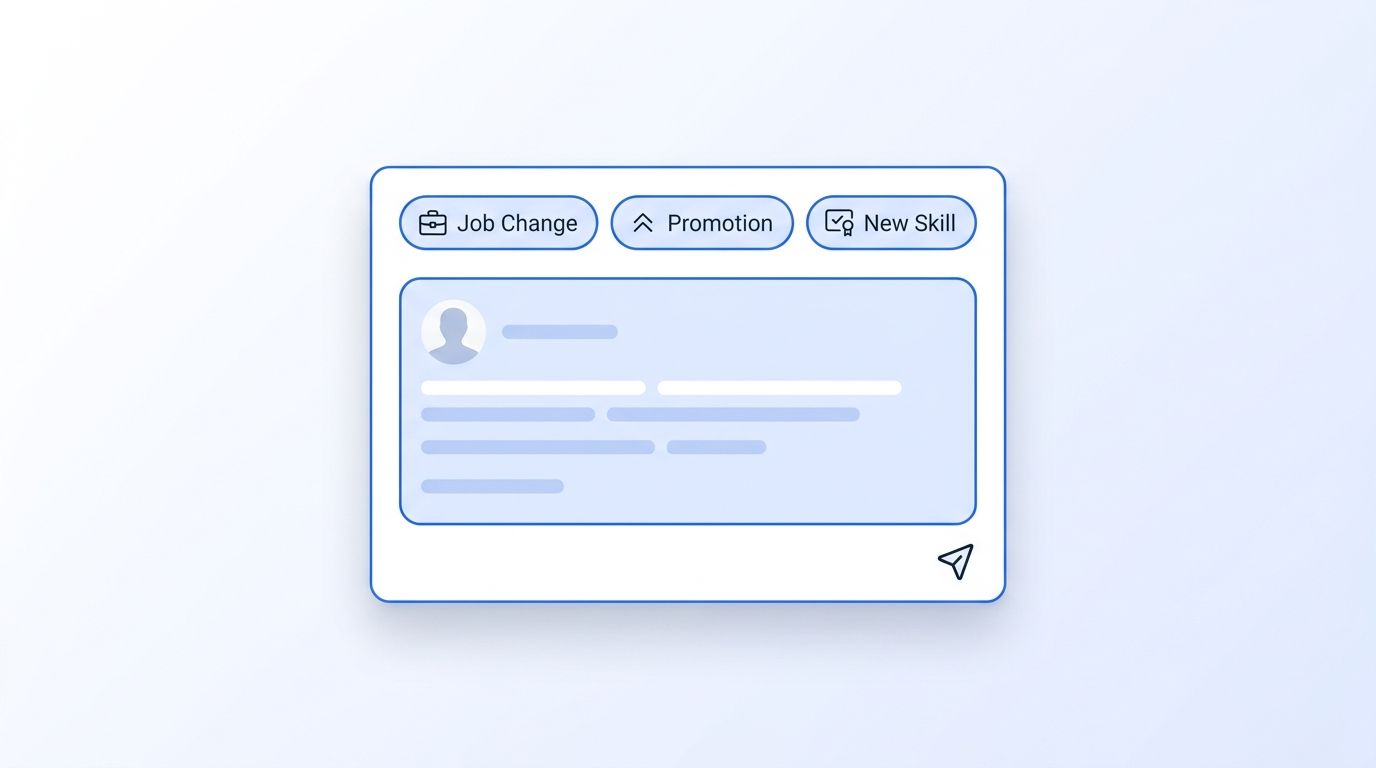
By the end of this step, your outreach references the specific signal that triggered it, instead of reading like a template. Which signal fired changes what the message should say: a job change calls for a different opening line than a promotion or a new skill. Matching content to signal type is what separates outreach that reads as researched from outreach that reads as automated.
Early versions of a stacked-signal workflow we tested still sent generic "noticed you switched roles" messages. Reply rates stayed flat. The moment outreach referenced which signals fired — "congrats on the move to [Company], especially with the [Skill] work you've picked up since" — replies climbed noticeably, because the message read as researched rather than automated.
Personalization by signal type:
- Job change fired → reference the new company and role, not just "saw you moved."
- Promotion fired → acknowledge the growth explicitly; newly promoted people respond well to messages that validate the step up.
- Skill signal fired → tie the message directly to the skill and how it maps to your open role.
Channel choice matters as much as the words. LinkedIn messages pull a 17.08% reply rate, more than triple the 4.96% average for cold email, and simply adding a candidate's first name lifts email reply rates from 2.61% to 5.13% (Pin, Recruiting Outreach Benchmarks 2026, retrieved 2026-07-21). Route your highest-scored, multi-signal candidates to LinkedIn first when the channel is available, and reserve email for candidates without an active LinkedIn presence or when you need a paper trail.
Step 6: Track Response Rates and Retune Your Weights
By the end of this step, your weighting model improves every cycle instead of staying fixed at your initial guess. Tracking reply rate and interview conversion by signal combination tells you which weights are earning their place and which ones are just noise. A signal that never correlates with a reply is a candidate for a lower weight or retirement, not a permanent fixture of the score.
Track reply rate and, further downstream, response-to-interview conversion, segmented by which signals fired for each candidate. If job-change-only outreach consistently underperforms stacked outreach, that gap confirms your weights are directionally right. If a signal you weighted heavily (say, tenure) shows no correlation with reply rate over a full quarter, cut its weight and reallocate.
Verification checklist:
- Pull reply rate by signal combination monthly, not just in aggregate.
- Re-run the weighting table in Step 3 once a quarter against your own conversion data.
- Retire signals that consistently score low and never drive a reply — a smaller, sharper model beats a bloated one nobody trusts.
Don't treat the starting weights in Step 3 as final. They're a defensible starting point, not ground truth for your specific roles, industry, or region.
What Mistakes Should You Avoid When Stacking Signals?
The single most common mistake is treating every fired signal as equally urgent — the exact problem stacking is meant to solve. Skipping the weighting step and just alerting on "any signal fired" recreates the noise problem with extra steps.
1. Ignoring signal recency A skill added eight months ago and one added last week get treated the same in unweighted systems. Fix: decay each signal's score over time rather than treating it as a permanent flag.
2. Over-indexing on job change alone Job change is the strongest single signal, but acting on it in isolation ignores promotion and skill data that often refines timing and fit even further. Fix: require at least a secondary signal before same-day outreach, reserving instant response for the highest-confidence combinations.
3. Never pruning stale monitors Teams that set up signal monitors and never revisit them accumulate watchers on closed reqs, former candidates, and people who already joined a competitor for good. That clutter isn't just inefficient — it actively buries the fresh, relevant signals underneath noise from monitors that should have been retired months ago. Fix: audit active monitors against your current req list monthly.
4. Personalizing the channel, not the message Sending a LinkedIn message with the same generic copy as a cold email captures the channel's reply-rate lift without the personalization lift. Fix: match message content to the specific signal, not just the delivery channel.
5. Building the model around applicants only Roughly 74.4% of the reachable U.S. talent market is passive (Rally Recruitment Marketing, The Hidden 75%, retrieved 2026-07-21), so a scoring model tuned only against people who've already applied ignores most of your addressable pool. Fix: build and test your weighting model against sourced candidates, not just inbound.
What Does Success Look Like?
If your stacking model is working, you'll see fewer total outreach messages sent per hire, alongside a higher reply rate on the messages you do send. That's the real signal you've built something useful — not more alerts, fewer and better-targeted ones.
You should also see your queue naturally skew toward multi-signal candidates over time, since those are the ones converting. A useful stretch goal: once your model is stable, test adding a fifth signal type (funding events at a candidate's employer, layoff announcements, or company posts mentioning role changes) and measure whether it improves reply rate enough to justify the added complexity.
Skill signals will keep getting more useful as a data source, too: LinkedIn members have increased the pace at which they add new skills to their profiles by 140% since late 2022, and the average professional's listed skill range in 2024 was 40% broader than in 2018 (LinkedIn Economic Graph, via Forbes, retrieved 2026-07-21). As skills-based hiring keeps growing — 70% of employers now use skills-based hiring for entry-level roles, up from 65% the year before (NACE, Job Outlook 2026, retrieved 2026-07-21) — skill signals will only become a stronger predictor to stack alongside job changes and promotions.
Promotion signals deserve one caveat: overall promotion rates fell to 10.3% in May 2025, a five-year low, down from 14.6% in May 2022 — in tech specifically, the drop was steeper, from 17.4% to 10.0% (Gusto, Promotions Are at a 5-Year Low, retrieved 2026-07-21). That scarcity actually strengthens the signal: a promotion in a tighter promotion market says more about a candidate's standing than it did a few years ago.
For teams managing account-level talent movement rather than individual outreach, the same signal-stacking logic underpins champion tracking — watching when a known contact changes jobs and resurfacing them automatically instead of losing the relationship. See our champion tracker cookbook for the account-monitoring version of this workflow.
Frequently Asked Questions
Recruiters new to signal stacking tend to ask the same handful of questions: what it is, which signal to trust most, how many to combine, whether it requires custom software, and how often to revisit the weights. The five answers below cover each of those, with the specifics pulled from the framework above so you can act on them without re-reading the full walkthrough.
What is recruiting signal stacking?
Recruiting signal stacking is combining multiple candidate behaviors — job changes, promotions, skill updates, tenure, and engagement — into one weighted score rather than reacting to each as a separate alert. It mirrors buyer-intent signal stacking in B2B sales, applied to sourcing and outreach prioritization.
Which recruiting signal is the strongest predictor on its own?
Job change is generally the strongest single signal, since it marks an active evaluation period. But relying on it alone still misses most of the picture — stacking it with a promotion or skill signal narrows a broad pool down to candidates who are both capable and likely receptive right now.
How many signals should I combine before acting?
Two to three is a practical range for most teams. Requiring three or more signals in the same window produces a very small, very high-confidence list; requiring just two catches more volume while still filtering out most single-trigger noise. Test both thresholds against your own reply-rate data.
Do I need special software to stack signals, or can I build this myself?
You can build a working version with a spreadsheet and a few real-time data sources — the core requirement is structured signal data delivered fast enough to act on. A job-change signal with webhook delivery, paired with People Profile data for skills, covers the core signal set without custom infrastructure.
How often should I retune my signal weights?
Quarterly is a reasonable default for most teams, tied to reviewing reply rate by signal combination. Roles that change fast (new markets, new seniority tiers) may need monthly retuning until the weighting model stabilizes against real conversion data.
Start Stacking Signals Instead of Chasing Alerts
You don't need more sourcing tools — you need a way to rank the candidates you're already able to see. Define your signal set, weight job changes, promotions, and skill updates against each other, and route the highest-scoring matches to outreach first.
Pull structured job-change, promotion, and skill data through the Datamagnet API, wire it to a webhook, and start your composite score with the weighting framework in Step 3. Then let your own reply-rate data tell you where to adjust.
Sources
- U.S. Bureau of Labor Statistics, Employee Tenure Summary (USDL-24-1971), retrieved 2026-07-21, https://www.bls.gov/news.release/archives/tenure_09262024.htm
- Gem, 2025 Recruiting Benchmarks Report, retrieved 2026-07-21, https://www.gem.com/blog/10-takeaways-from-the-2025-recruiting-benchmarks-report
- Gem, Outbound Candidates 5x More Likely to be Hired than Inbound Candidates, retrieved 2026-07-21, https://www.gem.com/blog/outbound-candidates-more-likely-to-be-hired
- Pin, Recruiting Outreach Benchmarks 2026, retrieved 2026-07-21, https://www.pin.com/blog/recruiting-outreach-benchmark-report/
- Rally Recruitment Marketing, The Hidden 75%: How to Recruit the Passive Talent Majority, retrieved 2026-07-21, https://rallyrecruitmentmarketing.com/2025/04/hidden-75-percent-recruit-the-passive-talent-majority/
- Gusto, Promotions Are at a 5-Year Low, retrieved 2026-07-21, https://gusto.com/resources/gusto-insights/2025-workforce-promotions
- NACE, Job Outlook 2026 (Employer Use of Skills-Based Hiring Practices Grows), retrieved 2026-07-21, https://www.naceweb.org/job-market/trends-and-predictions/employer-use-of-skills-based-hiring-practices-grows
- LinkedIn Economic Graph data, via Forbes, LinkedIn Reveals The Most In-Demand Skills On The Rise For 2025, retrieved 2026-07-21, https://www.forbes.com/sites/carolinecastrillon/2025/03/19/linkedin-reveals-the-most-in-demand-skills-on-the-rise-for-2025/
- Mitratech, citing HR.com's Future of Recruitment Technologies 2025-26, What 2025 Time-to-Fill Benchmarks Reveal, retrieved 2026-07-21, https://mitratech.com/resource-hub/blog/what-2025-time-to-fill-benchmarks-reveal-about-hiring-agility-and-risk/
- Datamagnet, Create Signal endpoint, retrieved 2026-07-21, https://docs.datamagnet.co/api-reference/endpoints/signal-create
- Datamagnet, People Profile endpoint, retrieved 2026-07-21, https://docs.datamagnet.co/api-reference/endpoints/people
- Datamagnet, Webhooks, retrieved 2026-07-21, https://docs.datamagnet.co/api-reference/webhooks
