
Disclosure: Datamagnet publishes this article. Product capabilities described below are based on public documentation, retrieved July 19, 2026. Collect and process public profile data in line with LinkedIn's terms, GDPR, and CCPA, and confirm your own compliance posture before you run any sourcing workflow.
Recency-Aware Candidate Sourcing: Stop Surfacing 15-Year-Old Relevant Experience
A candidate's most "relevant" experience on paper is often the oldest thing on their profile. Search by keyword and you'll happily surface someone whose big, matching project shipped 15 years ago — while the person who moved into that exact role three days ago never shows up. That's the trap of keyword-first sourcing: it rewards buried history, not what someone is doing right now.
Recency-aware sourcing flips the priority. Instead of ranking a static map of names by how well old experience matches, you watch for movement and score people by how fresh their signal is. This guide shows how to build that watcher — one that tracks the known names on your list and catches the new movers you've never heard of, especially in fast-churning markets like AI research labs.
TL;DR
- Hand-built talent maps decay fast — B2B contact data goes stale at roughly 2% a month, so a spreadsheet built this quarter is wrong by next (HubSpot, retrieved 2026-07-19).
- Keyword search over-weights old experience; recency-aware sourcing scores people by how recently they moved, posted, or changed roles instead.
- Build a two-track watcher: one lane monitors known names for job changes, the other scans for new movers matching your ICP.
- Wire it to a job-change signal with webhook delivery so a move reaches your team in minutes, not on your next manual refresh.
- AI-lab talent churns between employers constantly — SignalFire found retention gaps of 10+ points between top labs, so a static map is out of date almost immediately (SignalFire, retrieved 2026-07-19).
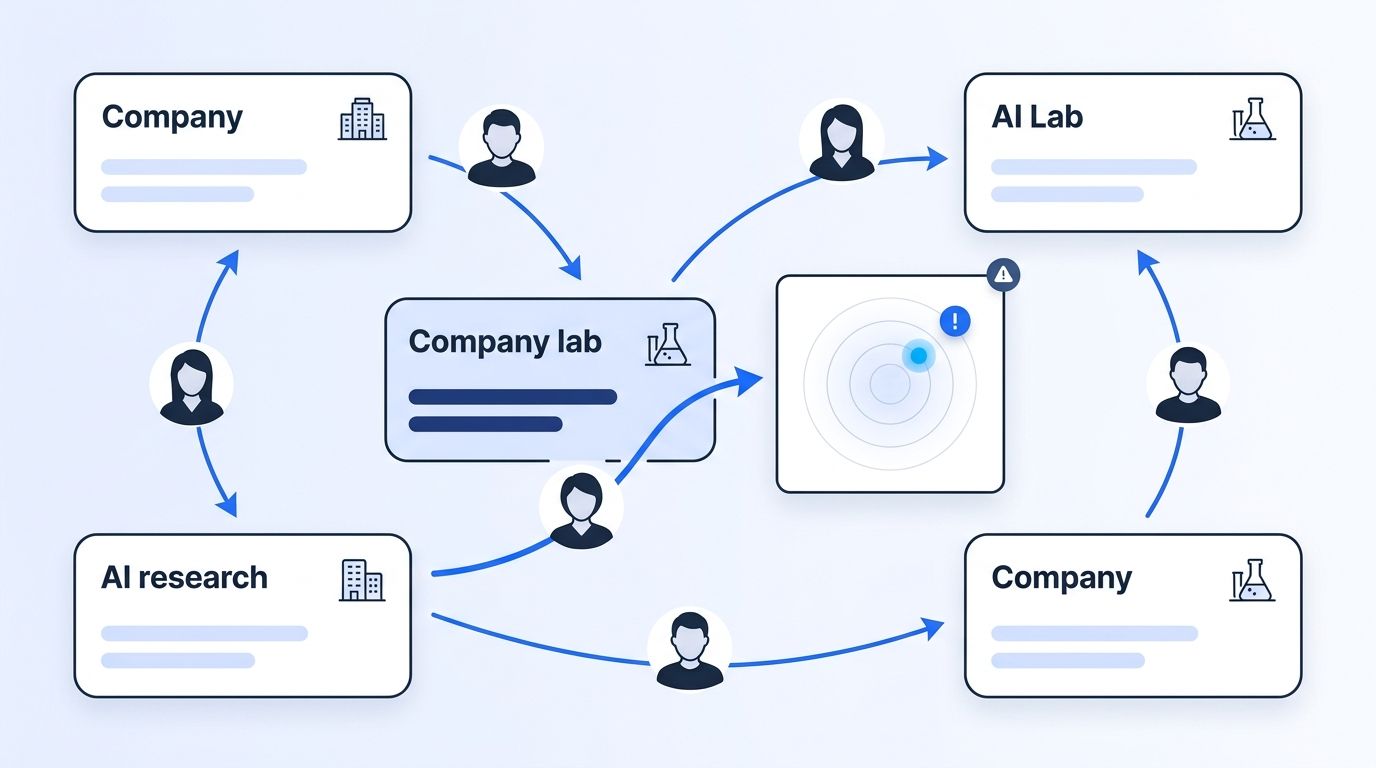
Why do hand-built talent maps go stale in weeks?
Hand-built talent maps decay because the underlying data does. B2B contact records go stale at roughly 2% every month — about 22.5% a year — as people change jobs, titles, and companies (HubSpot, Database Decay Simulation, retrieved 2026-07-19). Map 300 researchers into a spreadsheet today, and dozens of those rows are wrong before your next quarterly review.
Tenure makes it worse in tech. In its January 2024 release, the U.S. Bureau of Labor Statistics put median employee tenure at just 3.9 years — and it runs shorter in high-demand technical roles (U.S. Bureau of Labor Statistics, Employee Tenure Summary, retrieved 2026-07-19). Short tenure means constant movement. Constant movement means any static map is a photograph of a moving crowd.
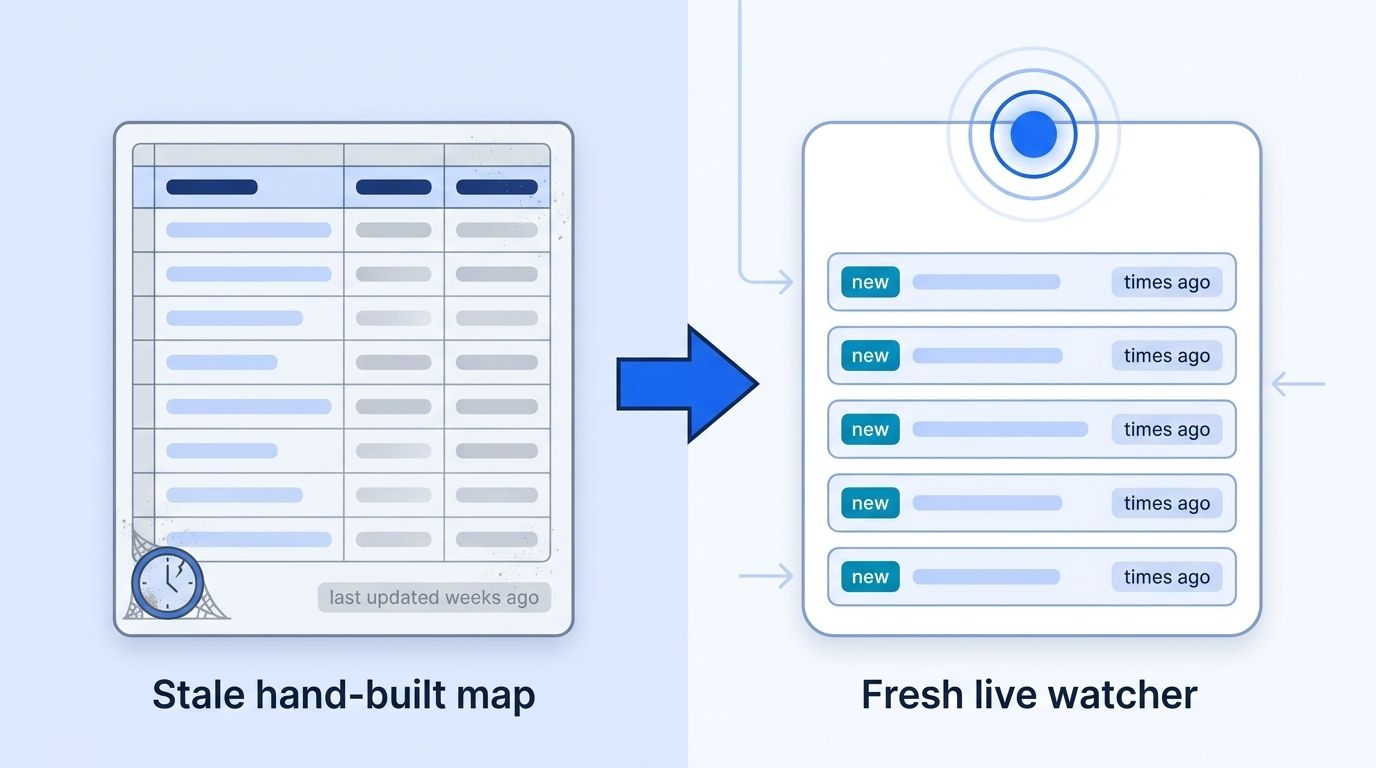
Here's the part most teams miss: a stale map doesn't just lose people, it actively misleads you. When a row is outdated, you email the wrong company, pitch the wrong role, or skip someone who just became a perfect fit. The cost isn't a blank cell — it's a confident, wrong action. A live watcher fixes this by never claiming to be a snapshot. It's a feed. To keep this current in your own systems, you can re-enrich any profile on demand through the People Profile endpoint instead of trusting a cached row.
What does "recency-aware" candidate sourcing actually mean?
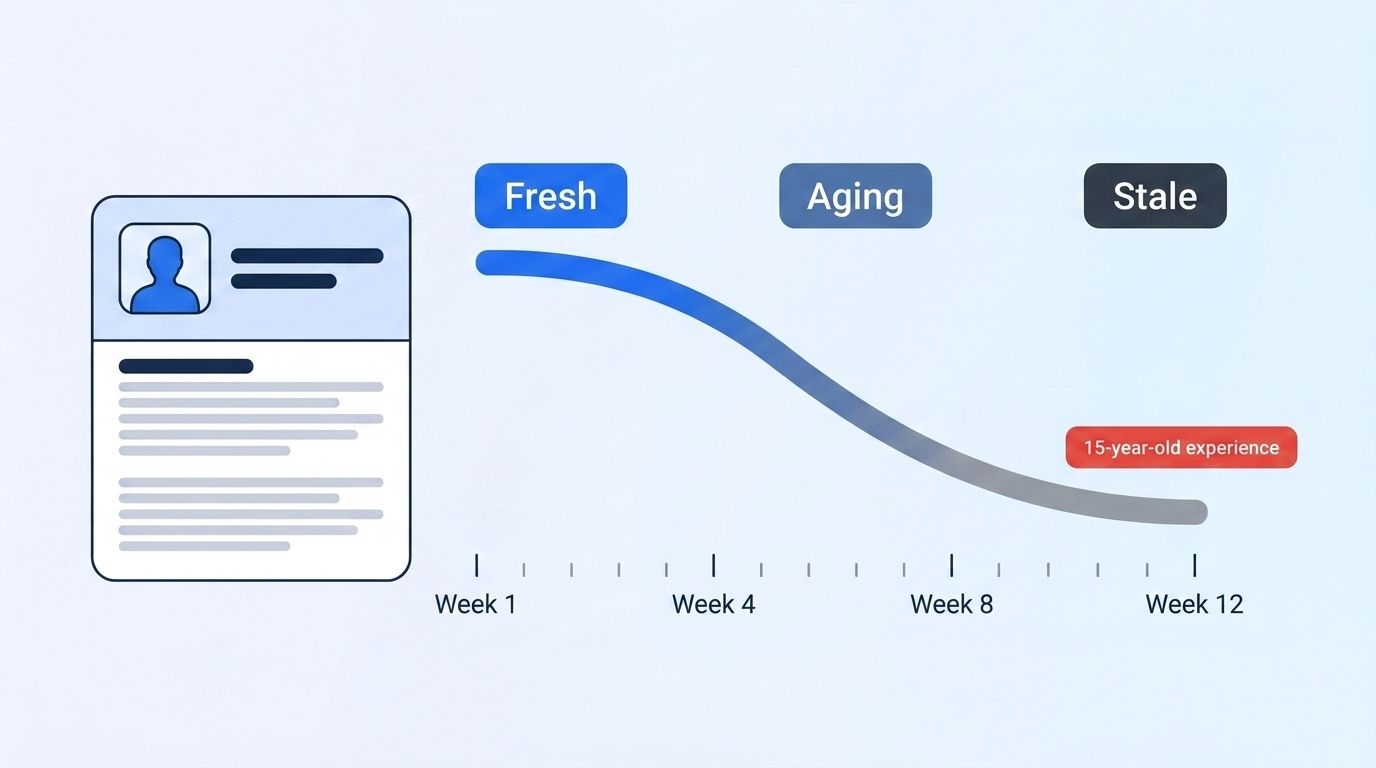
Recency-aware sourcing means ranking candidates by how fresh their signal is, not just how well their history matches a keyword. A profile's relevance decays over time — a project from week one is worth more than the same project from 12 weeks or 12 years ago. So you score for freshness first, then match on fit.
Think of every candidate's signal as moving through three states: fresh, aging, and stale. A move you detected this week is fresh and worth acting on now. A signal from last quarter is aging. And "15 years of relevant experience" with no recent activity? That's stale — interesting context, but not a reason to reach out today.
In practice, recency comes from three things you can actually measure: the date of a job change, the timestamp on recent activity, and how recently the profile itself was verified. According to Datamagnet's documentation, activity like a candidate's recent posts and engagement is retrievable per profile through the Person Activity endpoint, so "recent" is a field you can sort on — not a guess (Datamagnet, People API, retrieved 2026-07-19). That turns recency from a vibe into a sortable number.
How do you build a two-track watcher for talent moves between AI labs?
A good watcher runs two lanes at once, because you need to cover both the names you know and the ones you don't. The top lane watches a saved list of known people for job changes. The bottom lane scans the wider market for new movers who match your profile. One central monitor feeds both.
The known-names lane is a job-change signal over your watchlist. You save the researchers and engineers you already care about, and the monitor tells you the moment any of them changes employer. That's exactly the pattern in Datamagnet's Champion Tracker cookbook, which uses job_change signals to catch when tracked people move — built for revenue teams, but the mechanics are identical for a recruiter's shortlist.
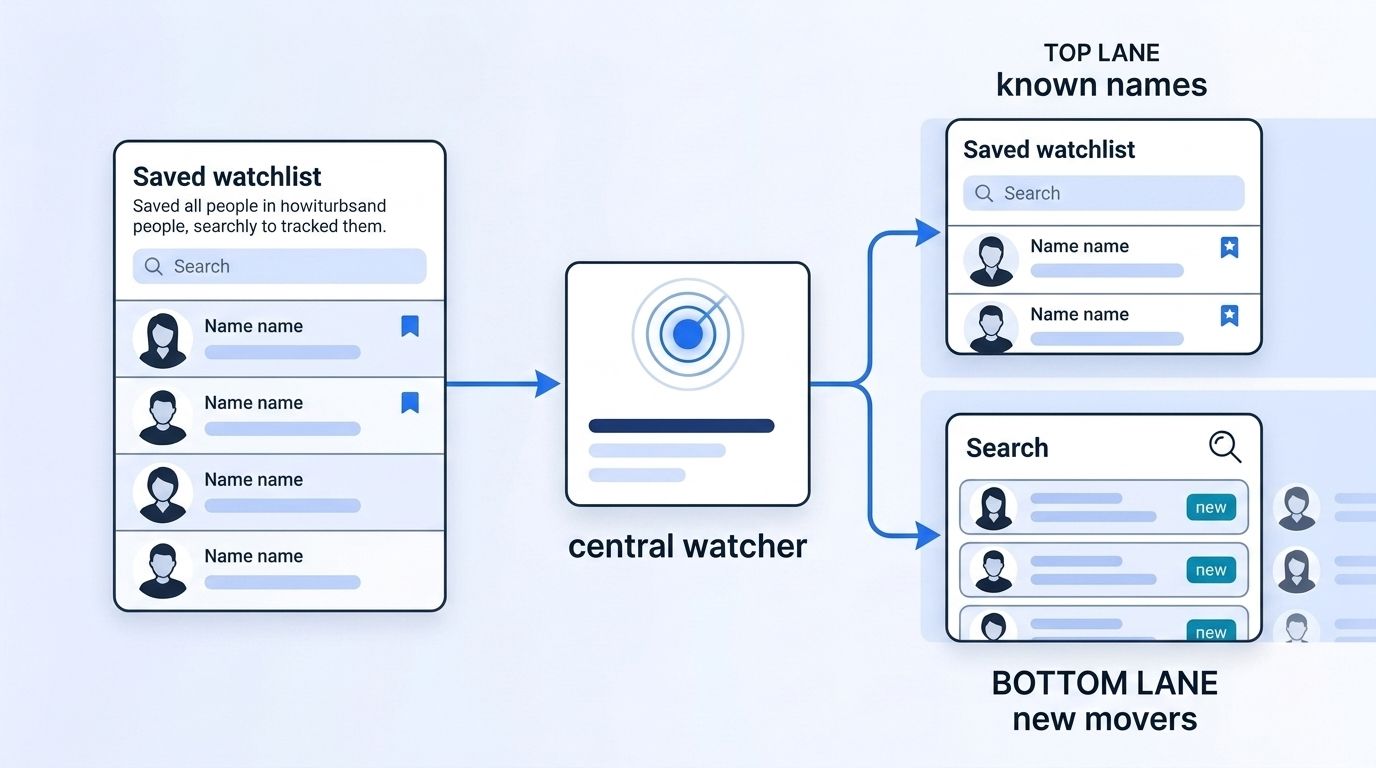
You set the whole thing up with one call. The Create Signal endpoint registers a monitor that tracks LinkedIn profiles for job changes, and you can pause, resume, or edit that list later through the Update Signal endpoint. One monitor covers your entire watchlist — you don't poll each profile by hand. Why check 300 profiles every Monday when a signal can check them for you and only ping you when something actually changed?
How do you catch new movers you've never heard of?
You catch new movers with search, not with a watchlist — because you can't save a name you don't know yet. The bottom lane of the watcher runs a repeatable ICP query for the roles, seniorities, and companies you care about, then flags anyone new since your last run. That's how a researcher who just joined a frontier lab surfaces even though they were never on your map.
Two endpoints do the heavy lifting here. The ICP People Search endpoint finds decision-makers and specialists by job title, seniority, function, company, and location — no internal IDs required. And the People Search DB endpoint queries Datamagnet's own store of enriched profiles with include and exclude filters on company URLs, so you can say "AI research roles, at these labs, not at that one" in a single query.
<!-- [UNIQUE INSIGHT] -->The exclude filter is the quiet power move for recency. Run the same ICP query on a schedule and exclude the companies you already sourced from — what's left is, by definition, people who moved into your target set since last time. You've turned a search endpoint into a change detector. The new movers fall out automatically, ranked by how recently they appeared, ready to enrich and score.
Why does a recency score beat a keyword match?
A recency score beats a keyword match because it answers a sharper question: not "who once did this?" but "who is doing this now, and just moved?" A scored candidate record puts current company, previous lab, seniority, and location up front — and pushes decade-old experience to the bottom, where it belongs. The headline is the move itself: "moved 3 days ago."
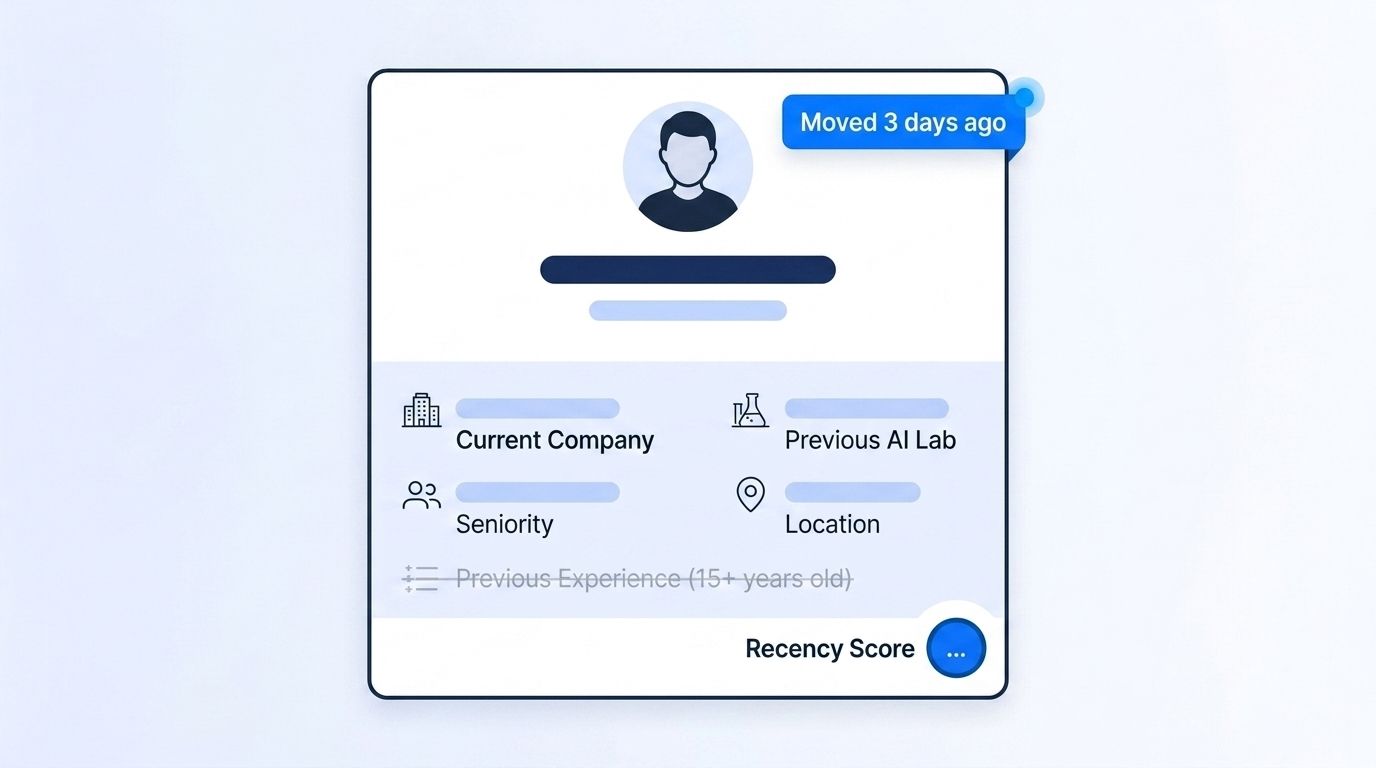
This matters most in markets that never sit still. In its 2025 State of Talent Report, SignalFire found that top AI labs poach heavily from one another, with two-year retention varying by more than 10 points between the leading labs — Anthropic held onto the largest share of the technical talent it hired, well ahead of some rivals (SignalFire, State of Talent Report 2025, retrieved 2026-07-19). When people move between labs that fast, the name that matched your keyword search last month may already sit at a competitor. A recency score catches that; a static keyword map never will.
How fast does the watcher need to be?
Fast enough that you reach out before everyone else does. In recruiting and sales alike, the first credible contact after a move wins an outsized share of the response — and a candidate who just switched labs is fielding messages from every recruiter with a keyword alert. Speed is the edge. A watcher that tells you next Monday is a watcher that tells you too late.
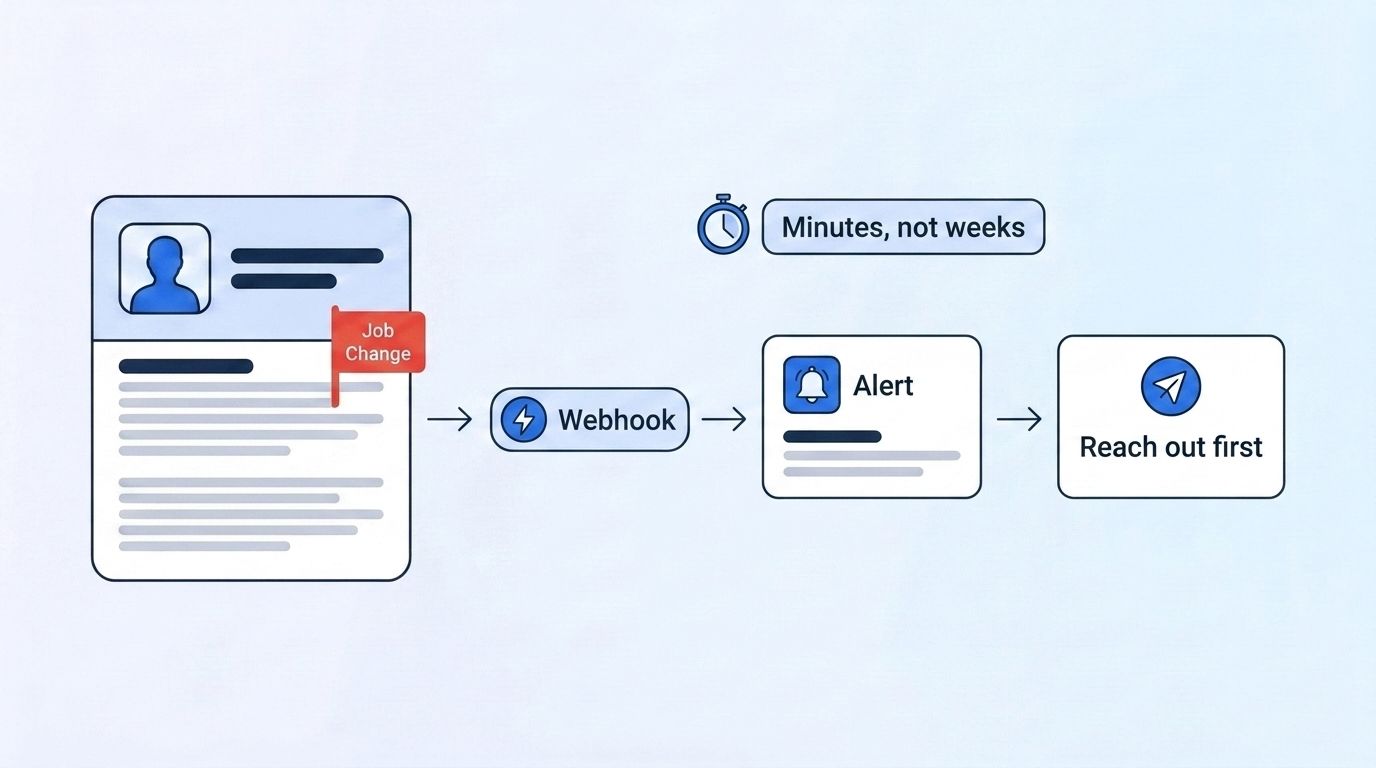
The delivery mechanism is what makes this real-time. Instead of polling, you register a webhook and Datamagnet posts the job-change event to your endpoint the moment it's detected, with signature verification and retry handling built in. From there it's a short hop to Slack or your ATS. You can list and audit every active monitor through the List Signals endpoint so nothing runs silently in the background.
This is the whole promise of a job-change signal API: monitor movement continuously, filter it to your ICP, and get pinged in minutes. Pair it with a recruiting workflow and you've replaced the quarterly map refresh with a live feed. See how teams wire this into sourcing on the recruiting intelligence page.
Start watching moves instead of mapping names
Stop maintaining a spreadsheet that's wrong by the time you save it. Save your known names to a job-change signal, run a scheduled ICP query for new movers, and score everyone by recency instead of buried keywords. You'll surface the person who moved this week — not the one whose best work shipped 15 years ago. Start a job-change watcher and see who just moved.
Frequently Asked Questions
What is recency-aware candidate sourcing?
Recency-aware sourcing ranks candidates by how fresh their signal is — a recent job change, recent activity, or a recently verified profile — rather than by how well old keywords match. It exists because B2B data decays about 2% a month (HubSpot, retrieved 2026-07-19), so freshness is a better relevance signal than history.
Why do hand-built talent maps go out of date so fast?
Because the people in them keep moving. Median employee tenure was just 3.9 years in the January 2024 BLS release, and it's shorter in tech (U.S. Bureau of Labor Statistics, retrieved 2026-07-19). Combined with ~2% monthly data decay, a static map built this quarter carries dozens of wrong rows within weeks.
How do I track when specific people change jobs?
Save the profiles to a job-change signal monitor. Datamagnet's Create Signal endpoint registers one monitor across your whole watchlist and pushes an event via webhook the moment anyone moves — the same pattern as the Champion Tracker cookbook. No manual polling required.
How do I find new movers I've never heard of?
Run a scheduled ICP query and flag anyone new since last time. The ICP People Search endpoint filters by title, seniority, and company, and the People Search DB endpoint supports company include/exclude filters — so excluding already-sourced companies leaves only fresh movers.
Is monitoring public profile moves compliant?
Datamagnet collects data from public sources and supports GDPR- and CCPA-aligned handling, but compliance depends on your use case. Review the terms for your jurisdiction and outreach channel before you act. Treat every signal as a prompt to verify, not as automatic permission to contact someone.
Sources
- HubSpot, Database Decay Simulation, retrieved 2026-07-19, https://www.hubspot.com/database-decay
- U.S. Bureau of Labor Statistics, Employee Tenure Summary (January 2024 release), retrieved 2026-07-19, https://www.bls.gov/news.release/tenure.nr0.htm
- SignalFire, State of Talent Report 2025, retrieved 2026-07-19, https://www.signalfire.com/blog/signalfire-state-of-talent-report-2025
- Datamagnet, LinkedIn Signal API, retrieved 2026-07-19, https://www.datamagnet.co/signal-api/
- Datamagnet, People API, retrieved 2026-07-19, https://www.datamagnet.co/people-api/
