
7 Best Real-Time B2B People Enrichment APIs for Sales Teams (2026)
Speed and precision aren't nice-to-haves in B2B sales anymore — they're the baseline. Sales teams that operate on incomplete or outdated prospect data lose outreach opportunities before they even start. Contact data decays at rates between 22.5% and 70.3% per year (Landbase, 2026), meaning the list you built six months ago is already riddled with wrong titles and dead emails.
Real-time B2B people enrichment APIs fix that. They instantly append missing contact and company data directly inside your sales workflow, so every rep is working with current, verified information — not stale records pulled from a spreadsheet.
explore Datamagnet's people data API
TL;DR
- Contact data decays up to 70% annually, making real-time enrichment a must for outbound teams (Landbase, 2026).
- Top enrichment APIs respond in under 300ms and hit 98%+ email accuracy.
- Evaluate providers on accuracy, speed, compliance, and CRM integration.
- Use the RACE Framework (Request, Authenticate, Cascade, Evaluate) to implement cleanly.
- A hybrid real-time + batch approach gives you the best balance of speed and cost.
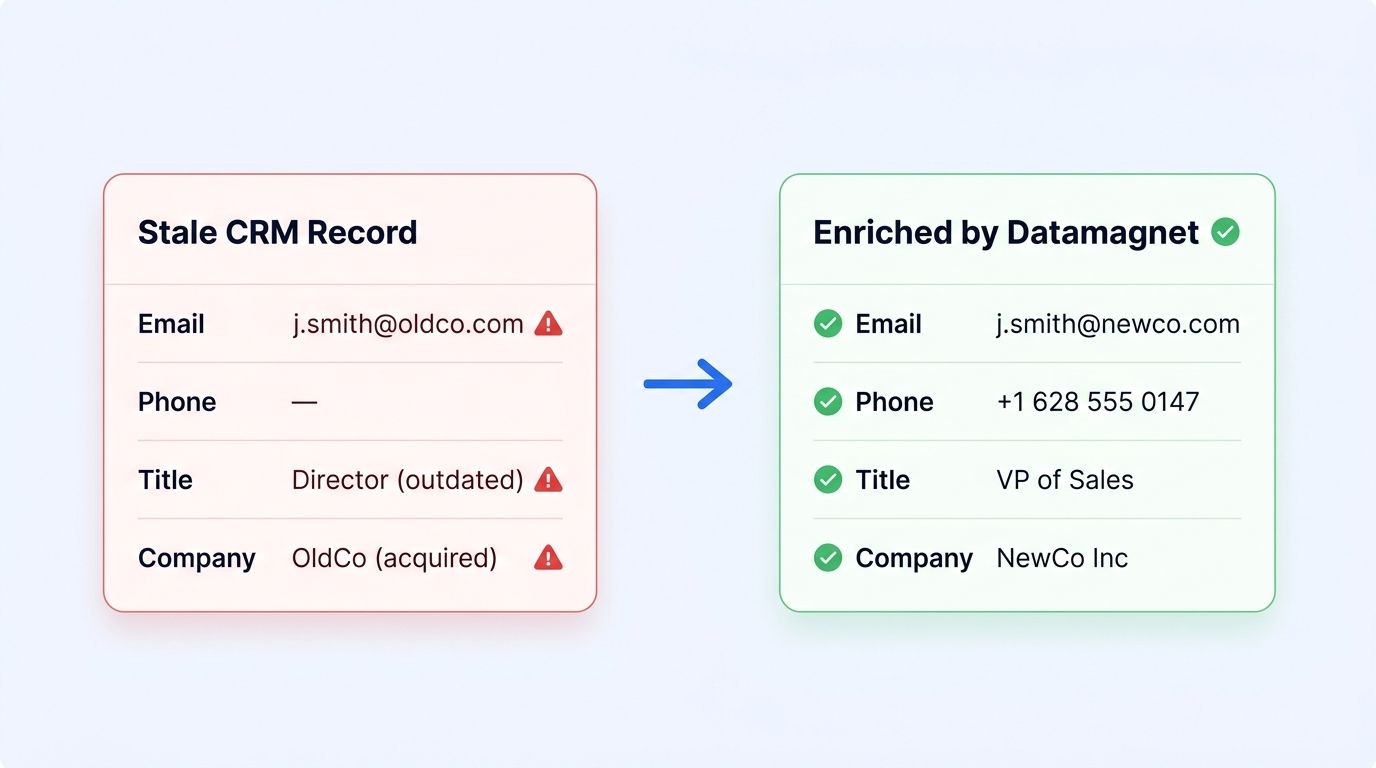
What Is Real-Time B2B People Enrichment?
Real-time B2B people enrichment is the automated process of instantly appending or validating contact and company data for a prospect — directly inside your sales tools. Unlike batch processing, which updates records on a schedule, real-time enrichment responds on demand, often in milliseconds. Contact data decays at rates between 22.5% and 70.3% per year (Landbase, 2026), so stale records aren't a minor inconvenience — they're a pipeline killer.
Think of it this way: a rep types in a prospect's email, and within half a second they've got a verified job title, direct phone number, company size, and LinkedIn profile. No manual research. No guesswork. That's the core value proposition.
Data enrichment (jargon alert, defined here) means adding third-party data points to an existing record. "Real-time" means that lookup happens the moment you ask for it, not overnight. The combination makes your outreach faster, more personal, and far less likely to bounce.
what is B2B data enrichment and how does it work
What Do Real-Time People Enrichment APIs Actually Do?
The best APIs transform a single input, like an email address or a name plus company, into a complete, actionable contact profile. People Data Labs achieves roughly 200ms median latency (Autobound, 2026), and Prospeo reports 98% email accuracy across 300M+ profiles with a 7-day refresh cycle (Prospeo, 2026). You get real data, fast.
Here's what a typical enrichment API returns from a single email or LinkedIn URL lookup:
- Email verification — confirms deliverability before you hit send
- Phone discovery — surfaces direct dials and mobile numbers
- Job title validation — checks that the title on the record is still current
- Company affiliation updates — flags if the contact has moved employers
Data sources vary by provider but generally include public records, social media profiles, proprietary business databases, and web scraping. The best providers combine multiple sources and cross-validate results before returning a record.
Waterfall enrichment cascades a lookup across multiple data providers in sequence, stopping when a complete match is found. ("Waterfall" defined: the system tries the next source automatically when the first one has a gap.) That architecture is what separates top-tier APIs from single-source tools. A single-source API fails silently when its database has a gap. A waterfall system tries the next source automatically, which is why Datamagnet's multi-source approach consistently returns more complete profiles than single-vendor lookups.
Citation capsule: Real-time people enrichment APIs convert a minimal input (email, name, or LinkedIn URL) into a full contact profile in under 500ms. Prospeo's platform achieves 98% email accuracy across 300M+ records with 7-day data refresh (Prospeo, 2026). People Data Labs reports a median API latency of approximately 200ms (Autobound, 2026).
What Are the Key Use Cases for Sales Teams?
Real-time enrichment earns its place in four specific workflows, each with measurable impact on pipeline. Inbound leads reached within 5 minutes of form submission are 9x more likely to convert than those reached later (Utmost Agency, 2026), which makes enrichment at the moment of inbound especially valuable. Here's where it matters most.
Inbound Lead Enrichment
A prospect submits a form with just their email and company name. The enrichment API fires instantly — before they've even clicked away from your thank-you page. Job title, phone number, LinkedIn URL, company size, and industry all populate automatically. Your lead scoring model has what it needs. The rep gets a fully routed, prioritized lead in seconds, not hours. That speed is the difference between being first or third to follow up.
Outbound Prospecting
You've got a name and a company. That's it. The enrichment API builds the rest: verified work email, direct dial, current title, seniority level, and company headcount. List-building that used to take an SDR an hour per rep — hunting emails, cross-referencing LinkedIn, guessing direct dials — now happens in seconds. The rep spends that saved time on conversations instead of research.
CRM Hygiene
CRM records rot faster than most teams realize. Job titles change. People leave companies. Departments restructure. Automated re-enrichment on a rolling schedule catches those changes before a rep sends a pitch to someone who left the company six months ago, or references a title that changed last quarter. With data decaying up to 70% annually (Landbase, 2026), this isn't optional maintenance. It's continuous triage on a database that's quietly falling apart.
Meeting Preparation
Enrich a contact two minutes before a discovery call. You get their latest job title, recent company news, any funding announcements, and updated LinkedIn activity — all without opening a browser tab. The rep walks in knowing exactly who they're talking to and what's changed at the account since the last touchpoint. It turns a cold intro into a warm, informed conversation.
how to build a CRM hygiene workflow with enrichment APIs
how to detect job changes in real time and trigger outreach
What Critical Features Should You Evaluate in Enrichment APIs?
Not all enrichment APIs are equal, and the gaps matter. Cleanlist reports 98% email deliverability accuracy as a benchmark for top-tier providers (Cleanlist, 2026), and People Data Labs achieves roughly 200ms P50 latency (Autobound, 2026). Anything significantly below those marks will cost you in bounce rates and slow workflows.
Here's what to assess before you sign up:
Data Coverage and Accuracy Look for email deliverability rates above 95%, phone validation (not just presence), and job-change detection. Coverage depth matters for your specific market: a provider with great US coverage might have thin data for APAC or EMEA.
API Performance Sub-second response times are the standard for real-time enrichment. Check P50 and P99 latency, uptime SLAs, and rate limits. A provider that's fast at P50 but slow at P99 will create inconsistent user experiences.
Data Compliance GDPR and CCPA compliance aren't checkboxes. GDPR's legitimate interest standard applies to B2B enrichment but requires a documented balancing test (Cleanlist, 2026). Ask your provider how data is sourced, how opt-outs are handled, and whether they maintain an audit trail.
Integration Flexibility You need REST API access, webhook support for event-driven workflows, and ideally native CRM connectors for Salesforce and HubSpot. Bulk enrichment for CRM cleanup and single-record enrichment for live lookups should both be available.
Citation capsule: GDPR's legitimate interest basis is the standard legal ground for B2B data enrichment in Europe, but it requires documented balancing tests confirming that the data subject's rights don't override the business interest (Cleanlist, 2026). Providers should maintain audit trails and transparent opt-out mechanisms.
How Do the Top People Enrichment APIs Compare?
Here's a side-by-side comparison of the leading providers on the dimensions that matter most for sales teams. Accuracy figures are vendor-reported unless otherwise noted. Datamagnet leads on email accuracy at 98%+ with sub-300ms response times, while Apollo's actual accuracy sits closer to 65-70% despite similar pricing. Those gaps directly affect bounce rates and how much time reps lose chasing dead contacts, so treat this table as a shortlist filter, not just a feature checklist.
| Provider | Email Accuracy | Phone Coverage | API Response Time | GDPR Compliant | Pricing Model |
|---|---|---|---|---|---|
| Datamagnet | 98%+ | Excellent (direct dials, mobile) | <300ms | Yes | Credit-based, usage-driven |
| ZoomInfo API | 85-90% | Good | ~500ms | Yes | Annual contracts, seat-based |
| Clearbit Enrichment | 85%+ | Fair | <200ms | Yes | Subscription, usage tiers |
| Apollo.io API | 65-70% (actual) | Good | ~400ms | Yes | Subscription, credit-based |
| Lusha API | ~75-80% | Good | ~300ms | Yes | Credit-based, monthly subs |
| People Data Labs | ~90% | Good | ~200ms | Yes | Pay-per-record |
A few things worth flagging here. Apollo's 65-70% actual email accuracy is a real gap — if you're running high-volume outbound, that bounce rate adds up fast. ZoomInfo's annual contract model can lock smaller teams into pricing that doesn't match their actual usage. PDL is the strongest raw-data option for engineering teams building custom systems, but it's not plug-and-play for a sales rep.
The providers with the best email accuracy tend to use waterfall architecture internally, not single-source lookups. That's why Datamagnet's multi-source cascade approach consistently outperforms single-vendor APIs on completeness and deliverability, especially for contacts outside North America where individual data sources have thinner coverage.
compare enrichment API pricing options
How Do You Implement a People Enrichment API in Your Sales Stack?
Implementation done badly creates more problems than it solves: duplicate records, over-enrichment costs, and compliance gaps. The RACE Framework gives you a structured approach: Request, Authenticate, Cascade, Evaluate. Each step maps to a concrete technical decision, from picking your enrichment triggers to setting up waterfall fallback logic between providers, and skipping any one of them tends to surface later as either a bloated API bill or reps working from half-enriched CRM records.
Step 1: Identify Enrichment Triggers (Request)
Decide when enrichment fires. Common triggers include a new lead form submission, a new contact added to CRM, a manual rep lookup, and a scheduled CRM re-enrichment job. Don't enrich everything blindly — that burns credits fast. Set conditions: only enrich if the email field is present and the title field is empty.
Step 2: Configure Authentication (Authenticate)
Most APIs use API key authentication. Some offer OAuth or IP whitelisting for higher-security environments. Store keys in environment variables, not in code. Set up sandbox credentials for testing before connecting to production CRM data.
Step 3: Map Fields and Set Up Fallback Logic (Cascade)
Map every API response field to its CRM counterpart. Then decide what happens when the primary enrichment source returns a partial result. A waterfall setup tries the next data source automatically. Without fallback logic, you'll get a lot of half-enriched records and frustrated reps.
Step 4: Monitor and Iterate (Evaluate)
Track API credit usage, email bounce rates after enrichment, and phone connect rates. If enriched emails still bounce at high rates, your primary source has a coverage gap and you need a fallback. Review the impact on pipeline KPIs monthly. Enrichment should have a measurable effect on time-to-first-activity and conversion rate.
Real-Time vs. Batch Enrichment: Which Should You Use?
The honest answer is both. Real-time enrichment is essential for inbound leads — contacts reached within 5 minutes of form submission are 9x more likely to convert (Utmost Agency, 2026). Batch enrichment is cost-efficient for large periodic CRM cleanups where speed doesn't matter as much as coverage.
Real-time advantages:
- Instant data at the moment of conversion
- Enables immediate personalization and routing
- Feeds live lead scoring models
Batch enrichment advantages:
- Lower cost per record for high volumes
- Ideal for periodic CRM re-enrichment runs
- Less API load on your infrastructure
Real-time enrichment costs roughly $0.01 per email lookup at the low end (Prospeo, 2026). For a team processing 1,000 inbound leads per month, that's $10 in API costs. Batch re-enriching your entire 50,000-record CRM quarterly at that rate is $500 — a rounding error compared to the cost of sending 50,000 emails to dead addresses.
Citation capsule: Inbound leads contacted within 5 minutes of a form submission are 9x more likely to convert compared to those reached after 30 minutes or more (Utmost Agency, 2026). Real-time enrichment makes immediate, personalized follow-up possible by eliminating the research step between form submission and first contact.
What Are the Most Common Implementation Challenges?
Every team hits the same four friction points when rolling out enrichment. Here's what they are and how to handle them before they become problems. Rate limits, incomplete or mismatched records, cost overruns, and compliance gaps show up regardless of company size or which provider you pick. Left unaddressed, they quietly erode the ROI that pulled you toward real-time enrichment in the first place, so it's worth planning for each one before launch, not after reps start complaining.
API Rate Limits. High-volume teams can hit rate limits during peak hours. Solution: implement a request queue with exponential backoff. Batch lower-priority enrichments (like CRM cleanup) during off-peak hours so real-time inbound enrichment always gets priority bandwidth.
Incomplete or Mismatched Records. Even the best API returns partial results sometimes. Don't let incomplete enrichment overwrite existing CRM data — use conditional field mapping that only updates a field if the enriched value has higher confidence than what's already there. Waterfall enrichment minimizes this by trying multiple sources.
Cost Overruns. Enriching every record unconditionally is wasteful. Set rules: only enrich if specific fields are missing and the lead meets minimum qualification criteria. This alone can cut enrichment costs by 40-60% without affecting lead quality.
Data Compliance. Your enrichment provider's compliance posture becomes your compliance posture. Ensure they're GDPR and CCPA certified, maintain data sourcing documentation, and support opt-out mechanisms. Keep your own audit trail of when records were enriched and from which sources (Derrick App, 2026).
B2B data compliance checklist for enrichment workflows
Does Real-Time Enrichment Actually Improve Sales Efficiency?
The numbers say yes. Teams using real-time enrichment have reported a 180% increase in AE-sourced pipeline, with email bounce rates dropping from 35-40% to under 5% (Prospeo customer case study, self-reported, 2026 — see Prospeo). Those aren't marginal improvements — they're structural changes in how efficiently a sales team operates.
The core mechanism is simple. Reps stop spending time on manual research and spend more time on conversations. Enriched records mean higher deliverability, better personalization, and faster qualification. Leads that used to take 20 minutes of prep take 30 seconds. At scale, that compounds into a meaningfully different output per rep per day.
Real-time B2B people enrichment isn't a feature to bolt on after you've built your stack. It's infrastructure. Get it right before bad habits around manual research embed themselves in your team's workflow.
Frequently Asked Questions
What is a real-time B2B people enrichment API?
A real-time B2B people enrichment API instantly appends missing contact and company data to a prospect record the moment you request it. Submit an email, name, or LinkedIn URL and get back a full profile: verified email, phone, job title, company size, and more. Top APIs respond in under 500ms. Contact data decays at up to 70% annually (Landbase, 2026), making real-time enrichment essential for accurate outreach.
How accurate are real-time people enrichment APIs?
Accuracy varies significantly by provider. Top-tier APIs hit 90-98% email deliverability accuracy, with Cleanlist citing 98% as the benchmark for best-in-class providers (Cleanlist, 2026). Apollo.io's actual email accuracy runs closer to 65-70%, which drives up bounce rates on high-volume campaigns. Always test accuracy on a sample of your specific target market before committing to a provider.
What's the best real-time enrichment API for sales teams?
It depends on your workflow. For outbound teams that need speed and accuracy, Datamagnet's multi-source waterfall approach delivers 98%+ email accuracy at under 300ms response time. PDL is better for engineering teams building custom data systems. Apollo.io suits smaller teams who want enrichment inside an all-in-one platform. Match the API's architecture to your team's motion — accuracy at speed is the key variable for outbound-first teams.
How much does real-time people enrichment cost per contact?
Costs range from roughly $0.01 per email lookup at the low end to $0.50 per full contact record for premium providers, depending on data depth and volume tier (Prospeo, 2026). Most providers use credit-based pricing that scales with usage. Setting conditional enrichment rules — only enrich records missing critical fields — typically cuts costs by 40-60% without affecting lead quality.
How do I integrate a people enrichment API into my CRM?
Most APIs connect via REST endpoints. For Salesforce and HubSpot, you can use native connectors, Zapier, or Make for no-code setups, or build a custom middleware layer for more control. Follow the RACE Framework: identify your enrichment triggers, configure authentication, map fields, and set up fallback logic. Plan for conditional field mapping so enriched data doesn't overwrite higher-confidence existing records.
What data fields can I get from a people enrichment API?
Standard fields include verified email address, direct dial and mobile phone, current job title, company name and domain, industry, company size, seniority level, and LinkedIn profile URL. Premium providers also return recent job changes, company funding status, technographic data, and social media handles. The field set varies by provider — check coverage for your specific market before assuming a provider has what you need.
Is real-time enrichment better than batch enrichment for sales?
Real-time enrichment is better for inbound lead handling and live outbound prospecting. Batch enrichment is better for periodic CRM cleanup and large-scale re-enrichment runs. The most efficient approach combines both: real-time at the moment of conversion, batch for ongoing CRM hygiene. Inbound leads reached within 5 minutes of form submission are 9x more likely to convert (Utmost Agency, 2026).
How fast should a real-time enrichment API respond?
Under 500ms is the baseline for a usable real-time experience. Under 300ms is strong. Top providers like PDL and Clearbit hit roughly 200ms at P50 latency (Autobound, 2026). Response time matters most for interactive use cases where a rep is waiting for data during a live workflow. For batch jobs, latency matters less than throughput and accuracy.
Are people enrichment APIs GDPR and CCPA compliant?
Most reputable providers maintain GDPR and CCPA compliance frameworks, but compliance is your responsibility too. GDPR's legitimate interest basis applies to B2B enrichment but requires a documented balancing test (Derrick App, 2026). Verify your provider's data sourcing documentation, opt-out mechanisms, and audit trail capabilities. Don't assume compliance based on a checkbox on a pricing page.
How do I prevent over-enriching and wasting API credits?
Set conditional enrichment rules that only trigger when specific fields are empty or below a confidence threshold. Don't enrich every record unconditionally — focus on leads that meet minimum qualification criteria. Use event-driven enrichment (triggered by specific CRM actions) rather than scheduled bulk runs. Audit your enrichment usage monthly and adjust rules based on actual field completion rates and lead quality outcomes.
What is waterfall enrichment and why does it matter?
Waterfall enrichment cascades a lookup request across multiple data sources in sequence. If the first source returns an incomplete result, the next source is queried automatically. This produces significantly more complete profiles than single-source lookups — especially for contacts outside North America, where individual data sources have thinner coverage. It's the key architectural difference between top-tier enrichment APIs and single-vendor tools.
Glossary
Real-Time Enrichment: Instantly appending contact or company data on demand, in response to a specific trigger or API call. Differs from batch enrichment, which updates records on a schedule.
Batch Enrichment: Processing a large set of records at once on a fixed schedule. Cost-efficient for CRM cleanup but not suited for inbound lead handling that requires immediate data.
API Latency: The elapsed time between sending a request to an enrichment API and receiving a complete response. Measured at P50 (median) and P99 (99th percentile). A fast P50 with a slow P99 creates inconsistent real-world experiences.
Waterfall Enrichment: A cascading lookup strategy that queries multiple data sources in sequence. If the first source returns an incomplete result, the next source is queried automatically. Produces more complete profiles than single-source lookups.
Data Decay: The rate at which contact data becomes inaccurate over time due to job changes, company moves, and contact detail updates. B2B contact data decays at 22.5% to 70.3% per year (Landbase, 2026).
GDPR (General Data Protection Regulation): The EU's primary data privacy law, governing how personal data is collected, processed, and stored. Applies to any company handling data about EU residents, including B2B enrichment workflows.
CCPA (California Consumer Privacy Act): California's data privacy law, granting consumers rights over their personal data. Applies to B2B contact data for individuals in California.
CRM Hygiene: The ongoing process of keeping CRM records accurate, complete, and current. Includes removing duplicates, updating changed records, and filling in missing fields through enrichment.
