
Disclosure: This article is published by Datamagnet. Vendor claims are self-reported unless otherwise noted.
8 Best People Data Labs Alternatives for B2B Data in 2026
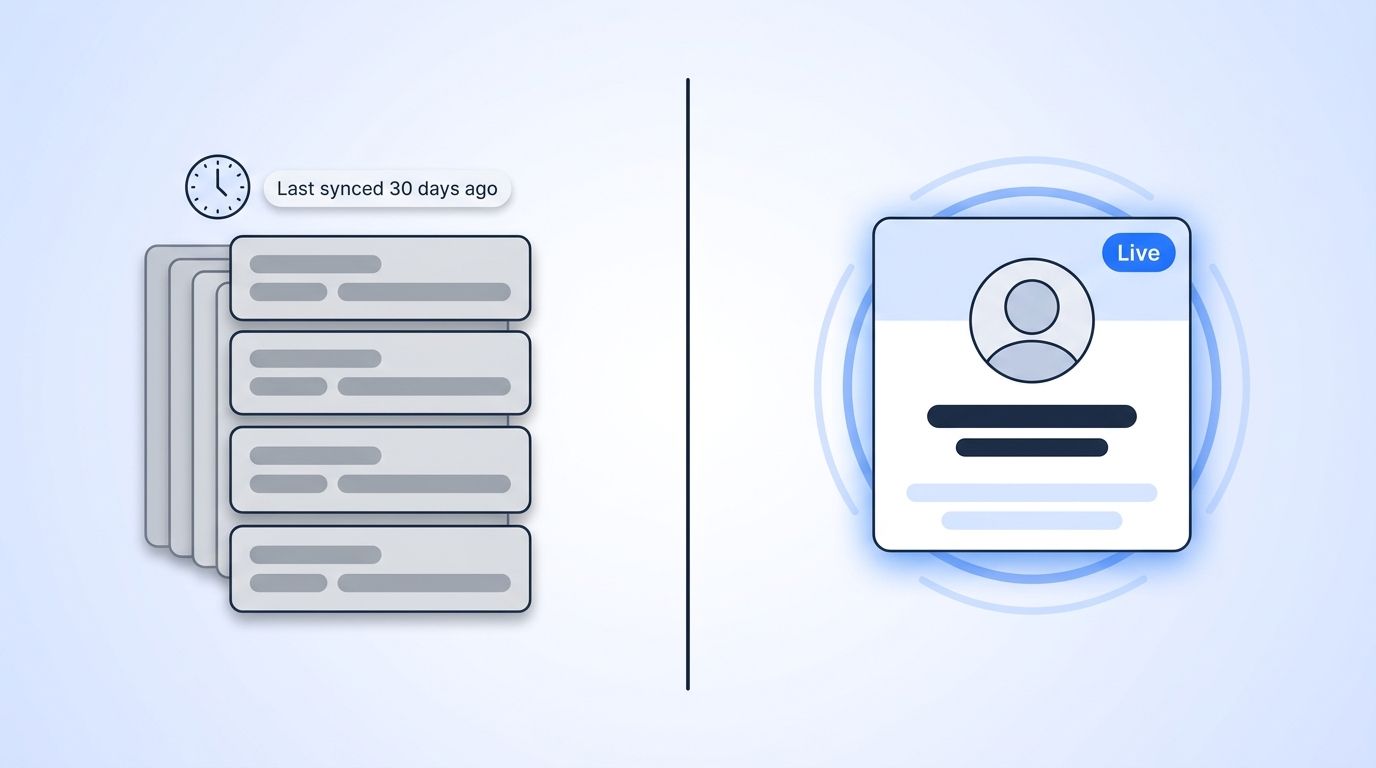
People Data Labs matches candidate records against "nearly three billion individual profiles" (People Data Labs, 2026). That's a genuinely large bulk dataset. But bulk isn't the same thing as fresh, and a lot of GTM teams searching for a PDL alternative aren't unhappy with the size of the database — they're unhappy with how quickly it goes stale between refresh cycles.
This guide compares eight alternatives to People Data Labs, including PDL itself, so you can see where a static bulk database still makes sense and where a real-time lookup API is the better fit for your stack.
TL;DR
- PDL's dataset is huge (~3B profiles, People Data Labs, 2026), but it's refreshed in batches, so records between updates can lag actual job changes and title updates.
- B2B contact data decays fast — estimates run from roughly 22.5% to 70.3% per year depending on methodology (MarketingSherpa/Dun & Bradstreet/Biznology via Landbase, 2026).
- The best PDL alternative depends on whether you need scale (Coresignal, Apollo), CRM-native workflows (ZoomInfo, HubSpot Breeze), or request-time freshness (Datamagnet, ScrapIn, Bright Data).
- Choose a real-time API if job-change timing matters to your outreach. Choose a bulk database if you need to enrich millions of records in one batch and freshness is secondary.
Why Are Teams Looking for a People Data Labs Alternative?
Most searches for a PDL alternative come down to one issue: data freshness against a moving job market. In January 2024, the median U.S. private-sector employee had been with their current employer just 3.5 years — the shortest tenure on record since 2002 (Bureau of Labor Statistics, 2024). People change roles constantly, and a batch-refreshed database can't keep pace in real time.
That churn shows up directly in CRM data quality. B2B contact records decay somewhere between 22.5% and 70.3% a year depending on the study and definition of "decayed" (MarketingSherpa/Dun & Bradstreet/Biznology via Landbase, 2026). Even the conservative end of that range means roughly one in five contact records goes stale annually — titles change, people leave, emails bounce.
Most "PDL alternatives" roundups compare price and database size and stop there. The distinction that actually predicts whether your outreach lands on a working email and current title is architectural: does the provider look up data at request time, or does it hand you a snapshot from the last batch refresh? That's the lens we use for every profile below.
Beyond freshness, three other triggers push teams to shop for alternatives: pricing changes at competitors (ZoomInfo contracts commonly renew with 5-15% increases and 60-day auto-renewal windows, according to multiple vendor-comparison guides — Cognism, 2026), consolidation among data vendors (HubSpot folded Clearbit into "Breeze Intelligence" in 2024 and sunset Clearbit's standalone free tools by April 2024 — Clearbit, 2024), and compliance concerns about how a provider sources its records in the first place.
How Does People Data Labs Compare to 7 Alternatives?
People Data Labs leads on raw dataset size, matching nearly three billion profiles in a single batch export (People Data Labs, 2026). The table below lines up all eight providers on data model, best-fit use case, entry pricing, and the one limitation most likely to matter once you're evaluating a switch.
| Provider | Data Model | Best For | Entry Pricing | Notable Limitation |
|---|---|---|---|---|
| People Data Labs | Batch bulk database | Large one-time enrichment jobs | Free tier (100 lookups/mo); Pro ~$98/mo | Refresh cycle lags real-time job changes |
| Datamagnet | Real-time LinkedIn lookup | Live enrichment inside CRM/SDR workflows | 10 free credits, pay-as-you-go | No bulk static database to browse offline |
| ZoomInfo | Batch + intent data | Enterprise sales orgs with budget | Custom, not published (est. $15K-$100K+/yr) | Opaque pricing, long contracts |
| Apollo.io | Batch database + sequencing | Sales teams wanting data + outreach in one tool | Free tier available | Contact counts vary widely across sources |
| Clearbit (HubSpot Breeze) | Batch, HubSpot-gated | Existing HubSpot customers | Included in HubSpot tiers | No longer usable standalone |
| Coresignal | Batch, 6-hour refresh cycle | Data teams building their own models | Custom / usage-based | Built for bulk export, not live lookups |
| Bright Data | Real-time scraping infrastructure | Teams building custom scrapers | Usage-based | Requires engineering to operationalize |
| ScrapIn | Real-time LinkedIn API | Developers wanting a direct LinkedIn API alternative | Usage-based | Narrower endpoint coverage than larger vendors |
Pricing figures for PDL, ZoomInfo, and Apollo are third-party estimates (vendors don't publish exact rates); confirm current pricing directly before budgeting.
1. People Data Labs (The Baseline)
People Data Labs wins on raw dataset size — its Person Enrichment API matches against nearly three billion profiles and its Company Data product covers more than 71 million companies (People Data Labs, 2026). If you need to enrich a huge batch of leads in a single pass and don't need minute-by-minute freshness, PDL's scale is hard to beat.
The tradeoff is update cadence. PDL's records reflect whenever that portion of the dataset was last refreshed, not the current state of a person's LinkedIn profile. For fast-moving GTM teams — territory assignment right after a prospect changes jobs, for instance — that lag matters more than raw record count.
PDL also carries reputational baggage: in 2019, a security researcher found 1.2 billion records (4TB, including 622 million unique email addresses) exposed on an unsecured server traced back to PDL-sourced data, though the server itself wasn't owned by PDL (Forbes, 2019; Have I Been Pwned). It's an old incident, but it still surfaces in security reviews.
Verdict: PDL is the strongest pick for large batch enrichment jobs where freshness is secondary to coverage. For a full head-to-head, see our detailed PDL comparison.
2. Datamagnet — Real-Time LinkedIn Data API
Datamagnet wins for teams that need current job titles and company data at the moment of outreach, because it looks up LinkedIn at request time instead of serving a cached batch record. Every People Profile and Company Profile call fetches structured data live, so a job change from last week shows up in the response instead of waiting for the next scheduled refresh.
Building a request-time lookup instead of a static database changes the engineering tradeoffs, not just the marketing pitch. A batch database can answer a million lookups in one export; a live API answers one lookup with today's data. Datamagnet is built for the second case: enriching a lead the moment it hits your CRM, or verifying a target's current employer before an SDR sends a signal-triggered message.
Datamagnet also ships ICP people search and job-change signal monitoring, so the same account that enriches a record can also watch for the next job change instead of re-running a bulk export. Setup starts with 10 free credits and the quickstart guide walks through authentication and your first request.
According to Datamagnet's own product documentation, the People Profile endpoint returns job history, education, skills, and activity data from a live LinkedIn fetch rather than a cached snapshot (Datamagnet API docs, 2026). This request-time model is the core differentiator between real-time APIs and batch databases like PDL.
Verdict: Datamagnet wins when timing matters more than raw dataset browsing.
3. Is ZoomInfo Worth the Enterprise Price Tag?
ZoomInfo wins on breadth of enterprise features — intent data, org charts, and a mature sales engagement layer bundled together into one platform. It's the default pick for sales orgs that already budget for a full stack rather than a pay-as-you-go API, and don't mind negotiating a contract to get it.
The catch is pricing and contract terms. ZoomInfo doesn't publish rates, and multiple vendor-comparison guides put typical enterprise contracts at $15,000 to $100,000+ per year, with auto-renewal windows around 60 days before term end and renewal increases commonly cited in the 5-15% range (Cleanlist; Cognism, 2026). Reviewers on G2 have flagged auto-renewal as their top complaint as of Q1 2026.
Verdict: ZoomInfo wins for enterprise teams that want intent data bundled in and can absorb opaque, negotiated pricing. See our full ZoomInfo comparison for a deeper breakdown.
4. Apollo.io — Data Plus Outreach in One Tool
Apollo.io wins for teams that want prospecting data and sequencing bundled together instead of stitching a data provider to a separate outreach tool. Reported contact counts vary meaningfully across sources — most 2026 citations land around 275 million contacts and 73 million company accounts, though figures range from roughly 210 million to 320 million depending on the source, so treat exact counts as directional rather than precise (multiple vendor reviews via G2, 2025-2026).
Where Apollo differs from PDL is workflow: it's built as an all-in-one sales platform (data plus sequences plus a dialer) rather than a pure enrichment API, so it suits reps who want one login more than developers building enrichment into a pipeline.
Verdict: Apollo wins for sales teams that want data and outreach in a single seat, not a developer-first API. Compare it directly in our Apollo.io breakdown.
5. Is Clearbit / HubSpot Breeze Still an Option Outside HubSpot?
Clearbit — now "Breeze Intelligence" — wins only if you're already a HubSpot customer. HubSpot acquired Clearbit in December 2023 and folded it into Breeze Intelligence at INBOUND 2024, sunsetting Clearbit's standalone free tools (including its free Slack integration and TAM calculator) by April 30, 2024 (Clearbit, 2024).
That shutdown is exactly the kind of consolidation risk that pushes teams to look for alternatives in the first place — a standalone tool you built workflows around can disappear behind a bigger platform's paywall overnight. If your CRM isn't HubSpot, Clearbit/Breeze isn't accessible to you as a standalone enrichment source anymore.
Verdict: Breeze wins only inside the HubSpot ecosystem; everyone else needs a standalone alternative. See the full story in our Clearbit alternative comparison.
6. Is Coresignal Right for Building Your Own Models?
Coresignal wins for data teams building proprietary models on top of raw records, not for reps doing one-off lookups. Its dataset spans roughly 694 million employee records, 92 million company records, and 399 million job postings, refreshed on a stated six-hour cycle (Coresignal, self-reported, 2026).
That refresh cadence is faster than most bulk providers, but Coresignal is still a batch export product at its core — designed for data engineering teams to pull into a warehouse, not for a rep to query mid-call. It's a strong PDL alternative if your team needs raw volume to build custom scoring models rather than a plug-and-play lookup.
Verdict: Coresignal wins for engineering-led teams building on top of the data, not for out-of-the-box sales workflows. Full comparison: Coresignal alternative.
7. Bright Data — Infrastructure for Custom Scrapers
Bright Data wins for teams with engineering resources who want to build a fully custom scraping pipeline rather than consume a pre-built endpoint. It reports powering more than 20,000 companies with a claimed 99.99% uptime and 400 million+ real user IPs across 195 countries (Bright Data, self-reported, 2026).
The tradeoff is operational overhead. Bright Data is infrastructure, not a finished data product — you're responsible for building and maintaining the scraper logic, parsing, and rate-limit handling on top of it. That's a meaningful engineering commitment compared to calling a finished endpoint.
Verdict: Bright Data wins for teams that want to own their scraping stack end to end. Read our Bright Data comparison for the tradeoffs in more detail.
8. Is ScrapIn the Right Fit for Developer-First Teams?
ScrapIn wins for developers who specifically want a lightweight LinkedIn-focused API without a broader sales platform attached to it. Like Datamagnet, it's a real-time lookup model rather than a batch database, pulling profile, company, and post data directly at request time instead of from a cached snapshot.
Where it differs from Datamagnet is endpoint depth — Datamagnet adds ICP search, Sales Navigator search-URL parsing, funding data, and job-change signal monitoring on top of the core profile/company lookups, while ScrapIn covers a narrower core set. If all you need is straightforward profile and company enrichment, ScrapIn is a reasonable, focused option.
Verdict: ScrapIn wins for teams that want the smallest possible real-time API surface. See the full comparison in our ScrapIn breakdown.
Real-Time API or Static Database: Which Should You Choose?
Choose a real-time API (Datamagnet, ScrapIn, Bright Data) if job-change timing drives your outreach — territory reassignment, signal-triggered messaging, or verifying a title before a call all depend on current data, not a cached snapshot from the last batch refresh cycle.
Choose a static bulk database (People Data Labs, Coresignal, Apollo) if you need to enrich millions of records in one pass and can tolerate records being weeks or months old between refresh cycles. This is common for building a TAM model or scoring a large historical list.
Choose a bundled platform (ZoomInfo, HubSpot Breeze) if you want data plus workflow tools in one contract and have the budget for an enterprise agreement rather than a pay-as-you-go API.
If none of these fit cleanly — say you need real-time freshness and the ability to browse a bulk export — a hybrid, waterfall-style stack (calling a real-time API first and falling back to a bulk database) is worth considering instead of forcing one tool to do both jobs.
Frequently Asked Questions
These are the questions GTM teams ask most often when evaluating People Data Labs against real-time and bulk alternatives, covering migration paths, free-tier limits, and the legal basis for scraped LinkedIn data. Each answer below draws on the same sourced figures used throughout this comparison.
Is People Data Labs still worth using in 2026?
Yes, for large batch enrichment jobs. PDL's nearly three-billion-profile dataset (People Data Labs, 2026) makes it strong for bulk projects, but its batch refresh cycle means individual records can lag real-time job changes — plan around that if timing matters to your workflow.
What's the real difference between a real-time API and a static database like PDL?
A static database like PDL serves records from its last scheduled refresh, while a real-time API like Datamagnet fetches data at the moment you make the request. The practical effect: with request-time lookups, a job change from last week shows up immediately instead of waiting for the next batch cycle.
Can I migrate from People Data Labs to Datamagnet?
Yes. Both are REST APIs authenticated with bearer tokens, so migration is mostly a matter of remapping field names and switching from batch calls to per-record lookups. Start with the quickstart guide to test a request before committing to a full swap.
Which PDL alternative has the best free tier?
Datamagnet offers 10 free credits to test People Profile and Company Profile lookups before you commit to a paid plan. PDL's free tier caps at 100 person/company lookups plus 25 IP lookups per month. Compare current tiers on each provider's pricing page before deciding.
Is scraped LinkedIn data legal to use for enrichment?
Providers that collect public LinkedIn data generally rely on the public-data exception established in hiQ Labs v. LinkedIn, but compliance practices vary by vendor — look for providers that respect robots.txt, avoid collecting non-public data, and publish a clear data-practices page before choosing one.
The Bottom Line
People Data Labs remains a solid choice for one-time bulk enrichment where scale matters more than freshness. But if job-change timing, live title verification, or signal-triggered outreach are core to how your team works, a real-time API is the better architectural fit — not just a cheaper one. Our real-time B2B people enrichment API post covers the request-time model in more depth if you want to test a lookup yourself with your first 10 free credits.
