
Disclosure: Datamagnet publishes this article. Product capabilities described below are based on public documentation, retrieved 2026-07-21.
Passive Candidate Signals: What to Track Beyond 'Open to Work'
Your best hire this quarter isn't wearing the green "Open to Work" ring. In 2026, roughly 75% of the global workforce counts as passive - not actively job hunting - while only 25% is openly searching (LinkedIn Talent Solutions, Active vs. Passive Candidates: The Latest Global Breakdown Revealed, retrieved 2026-07-21). If you're only sourcing from the badge, you're fishing in a quarter of the pond.
Here's the catch: passive doesn't mean unreachable. Most of that 75% splits into people who'd talk to the right recruiter with the right pitch, and people still a step or two away from even thinking about it. This guide walks through six concrete signals - beyond the badge - that tell you which passive candidates are actually close to moving, and how to build a tracking workflow around them instead of guessing.
Key Takeaways
- 75% of the global workforce is passive, not actively searching, versus 25% active (LinkedIn Talent Solutions, retrieved 2026-07-21).
- Promoted employees are 70% likely to stay put three years later, versus 45% for people stuck in the same role - tenure stagnation is a receptiveness signal (LinkedIn Talent Solutions, retrieved 2026-07-21).
- Employers announced over 1.2 million job cuts in 2025, up 58% year over year - layoffs and funding trouble at a candidate's employer are strong outreach triggers (Challenger, Gray & Christmas, retrieved 2026-07-21).
- Only 43% of U.S. workers plan to job search in 2026, down from 93% who said the same about 2025 - the active pool is shrinking fast, making passive signal tracking a bigger competitive edge (Monster's 2026 WorkWatch Report, retrieved 2026-07-21).
- Signal-based sourcing beats badge-based sourcing because it catches candidates before they post an update - track tenure, instability, and engagement shifts instead of waiting for a status change.
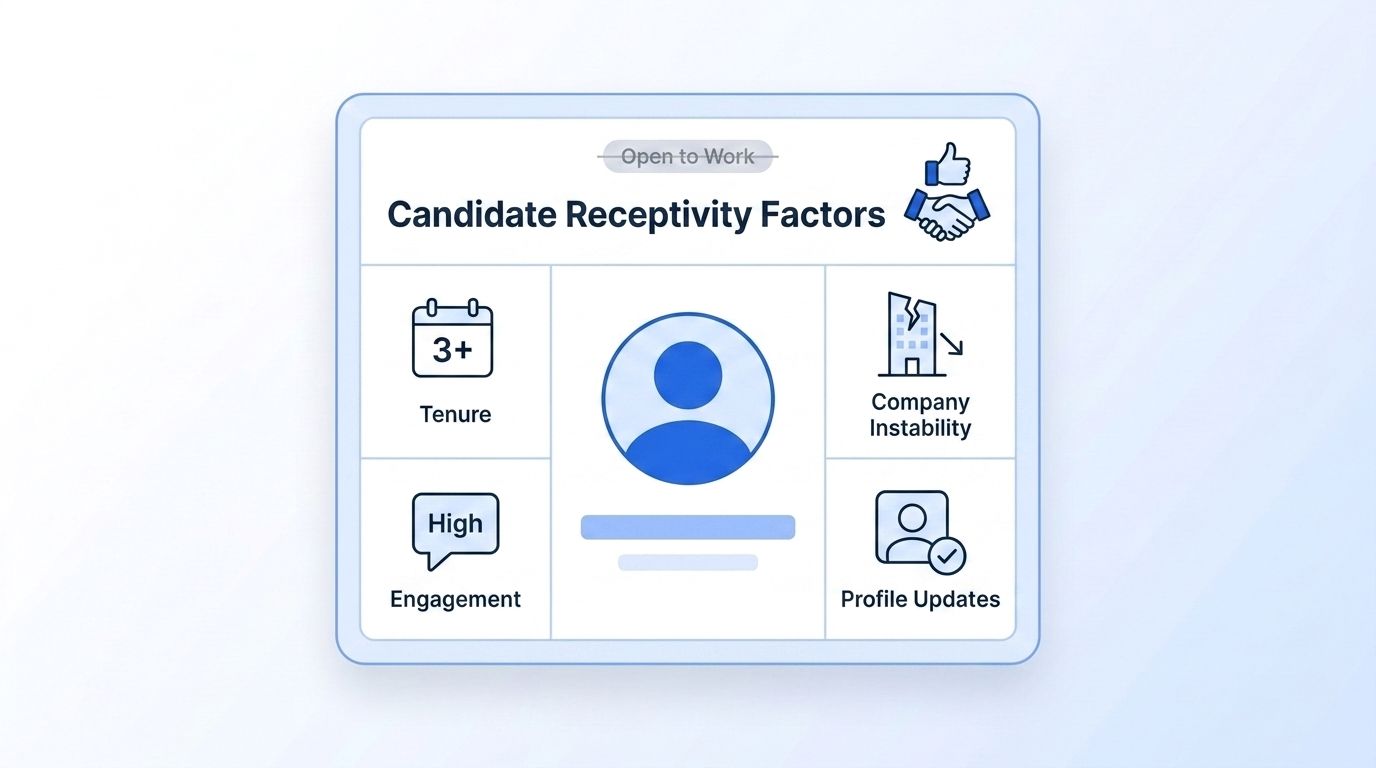
Why Does the 'Open to Work' Badge Miss Most of the Market?
The badge only flags people who've decided to search and turned on a visible signal - a small, self-selected slice of the workforce. In 2026, 75% of professionals are passive, and LinkedIn's own research splits that group into roughly 45% "approachable" (open to the right outreach), 15% early-stage networkers, and 15% genuinely uninterested in a pitch (LinkedIn Talent Solutions, retrieved 2026-07-21).
That means the badge isn't wrong, exactly - it's just answering a narrow question. It tells you who's already decided to move. It says nothing about who's about to decide, which is where the best hires actually get made: before a role goes public and the competition shows up.
The active pool is also shrinking. As of 2026, only 43% of U.S. workers plan to job search this year, a steep drop from 93% who said the same for 2025 (Monster's 2026 WorkWatch Report, retrieved 2026-07-21). Fewer people are raising their hand. If your sourcing strategy depends on the hand going up, you're competing for a smaller target every year.
Recruiters who track behavioral signals instead of status badges get a head start - they're reaching out while a candidate is still forming the decision, not after a hundred other recruiters already saw the same green ring. For more on catching movement before it's public, see our guide to real-time job change intent signal APIs.
What Tenure Patterns Predict Passive Candidate Receptiveness?
A candidate's career trajectory tells you more than their headline does. Employees who get promoted have a 70% chance of still being at the same company three years later, compared with only 45% for employees who stayed in the same role the whole time (LinkedIn Talent Solutions, 3 Factors Strongly Linked to Better Employee Retention, retrieved 2026-07-21). Stalled career progression is one of the clearest receptiveness signals available.
Watch for these tenure patterns when you're building a target list:
- No title or scope change in 24+ months. This is the group most likely to feel stuck, even if they're not actively browsing job boards.
- Recently passed over for an internal promotion. Public LinkedIn activity rarely announces this directly, but a peer's promotion post with no matching update from your target is a soft tell.
- Tenure just crossed a "vesting cliff" milestone. People often become receptive right after a 1-year or 4-year equity vest, once the retention lever loses its grip.
- Lateral move within the last 6 months, no upward trajectory since. Lateral movers stay at a 65% rate versus 70% for the promoted - meaningfully less locked in than someone recently leveled up (LinkedIn Talent Solutions, retrieved 2026-07-21).
Cross-reference tenure data against a candidate's job history at scale using the People Profile endpoint, which returns structured role dates, titles, and company history you can filter on rather than reading one profile at a time.
How Do You Spot Employer Instability as a Sourcing Trigger?
Company-side signals are often stronger than candidate-side ones, because they create urgency the candidate hasn't fully processed yet. Employers announced 1,206,374 job cuts across 2025, up 58% from 761,358 in 2024 - the highest annual total since the 2020 pandemic (Challenger, Gray & Christmas, 2025 Year-End Challenger Report, retrieved 2026-07-21). Every one of those cuts creates a wave of survivors who are suddenly rethinking their loyalty, even if they weren't personally let go.
Track these employer-side indicators for every account on your target list:
- Layoff announcements, even partial ones affecting other teams. Survivors of a layoff round are measurably more receptive than employees at a stable company.
- Funding stalls or down rounds. A startup that hasn't announced new funding in 18+ months, or raised a down round, signals runway pressure that eventually reaches hiring and comp.
- Leadership churn, especially a VP or C-suite departure in the candidate's reporting chain. New leadership often triggers reorganizations that unsettle even top performers.
- Hiring freezes announced publicly or visible through a sudden drop in that company's own job postings.
Datamagnet's Funding Rounds endpoint surfaces a target company's Crunchbase funding history by domain, so you can flag stalled or down rounds programmatically instead of manually checking press releases. Pair that with a Company Engagement Signal to catch the moment employees at an unstable account start engaging with outside content.
<!-- [PERSONAL EXPERIENCE] -->We've watched sourcing teams double their reply rate almost overnight by simply re-prioritizing outreach toward accounts with a layoff announcement in the prior 30 days. Nothing about the pitch changed - just the timing.
Which LinkedIn Engagement Shifts Signal a Candidate Is Warming Up?
Behavior changes before status does. A candidate who starts liking recruiter posts, commenting on competitor content, or engaging with industry pain-point discussions is quietly signaling openness weeks before they'd ever type "Open to Work" into their profile settings.
Watch for these engagement shifts:
- New engagement with recruiter or staffing content they never interacted with before, especially posts about specific companies or roles.
- Increased commenting on competitor company pages or posts - a strong tell that someone is scoping alternatives.
- A sudden change in posting cadence - either going quiet (disengaging from the current employer's culture) or posting more (building a personal brand ahead of a move).
- Following new company pages outside their current employer's industry cluster, particularly ones that match your ICP.
This is genuinely an under-researched corner of recruiting data - no tier 1-3 study we found puts a hard number on how predictive engagement-frequency shifts are for an eventual job move. That gap is itself useful information: most recruiters are still guessing here, so a team that tracks it systematically has real room to get ahead of competitors relying on gut feel.
Datamagnet's Person Engagement Signal monitors a specific person's LinkedIn posts and mentions and flags when they like, comment on, or share qualifying content, so you don't have to manually check a target's activity feed every week. Combine it with a Keyword Engagement Signal to catch anyone in your ICP engaging with role-relevant keywords across LinkedIn, not just people already on your list.
How Should You Read Profile and Skill Changes?
A profile edit is a weaker signal than engagement, but it's still worth tracking - especially in combination with other signals rather than alone. Skills added, a headline tweak, or a new certification listed often precede an active search by weeks, even if the person hasn't touched the "Open to Work" toggle.
What to look for, in rough order of predictive strength:
- New skills added that don't match the current role. This usually means someone is either upskilling for an internal move or quietly positioning for something external.
- Headline changes that soften employer identification - swapping "Senior Engineer at [Company]" for a more generic "Senior Engineer | [Discipline]" framing.
- New certifications or courses listed, particularly ones tied to adjacent roles or industries.
- Summary/About section rewrites, which candidates rarely touch unless they're preparing to be found.
None of these alone should trigger outreach. Stack two or more - say, a skill update plus a layoff at their employer - and you've got a candidate meaningfully more likely to respond. AI-assisted skills-based candidate search is already paying off at scale: organizations running the most skills-based searches are 12% more likely to make a quality hire (LinkedIn Talent Solutions, Future of Recruiting 2025, retrieved 2026-07-21). You can search LinkedIn profiles by skill and title directly through Datamagnet's People Search endpoint to build these stacked-signal lists at scale.
How Do You Turn These Signals Into an Outreach Cadence?
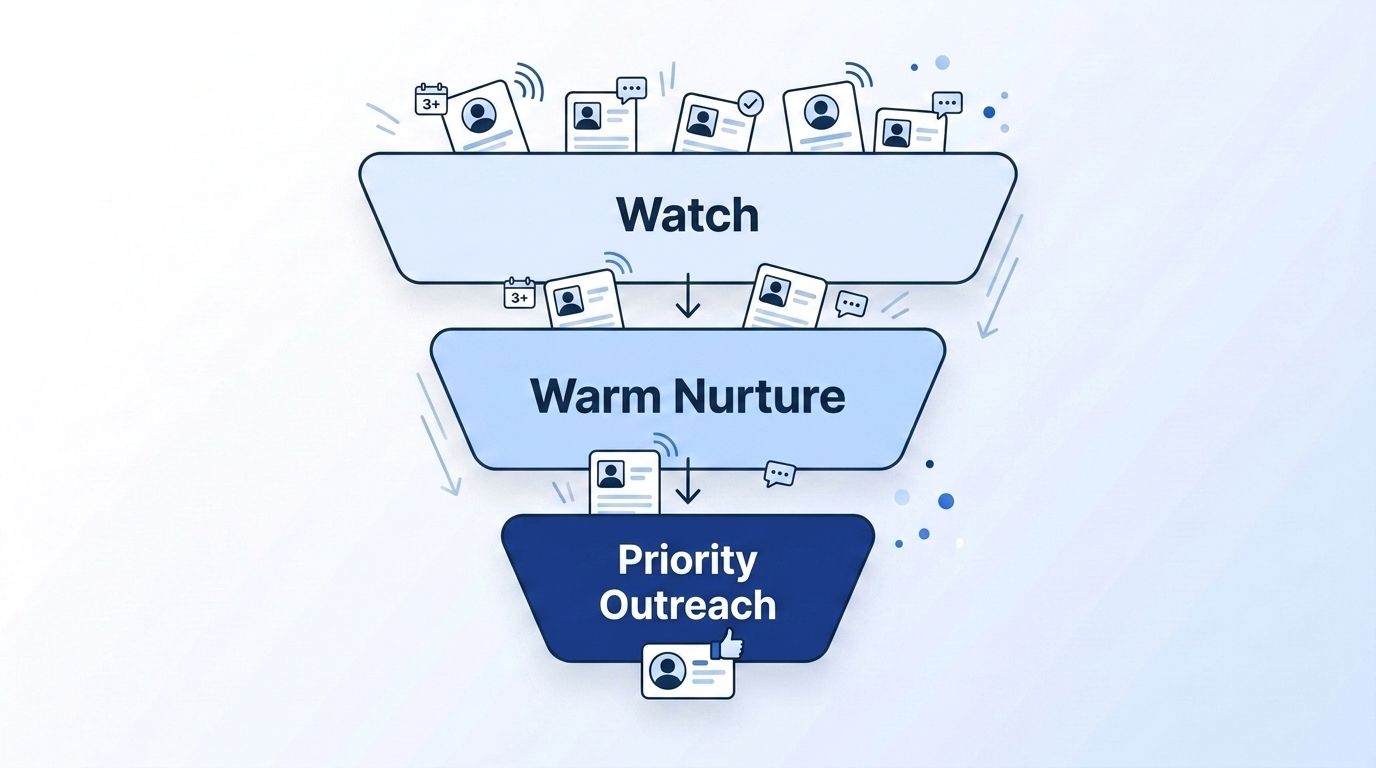
Signals are only useful if they route into action. Build a tiered cadence: candidates with one soft signal (a profile tweak, a stalled tenure) go into a slower nurture track, while candidates stacking two or more strong signals (layoff at their employer plus recent engagement activity) get personalized outreach within days, not weeks.
A simple three-tier structure works well for most teams:
- Tier 1 - Watch only. One weak signal (skill update, no title change). Add to a list, no outreach yet.
- Tier 2 - Warm nurture. Two signals, or one strong signal (layoff, leadership departure). Send a low-pressure, personalized message referencing something specific about their situation.
- Tier 3 - Priority outreach. Three or more signals stacked, or one very strong trigger (public layoff announcement plus active engagement with your content). Reach out same week, ideally same day.
Generic outreach doesn't hold up well against this kind of targeting. 37% of talent acquisition professionals are already experimenting with or actively integrating generative AI into hiring workflows, and the ones who use it save an average of 20% of their workweek (LinkedIn Talent Solutions, Future of Recruiting 2025, retrieved 2026-07-21) - time that's better spent writing sharper, signal-informed messages than sending the hundredth templated InMail this month.
To automate the routing itself, register a signal via the Create Signal endpoint for each priority account or candidate, and deliver matches straight to your ATS or Slack through webhooks instead of checking a dashboard manually every morning.
Common Mistakes When Tracking Passive Candidate Signals
The biggest mistake teams make is treating any single signal as a green light. A skill update alone means almost nothing - most people who add a skill to LinkedIn are not job hunting. Reaching out on that alone reads as noise and burns the relationship before you've earned a response.
1. Acting on one weak signal instead of stacking multiple. A profile edit or a single like on a recruiter's post isn't enough context to send a personalized pitch. Wait for a second, stronger signal - tenure stagnation, a layoff, or an engagement pattern - before reaching out.
2. Ignoring timing and reaching out too late. Layoff-driven receptiveness has a shelf life. Companies laying off staff saw federal-sector job applications run nearly 150% above year-ago levels within weeks of major cuts in 2025 (Indeed Hiring Lab, Indeed's 2026 US Jobs & Hiring Trends Report, retrieved 2026-07-21) - other recruiters move fast once instability hits the news, so a 30-day-old layoff signal is far less valuable than a 3-day-old one.
3. Treating all "passive" candidates the same. Only about 45% of the passive workforce is genuinely approachable; another 15% is uninterested in outreach regardless of how good the pitch is (LinkedIn Talent Solutions, retrieved 2026-07-21). Sending the same cadence to both groups wastes effort on people who were never going to respond.
4. Not verifying signal freshness before outreach. A "current employer" field pulled from a static database six months ago is a stale signal wearing a fresh coat of paint. Cross-check against a real-time source before you send anything referencing someone's current role.
What Does a Signal-Based Sourcing Practice Look Like Once It's Working?
Once tracking is in place, you should see fewer cold, generic sends and a measurably higher reply rate on the messages you do send, because each one references something true and current about the candidate's situation. National hiring activity has slowed 1.1% since January 2025 and sits over 20% below pre-pandemic levels (LinkedIn Economic Graph, LinkedIn Workforce Report - January 2026, retrieved 2026-07-21), which means every open req is drawing from a tighter, more competitive pool - signal-based sourcing is how you win a larger share of that pool before your competitors even start looking.
The next step, once the basics are working, is automating signal delivery entirely: routing job-change, engagement, and company-instability signals directly into your ATS or CRM via webhook so a recruiter never has to manually check a list again. Our champion tracking playbook walks through setting up that kind of automated alerting end to end.
Frequently Asked Questions
What counts as a passive candidate signal?
A passive candidate signal is any behavioral or company-side data point that indicates someone might be open to a new role without them explicitly saying so - tenure stagnation, employer instability like layoffs or leadership churn, LinkedIn engagement shifts, and profile or skill updates all qualify. None of these require the candidate to flip on "Open to Work."
Is it worth reaching out based on a single signal?
Generally no. A single weak signal, like one skill added or one profile edit, has too high a false-positive rate on its own. Stack at least two signals, or one strong trigger like a company layoff, before sending a personalized message - it dramatically improves reply rates and avoids wasting outreach on people who aren't actually receptive.
How do layoffs affect passive candidate receptiveness?
Layoffs sharply increase receptiveness among survivors, not just people directly cut. Employers announced over 1.2 million job cuts in 2025, up 58% year over year (Challenger, Gray & Christmas, retrieved 2026-07-21), and job applications from affected sectors spiked nearly 150% within weeks. Move fast once you spot the signal.
Can passive candidate signal tracking be automated?
Most of it can. Job change, company engagement, and person engagement signals can all be registered against target accounts and candidates, with matches delivered via webhook so a recruiter isn't manually re-checking profiles every week.
How is signal-based sourcing different from just using the 'Open to Work' filter?
The badge only surfaces the 25% of the workforce actively searching. Signal-based sourcing tracks tenure, employer instability, and engagement shifts across the other 75%, letting you reach candidates before they've decided to search publicly - and before every other recruiter sees the same green ring you do.
Start Tracking Signals Instead of Waiting for the Badge
The badge tells you who already decided to move. Tenure stagnation, employer instability, engagement shifts, and profile changes tell you who's about to. Stack at least two signals before you reach out, move fast once you spot a layoff or funding stall, and route the routine checking into an API instead of a manual weekly scan. See how real-time signal monitoring surfaces passive candidates first - it's a faster way to build a target list than refreshing a saved search.
Sources
- LinkedIn Talent Solutions, Active vs. Passive Candidates: The Latest Global Breakdown Revealed, retrieved 2026-07-21, https://www.linkedin.com/business/talent/blog/talent-strategy/active-vs-passive-candidates-latest-global-breakdown-revealed
- LinkedIn Talent Solutions, 3 Factors Strongly Linked to Better Employee Retention According to 32 Million LinkedIn Profiles, retrieved 2026-07-21, https://www.linkedin.com/business/talent/blog/talent-strategy/factors-linked-to-better-employee-retention
- LinkedIn Talent Solutions, Future of Recruiting 2025, retrieved 2026-07-21, https://www.linkedin.com/business/talent/blog/talent-acquisition/future-of-recruiting-2025
- Challenger, Gray & Christmas, 2025 Year-End Challenger Report, retrieved 2026-07-21, https://www.challengergray.com/blog/2025-year-end-challenger-report-highest-q4-layoffs-since-2008-lowest-ytd-hiring-since-2010/
- Indeed Hiring Lab, Indeed's 2026 US Jobs & Hiring Trends Report, retrieved 2026-07-21, https://www.hiringlab.org/2025/11/20/indeed-2026-us-jobs-hiring-trends-report/
- Monster, Monster's 2026 WorkWatch Report, retrieved 2026-07-21, https://www.monster.com/career-advice/job-search/news-and-insights/2026-workwatch-report
- LinkedIn Economic Graph, LinkedIn Workforce Report - United States, January 2026, retrieved 2026-07-21, https://economicgraph.linkedin.com/resources/linkedin-workforce-report-january-2026
- Datamagnet, People Profile endpoint, retrieved 2026-07-21, https://docs.datamagnet.co/api-reference/endpoints/people
- Datamagnet, Funding Rounds endpoint, retrieved 2026-07-21, https://docs.datamagnet.co/api-reference/endpoints/funding-rounds
- Datamagnet, Signal endpoints (Create, Person Engagement, Company Engagement, Keyword Engagement), retrieved 2026-07-21, https://docs.datamagnet.co/api-reference/endpoints/signal-create
