
Disclosure: This article is published by Datamagnet. Vendor claims are self-reported unless otherwise noted.
Layoff and Hiring Signals: What They Actually Tell You About Budget
In 2026, employers announced 443,604 job cuts through the first half of the year — down 40% from 744,308 over the same period in 2025 (Challenger, Gray & Christmas, June 2026 Job Cut Announcement Report, retrieved 2026-07-24). Hiring plans moved the opposite direction, up 10% year over year. If you're still reading layoffs as a flat "don't call them" signal and hiring as a flat "call them now" signal, you're leaving pipeline on the table.
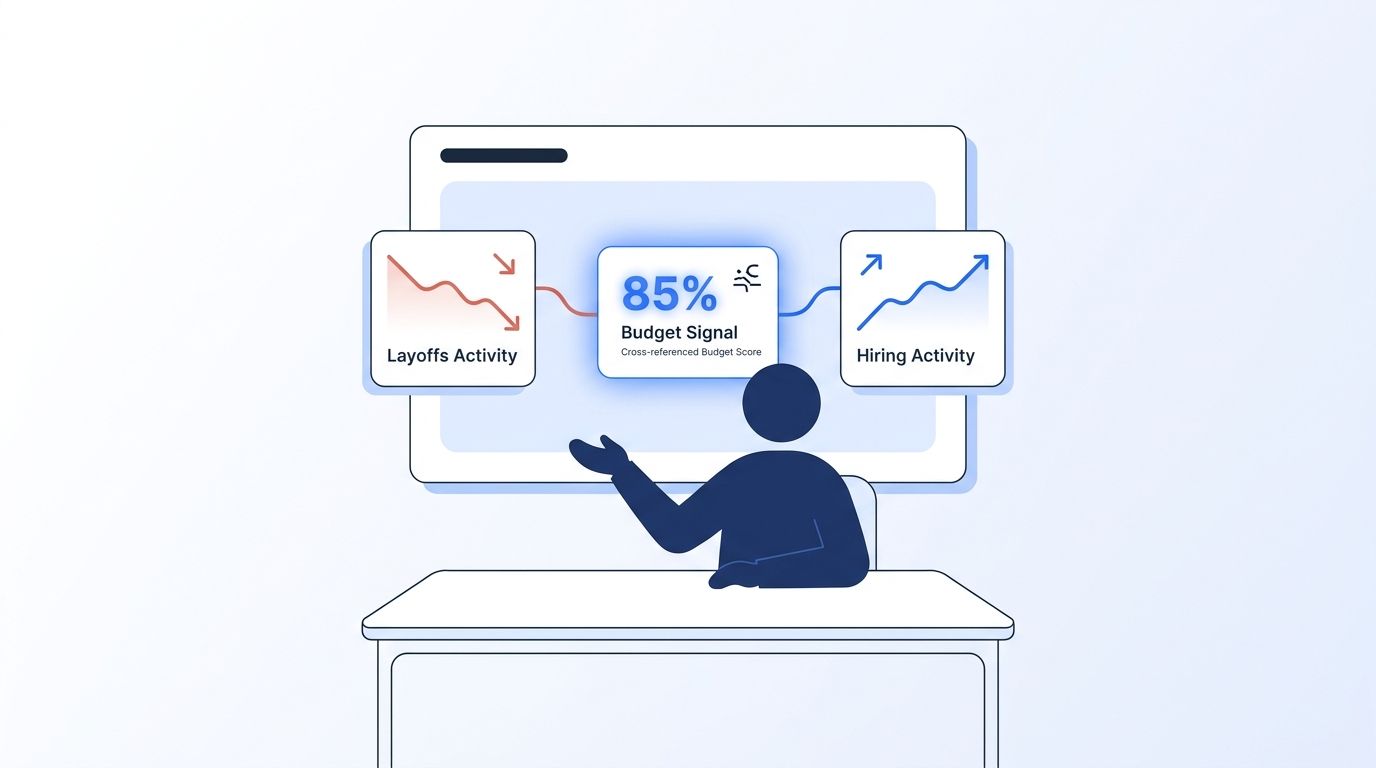
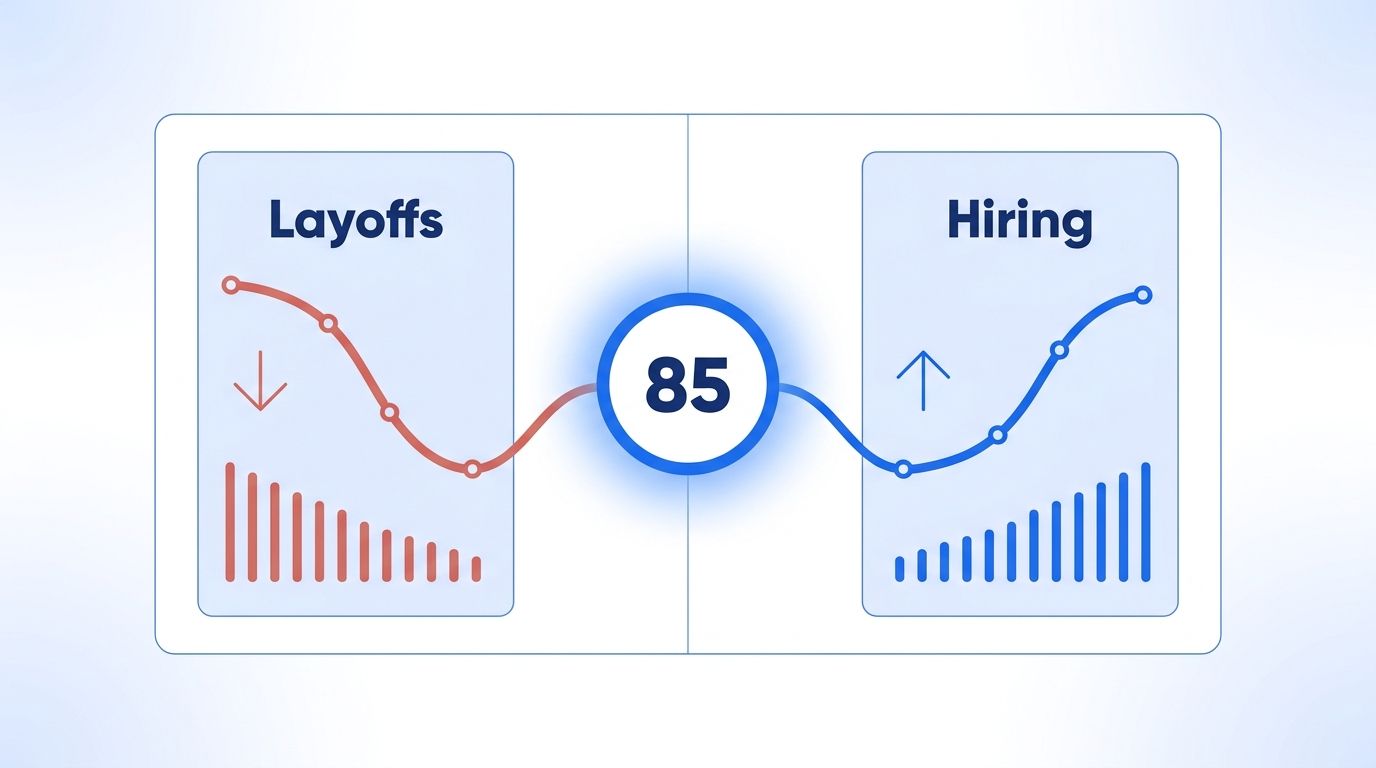
Most reps treat headcount news as a binary. A layoff means freeze the deal. A hiring surge means chase the deal. Neither read is reliable on its own — a department can lay off ten people and hire three specialists in the same quarter, and that combination tells you more about live budget than either event alone. This guide walks through how to separate real budget signal from headcount noise, using the layoff and hiring signal data actually available to you right now.
Key Takeaways
- H1 2026 job cuts fell 40% year over year to 443,604, while hiring plans rose 10% to 91,405 (Challenger, Gray & Christmas, 2026) — both signals move at once, so read them together.
- Raw job postings are a weak budget signal: a 20%+ posting increase lifted software purchases only 7%, versus 38% for actual headcount growth and 28% for a new VP hire (Bloomberry, 2025).
- Intent-prioritized accounts convert to opportunity at 21.3%, versus 8.4% for accounts worked without signal prioritization — 2.5x the conversion rate (The Starr Conspiracy, B2B Intent Data Benchmarks 2025).
- Layoffs aren't automatically a red flag — a targeted reduction paired with department-level hiring often signals budget reallocation, not budget loss.
What Do You Need Before You Start Reading Layoff and Hiring Signals?
You don't need a data science team to do this well, but you do need a few things in place before layoff and hiring signals turn into usable account intelligence. The list below covers the data sources, the tracking method, and the scoring habit that turn raw headcount news into an account-level budget read you can act on with confidence.
- A source for company-level layoff data — WARN Act filings, Challenger, Gray & Christmas reports, or a real-time company data API that surfaces headcount changes.
- A source for hiring data that goes beyond job postings — actual headcount growth and new-hire titles, not just open requisitions.
- A way to track individual job changes — when a champion or target buyer leaves one company and lands at another, via a tool like DataMagnet's Signal API.
- A simple scoring framework — so reps aren't manually eyeballing headcount news account by account.
- Time: ~30 minutes to set up your first scoring pass, then a few minutes per week to review.
- Difficulty: Beginner to intermediate.
Step 1: How Do You Track Layoff Signals at the Right Granularity?
By the end of this step, you'll know the difference between a company-wide layoff and a department-level cut — and why that distinction matters more than the layoff itself. Company-wide layoffs are the headline event, but they're a blunt instrument. Technology sector job cuts rose 83% year over year through June 2026, from 76,214 to 139,156 (Challenger, Gray & Christmas, 2026), and that volume alone tells you almost nothing about a specific account's near-term budget.
What matters is where the cuts landed. A 10% reduction across G&A while product and engineering headcount holds steady is a different account than a 10% reduction that hits every department evenly. The first often means the company is protecting revenue-generating budget; the second usually means a broader freeze.
- Pull layoff data at the account level, not just the industry level.
- Check whether the cuts are concentrated in one function or spread company-wide.
- Cross-reference against the account's most recent funding or earnings news for context on why the cuts happened.
Look at which teams were spared, not just which teams were cut — that's the strongest early read on where budget is still protected.
Step 2: Which Hiring Signals Actually Predict Spend?
You'll walk away from this step knowing which hiring signal to trust and which one to ignore, because they are not equally predictive. Companies with 200–1,000 employees that grew headcount 20%+ made 38% more software purchases than non-growing firms — an average of 3.01 purchases versus 2.18 (Bloomberry, "I Analyzed 1M Software Purchases to Find the Strongest Buyer Intent Signals," 2025). That's actual headcount growth, confirmed hires — not open job listings.
Job postings, by contrast, are a weak budget signal on their own. A 20%+ increase in job postings only lifted software purchases by 7% in the same study, because a posting doesn't mean a hire, and a hire hasn't onboarded yet. The researcher's own conclusion: hiring plans are "too early an indicator," since actual onboarding — not the posting — is what drives new tool purchases.
There's one hiring event that punches above its weight: a new VP-level hire. Companies that hired a VP made 28% more software purchases than companies that didn't (3.12 versus 2.44 average purchases). New department leaders re-evaluate their stack within the first few months on the job, which is exactly the window sales teams should be watching for.
Step 3: How Do You Separate Confirmed Hires From Open Requisitions?
By the end of this step, you'll have a filter that stops job-posting noise from diluting your account priority list. Most sales tools that claim to track "hiring signals" are really tracking job postings, because postings are cheap to scrape and hires are not. That distinction is exactly why the raw posting lift (7%) trails the confirmed headcount growth lift (38%) in the data above — postings measure intent to hire, not budget already committed.
- Confirm the hire actually happened — via a headcount field, an updated org chart, or a person's LinkedIn profile reflecting the new role.
- Note the hire's seniority and function, since a VP hire and an individual-contributor hire are not the same signal strength.
- Flag whether the posting has been open for an unusually long time, which can actually indicate budget uncertainty rather than growth.
Confirmed headcount growth beats raw job-posting counts as a budget signal — weight your account scoring accordingly, and treat a spike in postings alone as a "watch" signal, not a "call now" signal.
Step 4: Cross-Reference Layoffs and Hiring at the Same Account
You'll come out of this step able to spot the pattern that most reps miss entirely: layoffs and hiring happening at the same account, in the same quarter. This is not a contradiction in the data — it's the most useful signal in this entire guide, and it's why company-level hiring and headcount data (now available as a single lookup via the Company Profile API's hiring trends fields) matters more than either number in isolation.
A company that cuts 15% of its support team while growing engineering headcount isn't in trouble — it's reallocating. A company that cuts across every department while also freezing open requisitions is in a genuine slowdown. The net signal, not the gross layoff or gross hire number, is what predicts whether there's real budget behind an opportunity.
Reps who only track layoffs as a disqualifier miss a specific pattern worth flagging as high-priority: a company laying off legacy or manual-process roles while hiring for automation, data, or AI-adjacent functions in the same window. That pairing often means a tooling decision is already underway, not just headcount churn — it's a budget-reallocation signal, not a budget-freeze signal.
- Pull both layoff and hiring activity for the account over the trailing 90 days.
- Compare which functions lost headcount against which functions gained it.
- Treat same-function net growth as a strong signal, and cross-function reallocation as a moderate one worth a discovery call to confirm.
Step 5: How Do You Score Accounts by Combined Signal Strength?
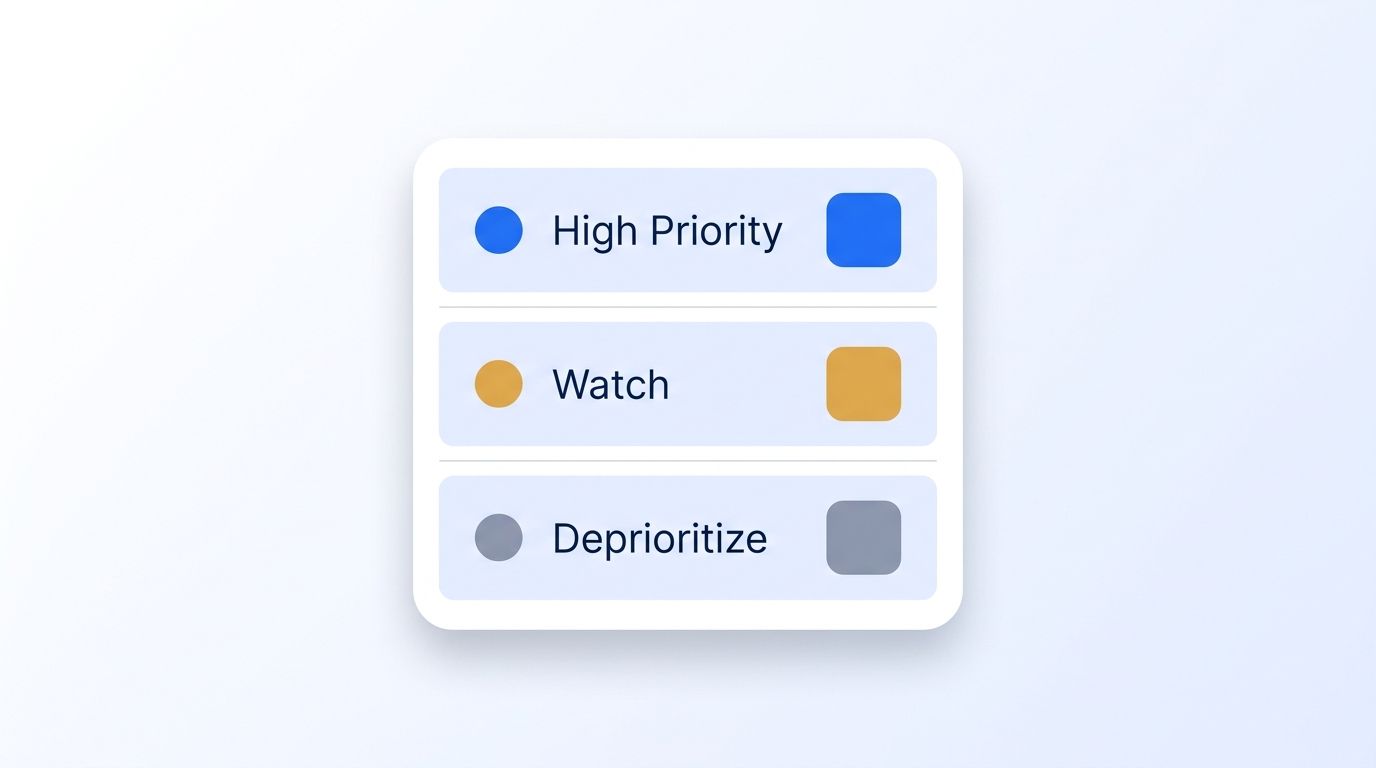
By the end of this step, you'll have a simple three-tier framework instead of a spreadsheet full of conflicting headcount alerts. This step turns the layoff and hiring signals from Steps 1 through 4 into a single priority label a rep can act on in seconds, rather than re-reading raw headcount data account by account. Keep the scoring dead simple so reps actually use it:
- High priority: Confirmed headcount growth 20%+, a new VP hire in the last 90 days, or department-level hiring paired with unrelated-department layoffs.
- Watch: Job-posting increases without confirmed hires, or hiring in a function with no clear budget owner yet.
- Deprioritize: Company-wide layoffs across every function with no offsetting hiring activity, and no recent funding event.
This is also where a scoring tool like ICP Company Search earns its keep — filtering live accounts by headcount and industry against your ICP criteria means you're scoring real, current data instead of a quarterly export that's already stale by the time it reaches a rep's queue.
Step 6: Time Your Outreach to the Signal, Not the Calendar
You'll finish this step with a clear rule for when to reach out relative to a signal, instead of batching outreach on a fixed weekly cadence. There isn't a single, verified industry number for exactly how many days a layoff or hiring signal stays "warm" — treat any specific day-count you see quoted elsewhere with skepticism, since most of those figures trace back to uncited vendor claims rather than a named study. What is verified: the average B2B buying cycle compressed from roughly 11 months in 2024 to roughly 10 months in 2025, and 94% of buying groups had already identified a preferred vendor before the first sales conversation even happened (6sense, 2025 Buyer Experience Report).
That compression is the real argument for acting on a signal the week it appears, not the month after. A preferred vendor that already has 77-80% odds of winning the deal usually earned that position by showing up before the buying committee finished forming its shortlist — which starts right around the time a new VP is hired or a team starts growing.
Act within the same week a confirmed signal appears, before the buying committee has already picked a frontrunner.
What Are the Most Common Layoff and Hiring Signal Mistakes?
Most of the mistakes teams make with layoff and hiring signals come down to treating cheap, noisy data as if it were confirmed budget. Each mistake below shows up repeatedly in pipeline reviews, and each one has a simple fix that takes less effort than the mistake itself costs in wasted outreach. Here's what to watch for.
1. Counting job postings as hires. A posting is an intention, not a commitment — and the data backs that up directly: postings alone produced only a 7% purchase lift versus 38% for confirmed headcount growth (Bloomberry, 2025). Fix: score confirmed hires higher than open requisitions, always.
2. Treating layoffs as an automatic disqualifier. A targeted, department-specific reduction can free up budget elsewhere in the org just as easily as it signals a freeze. Fix: always check what's growing alongside what's shrinking before you deprioritize the account.
3. Working from quarterly or self-reported headcount snapshots. [PERSONAL EXPERIENCE] Reps working from a stale spreadsheet export routinely reach out to accounts that already went through a full budget cycle by the time the data hit their queue — the hire (or the freeze) had already happened weeks earlier and the moment to be first had passed. Fix: pull headcount and hiring-trend data from a live source, not a periodic export.
4. Not connecting the hiring signal to a specific person. A headcount increase without a name attached to it is hard to act on. Fix: use ICP People Search to identify the specific new hire — especially at the VP level — so outreach can reference their actual mandate.
5. Ignoring your own champions who get laid off. A layoff doesn't just affect the company being cut — it also scatters your existing champions into new roles at new companies, some of whom are now decision-makers somewhere else. Fix: track job changes for your own champion list, not just target-account headcount.

What Does a Well-Built Signal Program Look Like?
If you've applied this framework correctly, your pipeline should start looking meaningfully different within a quarter — not just bigger, but weighted toward accounts with a confirmed reason to buy right now. Intent-prioritized accounts convert to opportunity at 21.3%, compared to 8.4% for accounts worked without any signal prioritization (The Starr Conspiracy, B2B Intent Data Benchmarks 2025) — a 2.5x difference that shows up directly in pipeline efficiency, not just activity volume.
That kind of prioritization is also becoming table stakes rather than a differentiator. 71% of B2B marketers actively used third-party intent data in ABM programs in 2024, up from 55% in 2022 (The Starr Conspiracy, B2B Intent Data Benchmarks 2025) — a 16-point jump in two years. Teams still scoring accounts by gut feel on headcount news are increasingly competing against reps who are working from confirmed, current signals.
For a next-level version of this framework, extend it with account-level engagement signals — see our guide on real-time intent signal APIs for job changes for how to layer engagement data on top of the layoff and hiring read you just built.
Frequently Asked Questions
The questions below cover what reps ask most often once they start scoring accounts on layoff and hiring signals together, from telling the two signal types apart to knowing how fast to act once one appears.
What's the difference between a layoff signal and a hiring signal for budget qualification?
A layoff signal shows where a company pulled budget back; a hiring signal shows where it's actively spending on headcount. Neither predicts software or vendor spend reliably alone — confirmed headcount growth of 20%+ produced a 38% software-purchase lift, while raw layoffs require checking what's growing elsewhere before you draw a conclusion (Bloomberry, 2025).
Do job postings count as a hiring signal?
Only weakly. A 20%+ increase in job postings lifted software purchases by just 7%, compared to 38% for confirmed headcount growth, because a posting doesn't guarantee a hire actually closes (Bloomberry, 2025). Treat postings as a "watch" signal, not a qualification trigger.
How fast should I act after spotting a layoff or hiring signal?
There's no verified industry-standard day count for signal decay, so be skeptical of specific figures quoted elsewhere. What is verified is that buying cycles are compressing — down to roughly 10 months on average in 2025 — and 94% of buying committees pick a preferred vendor before the first sales call (6sense, 2025 Buyer Experience Report). Reach out the same week a signal is confirmed.
Can layoffs actually be a buying signal, not just a red flag?
Yes, when they're targeted rather than company-wide. A department-specific reduction paired with hiring in another function — especially automation, data, or AI-adjacent roles — often signals budget reallocation toward a specific initiative rather than a company-wide freeze.
How do I get layoff and hiring signals in real time instead of quarterly reports?
Company data APIs that expose live headcount and hiring-trend fields, like the Company Profile API, remove the lag of quarterly exports. Pairing that with a job-change signal monitor also catches when your own champions land at new companies after a layoff.
Putting It Together
Layoff and hiring signals aren't opposites — they're two readings of the same underlying budget story, and the accounts worth prioritizing are usually the ones where both are moving. Track confirmed headcount changes over job postings, cross-reference layoffs against hiring at the same account, and act inside the same week a signal is confirmed, before a buying committee locks in a frontrunner.
Start by auditing how your current account scoring handles headcount news: does it treat every layoff the same, or does it check what's growing next to what's shrinking? For a deeper look at combining this with engagement-based signals, see our guide on real-time intent signal APIs for job changes, or explore DataMagnet's Signal API to start monitoring hiring and job-change activity on your target accounts directly.
