
Disclosure: This article is published by Datamagnet. Vendor claims are self-reported unless otherwise noted.
Job Change Signals: The Most Underused Trigger in B2B Sales
Your champion just took a new job, and you probably don't know yet. In 2021, LinkedIn found that 85% of B2B sellers had lost or delayed at least one deal in the past year because a key stakeholder changed roles (LinkedIn, The State of Sales Report 2021, 2021). Most teams still track this by accident.
That's the gap this guide closes. You'll learn what a job change signal actually is, why it outperforms generic intent data, and how to build a five-step playbook that turns "so-and-so changed jobs" into pipeline instead of a LinkedIn notification you scroll past.
Key Takeaways
- In 2021, 85% of B2B sellers reported losing or delaying a deal after a stakeholder changed jobs — and a third lost three or more (LinkedIn, 2021).
- Median U.S. employee tenure fell to 3.9 years in 2024, the lowest since 2002, so buying committees turn over constantly (BLS, 2024).
- In 2025, 91% of B2B marketers use intent data, but 87% say the signals are unreliable — job changes are a binary, verifiable exception (DemandScience, 2026).
- Accounts where customer success acted on a signal within 48 hours were 33% more likely to renew after a champion left (Sturdy, 2025).
- A five-step playbook — track, alert, route, respond, personalize — turns job changes into a repeatable trigger instead of a one-off save.
What Is a Job Change Signal, and Why Does It Matter So Much Right Now?
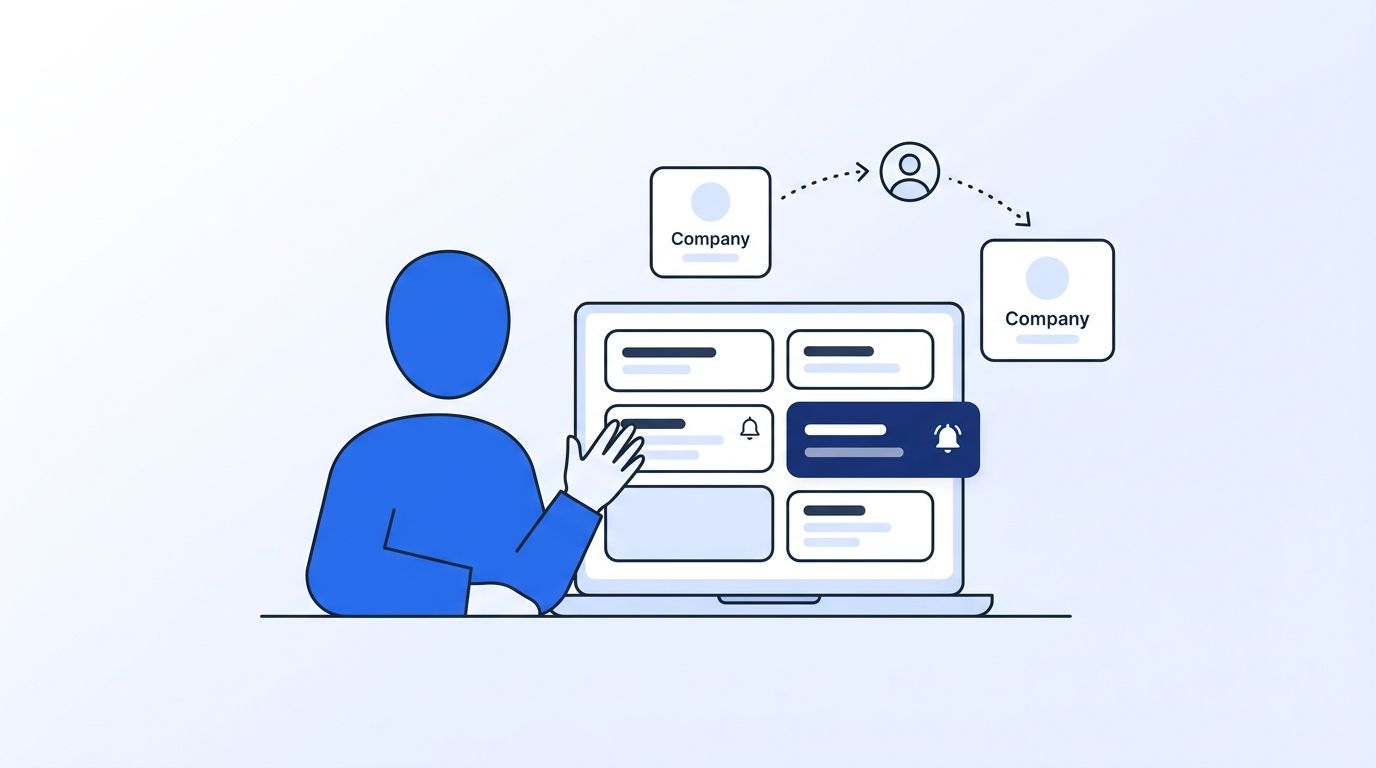
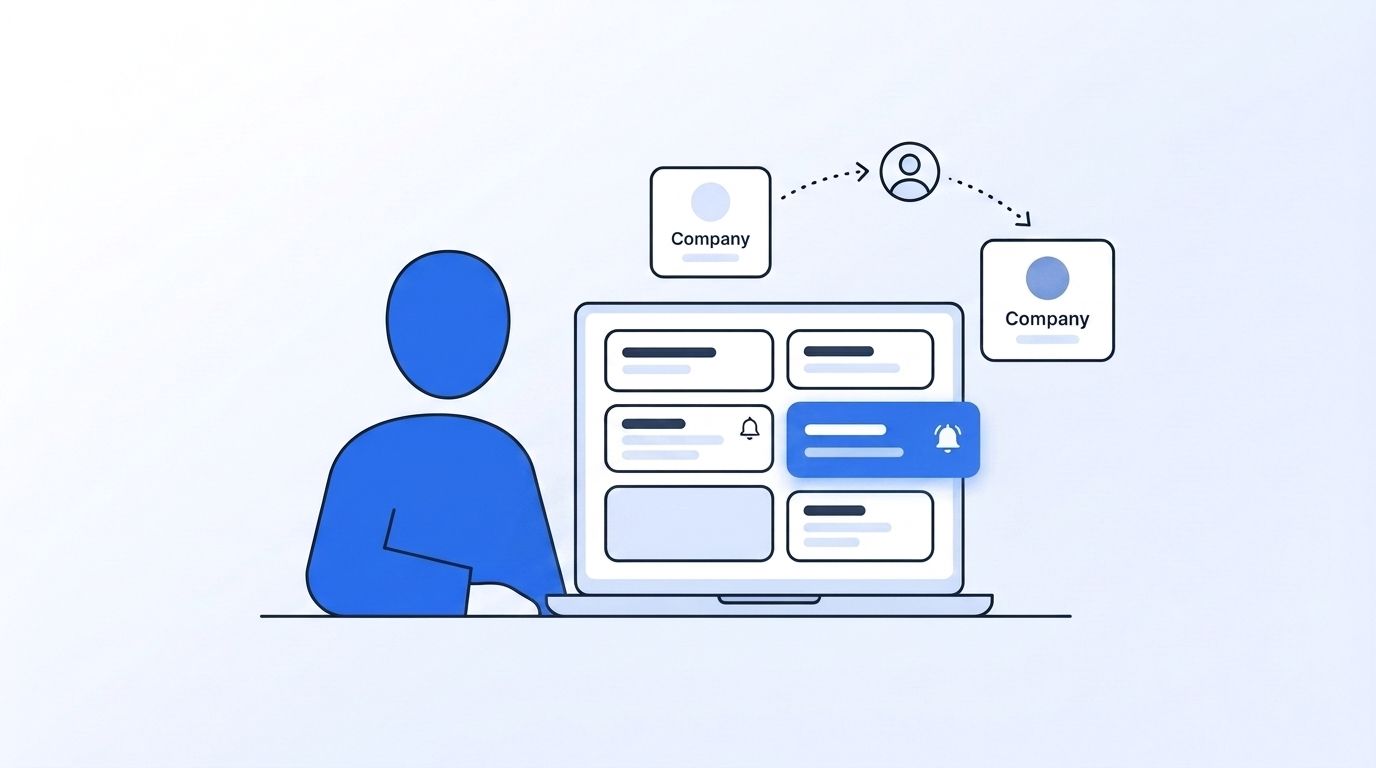
A job change signal is a real-time alert that fires when a specific person on your tracked list — a champion, a decision-maker, a past customer — moves to a new company or role. In 2024, median employee tenure in the U.S. dropped to 3.9 years, the lowest figure since the Bureau of Labor Statistics started tracking it this way in 2002 (BLS, Employee Tenure in 2024, 2024). Your buying committee is not static.
The tenure gap is steepest exactly where B2B buyers live. In 2024, workers aged 55 to 64 held a median tenure of 9.6 years, versus just 2.7 years for workers aged 25 to 34 — roughly 3.5 times longer (BLS, 2024). Since 25-to-44-year-olds fill most manager and director titles that actually evaluate vendors, this is the exact population changing seats the fastest.
Most sales orgs plan around annual buying-committee snapshots — a list of contacts pulled at the start of a deal and rarely refreshed. But with median tenure under four years and even shorter for the exact age band that holds budget authority, that snapshot is stale within a single sales cycle. A job change signal replaces the annual snapshot with a continuous one.
This is also why job change tracking pairs so naturally with a Person Engagement Signal — you're not just watching for a title change, you're watching whether that person is still active and reachable at their new company.
Why Are Job Change Signals the Most Underused Trigger in the Funnel?
Job change signals sit underused because most teams lump them into generic "intent data" and stop there. In 2026, 91% of B2B marketers reported using intent data, yet only 24% called the ROI exceptional, and 87% said their signals were unreliable or inflated (DemandScience, The 2026 State of Performance Marketing Report, 2026). Only 26% of flagged "intent" actually converted to a qualified opportunity.
That reliability gap is exactly where job change signals stand apart. A firmographic intent score is a probability. A job change is a fact — the person either moved companies or they didn't.
The buying committee has also grown, which multiplies the risk of a single departure going unnoticed. In 2025, Forrester's Buyers' Journey Survey found the average B2B purchase now involves 13 internal stakeholders and 9 external participants (Forrester, 2025). Tracking one contact per deal was never enough — now it's tracking a committee that reshuffles constantly.
Datamagnet's ICP People Search and People Search DB endpoints exist for exactly this: pulling the full committee, not just the one name on the contract, so you have a real list to monitor instead of a single point of failure.
How Do You Build a Job Change Signal Playbook? (5 Steps)
Rather than reacting to job changes ad hoc, treat them as a repeatable motion with five parts: who to track, how to track them, where alerts land, how fast you respond, and how you personalize the follow-up.
Step 1: Define who belongs on your tracked list
Start with closed-won champions, active-deal stakeholders, and any contact tied to a renewal. Don't limit the list to economic buyers — a mid-level champion who evangelized your product internally is often more valuable to re-engage than the VP who signed the contract, since they carry firsthand product knowledge into their next company.
Step 2: Set up automated tracking, not manual LinkedIn checks
Manually checking LinkedIn profiles doesn't scale past a handful of accounts. Datamagnet's Signal API lets you create a signal monitor that watches a list of LinkedIn profiles for job_change events, alongside new posts and engagement, so the system checks continuously instead of a rep remembering to look.
Step 3: Route alerts to where reps actually work
A signal that lands in a dashboard nobody opens doesn't change behavior. Deliver job change events via signed webhooks straight into Slack or your CRM, so the alert shows up in the same place reps already spend their day — not a separate tool they have to remember to check.
Step 4: Set a hard response-time window
Speed compounds. In a 2021 study of 55 million sales activities, InsideSales.com found that leads contacted within 5 minutes converted 8 times more often than those contacted between 5 minutes and 24 hours later — yet only 0.1% of leads were engaged that fast (InsideSales.com, Response Time Matters, 2021). Job change signals reward the same discipline: pick a window (48 hours is a reasonable default) and hold reps to it.
Step 5: Personalize using where they landed, not just that they moved
"Congrats on the new role" is not a strategy. Pull the person's new company, title, and any recent LinkedIn posts before reaching out, and reference something specific — a stated priority, a team they're building, a problem their new company is known for. The signal gets you the door; the context gets you the reply.
Teams that skip Step 4 tend to fall back into the pattern the signal was supposed to fix: the alert fires, sits in an inbox for two weeks, and by the time a rep reaches out, the new hire has already picked a vendor. The playbook only works end to end — a great signal with a slow response is just a more expensive way to miss the same window.
Ready to stop finding out about job changes secondhand? Start tracking job changes with the Signal API — six signal types including job change, ICP filtering, and delivery via email or signed webhooks, so alerts reach reps the moment they happen.
How Fast Should You Actually Respond Once a Signal Fires?
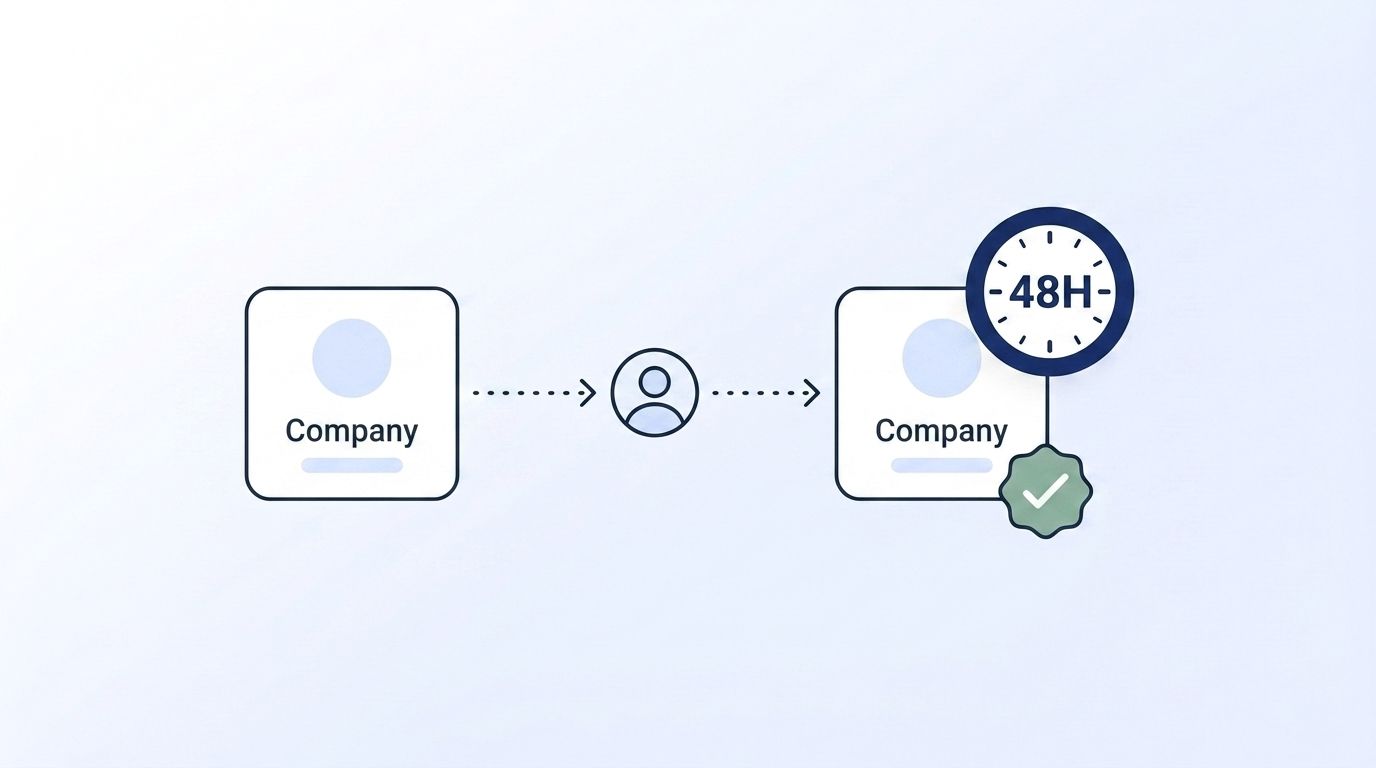
Respond inside 48 hours whenever the signal touches an active account, not just a prospecting list. In 2025, Sturdy's customer intelligence research, presented at the BIG RYG customer success conference, found accounts where customer success acted on a champion-departure signal within 48 hours were 33% more likely to renew (Sturdy, via ChurnZero, 2025). Wait longer and the numbers move against you fast.
The downside risk climbs the higher up the departure happens. That same research found a 51% chance of account churn within 12 months after any customer champion leaves, rising to 65% when the departure is at the executive level (Sturdy, 2025). A champion leaving isn't just a sales-side opportunity — it's a customer success risk that needs the same signal feeding both teams.
New-hire buying behavior points the same direction from the sales side. According to UserGems' analysis of buyer behavior, new executives spend roughly 70% of their budget within their first 100 days in a role, and director-through-C-suite titles are about 2.5 times more open to evaluating new vendors in their first three months than after a year on the job (UserGems, 2026). That figure is UserGems' own reported analysis rather than an independently audited study, so treat it as directional — the window is real, even if the exact percentage should be read with a grain of salt.
What Does a Job Change Signal Program Look Like in Practice?
The clearest public example comes from Outreach, which used UserGems' job-change tracking to re-engage past champions who had moved to new companies. Outreach reports the program generated over $1.2 million in new pipeline and an 8x return on investment in its first year (UserGems customer story). That's a single published case study rather than an industry benchmark, but it shows the mechanism working end to end: track departures, alert the right rep, follow up fast.
The pattern worth copying isn't the dollar figure — it's that the program treated a former champion the same way a recruiter treats a former employee: as a warm relationship to re-open, not a cold name to prospect. That's a fundamentally different starting point than most outbound sequences assume, and it's why the reply usually comes faster.
Datamagnet's Champion Tracker cookbook walks through the same idea using job_change signals: monitor your list of past champions and power users, get notified the moment one moves, and route the alert to sales or customer success depending on whether the account is still active. The champion tracking page covers how one signal monitor can watch your entire champion list at once, rather than checking profiles one by one.
Teams running this in HubSpot can skip the manual CSV exports entirely — the HubSpot integration updates contact and company records automatically when a job-change signal fires, so the alert and the CRM record stay in sync without a rep touching either one.
Frequently Asked Questions
What exactly counts as a job change signal?
A job change signal is an automated alert triggered when a tracked contact's LinkedIn profile shows a new employer or title. Unlike firmographic intent scores, it's a binary, verifiable event. In 2026, 91% of B2B marketers used intent data broadly, but 87% called those signals unreliable, which is why a confirmed job change is comparatively higher-trust (DemandScience, 2026).
How is a job change signal different from generic buyer intent data?
Generic intent data infers interest from content consumption or search behavior, which is probabilistic and often noisy. A job change signal reports a fact that already happened — the person moved companies. That's part of why only 26% of flagged intent activity converts to a qualified opportunity, while a departure or new hire event needs no interpretation (DemandScience, 2026).
How fast should sales and customer success respond to a job change signal?
Aim for 48 hours. In 2025, accounts where customer success acted on a champion-departure signal within that window were 33% more likely to renew, and speed advantages compound on the sales side too — leads contacted within 5 minutes convert 8 times more often than those reached hours later (Sturdy via ChurnZero, 2025; InsideSales.com, 2021).
Can job change signals reduce churn, not just win new deals?
Yes. When a customer champion leaves, the account faces a 51% churn risk within 12 months, rising to 65% for an executive-level departure (Sturdy via ChurnZero, 2025). Routing the same job-change alert to customer success — not just sales — lets a team re-establish a relationship with the new stakeholder before the account drifts.
Does job change tracking work for outbound prospecting too, or only existing accounts?
Both. On existing accounts it flags champion and stakeholder departures; on prospecting lists it flags when someone who fits your ICP lands in a new, relevant role. Pair a job_change signal monitor with ICP People Search filters so new-hire alerts only surface contacts who actually match your target buyer profile.
Sources
- BLS, Employee Tenure in 2024, retrieved 2026-07-21, https://www.bls.gov/opub/ted/2024/median-tenure-with-current-employer-was-3-9-years-in-january-2024.htm
- LinkedIn Economic Graph, Work Change Report, retrieved 2026-07-21, https://economicgraph.linkedin.com/research/work-change-report
- LinkedIn, The State of Sales Report 2021, retrieved 2026-07-21, https://www.linkedin.com/business/sales/blog/trends/the-linkedin-state-of-sales-report-2021
- UserGems, Use new hire buying signals to boost pipeline generation, retrieved 2026-07-21, https://www.usergems.com/blog/new-hire-buying-signal
- UserGems, How Outreach Generated 8x ROI in Their First Year, retrieved 2026-07-21, https://www.usergems.com/customers/outreach
- Sturdy customer intelligence research via ChurnZero, The Silent Cause of Customer Churn: Champion Change, retrieved 2026-07-21, https://churnzero.com/blog/churn-customer-champion-change/
- DemandScience, The 2026 State of Performance Marketing Report, retrieved 2026-07-21, https://demandscience.com/press-releases/state-of-performance-marketing-2026-benchmark-report/
- InsideSales.com, Response Time Matters, retrieved 2026-07-21, https://www.insidesales.com/response-time-matters/
- Forrester, Digital Natives Are Rewriting B2B Buying, retrieved 2026-07-21, https://www.forrester.com/blogs/digital-natives-are-rewriting-b2b-buying-and-its-impacting-your-revenue-performance/
