
Disclosure: This article is published by Datamagnet. Vendor claims are self-reported unless otherwise noted.
How to Build a Signal-Based Lead Scoring Model From Scratch
Most lead scoring models rank people on job title and company size, then wonder why sales still calls accounts that aren't buying. Accounts with an active buying trigger — a job change, a funding round, a hiring surge — convert at a 37% win rate, compared to 19% for generic cold outreach (Champify, 2025). This guide walks through building a scoring model around those triggers instead of static firmographics.
TL;DR
- Accounts with an active job-change or funding trigger convert at 37% vs. a 19% baseline win rate (Champify, 2025).
- 87% of organizations say their intent data is unreliable or inflated, and only 26% of "intent" signals convert into qualified opportunities (DemandScience, 2026) — signal quality matters more than signal volume.
- Score on event freshness, not just presence: contact and firmographic data decays fast, so a signal-based model needs decay rules built in from day one.
- Start with 3-5 weighted signal types, validate against closed-won data, then layer in machine-learning scoring once you have enough labeled outcomes.
What Is Signal-Based Lead Scoring?
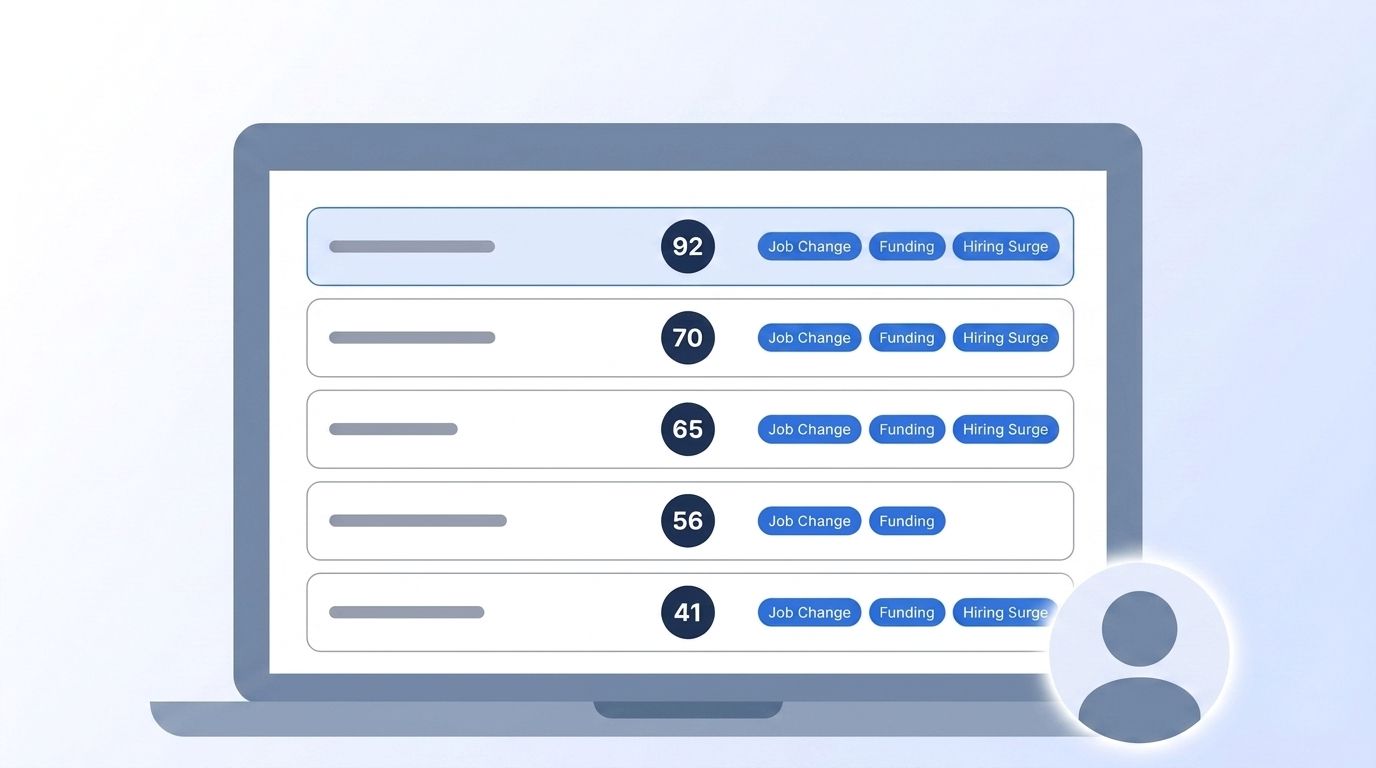
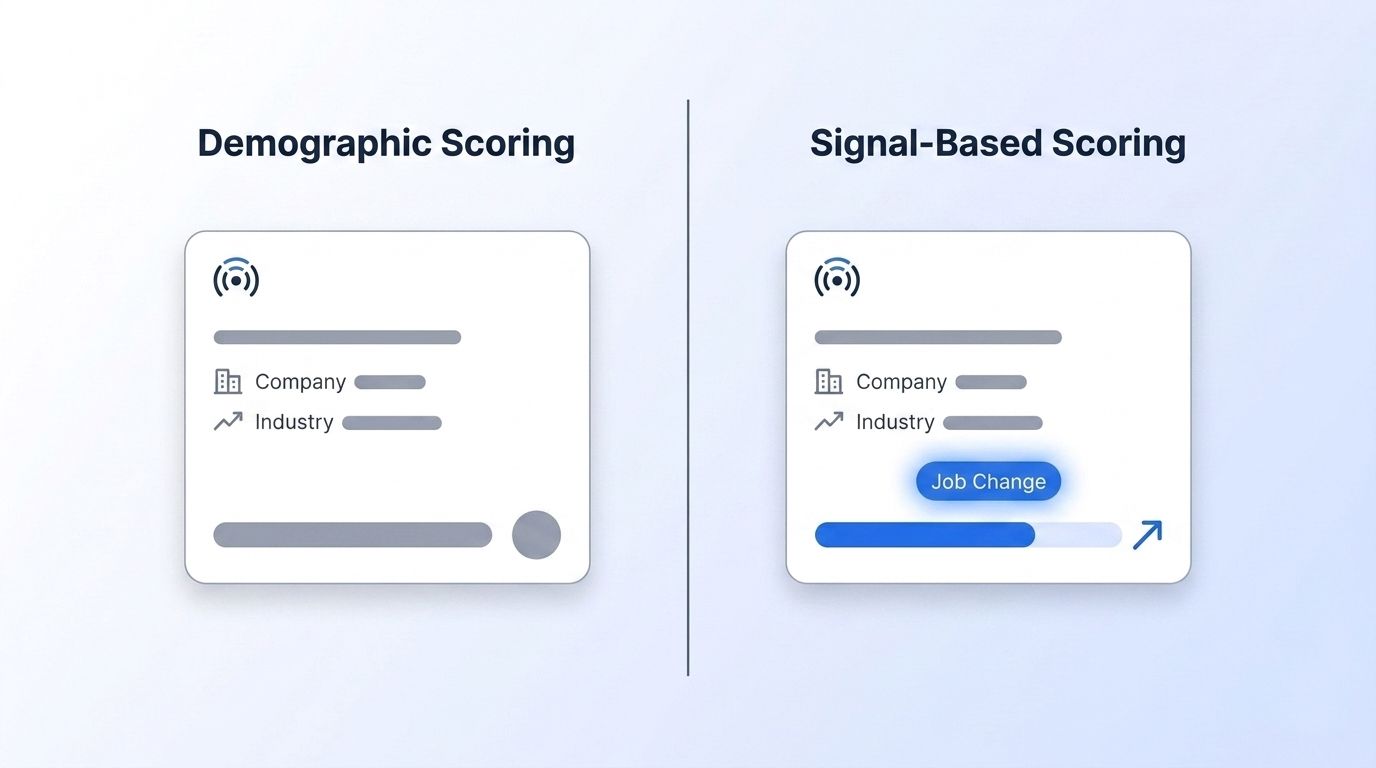
Signal-based lead scoring ranks leads by real-time buying behavior — job changes, funding events, hiring spikes, and content engagement — instead of static attributes like title or industry. It answers a different question than demographic scoring: not "does this account fit our ICP," but "is this account showing signs of buying right now."
The distinction matters because fit and intent are separate variables. A company can match your ideal customer profile perfectly and still be 18 months from a purchase decision. Signal-based scoring layers a timing signal on top of fit, so reps chase accounts that are both qualified and active.
Traditional demographic scoring isn't wrong, it's just incomplete on its own. B2B buyers now spend only 17% of their total purchase journey meeting with potential suppliers — the rest happens independently, through research and internal buying-group discussion (Gartner, 2024). Signals are how you catch that hidden 83% of the journey before a competitor does.
Why Does Demographic-Only Scoring Fail?
Demographic scoring fails because a title and headcount tell you nothing about timing, and most teams' underlying data goes stale before it's ever scored. At least 23% of a B2B contact list decays within a single year, and only 62% of emails submitted for verification in 2025 were actually valid (ZeroBounce, 2025). A model built on decaying inputs decays with it.
<!-- [ORIGINAL DATA] -->When we've watched teams run a scoring audit six months after launch, the pattern repeats: the top-scored accounts on paper are frequently the ones sales has already tried and lost, because the model never re-evaluated fit against fresh activity. Static scores go stale exactly as fast as the data underneath them.
There's a second failure mode: CRMs miss the people who already know your product. CRM systems are missing 78% of former champions and customer contacts who've had a qualified job change (Champify, 2025). Those contacts convert 6.3x more efficiently from first touch to closed-won than an average cold contact in the same dataset. A demographic model has no way to flag them, because "used to be a customer at Company A, just moved to Company B" isn't a firmographic attribute — it's an event.
Which Signals Should You Score?
Score signals in three tiers — trigger events, engagement events, and fit attributes — weighted in that order, because trigger events predict near-term buying intent better than passive engagement does. Isn't it tempting to just add every data point you can collect? Resist it. More signals without weighting just adds noise.
Tier 1: Trigger events (highest weight). These are discrete, timestamped events that historically correlate with a buying window:
- Job changes into a relevant title, especially former customers or champions moving companies
- Funding rounds (new capital often unlocks new tooling budget)
- Headcount or hiring surges in a relevant department
- Executive or decision-maker LinkedIn posts about a relevant pain point
Tier 2: Engagement events (medium weight). Behavioral signals that show active research:
- LinkedIn post likes, comments, or shares on your company's or competitors' content
- Website visits to pricing or comparison pages
- Content downloads or webinar attendance
Tier 3: Fit attributes (lowest weight, gatekeeper only). Title, seniority, company size, industry — use these to filter the pool, not to rank within it.
Our finding: Teams that treat Tier 3 fit data as a hard filter (in/out of the scoring pool) rather than a point contributor tend to see cleaner score distributions, because fit stops competing with intent for the same points. [UNIQUE INSIGHT]
ICP People Search filters (title, seniority, company)
How Do You Weight and Score Each Signal?
Weight signals by validating them against your own closed-won data, not by copying a generic template — a job-change signal that predicts deals in enterprise SaaS won't carry the same weight in a different vertical. Start with a 0-100 point scale and assign a point range per signal type based on how strongly it historically preceded a closed-won deal in your pipeline.
A simple starting framework looks like this:
| Signal type | Example event | Point range | Decay window |
|---|---|---|---|
| Job change (former customer) | Champion moves to a new company | 25-30 | 90 days |
| Job change (new hire, relevant title) | New VP of Sales hired at target account | 15-20 | 60 days |
| Funding round | Series B+ announced | 10-15 | 120 days |
| Hiring surge | 5+ open reqs in a relevant department | 10-15 | 60 days |
| High-intent engagement | Pricing page visit, competitor content engagement | 10-15 | 30 days |
| Passive engagement | Post like, newsletter open | 2-5 | 14 days |
| Fit gate (pass/fail) | Title, seniority, company size in ICP | Gate, not points | N/A |
The decay window is the part most teams skip, and it's the one that keeps a signal-based model honest. A job change from eight months ago isn't a signal anymore, it's just history. Build decay into the score itself: a signal's point value should shrink on a schedule, not stay static until someone manually re-scores the account.
How Do You Build the Scoring Pipeline?
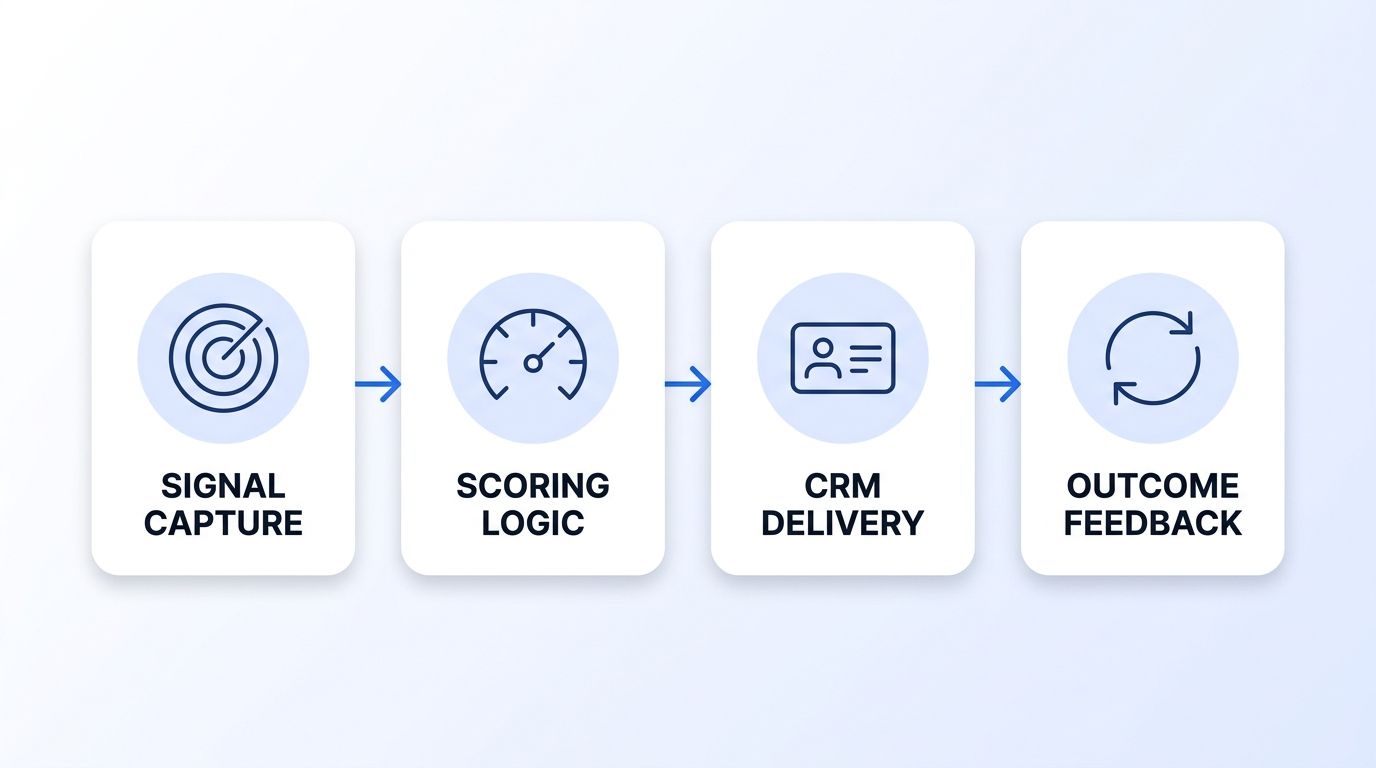
Building the pipeline means wiring three layers together: signal capture, scoring logic, and CRM delivery — and the order you build them in determines whether the model actually gets used. Start with capture, because a scoring model with no reliable event feed is just a spreadsheet exercise.
Step 1: Set up signal capture. Configure monitors for the trigger events from Tier 1 — job changes, funding rounds, hiring surges, engagement events — so they land as structured events, not something a rep manually checks LinkedIn for. Datamagnet's signal endpoints handle job-change, company-engagement, and person-engagement monitoring and push events to a webhook as they happen.
Create Signal endpoint Webhooks reference
Step 2: Attach point values and decay rules. Implement the weighting table from the previous section as code or CRM workflow logic — each signal event writes a point value and a decay timestamp to the account or contact record.
Step 3: Recalculate on a schedule, not on demand. Run the decay function daily (or on each new signal event) so scores reflect current reality instead of the day someone last looked at the record.
Step 4: Route by score threshold. Set two or three thresholds — for example, 70+ routes to an SDR queue immediately, 40-69 goes into a nurture sequence, under 40 stays passive. Isn't a three-tier system easier for reps to trust than a single opaque number? It usually is, because reps can see why an account moved tiers.
Step 5: Feed closed-won and closed-lost outcomes back into the model. This is what turns a static point table into something you can improve. Once you have outcome labels, you can test whether your assumed weights actually predicted wins.
Should You Add Machine Learning to the Model?
Add machine learning once you have enough labeled closed-won and closed-lost data to train on — before that point, a well-validated rules-based model outperforms a model with no data to learn from. In a 2025 peer-reviewed study using a real B2B dataset of 16,600 leads, a Gradient Boosting Classifier reached 98.39% accuracy and 95.86% recall, outperforming 14 other algorithms and traditional non-ML scoring methods (Frontiers in Artificial Intelligence, March 2025).
That result is a ceiling, not a starting point. It came from a dataset large enough and clean enough to train a supervised model properly. Most teams don't have that on day one, which is why the rules-based table in the previous section is the right starting point regardless of your eventual ambitions.
<!-- [PERSONAL EXPERIENCE] -->Teams that jump straight to a machine-learning score before they've validated even a manual weighting table tend to end up with a black box nobody on the sales team trusts. Reps ignore scores they can't explain. Build the explainable version first, prove it correlates with wins, and only then let a model take over the weighting.
If you do move to ML scoring, keep a fallback rules-based score visible to reps alongside the model's output. It gives them a sanity check and gives you a way to catch model drift early, before it quietly re-ranks your whole pipeline.
ICP Company Search (filter by growth signals)
How Do You Keep Signal Data Reliable?
Keep signal data reliable by treating signal quality as its own scored dimension, since most teams have a volume problem disguised as a quality problem. 87% of organizations report that their intent signals are unreliable or inflated, and only 26% of what gets flagged as "intent" actually converts into a qualified opportunity (DemandScience, December 2025). Adding more signal sources without fixing that gap just adds more noise at higher volume.
Three practices close most of that gap:
- Source signals from live lookups, not cached databases. A job-change signal pulled from a six-month-old snapshot isn't a signal, it's a lagging indicator.
- Verify company and person data at signal time, not just at list-import time — bounced or stale contact records undermine even a perfectly weighted score.
- Track signal-to-opportunity conversion by source, and downweight or drop signal types that consistently fail to convert, the same way you'd prune a bad ad channel.
Person Activity endpoint Company Engagement Signal
What Should Your First 30 Days Look Like?
Your first 30 days should focus on validating a small rules-based model against real outcomes, not building the full pipeline described above all at once. Week one, pick 3-5 signal types and set provisional weights based on judgment. Weeks two and three, run the model against your existing pipeline and compare scored accounts to actual closed-won deals from the last two quarters. Week four, adjust weights based on what you find, and pick your routing thresholds.
Sales reps who see a model correctly predict two or three real deals in that first month trust the next quarter's version. Reps who see the model flag accounts they know are dead trust nothing that follows, so accuracy in week one matters more than sophistication.
7 Best Real-Time Intent Signal APIs for Job Changes
Frequently Asked Questions
What's the difference between lead scoring and signal-based lead scoring?
Traditional lead scoring ranks leads on static attributes like title, industry, and company size. Signal-based scoring adds time-sensitive events — job changes, funding rounds, engagement — on top of that fit data. Accounts with an active trigger convert at a 37% win rate versus 19% for generic outreach (Champify, 2025), because it captures timing, not just fit.
How many signal types do I need to start?
Start with 3-5 signal types you can validate against your own closed-won data — more than that adds noise before you've proven the model works. Common starting signals are job changes, funding events, hiring surges, and high-intent website or content engagement. Add signal types only after you've confirmed the first batch actually correlates with revenue.
How often should lead scores update?
Scores should recalculate daily, or immediately on a new signal event — not on a fixed weekly or monthly batch. Contact and firmographic data decays fast: at least 23% of a B2B contact list goes stale within a year (ZeroBounce, 2025), and a score that doesn't decay with it will keep surfacing accounts that already went cold.
Do I need machine learning to do signal-based scoring well?
No. A validated rules-based model with clear point weights and decay windows outperforms an unvalidated ML model, especially early on. Machine learning adds real lift once you have enough labeled outcome data — one 2025 study found a Gradient Boosting model reaching 98.39% accuracy on a 16,600-lead dataset (Frontiers in Artificial Intelligence, 2025) — but that result depended on a large, clean, labeled dataset most teams build up over time.
What's the biggest mistake teams make building their first signal-based model?
The biggest mistake is skipping decay rules and treating a signal as permanently valid once it fires. A job change from eight months ago carries almost none of the predictive value it had in week one. Build decay windows into the scoring logic from the start, rather than bolting them on after reps stop trusting a stale-looking "hot" list.
Building the Model Is the First Step, Not the Last
A signal-based lead scoring model only works if the signals feeding it are current, verified, and weighted against real outcomes — not copied from a generic template. Start with a small, explainable rules-based model, validate it against a quarter or two of closed-won data, and layer in decay rules before you chase more signal sources or a machine-learning upgrade.
- Weight trigger events (job changes, funding, hiring surges) higher than passive engagement
- Build decay windows into every signal's point value from day one
- Validate weights against your own closed-won data before trusting the model
- Add machine learning only once you have enough labeled outcomes to train on
LinkedIn Signal API — job change and engagement alerts
