
Disclosure: This article is published by Datamagnet. Vendor claims are self-reported unless otherwise noted. Statistics retrieved 2026-08-20.
How to Build a GTM Engineering Team From Scratch: Roles and Reporting Lines
GTM engineer job postings grew 205% year-over-year between 2025 and 2026, with more than 3,000 open roles tracked across major job boards as of March 2026 (GTME Pulse, 2026). That's a role most RevOps leaders couldn't have defined two years ago, and now they're expected to hire for it without a template.
The hard part isn't convincing leadership the role matters. It's deciding who owns it, who it reports to, and how big the team should be before the second hire justifies itself. This guide walks through both - the roles you need and the reporting structure that keeps them from colliding with sales, marketing, and RevOps.
Key Takeaways
- GTM engineer postings grew 205% YoY and now number 3,000+ open roles, growing 13x faster than the broader tech labor market (GTME Pulse, March 2026).
- RevOps most commonly reports to the COO (26%), CEO (25%), or CFO (24%) - not to sales or marketing leadership (Salesloft/Wakefield Research, 2025).
- Most B2B software companies build an internal RevOps function by roughly 200 employees, running at about a 12:1 ratio of sellers to RevOps headcount (Peer Signal, 2024).
- Median GTM engineer base salary sits near $132K-$135K, with a $40K-$45K premium for coding skill over low-code operators (GTME Pulse, 2026).
- Clay shows up in 69% of GTM engineer job postings - no other single tool comes close (GTME Pulse, 2026).
What Is a GTM Engineer, and Why Are Companies Hiring for It Now?
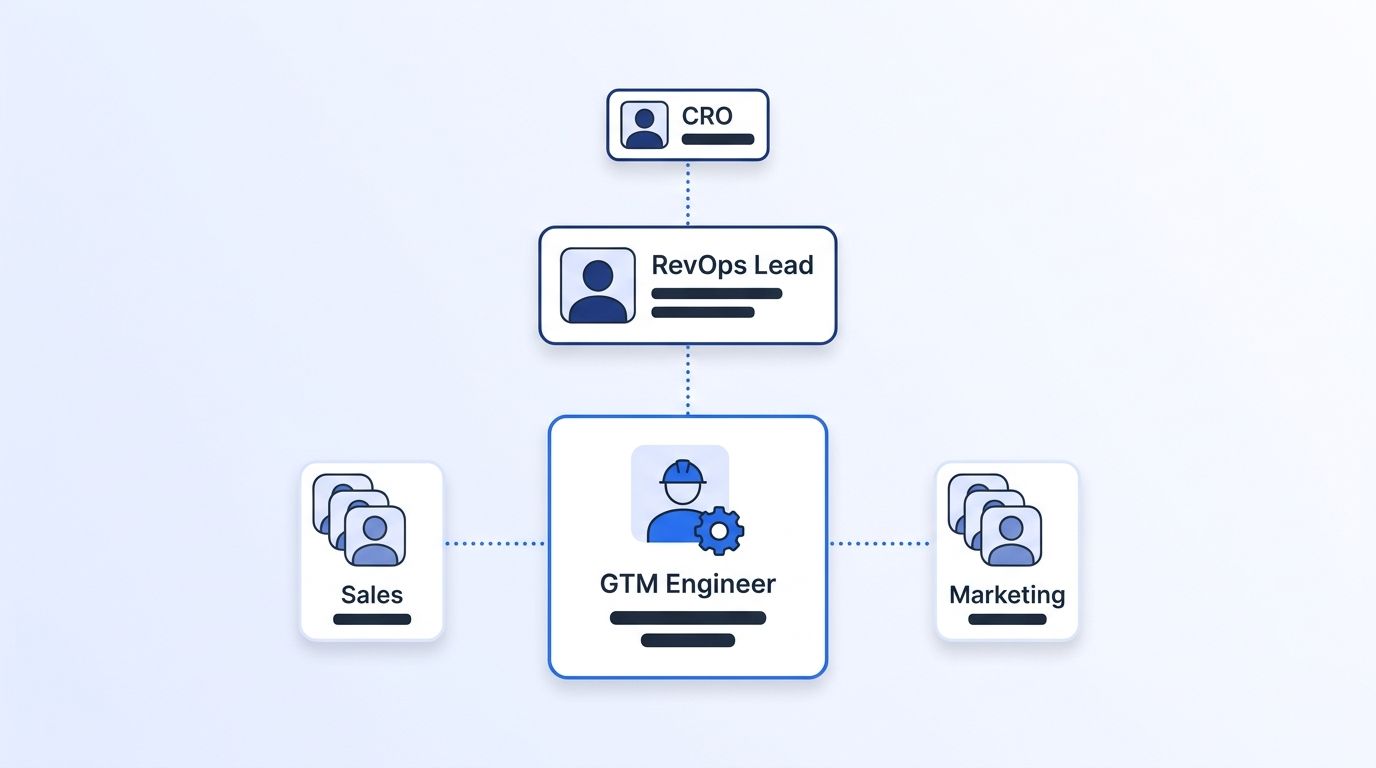
A GTM engineer is a technical hybrid who builds the automated infrastructure connecting your CRM, enrichment sources, and outbound tools - a role that didn't exist as a distinct job title three years ago. Demand exploded because manual list-building and spreadsheet-based prospecting can't keep pace with account-based motions that need fresh, filtered data updated daily instead of quarterly.
The role sits at the intersection of RevOps and engineering. Unlike a traditional sales ops analyst who configures CRM fields, a GTM engineer writes scripts, builds Clay tables, and wires webhooks between systems so that enrichment, scoring, and routing happen without a human touching a spreadsheet. That distinction matters when you're deciding who to hire first.
Citation capsule: GTM engineering emerged as a distinct discipline because prospecting workflows outgrew what no-code tools alone could handle - teams needed someone who could combine RevOps judgment with API-level scripting to keep enrichment and routing running continuously instead of in periodic batches.
For the underlying data layer these workflows depend on, see how ICP People Search lets a GTM engineer pull decision-makers by job title, seniority, and company filters directly into a build, without hand-copying LinkedIn URLs.
Step 1: Where Should the GTM Engineering Role Sit Before You Write the Job Post?
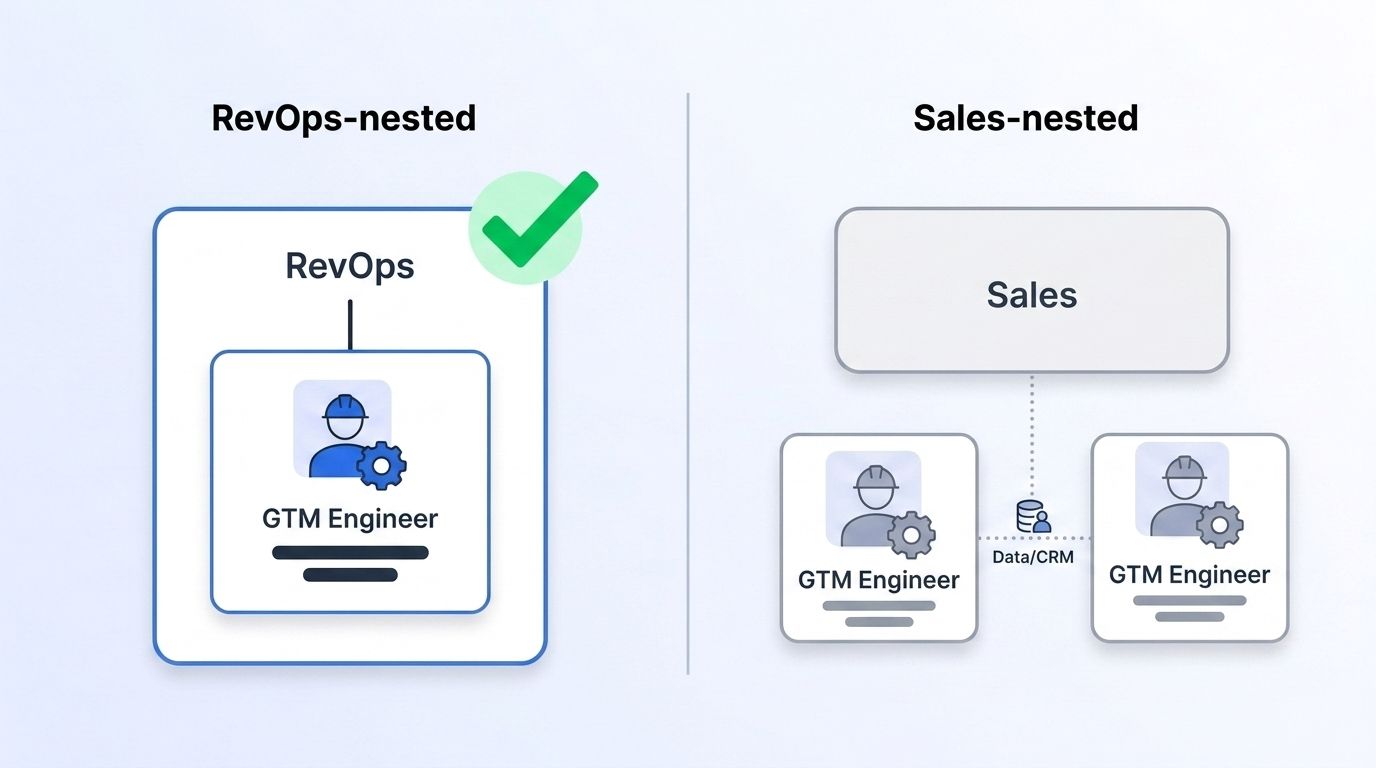
By the end of this step, you'll know whether GTM engineering should live inside RevOps, sales, marketing, or as its own function - a decision that shapes every hire after it. Getting this wrong means the first GTM engineer spends half their time in political meetings instead of building.
Most companies default to placing the first GTM engineer inside RevOps, since that's where the data, tooling, and cross-functional mandate already sit. Rachel Ledbetter's public RevOps model - popularized as the "Head of RevOps as air traffic controller" - treats GTM engineering as an execution arm of RevOps rather than a peer function to sales or marketing.
Verify this step worked: if your first GTM engineer reports somewhere other than the person who already owns your CRM, data stack, and cross-functional roadmap, expect duplicate tooling and turf fights within a quarter.
Step 2: Who Should RevOps and GTM Engineering Report to at the Top?
By the end of this step, you'll have a documented answer to "who does RevOps - and by extension, GTM engineering - ultimately report to?" This single decision determines whether the function gets funded like infrastructure or treated like a cost center.
RevOps reports to the COO in 26% of companies, the CEO in 25%, and the CFO in 24%, according to Wakefield Research's 2025 survey commissioned by Salesloft (Salesloft/Wakefield Research, 2025). That same survey found 73% of companies now have a C-suite role dedicated directly to RevOps, and 98% say the function's scope grew over the past year. Isn't it telling that no single reporting line dominates? Companies are still experimenting with where this authority should sit.
Citation capsule: RevOps reporting lines split almost evenly between COO (26%), CEO (25%), and CFO (24%), with no dominant pattern - meaning there's no single "correct" answer, but whichever executive owns it should already have budget authority over CRM and data tooling, since that's what the function spends money on.
Whoever holds that budget authority is also the person who should sign off on how enrichment gets automated - see how programmatic CRM enrichment fits into that same reporting line before you scope the first build.
Step 3: How Big Should Your GTM Engineering Team Be?
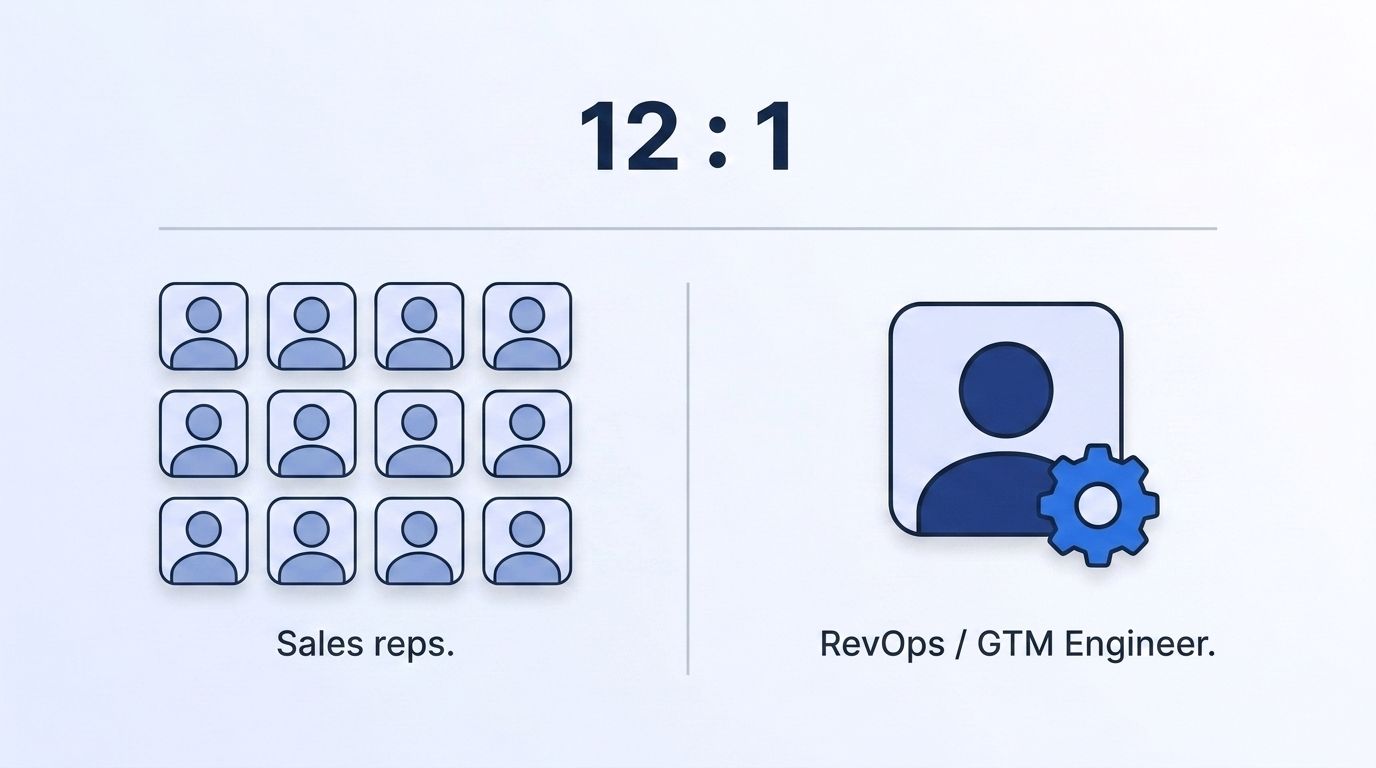
By the end of this step, you'll have a defensible ratio for how many GTM engineering and RevOps hires your current sales headcount supports, instead of guessing. Most B2B software companies build an internal RevOps function once they cross roughly 200 employees, running close to a 12:1 ratio of sellers (AEs plus SDRs) to RevOps headcount across a 2,500-company sample, with RevOps making up under 1% of total headcount (Peer Signal, 2024).
That ratio gets worse - fewer RevOps people per seller - once a company passes 1,000 employees, which is exactly when tooling sprawl makes a dedicated GTM engineer most valuable.
<!-- [UNIQUE INSIGHT] -->Most teams treat "when do we hire a GTM engineer" as a headcount question. It's actually a tooling-debt question. If your reps are manually stitching together three enrichment sources in a spreadsheet before every outbound push, you've already paid for a GTM engineer in lost selling hours - you just haven't hired one yet to collect on it.
Verify this step worked: map your current seller-to-RevOps ratio against the 12:1 benchmark. If you're well above it and growing, that's your signal to add GTM engineering capacity before adding more AEs.
Step 4: What Tools Does a GTM Engineer Need Before the Second Hire?
By the end of this step, you'll have the minimum tool stack a GTM engineer needs to be productive in their first month, based on what's actually showing up in job requirements, not what's trendy. Across 3,342 GTM engineer job postings analyzed by GTME Pulse, Clay appeared in 69% of listings, more than any other named tool (GTME Pulse, March 2026).
CRM experience (Salesforce or HubSpot) showed up in 55% of those postings, outbound sequencing tools in 45%, Python or SQL in 30%, API integration experience in 25%, and general workflow automation in 20% (GTME Pulse, March 2026). Separately, 84% of GTM engineers surveyed said they personally use Clay day to day, rising to 96% among agencies (GTME Pulse / Maja Voje, March 2026).
70% of surveyed GTM engineers also report using AI coding tools like Cursor or Claude Code as part of their daily workflow (GTME Pulse / Maja Voje, March 2026). A GTM engineer's toolkit is a data pipeline problem as much as a sales problem, which is why data quality at the source matters more than which automation platform sits on top of it. Datamagnet's Company Profile endpoint and People Profile endpoint give a GTM engineer live firmographic and contact data to feed into Clay tables, rather than working off a stale CSV export.
If Clay is already 69% of the market's stated requirement, wire it to a live source instead of a static list - see the Datamagnet + Clay integration for a working example of pulling live LinkedIn data straight into a Clay table.
Step 5: Set Compensation Bands Before You Post the Role
By the end of this step, you'll have a defensible salary range that matches what the market is actually paying, split by skill tier rather than one flat number. Median GTM engineer base salary lands around $132K-$135K in the US, according to two independent GTME Pulse analyses covering a 228-person survey and 3,342 job postings (GTME Pulse; GTME Pulse / Maja Voje, March 2026).
Junior hires (0-2 years) run $60K-$90K, senior or staff-level hires clear $200K+, and coding ability alone creates a $40K-$45K premium over low-code-only operators.
Geography still moves the number more than most people expect: US-based roles average about 80% higher pay than equivalent non-US roles ($135K vs. $75K), and equity only appears in 35% of listed postings (GTME Pulse, March 2026). Budget for the tier you actually need - a low-code Clay operator to maintain existing workflows costs meaningfully less than a high-code engineer who'll build new API integrations from scratch.
Step 6: Who Owns the Handoff Between GTM Engineering, Sales, and Marketing?
By the end of this step, you'll have a written answer to the question that causes the most friction after launch: who owns a workflow once it's live? A GTM engineer builds the pipeline: the Clay table, the enrichment call, the routing logic. Sales and marketing own what happens with the output, meaning which leads an AE works and which sequence a marketer sends.
Without a written handoff, GTM engineering ends up debugging a broken sequence that a marketer edited without telling anyone, or an AE blames "the data" for a list a sales ops person pulled manually outside the pipeline.
Route data changes through signals instead of manual re-pulls, so ownership stays clear: Datamagnet's Create Signal endpoint lets a GTM engineer set up job-change or engagement monitoring once, then deliver updates to sales and marketing via webhook instead of anyone re-running a manual export. The GTM engineer owns the pipe; sales and marketing own what flows through it.
For a deeper look at wiring that kind of monitoring into an existing outbound motion, see how real-time intent signal APIs apply the same signal-and-webhook pattern to job-change alerts specifically.
Common Mistakes to Avoid When Building the Function
1. Hiring a GTM engineer before you have a documented workflow to automate. Teams often hire reactively, after a founder sees a viral Clay demo, without a specific broken process in mind. The fix: write down the exact manual workflow (which tools, which steps, how many hours a week) before writing the job post.
2. Letting the role report to whoever asked for the headcount, not whoever owns the data stack. This creates the exact ambiguity Step 2 is meant to prevent - a GTM engineer with no authority over the CRM they're supposed to automate around.
3. Treating Clay fluency as the only hiring bar. 69% of postings mention Clay, but a candidate who can only build low-code tables will hit a ceiling the moment a workflow needs a real API integration or error handling logic.
<!-- [PERSONAL EXPERIENCE] -->Watching companies scope their first GTM engineering hire is a familiar pattern: the job post reads like a list of tool names instead of a list of problems. A candidate who's memorized Clay's UI but has never debugged a rate-limited API call will rebuild the same brittle workflow a no-code tool already gave you - just with more steps.
4. Skipping the compensation research and anchoring to a generic "ops" salary band. Median GTM engineer pay runs meaningfully above a generic sales ops analyst role, and underpaying against the $132K-$135K median in a hot market means losing the candidate to a company that didn't.
What Success Looks Like Six Months In
If the structure is working, you'll see fewer manual list-building requests landing in your RevOps team's queue and a documented reporting line that survives a reorg without a "who owns this now" scramble. The GTM engineer should be shipping new automated workflows, not just maintaining ones inherited from a departed contractor.
Frequent AI users in sales and marketing functions already report meaningfully better outcomes: ZoomInfo's 2025 survey of 1,002 GTM professionals found weekly-or-more AI users reported 78% shorter deal cycles, 76% improved win rates, and 47% higher productivity compared to infrequent users (ZoomInfo, 2026). A GTM engineering function is the infrastructure that turns that kind of AI and automation adoption from a one-off experiment into something every rep benefits from - RevOps reported the second-highest rate of weekly AI use among functions surveyed, at 55%, behind marketing's 63%.
That's the same infrastructure argument behind account research automation for AEs - once the pipeline exists, reps stop rebuilding it manually every time they open a new account.
Start With One Hire and a Written Reporting Line
Building a GTM engineering function from scratch doesn't require a five-person team on day one - it requires a clear answer to who the first hire reports to, a realistic seller-to-ops ratio, and a compensation band that matches what a 205% YoY-growing job market is actually paying. Get the reporting line and the tool stack right before the headcount, and the second and third hires get easier, not harder.
See how live people and company data plugs into a GTM engineering stack - check your current enrichment workflow against it this week.
Frequently Asked Questions
What does a GTM engineer actually do day to day?
A GTM engineer builds and maintains the automated infrastructure connecting a CRM, enrichment data, and outbound tools - typically inside a platform like Clay, which shows up in 69% of GTM engineer job postings (GTME Pulse, 2026). That includes writing scripts, wiring API integrations, and monitoring workflows so lists build and update without manual pulls.
Should GTM engineering report to RevOps, sales, or marketing?
Most companies place it inside RevOps, since RevOps already owns the CRM, data stack, and cross-functional mandate the role depends on. RevOps itself most commonly reports to the COO (26%), CEO (25%), or CFO (24%) rather than to sales or marketing leadership (Salesloft/Wakefield Research, 2025).
When is a company ready to hire its first GTM engineer?
Most B2B software companies build an internal RevOps function around 200 employees, running roughly a 12:1 ratio of sellers to RevOps headcount (Peer Signal, 2024). A GTM engineer often becomes the next hire once that RevOps function exists and manual data workflows start eating measurable selling time.
What tools does a GTM engineering team need to start?
Clay, a CRM (Salesforce or HubSpot), and a live people/company data source cover the core stack - Clay appears in 69% of job postings and CRM experience in 55% (GTME Pulse, 2026). API integration and Python/SQL skills matter more as workflows move past no-code limits.
How much does a GTM engineer cost to hire?
Median US base salary runs $132K-$135K, with junior hires at $60K-$90K and senior or staff-level hires clearing $200K+ (GTME Pulse / Maja Voje, 2026). Coding ability alone adds a $40K-$45K premium over candidates who only know low-code tools.
Sources
- GTME Pulse, State of GTM Engineering Report 2026 - Job Market Analysis, retrieved 2026-08-20, https://gtmepulse.com/insights/job-market-2026/
- GTME Pulse / Maja Voje, The 2026 State of GTM Engineering, retrieved 2026-08-20, https://knowledge.gtmstrategist.com/p/the-2026-state-of-gtm-engineering
- Salesloft, The Rise of RevOps: 2025 Wakefield Research Report, retrieved 2026-08-20, https://www.salesloft.com/resources/guides/wakefield-revops-study-2025
- Peer Signal, RevOps Benchmarks, retrieved 2026-08-20, https://ck.peersignal.org/posts/rev-ops-benchmarks
- ZoomInfo, State of AI in Sales & Marketing 2025, retrieved 2026-08-20, https://pipeline.zoominfo.com/sales/state-of-ai-sales-marketing-2025
- Datamagnet, ICP People Search endpoint, retrieved 2026-08-20, https://docs.datamagnet.co/api-reference/endpoints/icp-people-search
- Datamagnet, Create Signal endpoint, retrieved 2026-08-20, https://docs.datamagnet.co/api-reference/endpoints/signal-create
- Datamagnet, Webhooks, retrieved 2026-08-20, https://docs.datamagnet.co/api-reference/webhooks
