
Disclosure: Datamagnet publishes this article. Vendor claims about specific enrichment providers are based on public API documentation, retrieved 2026-07-31.
GraphQL vs REST for Enrichment APIs: Which Fits Your Stack (2026)
REST wins for enrichment APIs, and it isn't close. In 2026, 93% of developers report using REST versus 33% for GraphQL (Postman, 2025 State of the API Report, 2025), and every major B2B enrichment vendor — ZoomInfo, Apollo, People Data Labs, and Datamagnet — ships REST-only public APIs. GraphQL still wins on flexible, nested data-fetching, but that strength rarely matters for enrichment workloads built around simple, well-defined lookups.
Key Takeaways
- REST is used by 93% of developers vs GraphQL's 33% (Postman, 2025 State of the API Report, 2025) — and no major enrichment vendor publishes a GraphQL API.
- GraphQL's DataLoader batching runs roughly 6.4x faster than a naive N+1 query pattern (2.5s vs 0.4s) on comparable workloads (freeCodeCamp benchmark, 2023).
- 69% of developers already spend 10+ hours a week on API-related work (Postman, 2025) — architecture choice should reduce that load, not add a second one to learn.
- Choose REST if you're integrating an existing enrichment vendor. Choose GraphQL only if you're building an internal data layer that aggregates several sources behind one schema.
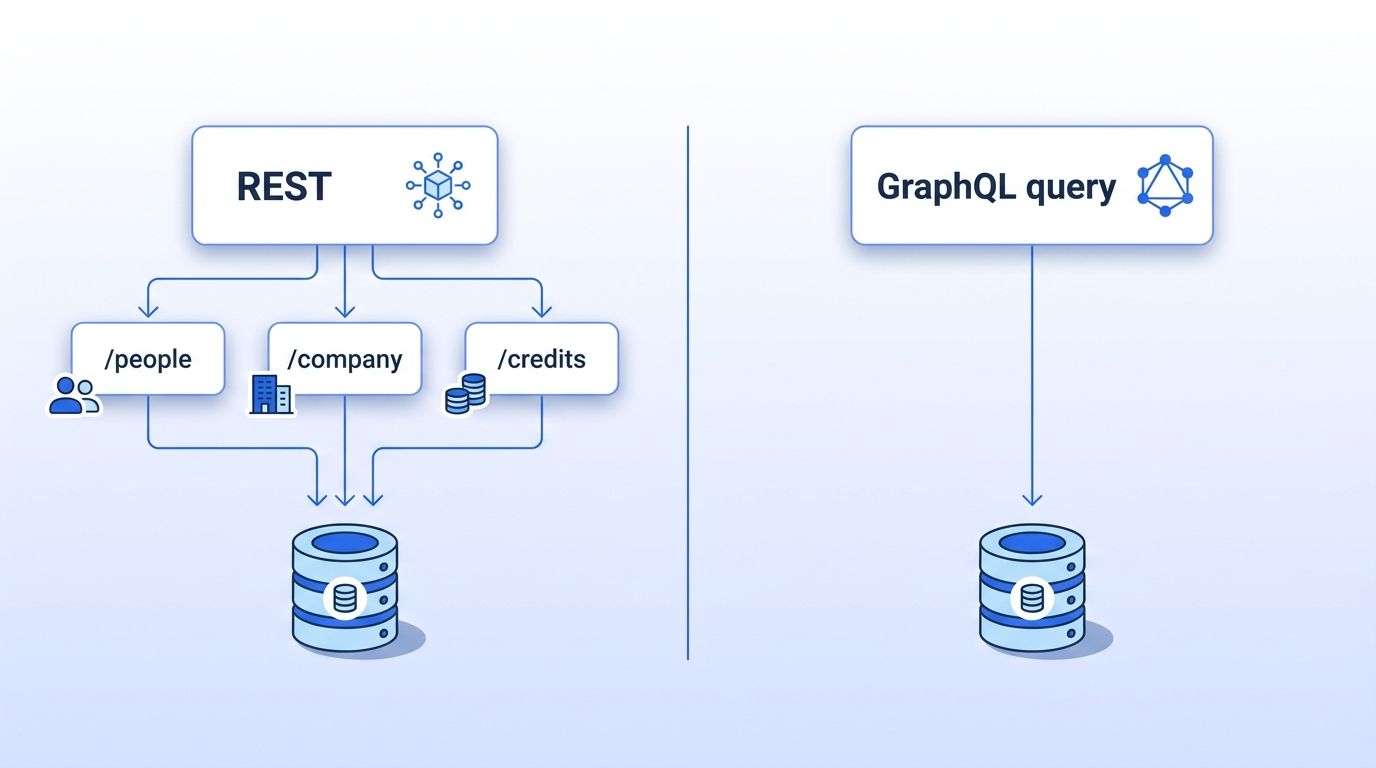
Quick Comparison: GraphQL vs REST for Enrichment Workloads
Here's the fast version for anyone who wants the table before the argument.
| Category | REST | GraphQL |
|---|---|---|
| Best For | Simple, well-defined lookups (person, company, credit balance) | Aggregating multiple internal data sources behind one schema |
| Developer Adoption (2025) | 93% (Postman) | 33% (Postman) |
| Enrichment Vendor Support | ZoomInfo, Apollo, People Data Labs, Datamagnet all REST | None of the major vendors publish a public GraphQL API |
| Over-Fetching Risk | Higher — fixed response shape per endpoint | Lower — client specifies exact fields |
| N+1 / Round-Trip Risk | Lower with one-resource-per-call design | Higher without DataLoader batching |
| HTTP Caching | Native — standard cache headers, CDN-friendly | Requires custom caching layer (most POST to one endpoint) |
| Learning Curve for New Devs | Lower — most engineers already know it | Higher — schema, resolvers, and query language to learn |
| Rate Limiting / Batching | Simple, per-endpoint limits most teams already understand | Complex — a single query can hide many resolver calls |
| Our Verdict | Win for enrichment integration | Win only for internal data-aggregation layers |
Which Is More Efficient for Fetching Enrichment Data?
GraphQL wins on raw fetching efficiency, but the enrichment use case rarely needs it. REST returns a fixed response shape per endpoint, so pulling a person's title and current company from Datamagnet's People Profile endpoint means accepting the full payload, even fields you won't use. GraphQL lets the client request exactly the fields it wants, cutting payload size for narrow queries.
The tradeoff shows up on the request side, not the response side. GraphQL's biggest failure mode is the N+1 problem — resolving nested fields with one database call per item instead of one batched call. A controlled benchmark found the naive N+1 pattern took roughly 2.5 seconds against a dataset of 1,000 records with nested relations, while DataLoader-based batching cut that to about 0.4 seconds — a 6.4x difference (freeCodeCamp, How to Avoid the N+1 Query Problem in GraphQL and REST APIs, 2023).
That gap is real, but it's a GraphQL implementation cost, not a REST penalty — REST never had an N+1 problem to begin with because each endpoint returns a flat, predictable shape. Verdict: GraphQL wins on payload precision. REST wins on avoiding the failure mode entirely.
Which Is Faster to Integrate Into Your Stack?
REST is faster to integrate for most teams, mainly because there's less to learn. [PERSONAL EXPERIENCE] Every enrichment integration we've watched customers build against a REST endpoint like Company Profile starts the same way: read the docs, send a request with a bearer token, map the JSON response to a CRM field. No schema to design, no resolver layer to write.
A controlled academic study asked 22 developers to complete eight equivalent data-fetching tasks against both a REST and a GraphQL API. The median GraphQL task took about 6 minutes versus about 9 minutes for REST, largely because GraphQL let developers fetch nested data in one round trip instead of chaining calls (Brito & Valente, REST vs GraphQL: A Controlled Experiment, arXiv, 2020). That result favors GraphQL for genuinely nested, multi-resource queries — the kind you'd write once you already know the schema.
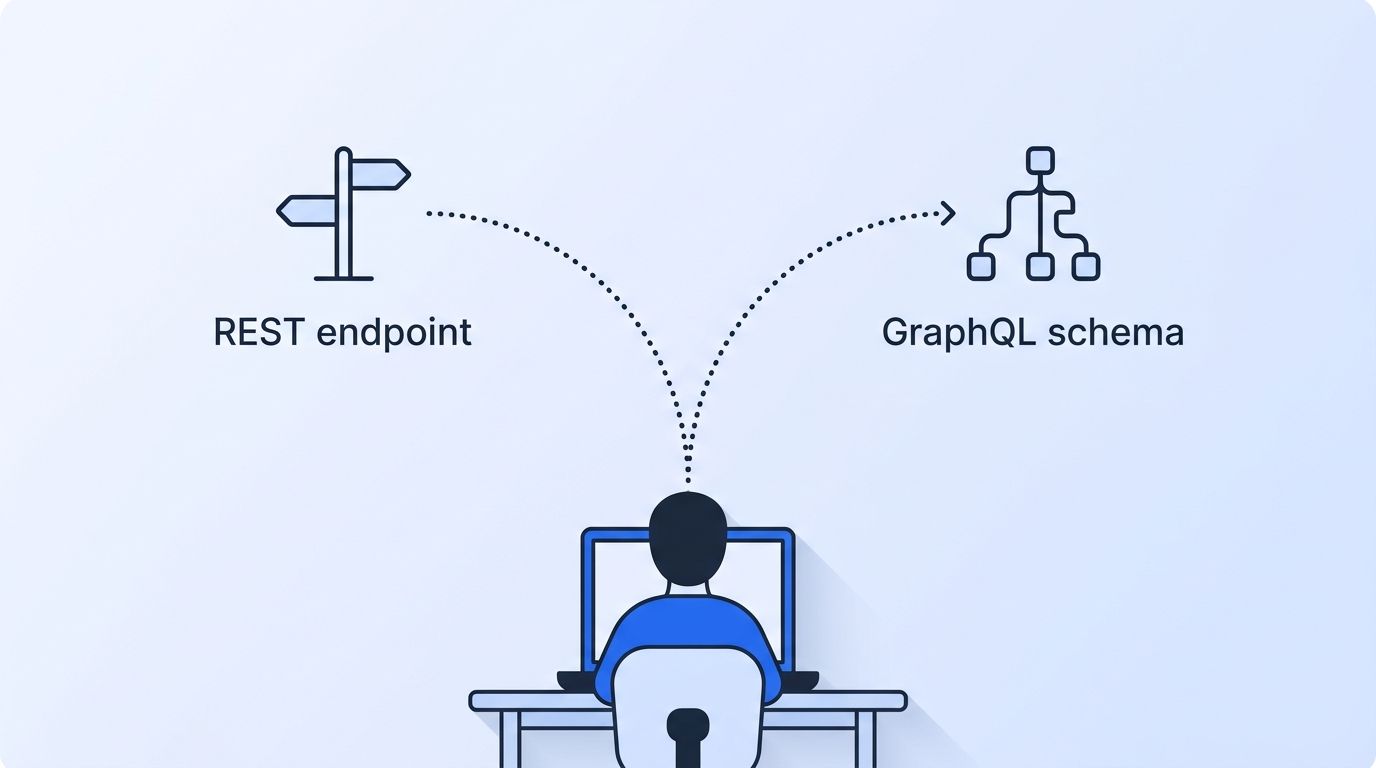
Most enrichment integrations aren't eight nested queries — they're one lookup at a time, triggered by a CRM webhook or a form fill. That shrinks GraphQL's per-query speed advantage while keeping its schema-design overhead. Verdict: REST wins for single-resource lookups. GraphQL wins only once you're already fetching multiple nested resources per request.
Which Handles Bulk and Batch Enrichment Requests Better?
REST handles enrichment's real bottleneck — too many small round trips — more predictably than GraphQL does. Enrichment workflows rarely make one call; they enrich lists, running person and company lookups against hundreds or thousands of rows via something like the ICP People Search endpoint. Microsoft's own architecture guidance calls this the "chatty I/O" antipattern, and its internal load test showed throughput rising from 410 requests per minute to 3,970 after consolidating many small calls into fewer, larger batched ones (Microsoft Learn, Chatty I/O antipattern, 2026).
REST solves this with pagination and bulk endpoints rather than a query language — you request a page of results, track your credit balance, and move to the next page. GraphQL can batch too, but every batched query still runs through resolver logic that can reintroduce the N+1 problem if the schema wasn't designed for it up front. Isn't that the whole point of an enrichment API — moving data at volume without babysitting the request pattern?
Verdict: REST wins for batch enrichment because pagination and rate limits are well-understood patterns every engineer already knows how to tune.
Which Has Wider Support Among Enrichment Vendors?
REST wins by default — no major enrichment vendor currently ships a public GraphQL API. As of research conducted July 2026, ZoomInfo's data-as-a-service platform, Apollo.io's public API, and People Data Labs' enrichment API are all documented as REST-based, JSON-in-JSON-out services with standard bearer-token or API-key authentication. Datamagnet's own API documentation follows the same convention for person, company, and signal data.
This is a stronger signal than any adoption survey: when an entire product category standardizes on one architecture, switching costs compound. A REST-based enrichment vendor lets you reuse the same authentication pattern, the same retry logic, and the same pagination handling across every provider you add — Clay, which closed a $100M Series C at a $3.1B valuation in August 2025 (TechCrunch, Clay confirms it closed $100M round at $3.1B valuation, 2025), built its entire orchestration model on wiring REST-based enrichment sources together.
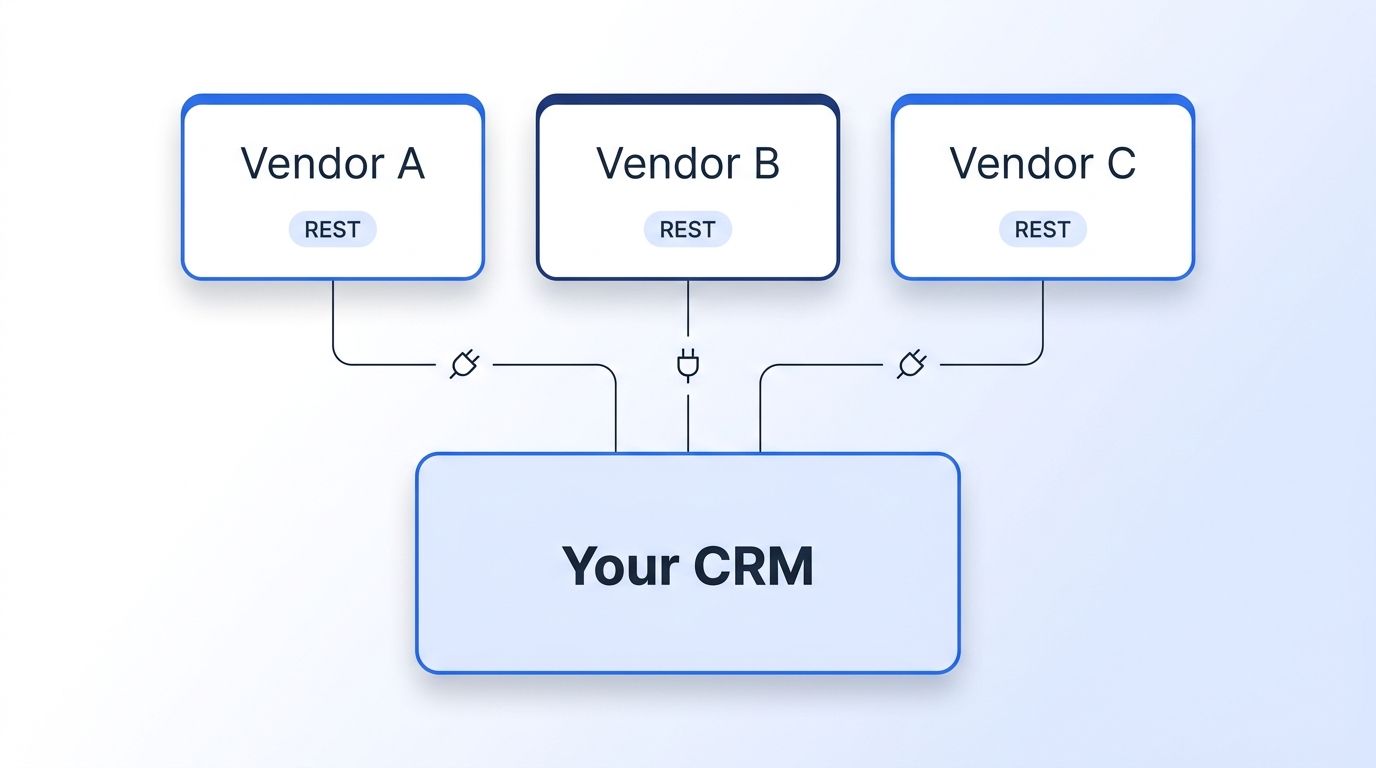
Verdict: REST wins decisively. GraphQL adoption exists elsewhere in the API world, just not in enrichment.
Which Costs Less to Maintain Long-Term?
REST costs less to maintain because the failure modes are already familiar to most engineering teams. In 2026, 69% of developers already spend 10+ hours a week on API-related tasks — integration, debugging, and maintenance combined (Postman, 2025 State of the API Report, 2025). Separately, 60% of companies say they spend too much time troubleshooting APIs, 88% troubleshoot API issues weekly, and 36% spend more time troubleshooting than shipping new features (Lunar.dev, 2024 State of API Consumption Management Report, 2024).
Every hour spent debugging a resolver-level N+1 bug or a GraphQL schema migration is an hour not spent on the enrichment logic itself — deduping records, mapping fields to your CRM, handling failed lookups. REST's maintenance burden is smaller in scope: a versioned endpoint, a documented authentication scheme, and predictable error codes documented once and rarely revisited.
Verdict: REST wins on maintenance cost for teams that don't already run GraphQL infrastructure elsewhere. If your org already operates a GraphQL gateway for other services, wrapping REST-based enrichment vendors behind it is reasonable — building a new GraphQL layer just for enrichment usually isn't.
Who Should Choose What
If you're integrating a third-party enrichment vendor, choose REST — it's what every vendor actually ships. The decision gets more nuanced once you factor in what else your team already runs.
- Startups and small engineering teams: Choose REST. You'll integrate person and company enrichment in an afternoon using standard HTTP calls, without designing a schema first.
- Teams already running a GraphQL gateway (Apollo Federation, Cosmo, or similar): Wrap REST-based enrichment vendors behind your existing gateway as a data source. You get GraphQL's client-side flexibility without asking a vendor to build one.
- RevOps teams building internal tooling on top of enrichment data: Choose REST for the vendor calls, then expose your own internal GraphQL layer if multiple internal apps need different slices of the same enriched data.
- Anyone evaluating a REST-based enrichment API directly: Start with a quickstart guide and generate an API key before comparing vendors on data freshness or coverage.
Frequently Asked Questions
Is GraphQL better than REST for enrichment APIs?
Not for the typical use case. REST is used by 93% of developers versus 33% for GraphQL (Postman, 2025), and every major enrichment vendor — ZoomInfo, Apollo, People Data Labs, Datamagnet — publishes REST-only APIs. GraphQL is better only when you're aggregating several internal data sources behind one schema for multiple internal consumers.
Can I use both GraphQL and REST in the same enrichment stack?
Yes, and many teams already do. A common pattern wraps REST-based enrichment vendors — like Datamagnet's People and Company endpoints — behind an internal GraphQL gateway, so downstream apps query one schema while the underlying vendor calls stay REST.
Why do enrichment vendors like ZoomInfo, Apollo, and Datamagnet all use REST instead of GraphQL?
Enrichment lookups are simple and well-defined — person by URL, company by domain — which doesn't need GraphQL's flexible querying. REST's native HTTP caching, familiar pagination, and lower learning curve matter more at scale than GraphQL's ability to shape nested responses, especially with 69% of developers already spending 10+ hours weekly on API work (Postman, 2025).
Does GraphQL solve the enrichment API rate-limit problem?
No, not directly. Rate limits are enforced per request regardless of architecture, and a single complex GraphQL query can trigger many resolver-level calls internally, sometimes worsening rate-limit pressure. REST's one-endpoint-per-resource design and documented credit balance tracking make usage easier to predict and budget for.
Is REST still worth building on in 2026?
Yes. REST usage sits at 93% among developers (Postman, 2025), and it remains the default for every enrichment vendor evaluated for this comparison. Unless your team already runs GraphQL infrastructure for other reasons, REST's lower learning curve and native caching make it the lower-risk choice for enrichment integrations specifically.
Verdict: Category Winners
| Category | Winner |
|---|---|
| Fetching Efficiency | GraphQL (payload precision) / REST (no N+1 risk) |
| Integration Speed | REST |
| Bulk & Batch Handling | REST |
| Vendor Support | REST |
| Long-Term Maintenance | REST |
| Overall | REST — for any integration with an external enrichment vendor |
REST wins this comparison for one practical reason: it's what the entire enrichment vendor category already ships, and it matches the shape of the work — simple, well-defined lookups at volume. Choose GraphQL only when you're building an internal aggregation layer on top of multiple enrichment sources, not when you're calling a vendor directly. For deeper API-specific patterns, see how programmatic CRM enrichment fits into a REST-based stack, or compare Datamagnet against ZoomInfo on data freshness and pricing model.
Sources
- Postman, 2025 State of the API Report, retrieved 2026-07-31, https://www.postman.com/state-of-api/2025/
- Lunar.dev, 2024 State of API Consumption Management Report, retrieved 2026-07-31, https://www.lunar.dev/post/2024-state-of-api-consumption-management-report
- freeCodeCamp, How to Avoid the N+1 Query Problem in GraphQL and REST APIs, retrieved 2026-07-31, https://www.freecodecamp.org/news/n-plus-one-query-problem/
- Microsoft Learn, Azure Architecture Center, Chatty I/O antipattern, retrieved 2026-07-31, https://learn.microsoft.com/en-us/azure/architecture/antipatterns/chatty-io/
- Gleison Brito & Marco Tulio Valente, REST vs GraphQL: A Controlled Experiment, retrieved 2026-07-31, https://arxiv.org/abs/2003.04761
- TechCrunch, Clay confirms it closed $100M round at $3.1B valuation, retrieved 2026-07-31, https://techcrunch.com/2025/08/05/clay-confirms-it-closed-100m-round-at-3-1b-valuation
- People Data Labs, API documentation, retrieved 2026-07-31, https://docs.peopledatalabs.com/docs/introduction
- Apollo.io, API documentation, retrieved 2026-07-31, https://docs.apollo.io/
- ZoomInfo, API documentation, retrieved 2026-07-31, https://docs.zoominfo.com/
- Datamagnet, API Documentation, retrieved 2026-07-31, https://docs.datamagnet.co/api-reference/introduction
