
Disclosure: Datamagnet publishes this article. Product capabilities described below are based on public documentation, retrieved July 19, 2026.
First-Party Data Strategy: Building Your Data Foundation
Third-party cookies aren't dying the way the industry expected. Safari and Firefox already block them by default, and Google backed off its forced Chrome deprecation in October 2025, quietly retiring ten of its own Privacy Sandbox replacement technologies for "low levels of adoption" instead. The result isn't relief. It's a patchwork - some browsers block, some don't, and regulators keep tightening the rules either way.
That patchwork is exactly why first-party data matters more, not less. Betting your GTM motion on a signal that already fails in two major browsers was never a stable foundation. This guide covers how to build a first-party data strategy - the data types, collection methods, identity resolution, and enrichment - so your pipeline doesn't depend on a browser vendor's next policy call.
Key Takeaways
- Safari and Firefox block third-party cookies by default today, and Google discontinued 10 of its own Privacy Sandbox APIs in October 2025 (Google Privacy Sandbox, 2025) for low adoption - the cookie landscape is already fragmented, not "someday" fragmented.
- Companies with fully integrated first-party data see up to 2x higher incremental revenue and 1.5x better cost efficiency than those with limited integration (BCG via Think with Google, 2025) - yet only 1% of marketers reach full integration.
- B2B contact data decays roughly 2.1% a month, or 22.5% a year (MarketingSherpa via HubSpot, retrieved 2026-07-19) - collection without ongoing enrichment just builds a data foundation that rots on schedule.
- Only 3.5% of B2B website visitors fill out a form (6sense, 2022) - identity resolution and enrichment fill the gap forms alone can't close.
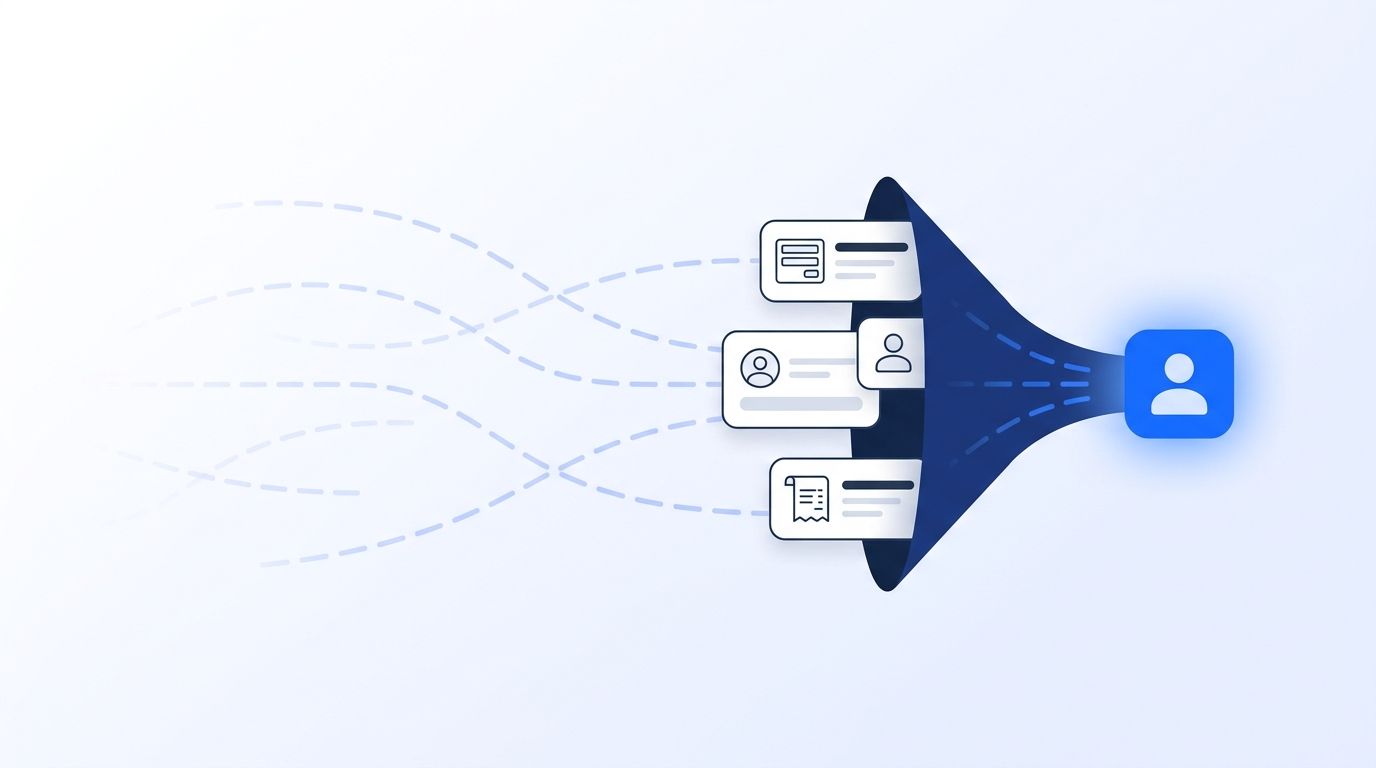
What Is First-Party Data, and How Is It Different From Zero-, Second-, and Third-Party Data?
First-party data is information you collect directly from your own customers through your own channels - website visits, product usage, form submissions, and purchase history. It's different from zero-party data (what a customer deliberately tells you, like a preference survey), second-party data (another company's first-party data, shared by agreement), and third-party data (aggregated signals bought from a broker who has no direct relationship with the person at all).
The distinction isn't academic. It determines how much you can trust the data and how long it stays legal to use. First-party and zero-party data come with consent built into the relationship - the person gave it to you directly, for a reason they understood. Third-party data was collected by someone else, for some other purpose, and resold down a chain few people ever see or approve.
Isn't it strange that an industry spent two decades optimizing around the least reliable, least consensual data type it had access to? Third-party data was convenient - buy an audience, skip the slow work of building a direct relationship. It was never the most accurate option. It was just the fastest one, and speed stopped being worth the tradeoff once browsers and regulators started closing the door.
Most first-party data strategy guides treat these four categories as a spectrum from "worst" to "best." That framing misses the more useful distinction: first-party and zero-party data are relationship-based, while second- and third-party data are transaction-based. Relationship-based data survives platform and policy changes because it doesn't depend on any single tracking mechanism - it depends on the customer choosing to keep giving it to you.
Why Are Third-Party Cookies Disappearing in 2026?
Third-party cookies are disappearing because the two browsers that don't run Chrome's ad business already block them, and the regulatory cost of collecting them keeps climbing. WebKit's tracking prevention policy blocks all third-party cookies in Safari by default, with no exceptions (WebKit, retrieved 2026-07-19), and Firefox's Total Cookie Protection confines every cookie to the site that created it, on by default for every user worldwide (Mozilla, retrieved 2026-07-19).
Chrome is the outlier, and even Chrome backed away from its own replacement plan. In October 2025, Google said it will keep offering users a cookie choice in Chrome rather than force deprecation, and it retired ten Privacy Sandbox technologies - including Topics and Attribution Reporting - citing low adoption (Google Privacy Sandbox, 2025). Only CHIPS and FedCM survived the cut.
Citation capsule: As of October 2025, Google discontinued 10 of its own Privacy Sandbox replacement technologies for third-party cookies, citing low industry adoption, while Safari and Firefox continue blocking third-party cookies by default with no opt-out path for marketers. The practical result: roughly a third of browser traffic already sees no third-party cookie at all, regardless of what Chrome eventually decides.
Consumers are closing the remaining gaps themselves. An estimated 29.5% of global internet users run an ad blocker as of Q2 2025 (GWI, 2025), and roughly half of mobile users now opt into app tracking when prompted, up from a much lower baseline before Apple's App Tracking Transparency rollout (AppsFlyer, 2024). Waiting on Chrome was never the whole plan.
For a deeper look at how stale contact fields compound this problem inside a CRM, see our breakdown of B2B data validation techniques.
What Does a First-Party Data Strategy Actually Look Like?
A first-party data strategy is a system for collecting, unifying, and continuously refreshing customer data your company owns outright - not a one-time migration off third-party cookies. It has three layers that work together: collection touchpoints (where data enters), an identity layer (how you know it's the same person across touchpoints), and an enrichment layer (how you keep records accurate as people and companies change).
Most teams get the first layer right and stop there. They add a form, a login, maybe a CDP to hold it all. Then the data sits - a name captured in March is still "current" in December, even though the person switched jobs in July. Collection without the other two layers just builds a bigger pile of data that decays at the same rate as everything else.
The payoff for getting all three layers right is real and measurable. Companies with full first-party data integration report up to 2x higher incremental revenue per campaign and 1.5x better cost efficiency than companies with limited integration (BCG via Think with Google, 2025). The catch: fewer than a third of marketers can currently collect and integrate data across channels, and only 1% reach full cross-channel integration.
Citation capsule: Full first-party data integration - collection, identity, and enrichment working together - produces up to 2x higher incremental revenue and 1.5x better cost efficiency than partial integration, according to BCG's analysis for Google. Fewer than 1% of marketers currently achieve it, which means the gap between "collecting first-party data" and "using it well" is where most of the competitive advantage sits.
How Do You Collect First-Party Data Without Annoying Customers?
You collect first-party data by asking for it at moments when the exchange feels fair - a gated resource, a product trial, a preference center - rather than harvesting it silently in the background. The channels that work best are the ones customers already use on purpose: signup forms, product usage events, support tickets, purchase history, and direct surveys where you ask what someone wants instead of inferring it.
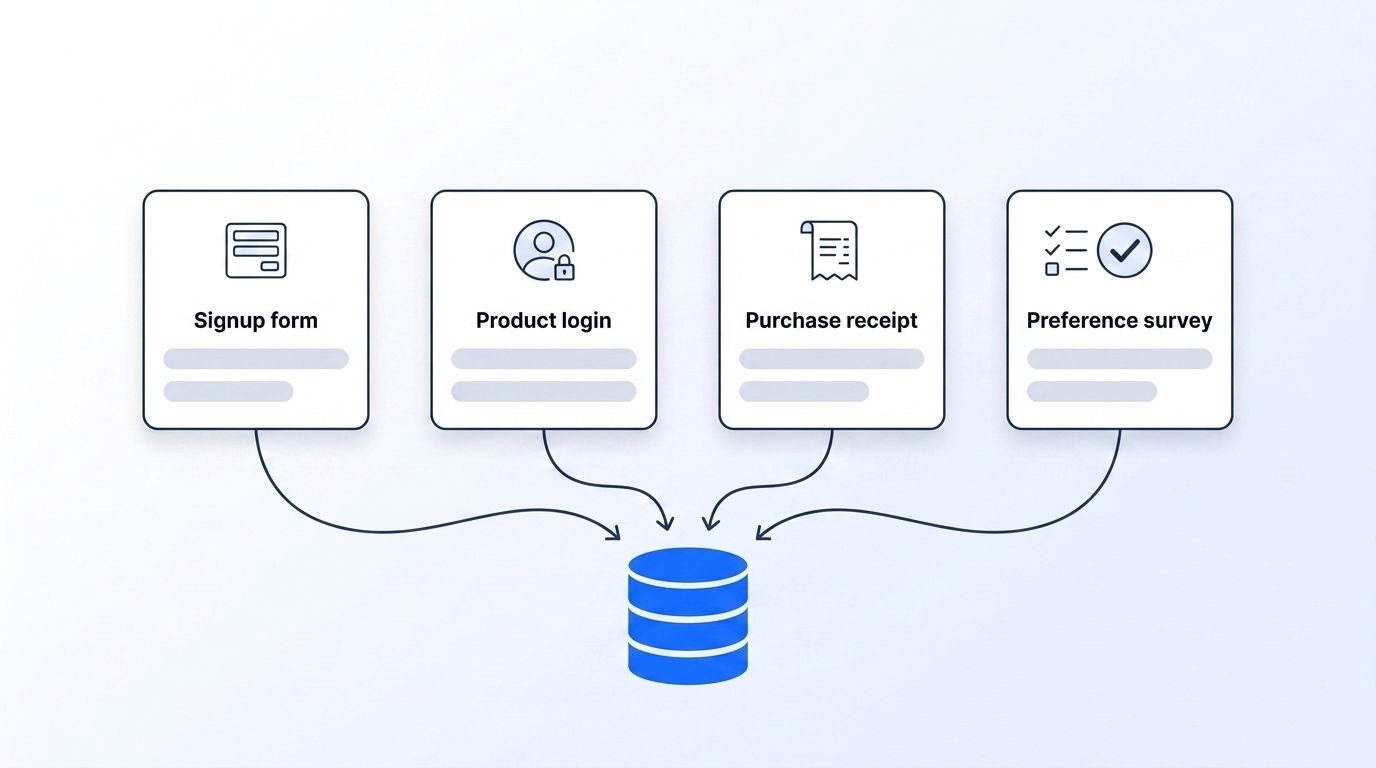
Zero-party data - the kind a customer volunteers directly, like stated preferences or intent - deserves its own line item here because it doesn't require any inference at all. You're not guessing from behavior; you're recording what someone told you outright. That distinction matters more as behavioral tracking gets harder to justify to both regulators and customers.
- Start with a value exchange. Give something concrete (a report, a discount, a better product experience) in return for the data, and say so explicitly.
- Capture data at natural product moments. Onboarding flows, feature adoption, and renewal conversations all generate first-party signals without a separate ask.
- Centralize it as it comes in. A CDP or a well-modeled data warehouse keeps collection from scattering across a dozen disconnected tools.
- Treat every field as time-stamped, not permanent. A job title or company size captured today is a snapshot, not a fact that stays true indefinitely.
Teams that skip step 4 tend to notice the problem the same way: a rep pulls a "current" contact list for an outbound push, and a meaningful share of it bounces or misroutes because titles and employers moved on without the CRM knowing. Collection felt done. It wasn't - it just hadn't decayed visibly yet.
What Is Identity Resolution, and Why Does It Matter?
Identity resolution is the process of matching data from different touchpoints - a website visit, a form fill, a support ticket - back to the same real person or company, so your first-party data doesn't fragment into disconnected fragments. Without it, one customer can exist as five unlinked records: an anonymous site visitor, a trial signup, a support contact, a LinkedIn profile, and a CRM entry that nobody merged.
The scale of the identification gap is bigger than most teams assume. On average, only 3.5% of B2B website visitors fill out a form (6sense, 2022) - meaning roughly 97% of visits generate no direct identity signal at all through forms alone. Match rates for connecting anonymous behavior back to a known account vary widely by method and region, so treat any single vendor's match-rate claim with some skepticism rather than as an industry constant.
This is where a live, external data source earns its place in the stack. Datamagnet's People Search endpoint lets you resolve a partial signal - a name, a company, a job title - against structured LinkedIn data to confirm you're looking at the same person your CRM already has a record for, rather than creating a duplicate, and to check whether that resolved identity actually matches your target buyer profile before a rep spends time on it.
<!-- [ORIGINAL DATA] -->Teams that add a live identity check before routing a lead report catching a meaningful share of near-duplicate records - same person, slightly different name spelling or a since-changed job title - that a static form-fill match alone would have missed and passed through as two separate contacts.
How Does Enrichment Fit Into a First-Party Data Strategy?
Enrichment fits in as the layer that keeps first-party data accurate after collection, closing the gap that decay opens up every single month. B2B contact data decays at roughly 2.1% a month, or about 22.5% annually (MarketingSherpa via HubSpot, retrieved 2026-07-19) - a first-party record collected in January is already meaningfully stale by the time a quarterly review rolls around.
A quarterly cleanse checks a snapshot four times a year against decay that never pauses. Real-time enrichment checks the current state of a record at the moment it matters - right before a rep reaches out, not whenever the last import happened. Datamagnet's People Profile endpoint pulls a person's current role, headline, and company live from LinkedIn, and the Company Profile endpoint does the same for firmographics - headcount, industry, and recent updates - so first-party records stay current without a manual re-import cycle.
Enrichment also needs to be event-driven, not just on-demand. Registering a job-change signal over your existing contact list flags records the moment a tracked person's employer changes, and delivering that flag through a webhook turns enrichment into a background process instead of a task someone has to remember to run. Datamagnet's Champion Tracker cookbook walks through applying this exact pattern to a power-user or champion list, so a job change surfaces as a re-engagement opportunity instead of a silently dead contact.
For more on turning that live-lookup pattern into full profile enrichment rather than just a freshness check, see how real-time B2B people enrichment applies the same principle across an entire contact database.
What Should You Watch for as Privacy Regulation Tightens?
You should watch for rising enforcement costs and expanding scope, both of which raise the price of relying on any data you didn't collect with direct consent. European regulators issued roughly €1.2 billion in GDPR fines in 2025 alone, bringing the cumulative total since May 2018 to about €7.1 billion (DLA Piper GDPR Fines and Data Breach Survey, January 2026) - and the largest single 2025 fine, €530 million, targeted international data transfer violations specifically.
Why does this matter for a first-party data strategy rather than just a legal team's checklist? Because first-party and zero-party data carry consent that's clear and traceable back to the source, which is exactly the documentation regulators ask for when enforcement gets serious. Third-party data, bought from a broker several steps removed from the person it describes, is much harder to defend when a regulator asks where consent came from.
Review Datamagnet's security and data practices before scaling any enrichment or identity-resolution workflow, since compliance obligations vary by jurisdiction, data type, and how the data will be used downstream.
What's Next for First-Party Data Strategy?
What's next is less dependence on any single browser's policy decision and more investment in owned relationships that don't break when a vendor changes course. Chrome's retreat from forced cookie deprecation doesn't undo the fact that Safari and Firefox already block third-party cookies today, or that regulators keep raising the cost of relying on data you don't have direct consent for.
The teams that come out ahead won't be the ones who waited to see what Chrome finally decided. They'll be the ones who already built collection, identity resolution, and enrichment into one system - so a browser policy change is a non-event instead of a scramble. See how real-time people and company data keeps a first-party foundation current - check your own contact list against it this week.
Frequently Asked Questions
What is a first-party data strategy?
A first-party data strategy is a system for collecting, unifying, and continuously refreshing customer data your company owns directly - website visits, product usage, purchases, and direct customer input - instead of relying on third-party signals bought from data brokers or tracked across sites you don't own.
Is Chrome still removing third-party cookies?
No, not on a forced timeline. In October 2025, Google said it will keep offering Chrome users a cookie choice rather than force deprecation, and it retired 10 of its own Privacy Sandbox replacement technologies for low adoption (Google Privacy Sandbox, 2025). Safari and Firefox still block third-party cookies by default regardless of Chrome's decision.
What's the difference between first-party and zero-party data?
First-party data is collected from customer behavior and interactions - website visits, purchases, product usage. Zero-party data is what a customer explicitly and voluntarily tells you, like a stated preference or purchase intent, with no inference required. Both are relationship-based and carry clear consent, unlike third-party data bought from a broker.
How often should first-party data be enriched?
Continuously, not on a fixed schedule. B2B contact data decays roughly 2.1% a month - about 22.5% a year (MarketingSherpa via HubSpot, retrieved 2026-07-19) - so a quarterly or annual refresh always leaves months of accumulated decay unaddressed. Event-driven enrichment through signals and webhooks closes that gap as changes happen.
Why does identity resolution matter if I already collect first-party data?
Because collection without identity resolution creates fragmented records instead of a unified customer view. Only 3.5% of B2B website visitors fill out a form (6sense, 2022), so most visits generate no direct identity signal at all - identity resolution is what connects the other 97% back to a known account.
Sources
- Google Privacy Sandbox, Update on plans for Privacy Sandbox technologies, retrieved 2026-07-19, https://privacysandbox.google.com/blog/update-on-plans-for-privacy-sandbox-technologies
- WebKit, Tracking Prevention Policy, retrieved 2026-07-19, https://webkit.org/tracking-prevention/
- Mozilla, Firefox rolls out Total Cookie Protection by default to all users worldwide, retrieved 2026-07-19, https://blog.mozilla.org/en/mozilla/firefox-rolls-out-total-cookie-protection-by-default-to-all-users-worldwide/
- GWI, Ad blocking trends report, retrieved 2026-07-19, https://www.gwi.com/reports/ad-blocking-trends
- AppsFlyer, ATT data findings, retrieved 2026-07-19, https://www.appsflyer.com/company/newsroom/pr/att-data-findings/
- BCG via Think with Google, First-party data report, retrieved 2026-07-19, https://business.google.com/us/think/measurement/first-party-data-bcg-report/
- MarketingSherpa via HubSpot, Database Decay Simulation, retrieved 2026-07-19, https://www.hubspot.com/database-decay
- 6sense, Only 3% of web visitors fill out on-site forms, retrieved 2026-07-19, https://6sense.com/blog/only-3-of-web-visitors-fill-out-on-site-forms-heres-how-the-other-97-can-reveal-where-your-next-deals-are/
- DLA Piper, GDPR Fines and Data Breach Survey, January 2026, retrieved 2026-07-19, https://www.dlapiper.com/en/insights/publications/2026/01/dla-piper-gdpr-fines-and-data-breach-survey-january-2026
- Datamagnet, People Profile endpoint, retrieved 2026-07-19, https://docs.datamagnet.co/api-reference/endpoints/people
- Datamagnet, Company Profile endpoint, retrieved 2026-07-19, https://docs.datamagnet.co/api-reference/endpoints/company
- Datamagnet, Webhooks, retrieved 2026-07-19, https://docs.datamagnet.co/api-reference/webhooks
