
Disclosure: Datamagnet publishes this article. Product capabilities described below are based on public documentation, retrieved July 20, 2026.
Event-Driven Data Enrichment Architecture: Real-Time Triggers & Webhooks
Your nightly enrichment job just re-queried 40,000 records to catch the roughly 800 that actually changed. B2B contact data decays about 2.1% a month (HubSpot, Database Decay Simulation, retrieved 2026-07-20), so most of a batch run's API budget goes toward records that were already correct.
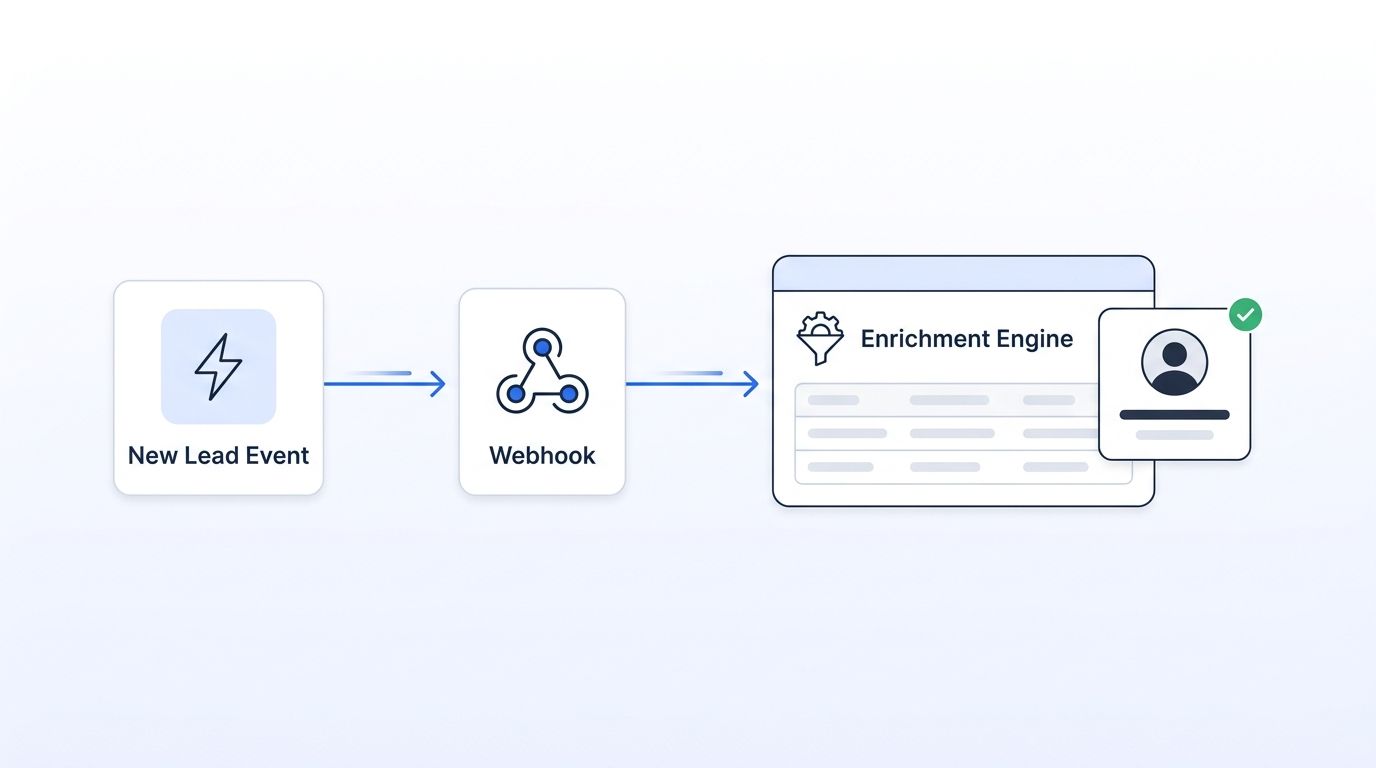
Event-driven enrichment skips that waste. Instead of touching every record on a timer, you enrich only when something actually happens - a lead fills out a form, a contact changes jobs, a company raises a funding round. This guide covers how to architect that system: event detection, webhook delivery, retry logic, and where it breaks if you skip a step.
TL;DR
- B2B contact data decays roughly 2.1% a month - about 22.5% a year (HubSpot, Database Decay Simulation, retrieved 2026-07-20), so a nightly batch job mostly re-checks records that haven't changed.
- Responding to a lead within the first minute lifts conversion by 391%, and instant response drives a 66.7% meeting-booking rate versus 30% for standard follow-up (Chili Piper, 2025 Benchmark Report on Demo Form Conversion Rates, Feb 2025).
- Webhooks, not polling, are the standard delivery mechanism for event-driven enrichment - reliable implementations target 99%+ delivery success over rolling windows.
- Retry logic needs exponential backoff plus idempotency, or a single upstream hiccup can double-enrich the same record.
- Only 13% of organizations report full event-driven architecture maturity, even though 85% call it critical (Solace / Coleman Parkes Research, 2021) - so build incrementally, not all at once.
What Is Event-Driven Data Enrichment?
Event-driven data enrichment triggers an API lookup the moment a specific event occurs, rather than on a fixed schedule. A new lead submits a form, and your system enriches that record within seconds - not at 2 a.m. when the nightly job runs. The trigger is the schedule.
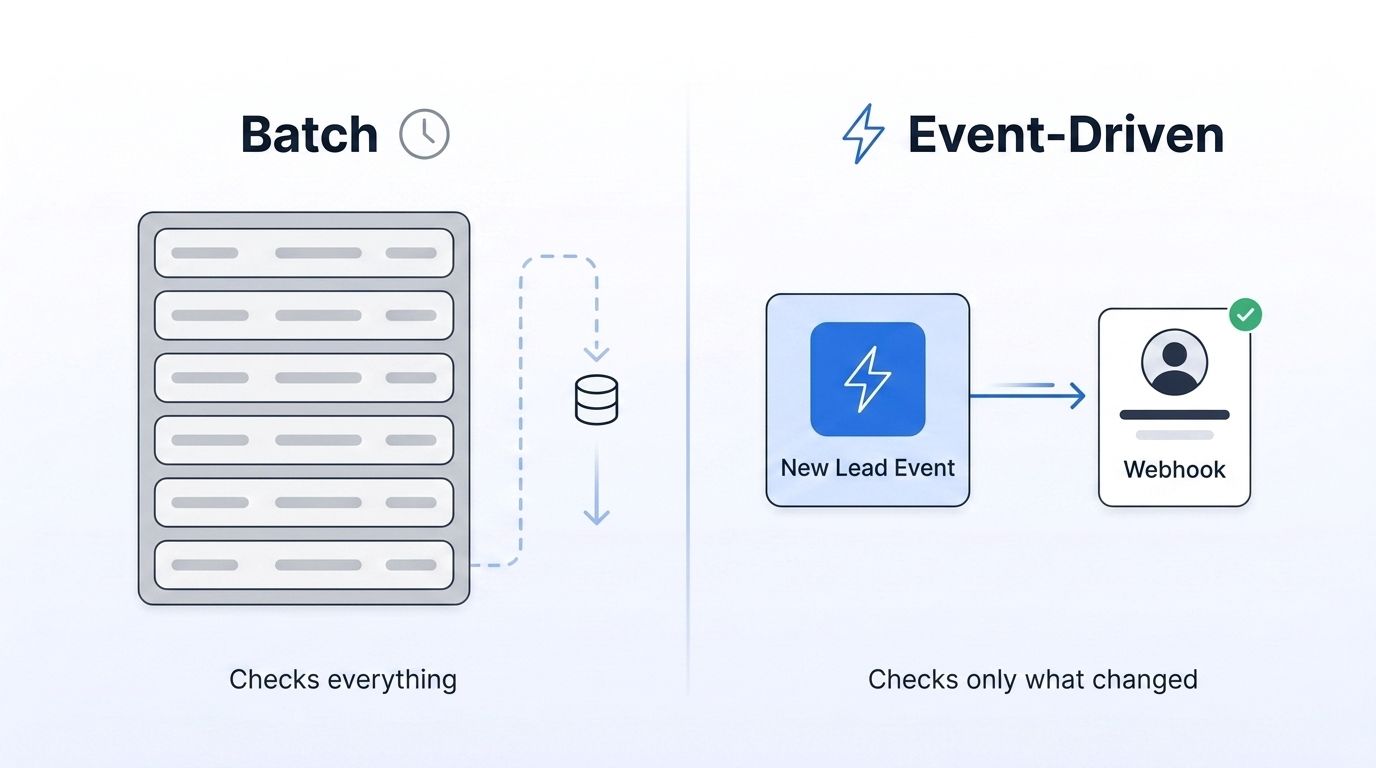
Batch enrichment treats every record the same way: touch it, check it, maybe update it, move to the next one. Event-driven enrichment treats records asymmetrically. A contact who just changed jobs gets enriched immediately. A contact who hasn't moved in three years doesn't get touched until something happens to them, too.
<!-- [UNIQUE INSIGHT] -->Most teams frame "event-driven" as a purely technical upgrade - faster infrastructure, newer tooling. The more useful framing is economic. Batch enrichment spends API credits on a schedule; event-driven enrichment spends them on relevance. You're not paying to refresh 40,000 records every night. You're paying to refresh the ~800 that actually moved.
This isn't a fringe pattern. A widely-cited 2021 Solace/Coleman Parkes survey of 840 organizations found 85% consider event-driven architecture critical business value, but only 13% had reached full maturity (Solace, "The Great EDA Migration", 2021). Most teams agree it's worth doing and still haven't finished doing it - which usually means they tried to convert everything at once instead of one workflow at a time.
Why Does Batch Enrichment Waste Time and Budget?
Batch enrichment wastes budget because it can't tell the difference between a record that changed and one that didn't - it checks all of them anyway. With B2B contact data decaying at roughly 2.1% a month (HubSpot, Database Decay Simulation, retrieved 2026-07-20), a weekly batch job re-enriching 40,000 records is spending most of its API calls confirming that ~39,200 records are unchanged.
There's a second cost that's harder to see on an invoice: latency. A lead who fills out a form on Tuesday morning doesn't get enriched until Thursday night's batch run, and by then a rep has either already reached out with incomplete context or missed the window entirely. Isn't that the whole point of enrichment - having the right data before you need it, not after?
Citation capsule: A record decaying at 2.1% a month means a weekly batch job spends the overwhelming majority of its enrichment budget re-verifying data that never changed, while the small fraction that did change often waits days for the next scheduled run to catch it - a delay event-driven triggers eliminate by design.
What Events Should Trigger Enrichment?
The events worth triggering on are the ones that make a record's data wrong or incomplete the moment they happen. A new lead created in your CRM, a form submission, an inbound email reply, a job change, or a company funding announcement all change what "current" looks like for that record - which is exactly when enrichment adds the most value.
Common enrichment triggers fall into a few buckets:
- Record creation - a new lead, contact, or account enters your CRM and needs a first enrichment pass before a rep ever sees it.
- Job changes - a contact moves companies, which invalidates their title, employer, and often their entire buying context. Datamagnet's job-change signal fires the moment this happens instead of waiting for a scheduled re-check.
- Funding events - a target account raises a round, which usually means new budget and new priorities worth re-enriching around. The Funding Rounds endpoint pulls that Crunchbase history on demand.
- Engagement signals - a prospect likes, comments on, or reposts content from a tracked company or keyword, which is a live buying signal worth enriching the moment it fires via a company engagement signal.
Watching teams pick their first trigger is a predictable pattern: they start with "enrich every new lead," ship it in a day, and only then realize job-change and funding triggers are where the actual pipeline lift shows up - because those events touch accounts already in an active deal, not just net-new leads at the top of the funnel.
How Do Webhooks Deliver Enrichment Events in Real Time?
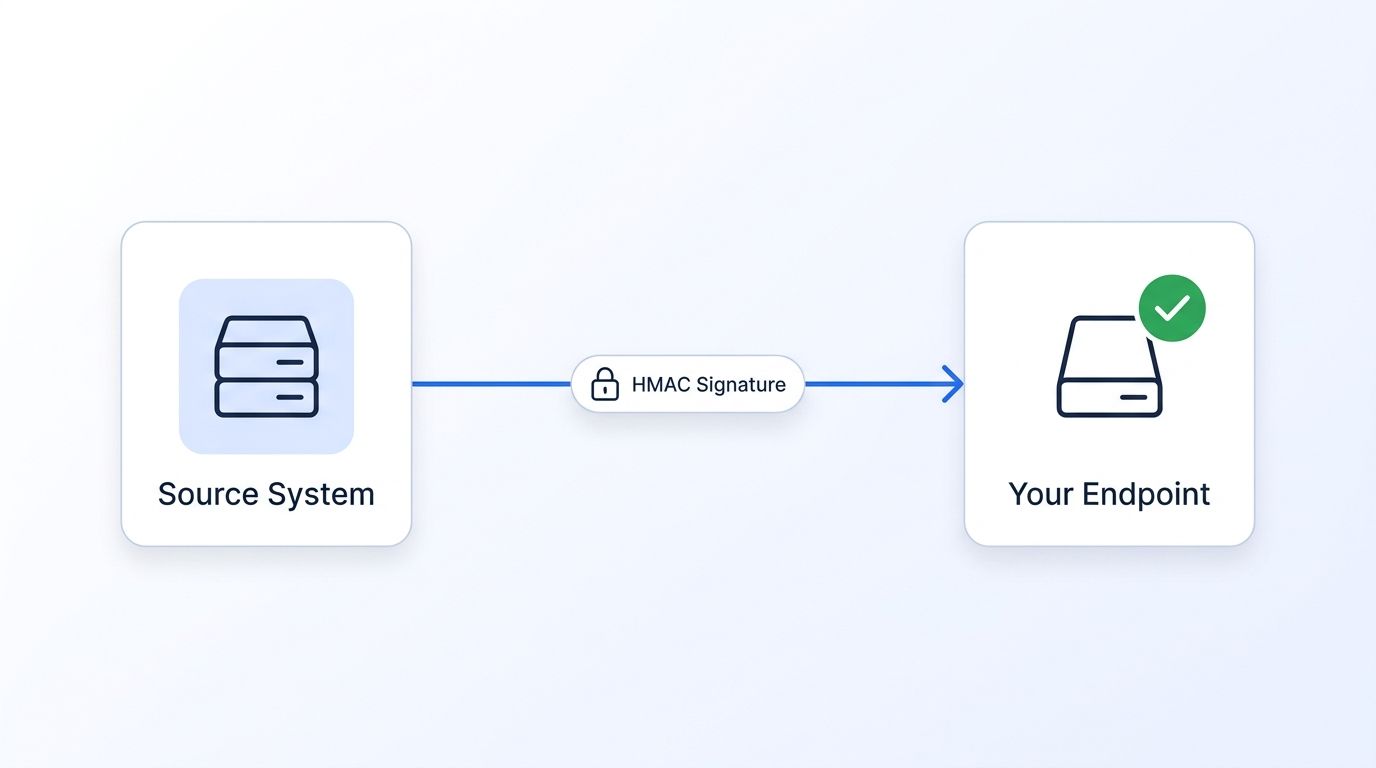
Webhooks deliver enrichment events in real time by having the source system push a notification to your endpoint the instant something happens, instead of your system polling and asking "anything new?" on a loop. That push model is why webhooks, not scheduled polling, are the standard transport for event-driven enrichment pipelines.
Reliability matters as much as speed here - a webhook that fires but never arrives is worse than no trigger at all, since the record silently never gets enriched. Atlassian's Cloud Fortified Marketplace Apps Program requires partner apps to maintain at least 99% webhook delivery success over a rolling 28-day period, with alerts triggered if any 15-minute window drops below that threshold (Atlassian Developer Docs, Cloud Fortified Apps Program, retrieved 2026-07-20) - a useful benchmark for what "production-grade" webhook delivery actually looks like.
Scale is achievable at this reliability bar. Webhook infrastructure provider Hookdeck reports processing over 100 billion webhooks, including absorbing 10x normal traffic during Black Friday 2024 without a single timeout (Hookdeck Engineering Blog, "Webhooks at Scale", 2025). Datamagnet delivers signal notifications via webhook the same way, with HMAC signature verification so your endpoint can confirm a payload actually came from Datamagnet before your enrichment logic acts on it.
How Should You Handle Retries and Errors Without Duplicating Work?
You handle retries without duplicating work by pairing exponential backoff with idempotent processing, so a retried delivery updates the same record instead of creating a second one. Networks drop packets and enrichment APIs occasionally return transient errors - the question isn't whether a delivery will fail, it's what your pipeline does next.
AWS documents exponential backoff as its standard pattern for handling transient errors like 429 or 503 responses, with an example configuration escalating retry delays through a 1.5x multiplier - 3 seconds, then 4.5, then 6.75 (AWS Prescriptive Guidance, "Retry with Backoff Pattern", retrieved 2026-07-20). Google Cloud's formula is similar in spirit: wait time equals the minimum of (2^n plus a random jitter in milliseconds) and a capped maximum, typically 32 to 64 seconds, with jitter recalculated on every retry to keep clients from retrying in sync (Google Cloud Docs, "Exponential Backoff", retrieved 2026-07-20).
Backoff alone isn't enough. Without idempotency - processing the same event twice and getting the same result, not a duplicate - a retried webhook can enrich a record twice, double-fire a downstream automation, or double-count a signal. Check Datamagnet's error reference to distinguish retryable errors (rate limits, timeouts) from ones that need a different fix, and use each webhook's event ID as an idempotency key so a redelivered payload gets recognized and skipped rather than reprocessed. If you need to change what a signal delivers - pause it, adjust its target list, or redirect its webhook - the Update Signal endpoint handles that without tearing down and recreating the monitor.
<!-- [ORIGINAL DATA] -->Teams that skip idempotency almost always find out the hard way: a brief upstream outage triggers a burst of retried webhooks, and a record that should have been enriched once shows up enriched three times in the activity log, each write overwriting the last with data that was already correct the first time.
Why Does Speed-to-Enrichment Matter for Sales Conversion?
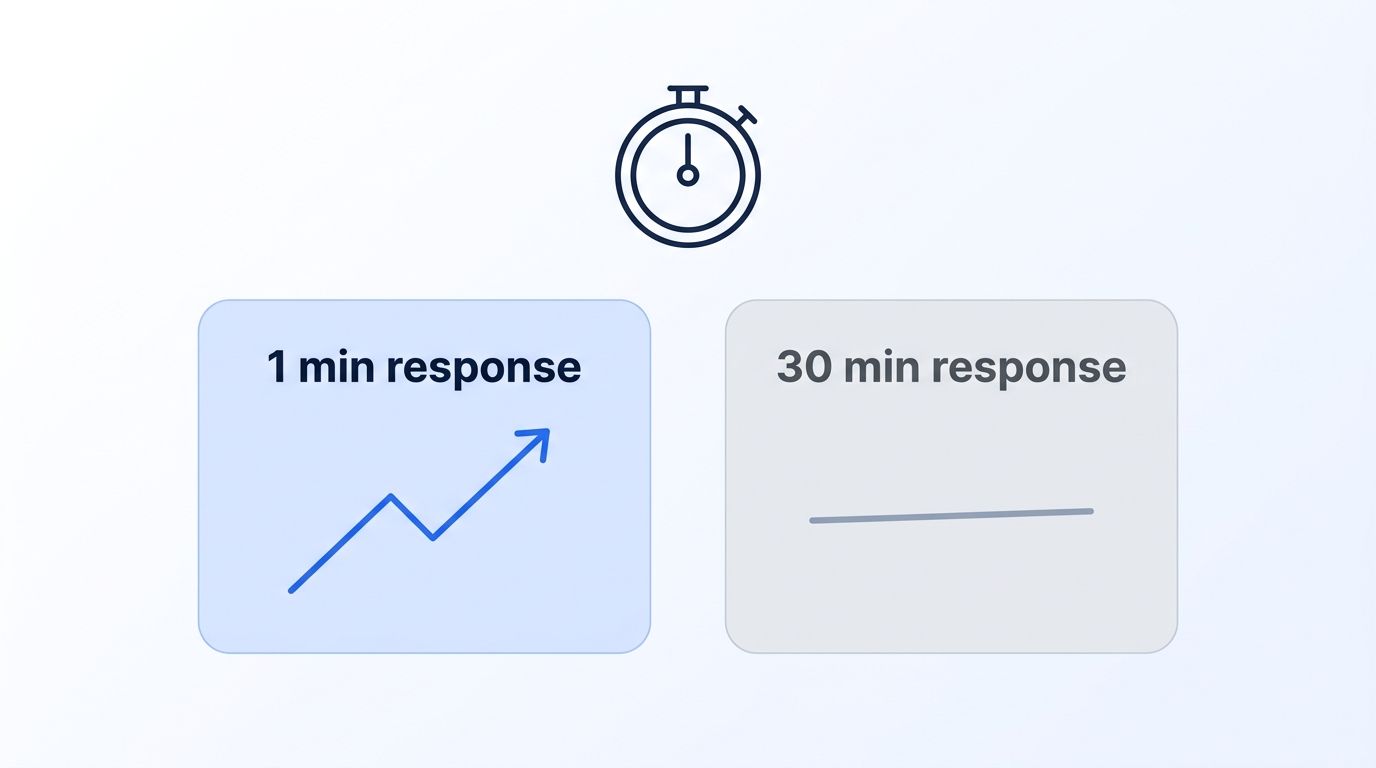
Speed-to-enrichment matters because the value of enriched data decays within minutes of a lead arriving, not days. Responding to a lead within the first minute increases conversion by 391%, and instant response drives a 66.7% meeting-booking rate compared with 30% for standard follow-up, based on an analysis of nearly 4 million form submissions (Chili Piper, 2025 Benchmark Report on Demo Form Conversion Rates, Feb 2025).
That pattern isn't new - it's just gotten more expensive to ignore. A landmark 2007 MIT Sloan study, still the most-cited data point on lead response speed, found the odds of successfully contacting a lead drop 100x, and the odds of qualifying that lead drop 21x, when a call happens 30 minutes after inquiry instead of 5 (MIT Sloan / InsideSales.com, "Lead Response Management Study"). A rep can't act on data they don't have yet, and a batch job that runs hours or days later hands them nothing to act on during the window that matters most.
For a closer look at how real-time signals feed this speed advantage, see our post on real-time intent signal APIs for job changes, which applies the same event-triggered principle to detecting when a target buyer is newly in-market.
How Do You Architect This with Datamagnet Signals and Webhooks?
You architect it by registering a signal for the event you care about, pointing its delivery at a webhook endpoint, and letting your enrichment logic run only when that webhook fires. Datamagnet's signal creation endpoint supports job-change, new-post, and keyword, industry, company, or person engagement events - each one a candidate trigger for a different enrichment workflow.
Two patterns show this well. The Champion Tracker cookbook monitors your existing champion list for job-change signals, so when a power user moves companies, a webhook fires and your CRM re-enriches them at their new employer automatically - no batch job needed to catch the move. The VIP Engagement Radar cookbook does the same for target executives, triggering enrichment and alert delivery the moment a tracked person posts on LinkedIn, so outreach can happen within minutes instead of at the next scheduled check.
Should you replace batch enrichment entirely? Not necessarily - a periodic full-database reconciliation still catches events your triggers weren't configured to watch for. But the day-to-day enrichment work - the leads, the job changes, the funding rounds, the engagement signals - belongs on triggers and webhooks, not a nightly cron job quietly burning through API credits on records that haven't moved.
What's Next for Event-Driven Enrichment Architectures?
What's next is fewer teams treating "event-driven" and "batch" as an either-or choice. The pattern maturing now is hybrid: triggers handle the events that matter in real time, while a lighter, less-frequent batch pass acts as a safety net for anything a trigger missed - not as the primary enrichment mechanism it used to be.
That shift tracks with a broader lesson from distributed-systems adoption: a 2024/2025 CNCF industry survey found 42% of organizations that adopted microservices are now consolidating some services back into larger units, citing debugging complexity and operational overhead (CNCF Annual Survey, as reported by SoftwareSeni, published April 2025). The takeaway for enrichment architecture is the same one: adopt event-driven patterns where the trigger genuinely matches a real business event, not everywhere just because the pattern is available.
Start with One Trigger, Not the Whole Pipeline
Event-driven enrichment beats batch on speed and cost for the same reason: it enriches records when something actually changes, not on a timer that can't tell the difference. Start with a single high-value trigger - job changes or new leads - wire it to a webhook with signed payloads, add exponential backoff and idempotency, and expand from there. See Datamagnet's Signal API for job-change, funding, and engagement triggers and register your first signal this week.
Frequently Asked Questions
What is event-driven data enrichment?
Event-driven data enrichment triggers an API lookup in response to a specific event - a new lead, a job change, a funding round - rather than enriching every record on a fixed schedule. It reduces wasted API calls and cuts the delay between a record changing and your system knowing about it.
How is event-driven enrichment different from batch enrichment?
Batch enrichment checks every record on a timer, whether or not it changed. Event-driven enrichment checks a record only when a relevant event fires - a job-change signal, a form submission, an engagement alert - so API spend tracks actual data changes instead of a calendar.
What events commonly trigger enrichment?
The most common triggers are record creation (a new lead or contact), job changes, company funding announcements, and engagement signals like a LinkedIn post, comment, or share from a tracked company or person. Each maps to a different Datamagnet signal type with its own webhook delivery.
How do webhooks power event-driven enrichment?
A webhook lets the event source push a notification to your endpoint the moment something happens, instead of your system polling on a loop. Production-grade implementations target 99%+ delivery success over rolling windows and use signature verification, like HMAC, so your endpoint can confirm a payload is legitimate before acting on it.
What happens when a webhook delivery fails?
A failed delivery should retry with exponential backoff - escalating delays like 3, 4.5, then 6.75 seconds - rather than retrying instantly and overwhelming the endpoint. Idempotent processing, keyed to each event's unique ID, ensures a retried delivery updates a record once instead of duplicating the enrichment.
Sources
- HubSpot, Database Decay Simulation, retrieved 2026-07-20, https://www.hubspot.com/database-decay
- Chili Piper, 2025 Benchmark Report on Demo Form Conversion Rates, retrieved 2026-07-20, https://www.chilipiper.com/post/form-conversion-rate-benchmark-report
- MIT Sloan / InsideSales.com, Lead Response Management Study, retrieved 2026-07-20, https://www.insidesales.com/response-time-matters/
- Atlassian Developer Docs, Cloud Fortified Apps Program - Webhook Delivery Success Rate, retrieved 2026-07-20, https://developer.atlassian.com/platform/marketplace/cloud-fortified-apps-program-webhook-delivery-success-rate/
- AWS Prescriptive Guidance, Retry with Backoff Pattern, retrieved 2026-07-20, https://docs.aws.amazon.com/prescriptive-guidance/latest/cloud-design-patterns/retry-backoff.html
- Google Cloud Docs, Exponential Backoff, retrieved 2026-07-20, https://docs.cloud.google.com/memorystore/docs/redis/exponential-backoff
- Hookdeck Engineering Blog, Webhooks at Scale: Best Practices and Lessons Learned, retrieved 2026-07-20, https://hookdeck.com/blog/webhooks-at-scale
- Solace / Coleman Parkes Research, The Great EDA Migration, retrieved 2026-07-20, https://www.prnewswire.com/news-releases/the-great-eda-migration-85-of-businesses-striving-for-event-driven-architecture-301432457.html
- CNCF Annual Survey (as reported by SoftwareSeni), The Great Microservices Consolidation, retrieved 2026-07-20, https://www.softwareseni.com/the-great-microservices-consolidation-what-the-cncf-2025-survey-reveals-about-industry-trends/
- Datamagnet, Webhooks, retrieved 2026-07-20, https://docs.datamagnet.co/api-reference/webhooks
- Datamagnet, Create Signal, retrieved 2026-07-20, https://docs.datamagnet.co/api-reference/endpoints/signal-create
