
Disclosure: This article is published by Datamagnet. Vendor claims are self-reported unless otherwise noted.
Building a Data Quality Team: Roles, Skills & Hiring Guide
In 2025, 64% of data leaders named data quality their single biggest data integrity challenge, up from 50% just two years earlier (Precisely and Drexel University LeBow College of Business, 2025 Outlook: Data Integrity Trends and Insights). That's what happens when "everyone's job" quietly becomes no one's job. This guide walks through when to hire your first dedicated data quality person, which roles to build around them, and how to scale from one hire to a full function.
TL;DR
- 64% of data leaders call data quality their top challenge, and 67% don't fully trust their data for decisions (Precisely, 2025).
- Poor data quality costs organizations an average of $12.9 million a year (Gartner), and IBM found 7% of orgs lose $25M+ annually (IBM IBV, 2025).
- Data quality ownership today is scattered across seven different job functions — the core reason it needs a dedicated owner (Monte Carlo/Wakefield Research).
- Governance teams split almost evenly between centralized, federated, and hybrid structures — there's no single right answer (Board.org, 2025).
- Start with one generalist hire, then add a data steward and a data quality engineer as data volume and AI initiatives grow.
When Do You Need a Dedicated Data Quality Team?
You need a dedicated data quality team once bad data starts costing you real money, not just annoyance. Gartner's benchmark study of 154 reference customers puts the average cost of poor data quality at $12.9 million a year, and it's not a one-time expense — it compounds every quarter you leave it unowned (Gartner, Data Quality topic page).
A few concrete signals tell you it's time:
- You're launching AI initiatives. Gartner predicts that through 2026, organizations will abandon 60% of AI projects that lack AI-ready data, and a Q3 2024 survey of 248 data management leaders found 63% aren't confident their data practices are actually ready (Gartner, February 2025). No AI model survives on stale contact records and duplicate accounts.
- Losses are already visible on a spreadsheet. In 2025, IBM's Institute for Business Value found more than a quarter of organizations estimate they lose over $5 million a year to poor data quality, with 7% reporting losses of $25 million or more (IBM Institute for Business Value, The True Cost of Poor Data Quality, 2025).
- Your CRM and contact data are decaying faster than you can clean it. In 2026, ZeroBounce's analysis of more than 11 billion verified email addresses found that at least 23% of email lists decay every year — a "low-end estimate" by the company's own admission (ZeroBounce, The Email List Decay Report for 2026).
If any of these hit close to home, the fix isn't a one-off cleanup sprint. It's a team whose job is making sure the mess doesn't come back. Teams pulling in real-time company and people data through an API instead of a static purchased list start this conversation from a much smaller decay problem.
What Roles Make Up a Data Quality Team?
A data quality team is rarely one job title doing everything — it's a small cluster of roles that split ownership between the technical pipeline and the business definitions. In its most recent ownership survey, Monte Carlo and Wakefield Research found data quality responsibility split across seven functions: 50% data engineering, 22% data analysts, 9% software engineering, 7% data reliability engineering, 6% analytics engineering, 5% data governance, and 3% non-technical business stakeholders (Monte Carlo and Wakefield Research, Annual State of Data Quality Survey).
<!-- [UNIQUE INSIGHT] -->That spread is the real argument for dedicating roles instead of leaving quality to whoever touches the pipeline last. When seven functions each own a slice, nobody owns the outcome — and outcomes are what a hiring manager, not a diagram, gets held accountable for.
The core roles worth budgeting for:
- Data Quality Analyst — profiles data, flags anomalies, and runs day-to-day remediation. Usually your first hire.
- Data Quality Engineer — builds the pipelines, validation rules, and automated cleansing that scale beyond manual fixes.
- Data Steward — a business-side role (per the DAMA-DMBOK framework) who defines what "correct" means for a given domain, like accounts or contacts.
- Data Custodian — the technical implementer of governance controls, often an engineer or DBA by background.
- Data Owner — a senior leader accountable for a data domain's policy and budget, not its day-to-day upkeep.
- Data Governance Lead — coordinates stewards, owners, and policy across domains once you have more than one steward.
Isn't it a little strange that "data governance" is only 5% of who actually owns quality today? That gap between who's accountable on paper and who's fixing records in practice is exactly what a dedicated team closes. Datamagnet's own API reference documents structured company and people fields precisely so a data quality engineer has a clean, typed source to validate against instead of scraped HTML.
What Skills Should You Hire For?
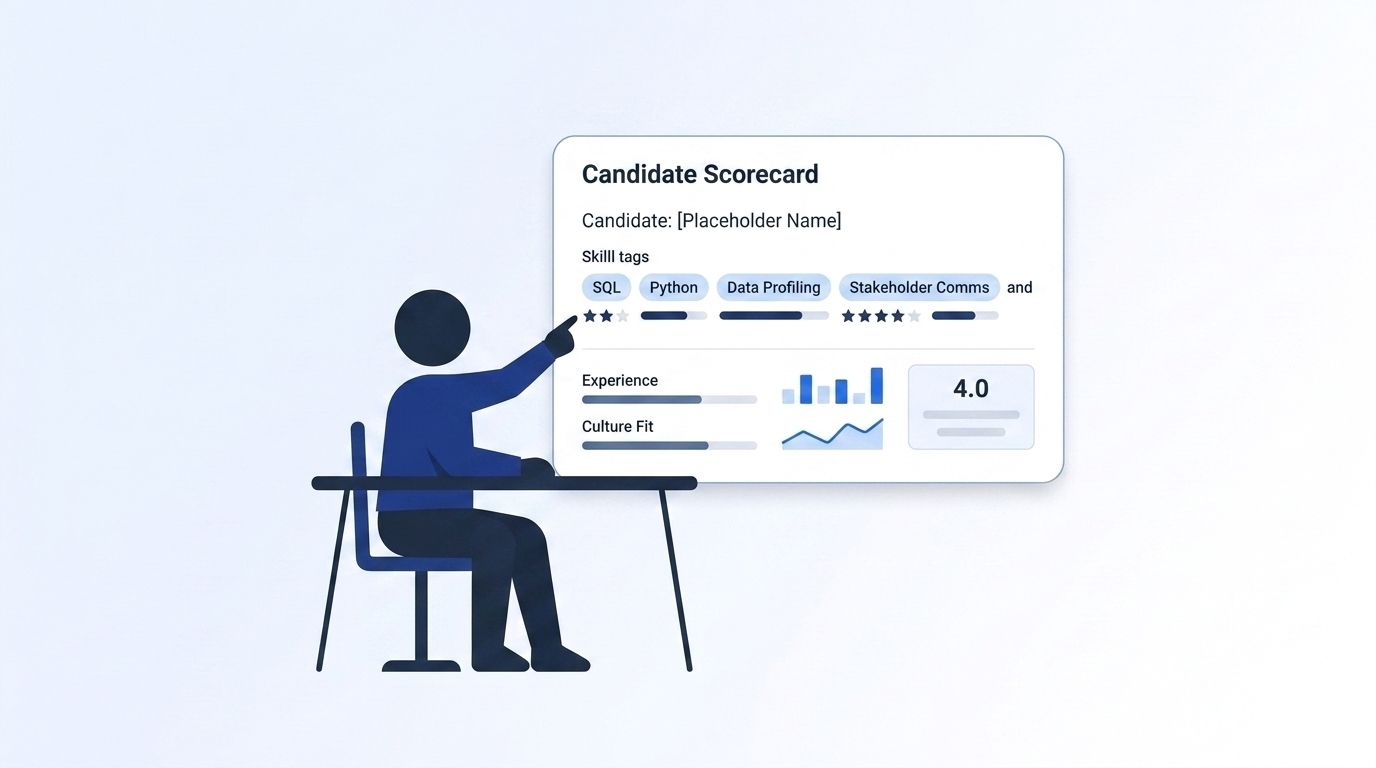
Hire for a mix of SQL fluency, profiling-tool experience, and the communication skills to tell a VP why their favorite dashboard is wrong. A data quality analyst who can write a query but can't explain the fix in plain English will get overridden by the next executive with a strong opinion and a spreadsheet.
Technical skills to screen for:
- SQL and Python for profiling, deduplication logic, and validation scripts
- Experience with a data observability or quality platform (Monte Carlo, Great Expectations, Datafold, or similar)
- Familiarity with ETL/ELT tooling — quality rules live inside the pipeline, not bolted on after
- Basic API literacy, since enrichment and validation increasingly happen through structured endpoints rather than manual lookups
Soft skills that matter just as much:
- Documentation habits — undocumented fixes get silently undone
- Stakeholder communication — translating "we're deduping the accounts table" into "your pipeline reports will be 12% more accurate"
- Comfort saying no to a launch until a validation rule passes
For your first data quality engineer specifically, weight pipeline and automation experience over raw analyst polish — they'll spend more time preventing the next mess than cleaning the current one.
Where Should the Data Quality Team Sit in Your Org?
There's no single correct place for a data quality team to report — the data backs that up directly. In 2025, Board.org found governance teams split almost evenly between three structures: 36% centralized, 36% federated, and 29% hybrid (Board.org, 2025 State of Enterprise Data Governance Report).
A centralized team sits inside data engineering or IT and sets standards for the whole company. It's easier to keep consistent, but it can become a bottleneck once every product team needs its own review.
A federated model embeds a steward or analyst inside each business unit, so quality work happens close to where the data is created. It scales better with headcount but risks each unit defining "clean" differently.
A hybrid model — a small central team setting standards, with embedded stewards enforcing them locally — is what most maturing teams land on. Airbnb documented exactly this shift in 2019: a central data engineering team set tooling and standards while "data engineering pods" of three or more engineers sat inside product teams, backed by a certification process called Midas that gated releases on data quality (Airbnb Engineering, Data Quality at Airbnb, 2020).
Whichever model you pick, document who owns escalation when a data issue crosses team lines — that single decision prevents more finger-pointing than any org chart. It's also worth reviewing how your data vendors handle security and data practices before you hand any team ownership of a shared source of truth.
How Do You Scale From One Hire to a Full Team?
Most companies scale a data quality function in four stages, and the trigger for each stage is data volume and initiative complexity, not a fixed headcount number. Start with a single generalist, then add specialization as the volume of records — and the number of teams depending on them — grows past what one person can review by hand.
Stage 1 — one generalist analyst. Handles profiling, deduplication, and ad hoc fixes. Sufficient while one system (usually the CRM) is the main data source.
Stage 2 — analyst plus engineer. Once manual fixes can't keep pace, a data quality engineer automates validation rules and builds monitoring into the pipeline instead of running checks by hand.
Stage 3 — steward network plus governance lead. As more business units touch the data, embedded stewards define domain-specific rules while a governance lead coordinates policy across them.
Stage 4 — full function with executive ownership. At scale, a Chief Data Officer or VP of Data owns budget and strategy, with data product managers translating quality work into roadmap priorities.
<!-- [UNIQUE INSIGHT] -->The market is backing this trajectory: the global data quality tools market is valued at roughly $2.8-2.96 billion in 2025 and growing 13.7-17.9% a year through the early 2030s (Grand View Research and Mordor Intelligence, 2025-2026 market reports). Tooling spend growing faster than headcount usually means teams are automating stage 2 and 3 work sooner than they used to, which changes what you should hire for first — engineers before analysts, in a lot of 2026 org charts.
Companies enriching accounts and contacts through company and people datasets that stay fresh at the source tend to reach Stage 3 with a smaller team, since less of stage 1 and 2's work is manual reconciliation against stale records.
What Does a Data Quality Team Cost?
Budget roughly $72,000 to $143,000 a year for a Data Quality Analyst and $104,000 to $163,000 for a Data Quality Engineer, with senior engineers averaging around $155,600 as of mid-2026 (Glassdoor, ZipRecruiter, and Salary.com salary data, 2026). Weigh that against Gartner's $12.9 million average annual cost of poor data quality, and a first hire pays for itself fast in most mid-market companies.
Two things move the number more than title: whether you're hiring in a major tech hub, and whether the role owns tooling procurement on top of the work itself. A data quality engineer negotiating a platform contract is worth more than one running scripts against a spreadsheet.
Ready to cut the manual cleanup work your first hire would otherwise inherit? See how Datamagnet's real-time company and people API keeps your source data current before it ever reaches your team's queue.
Frequently Asked Questions
What's the difference between a data steward and a data quality analyst?
A data steward is a business-side role that defines what "correct" means for a domain, like which fields make a contact record valid. A data quality analyst is the technical role that profiles data, finds violations of that definition, and fixes them. Per the DAMA-DMBOK framework, they're deliberately separate so business context and technical execution don't get conflated in one job.
Should data quality report to IT, data engineering, or a business unit?
It depends on your structure — Board.org found governance teams split almost evenly, with 36% centralized, 36% federated, and 29% hybrid in 2025 (Board.org). Centralized suits companies with one dominant data source; federated or hybrid suits companies where multiple business units generate and own their own data.
How many people do you need on a first data quality team?
One. Most companies start with a single generalist analyst handling profiling and remediation on their primary system, usually the CRM. A second hire — typically a data quality engineer to automate validation — comes once manual review can't keep pace with data volume, often within 12-18 months of the first hire.
Can you outsource data quality instead of hiring for it?
You can outsource the tooling and the raw data feed, but not the accountability. Using a real-time enrichment API reduces how much decayed data your team has to catch in the first place, but someone internal still needs to own validation rules, escalation, and the definition of "correct" for your business.
Sources
- Precisely and Drexel University LeBow College of Business, 2025 Outlook: Data Integrity Trends and Insights, retrieved 2026-07-19, https://www.precisely.com/blog/data-integrity/2025-planning-insights-data-quality-remains-the-top-data-integrity-challenges/
- Gartner, Lack of AI-Ready Data Puts AI Projects at Risk, retrieved 2026-07-19, https://www.gartner.com/en/newsroom/press-releases/2025-02-26-lack-of-ai-ready-data-puts-ai-projects-at-risk
- Gartner, Data Quality topic page, retrieved 2026-07-19, https://www.gartner.com/en/data-analytics/topics/data-quality
- IBM Institute for Business Value, The True Cost of Poor Data Quality, retrieved 2026-07-19, https://www.ibm.com/think/insights/cost-of-poor-data-quality
- ZeroBounce, The Email List Decay Report for 2026, retrieved 2026-07-19, https://www.zerobounce.net/email-list-decay
- Monte Carlo and Wakefield Research, Annual State of Data Quality Survey, retrieved 2026-07-19, https://www.montecarlo.ai/blog-data-quality-survey
- Board.org, 2025 State of Enterprise Data Governance Report, retrieved 2026-07-19, https://board.org/data/resources/what-we-learned-from-the-2025-state-of-enterprise-data-governance-report/
- Airbnb Engineering, Data Quality at Airbnb, retrieved 2026-07-19, https://medium.com/airbnb-engineering/data-quality-at-airbnb-e582465f3ef7
- Grand View Research, Data Quality Tools Market Report, retrieved 2026-07-19, https://www.grandviewresearch.com/industry-analysis/data-quality-tools-market-report
- Mordor Intelligence, Data Quality Tools Market Report, retrieved 2026-07-19, https://www.mordorintelligence.com/industry-reports/data-quality-tools-market
- Glassdoor, ZipRecruiter, and Salary.com salary data, retrieved 2026-07-19, https://www.glassdoor.com/Salaries/data-quality-engineer-salary-SRCH_KO0,21.htm
- DAMA-DMBOK, Data Quality Management Roles and Responsibilities, retrieved 2026-07-19, https://datamanagement.wiki/data_quality_management_system/roles_and_responsibilities
