
Disclosure: This article is published by Datamagnet. Vendor claims are self-reported unless otherwise noted.
Data Quality SLAs for Vendor Agreements: What to Put in Writing
Most data vendor contracts promise "accuracy" without ever defining it. That's how you end up with a 95% accuracy guarantee that only covers company-name matching, not the phone numbers your reps actually dial. Before your next data vendor starts work, get accuracy, freshness, coverage, and refund terms in writing — not marketing copy.
Key Takeaways
- 76% of CRM users say less than half their organization's data is accurate and complete, and 37% say bad data has directly cost them revenue (Validity, The State of CRM Data Management in 2025, July 2025).
- Vendor "accuracy guarantees" often cover a narrow field (like company match rate) — not the email or phone data you actually rely on. Read the remedy clause, not the headline number.
- Gartner predicts organizations will abandon 60% of AI projects lacking AI-ready data through 2026, raising the stakes on every data contract that feeds a model (Gartner, Lack of AI-Ready Data Puts AI Projects at Risk, Feb 2025).
- Demand four things in writing: field-level accuracy thresholds, a freshness/recency window, a cure period with a prorated refund or credit remedy, and audit rights.
What Is a Data Quality SLA, and Why Do B2B Data Contracts Need One?
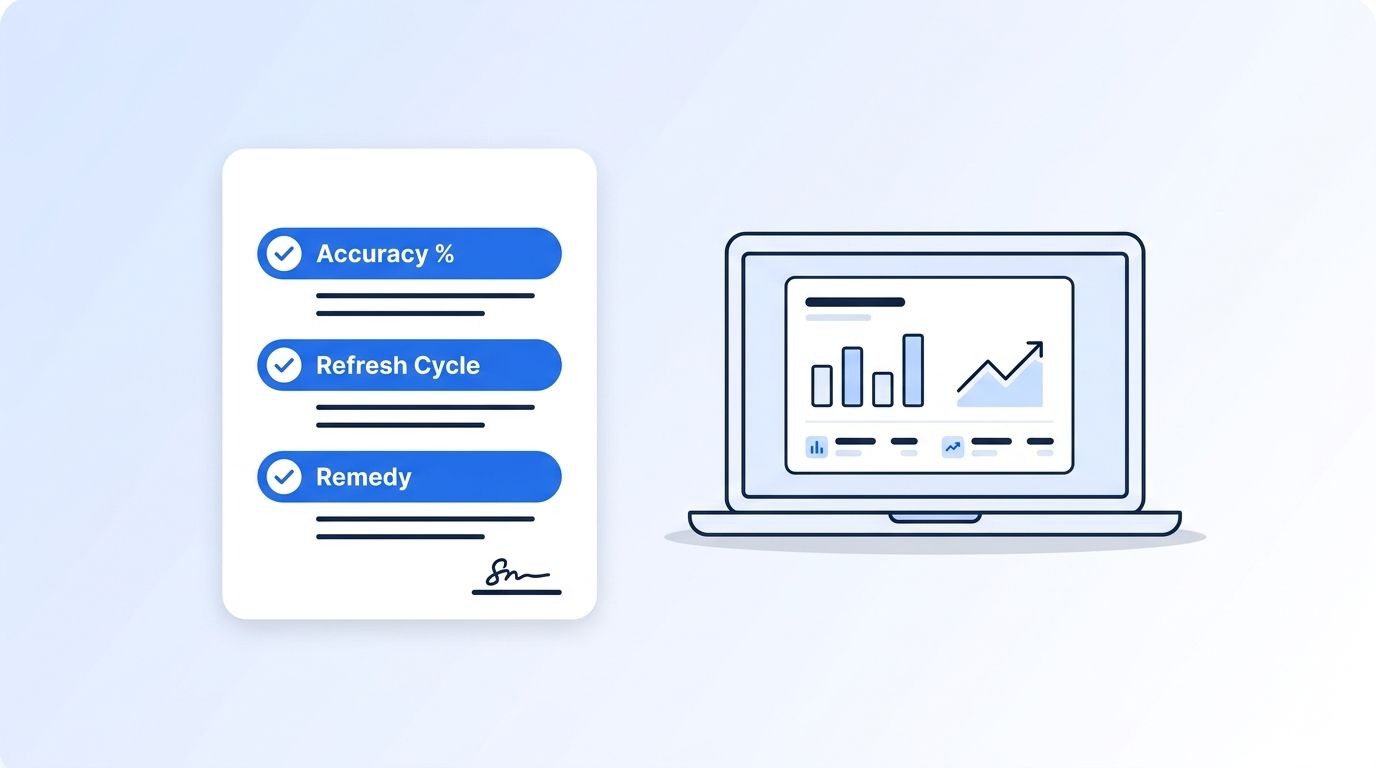
A data quality SLA is a written commitment that defines exactly how accurate, current, and complete a vendor's data must be — plus what happens when it isn't. Without one, "high-quality data" is just a sales adjective, not an enforceable term.
In 2025, Validity surveyed 602 CRM users and admins across the US, UK, and Australia and found that 76% believe less than half of their organization's CRM data is accurate and complete (Validity, The State of CRM Data Management in 2025, July 2025). More strikingly, 37% of those same respondents said poor data quality had directly cost their company revenue — not "might," but did.
That gap between what vendors promise and what buyers experience is exactly why an SLA matters. A verbal assurance from a sales rep isn't binding. A contract clause with a defined threshold, measurement method, and remedy is.
<blockquote>A data quality SLA works only if it names a measurable field (accuracy, freshness, coverage), a threshold, a measurement method, and a remedy — anything short of those four elements is a marketing promise, not a contract term.</blockquote>Buyers tend to negotiate hardest on price and seat count, then accept whatever quality language the vendor's standard terms already include. That's backwards — the quality clause is the one that determines whether the rest of the contract delivers any value at all.
If you're evaluating a data provider's actual capabilities before you negotiate terms, it helps to read the API documentation directly rather than relying on the sales deck — it tells you what fields are actually returned, which is the first input into any accuracy clause.
What Accuracy Guarantees Should You Demand From a Data Vendor?
Ask which specific field the guarantee covers before you accept a headline accuracy percentage. Most published vendor guarantees apply to one narrow field — not the full contact record you're paying for. Take ZoomInfo's own license terms as a real-world example: the company's contractual accuracy guarantee applies specifically to company-affiliation match rate at a 95% threshold, with a defined remedy of a 30-day cure period followed by a prorated refund if the threshold isn't met (ZoomInfo, License Terms and Conditions, current as of 2026). Notice what's absent: no contractual commitment on email deliverability, phone connectivity, or job-title currency — the fields sales teams actually depend on daily.
Cognism takes a different approach for a subset of records, publishing that phone-verified mobile numbers achieve a 45% correct-person pickup rate in independent testing, versus 18% for unverified numbers in the same 1,000-contact sample (Cognism, Diamond Data, 2025). That's a vendor disclosing a specific, testable number for a specific data type — which is the standard you should ask every vendor to meet, not just the one who volunteers it.
When you're drafting your own accuracy clause, specify:
- Which fields are covered (email, direct dial, mobile, job title, company, headcount)
- The minimum accuracy percentage per field, not a blended average
- How accuracy will be measured (independent sample audit, your own match-back testing, or a named third-party auditor)
- How often that measurement happens
How Fresh Should Your Vendor's Data Be?
Freshness matters as much as accuracy, because a correct record today can be wrong in three months. People change jobs, companies get acquired, and phone numbers get reassigned — a static database decays the moment it's captured. Rather than accepting a vague "regularly updated" promise, ask for a defined refresh cycle per field. Cognism, for example, publishes that 95% of its director-level-and-above contact records are refreshed on a 30-day cycle (Cognism, Diamond Data, 2025) — a specific, checkable commitment you can hold a vendor to.
Industry estimates on how fast B2B contact data decays vary widely — commonly cited figures range from roughly 20% to 40% per year depending on which fields are tracked and how "decay" is defined, and no single authoritative study nails down one universal number. Don't let a vendor cite a precise decay percentage as if it's settled science; ask them to define their own refresh cadence instead and put that cadence in the contract.
A freshness clause should specify:
- The maximum age of a record before it's re-verified (e.g., 30, 60, or 90 days)
- Whether refresh applies to the whole database or only accessed/queried records
- What happens to records that fall outside the refresh window — are they flagged, suppressed, or silently served as-is?
Real-time, request-time data collection sidesteps the freshness question differently than a static database does, since a record is only as old as the last API call — worth understanding how a vendor's collection model works before you write a freshness clause around a database snapshot that may not apply.
What Remediation and Credit-Back Terms Protect You When Data Fails?
An accuracy threshold without a remedy is just a number on a page. Before you sign, get a specific answer to: what happens, in writing, when the vendor misses the threshold you agreed to? The ZoomInfo cure-period model is a useful template: identify the shortfall, give the vendor a defined window (commonly 30 days) to fix it, and if it's still unmet, apply a prorated refund or credit (ZoomInfo, License Terms and Conditions, current as of 2026). Whatever structure you negotiate, make sure the contract answers these questions explicitly:
- Who reports the shortfall — you, the vendor, or a neutral auditor — and within what timeframe?
- What counts as evidence (a sample audit of N records, bounce/dial data, CRM match-back reports)?
- Is the remedy a credit, a refund, an extension of contract term, or replacement records?
- Does the remedy apply retroactively to records already used, or only going forward?
Teams that skip this section almost always regret it during a renewal conversation, when the vendor has no contractual obligation to do anything about the stale records the team has been complaining about for two quarters.
Also check how billing interacts with quality — some usage-based data APIs charge credits per request regardless of match quality, so it's worth confirming the credit consumption model and error-handling behavior before you assume a bad match doesn't cost you anything.
How Do You Monitor and Enforce a Data Quality SLA After Signing?
Signing the SLA is the easy part. Enforcing it requires an ongoing measurement process that both sides agree to before the contract starts, not after a dispute begins. Set up a recurring sample audit — pull a random set of records (100-500, depending on volume) on a monthly or quarterly cadence and check them against a source of truth: a phone dial test, an email deliverability check, or a manual LinkedIn cross-reference. Track the results against your contracted thresholds, field by field, not as a single blended score.
<blockquote>An SLA that's only checked once, at renewal time, isn't really being enforced — it's being hoped for. Build the audit cadence into the contract itself, with a named owner on both sides.</blockquote>Give yourself audit rights explicitly in the contract language — the right to request a sample, the right to a named contact for disputes, and the right to terminate for cause if the vendor misses thresholds across multiple consecutive audit periods. Compare how different vendors structure pricing and terms — a pay-as-you-go, credit-based model creates different incentives around data quality than an annual seat license, since you're only paying for records you actually pull.
Why Does AI Make Data Quality SLAs More Urgent in 2026?
As of 2025, Gartner found that 63% of organizations either lack, or aren't sure they have, the right data management practices to support their AI initiatives, based on a survey of 248 data management leaders (Gartner, Lack of AI-Ready Data Puts AI Projects at Risk, Feb 2025). The firm also predicts that through 2026, organizations will abandon 60% of AI projects that aren't backed by AI-ready data.
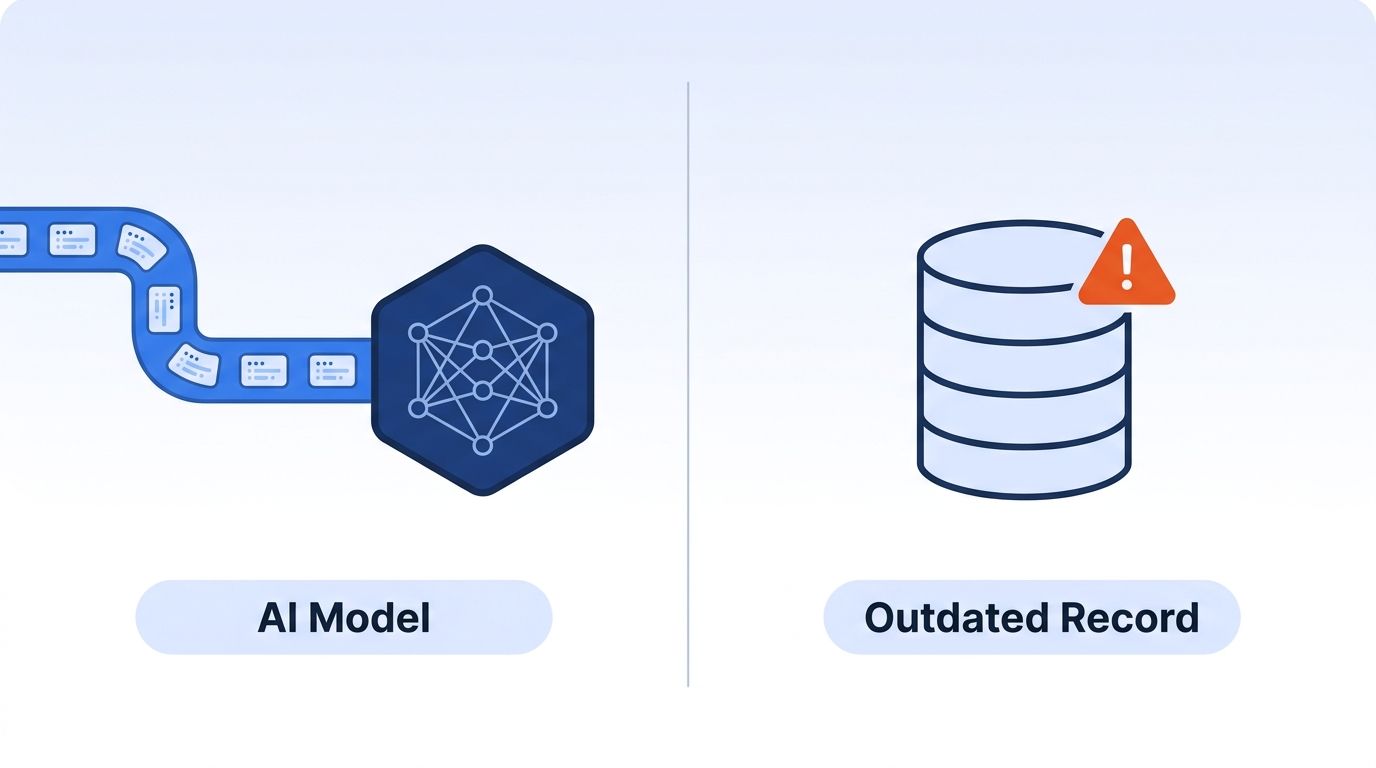
That matters for vendor contracts because AI models trained or triggered on vendor data inherit whatever quality problems the underlying records carry — at scale, and often invisibly, since a model doesn't flag a stale phone number the way a human rep might.
There's a legal dimension too. In November 2025, Debevoise & Plimpton flagged that many existing vendor and partner data contracts — some predating generative AI entirely — contain use-limitation clauses that block companies from feeding that data into AI models, and firms may be sitting on hundreds or thousands of such contracts with no standardized language (Debevoise & Plimpton, Debevoise Data Blog, Nov 2025). If you're renegotiating a data contract in 2026, add an explicit AI-use clause alongside your quality terms — don't assume the old license language covers it.
Regulated industries face added scrutiny here: the SEC's FY2026 examination priorities, published in November 2025, explicitly call out firm oversight of third-party vendor data management, with AI risk woven through nearly every exam category (U.S. Securities and Exchange Commission, SEC Division of Examinations Announces 2026 Priorities, Nov 2025). If your firm is examined, "we trusted our vendor" isn't a documented control — a written SLA with audit records is.
Ready to Put Measurable Terms in Your Next Data Contract?
Before you renew or sign a new data vendor agreement, pull the current contract and check it against the four elements above: field-level accuracy thresholds, a defined refresh cycle, a remedy with a cure period, and audit rights. If any of the four is missing, that's your negotiation agenda for the next call — not a nice-to-have.
If you're comparing providers, it's worth checking how a request-time LinkedIn data API structures accuracy and freshness differently than a static database vendor, since the two models create very different SLA conversations.
Frequently Asked Questions
These questions cover the details vendors rarely volunteer up front: how accuracy guarantees are scoped, how often data should refresh, what happens when a vendor misses its own threshold, and whether older contracts already restrict AI use. Use the answers below as a checklist before you sign or renew a data vendor agreement.
What's the difference between a data accuracy guarantee and a data quality SLA?
An accuracy guarantee is usually a single marketed number, like "95% accurate," that may apply to only one field. A full data quality SLA defines accuracy per field, a freshness window, a measurement method, and a specific remedy — the guarantee is one input into the SLA, not a substitute for it.
How often should a vendor be required to refresh contact data?
It depends on the field and the vendor's collection model. Some providers commit to a 30-day refresh cycle for senior-level contacts (Cognism, Diamond Data, 2025); request-time APIs refresh at the moment of the query instead of on a fixed schedule. Put whichever model applies into the contract explicitly, rather than accepting "regularly updated."
What should happen if a vendor misses its accuracy threshold?
The contract should specify a cure period (commonly 30 days) for the vendor to fix the shortfall, followed by a defined remedy — a prorated refund, service credit, or contract extension — if the threshold still isn't met, similar to the structure used in ZoomInfo's published license terms (ZoomInfo, License Terms and Conditions, 2026).
Do I need an AI-use clause in a data vendor contract even if we're not using AI yet?
Yes, if there's any chance the data will feed a model later. Legal analysts flagged in late 2025 that many existing data contracts contain use-limitation language written before generative AI existed, which can block AI use even when the underlying data license is otherwise fine (Debevoise & Plimpton, Debevoise Data Blog, Nov 2025).
Conclusion
A vendor's data is only as valuable as the terms backing it up. Before your next contract, get four things in writing: field-level accuracy thresholds, a defined freshness window, a remedy with a cure period, and audit rights to check compliance. Skip any of those and "data quality" stays a marketing claim instead of an enforceable commitment.
For a closer look at how request-time collection changes the freshness conversation, see Datamagnet's LinkedIn Scraper API documentation, or compare vendor models directly on the pricing page before your next renewal.
Sources
- Validity, "The State of CRM Data Management in 2025," retrieved 2026-07-19, https://www.validity.com/resource-center/the-state-of-crm-data-management-in-2025/
- Gartner, "Lack of AI-Ready Data Puts AI Projects at Risk," retrieved 2026-07-19, https://www.gartner.com/en/newsroom/press-releases/2025-02-26-lack-of-ai-ready-data-puts-ai-projects-at-risk
- ZoomInfo, "License Terms and Conditions," retrieved 2026-07-19, https://www.zoominfo.com/legal/ltc
- Cognism, "Diamond Data," retrieved 2026-07-19, https://www.cognism.com/diamond-data
- Debevoise & Plimpton, "AI's Biggest Enterprise Challenge in 2026: Contractual Use Limitations on Data," retrieved 2026-07-19, https://www.debevoisedatablog.com/2025/11/17/ais-biggest-enterprise-problem-in-2026-contractual-use-limitations-on-data/
- U.S. Securities and Exchange Commission, "SEC Division of Examinations Announces 2026 Priorities," retrieved 2026-07-19, https://www.sec.gov/newsroom/press-releases/2025-132-sec-division-examinations-announces-2026-priorities
