
Disclosure: Datamagnet publishes this article. Product capabilities described below are based on public documentation, retrieved August 9, 2026.
Data Quality Scorecards: A Template for Vendor Accountability
A data quality scorecard is a recurring, metric-based report you run against every data vendor you pay for - accuracy, match rate, freshness, and coverage, scored on a fixed cadence instead of trusted from a sales deck. You need one because a vendor's self-reported accuracy and your measured accuracy are rarely the same number.
In 2025, RevOps and Sales Ops leaders rated their B2B data vendors just 5.92 out of 10 on satisfaction, and 56% scored their vendor a 6 or below (DealSignal, Q2 2025 RevOps Benchmarks report, August 2025). This guide gives you a scorecard template you can copy today: the metrics to track, how to weight them, how often to run the review, and what to do when a vendor misses its number.
TL;DR
- RevOps and Sales Ops leaders rate their B2B data vendors 5.92 out of 10 on average, and 56% score a vendor 6 or below (DealSignal, Q2 2025 RevOps Benchmarks).
- Measured field accuracy across enrichment vendors ranged from 69.7% to 94.7% in an independent 2026 test of 282 companies, despite most vendors marketing "90%+ accuracy" (Openbenchmarks, 2026).
- B2B contact data decays about 2.1% a month - roughly 22.5% a year (HubSpot, Database Decay Simulation), so a scorecard has to run continuously, not annually.
- Score every vendor on four weighted metrics - accuracy, match/fill rate, freshness, and coverage - and review the score monthly or quarterly.
- Put teeth in it: tie a scorecard miss to service credits, a remediation deadline, or a termination clause in the contract, not just a Slack complaint to your rep.
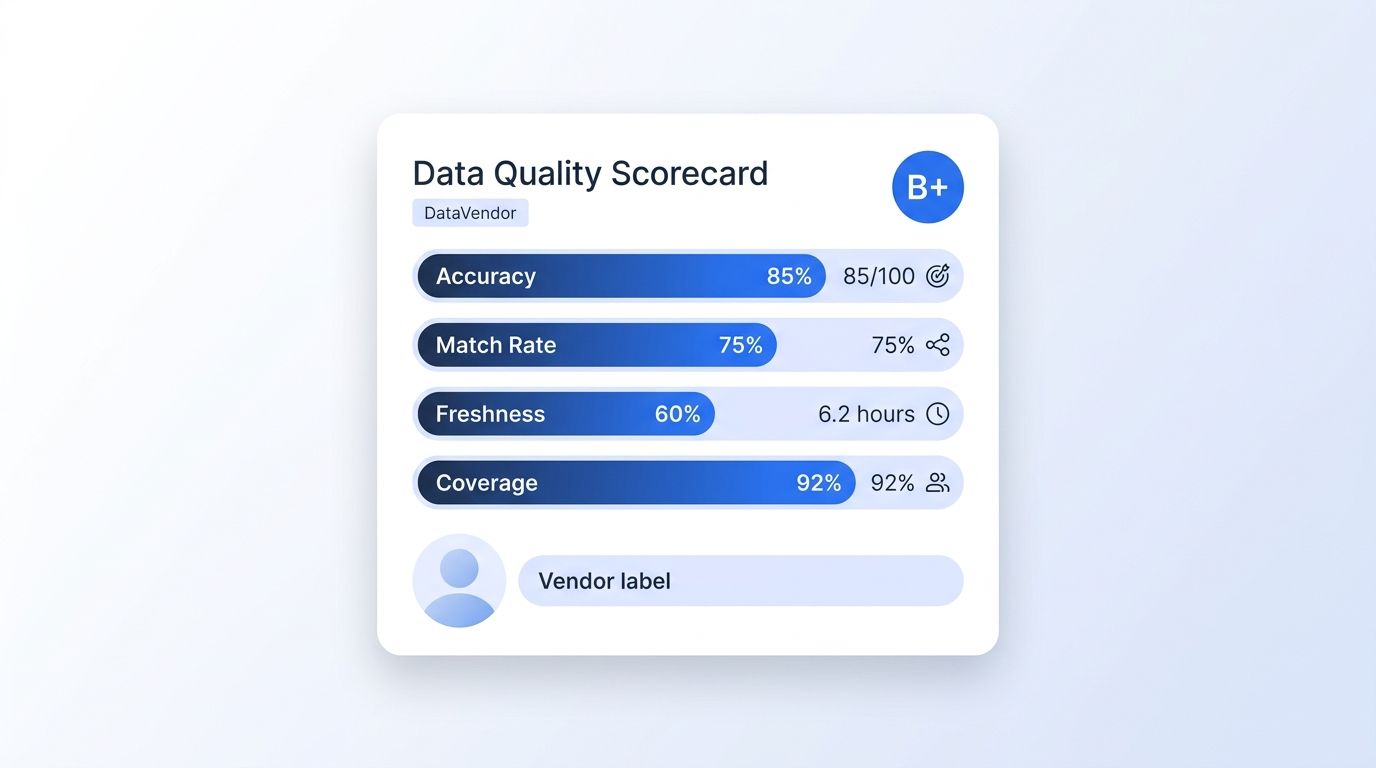
What Is a Data Quality Scorecard?
A data quality scorecard is a standardized report card that scores a data vendor against fixed, measurable criteria on a repeating schedule, instead of relying on the accuracy number printed on their pricing page. It turns "our data provider seems fine" into a number you can track, compare, and hold someone to.
Most teams discover they need one the hard way - a rep pulls a list, half the titles are stale, and nobody can say whether that's normal or a sign the vendor's quality has slipped. A scorecard exists precisely to answer that question with data instead of a gut feeling. It gives your data quality team, procurement, and the vendor themselves a shared, agreed-upon definition of "good enough."
<!-- [UNIQUE INSIGHT] -->Most teams treat vendor evaluation as a one-time decision made during the RFP. That's backwards. The RFP tells you what a vendor claims. A recurring scorecard tells you what a vendor actually delivers, month after month, once the contract is signed and the marketing team stops paying attention. The RFP earns the vendor your business; the scorecard earns them the renewal.
Independent testing backs up why this distinction matters. In a 2026 benchmark of eight B2B company-enrichment providers tested against the same 282 company domains, measured field accuracy ranged from 69.7% to 94.7% - a real spread, even though nearly every vendor in the test marketed "90%+ accuracy" on their own site (Openbenchmarks.com, Best B2B Company Enrichment API, 2026). A scorecard is how you find out which side of that gap your vendor actually lands on.
What Metrics Belong on a Data Quality Scorecard?
The four metrics that belong on every vendor scorecard are accuracy, match rate, freshness, and coverage - each one catches a failure mode the others miss. Skip one, and you'll have a vendor that looks great on the metrics you did check while quietly failing on the one you didn't.
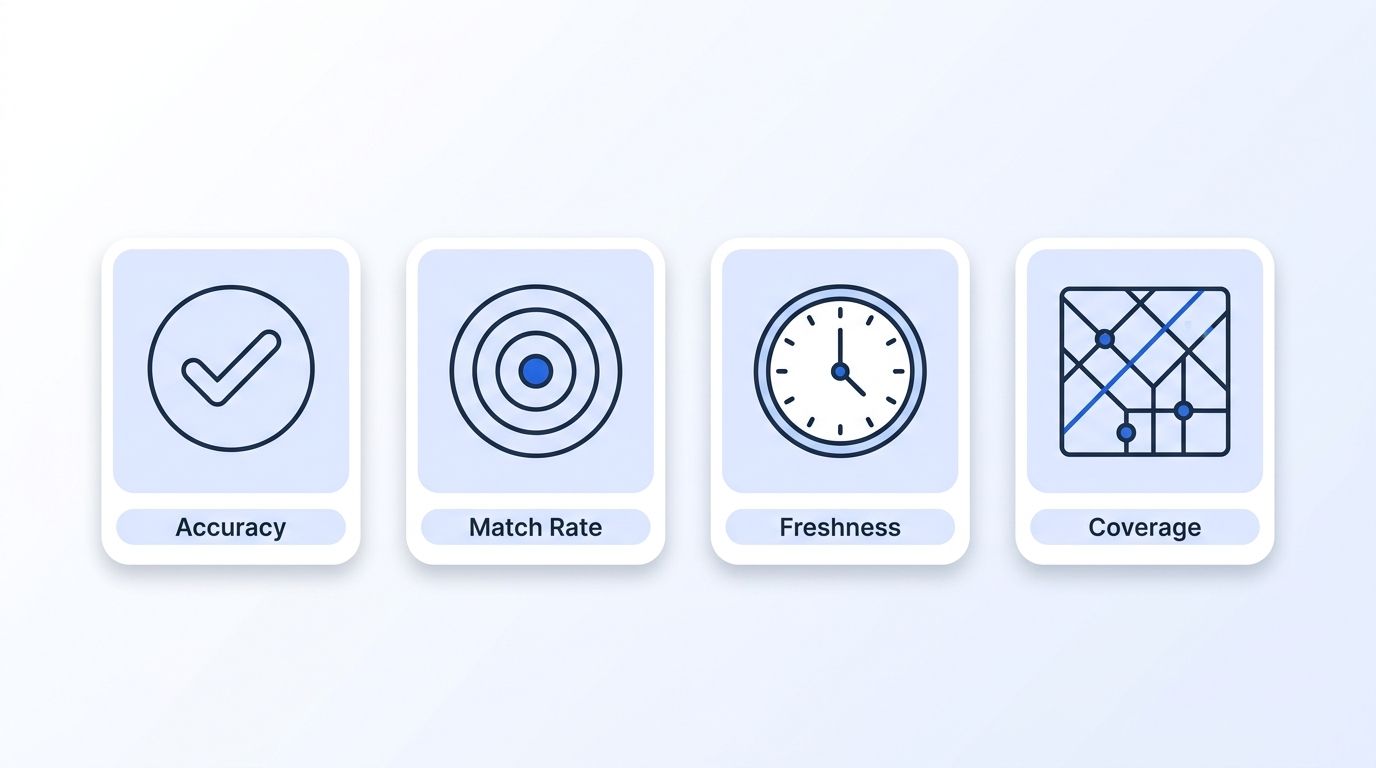
| Metric | What it measures | How to check it |
|---|---|---|
| Accuracy | % of fields (title, company, email, phone) that are correct as of today | Sample records and cross-check against a live source |
| Match/fill rate | % of input records the vendor successfully returns data for | Run a fixed test batch and count non-null returns |
| Freshness | How recently the underlying data was collected or verified | Compare vendor's "last updated" timestamp against known job changes |
| Coverage | % of your target market (ICP) the vendor actually has records for | Cross-reference against your target account/contact list |
Freshness deserves its own line item because accuracy and freshness aren't the same thing - a record can be 100% accurate the day it's collected and wrong three months later without anyone touching it. As of 2026, B2B contact data decays at roughly 2.1% a month, compounding to about 22.5% a year (HubSpot, Database Decay Simulation, based on MarketingSherpa research, retrieved 2026-08-09). A vendor scoring 95% accuracy on a batch pulled last quarter tells you almost nothing about what they're delivering this week.
Citation capsule: A data quality scorecard should score four distinct metrics - accuracy, match rate, freshness, and coverage - because each one exposes a different vendor failure. A vendor can post a high fill rate while returning stale titles, or high accuracy on a small sample while covering a fraction of your actual target market.
How Do You Score and Weight Vendor Data Quality?
You score vendor data quality by assigning each metric a weight based on what actually breaks your workflow when it's wrong, then converting raw measurements into a single number out of 100. Accuracy and freshness usually carry the most weight for sales and recruiting use cases, since a wrong or stale contact does more damage than a slightly lower match rate.
A workable starting formula: Accuracy (40%) + Freshness (25%) + Match rate (20%) + Coverage (15%) = Total score. Multiply each metric's measured percentage by its weight, sum the results, and you get one number a vendor can be held to quarter over quarter. A vendor scoring 92% accuracy, 80% freshness, 85% match rate, and 70% coverage lands at roughly 85/100 - a defensible pass, but one worth watching if freshness keeps trending down.
For fields you can verify live, weight measured data higher than self-reported data. Datamagnet's Company Profile endpoint and People Profile endpoint pull firmographic and person data directly from a company's or individual's current LinkedIn page at request time, which gives you a live comparison point to score any vendor's batch data against - including your own.
How Often Should You Review a Vendor's Scorecard?
Review a vendor's scorecard monthly for high-volume, high-stakes data (contact records feeding active outbound) and quarterly for lower-volume or reference data (firmographic segmentation, funding data). An annual review misses too much - decay doesn't wait for your renewal date.
Isn't it strange that most vendor contracts get reviewed once a year, right when the renewal decision is due, and never in between? By then, a vendor's quality could have slipped for eleven months before anyone noticed. Monthly or quarterly scorecard runs catch a decline early enough to fix it, escalate it, or start evaluating a replacement before you're locked into another year.
<!-- [PERSONAL EXPERIENCE] -->Teams that only check vendor data quality at renewal time consistently describe the same pattern: the number looks fine because nobody measured it in between, not because it stayed fine. A quarterly cadence, minimum, turns "seems okay" into a documented trend line you can actually act on.
If you want the scorecard to catch decay between review cycles instead of waiting for the next scheduled check, register a job-change signal against a sample of vendor-supplied contacts and route the alerts through a webhook. That turns freshness monitoring into a background process instead of a manual quarterly spot-check.
What Should You Do When a Vendor Misses Its Scorecard Targets?
When a vendor misses its scorecard targets, the response should already be written into the contract, not improvised in a Slack message to your account rep. Define three tiers in advance: a warning at a minor miss, a remediation deadline with re-testing at a repeated miss, and a termination or non-renewal right if the vendor fails to recover within an agreed window.
Put the scorecard's weighted score directly into the contract language as the trigger for each tier - for example, "below 80/100 for two consecutive reviews triggers a 30-day remediation period." Vague language like "commercially reasonable accuracy" gives a vendor room to argue; a specific number tied to your scorecard formula doesn't.
Citation capsule: A data quality scorecard only creates accountability if its output is contractually enforceable. Tie specific score thresholds to specific consequences - a remediation deadline, a service credit, or a termination right - so a missed target has a defined next step instead of an informal conversation that goes nowhere.
Before finalizing enforcement language, review how a vendor handles data sourcing and compliance more broadly - see Datamagnet's security and data practices page for the kind of disclosure a scorecard-worthy vendor should be willing to provide about how their data is collected.
A Sample Data Quality Scorecard Template You Can Copy
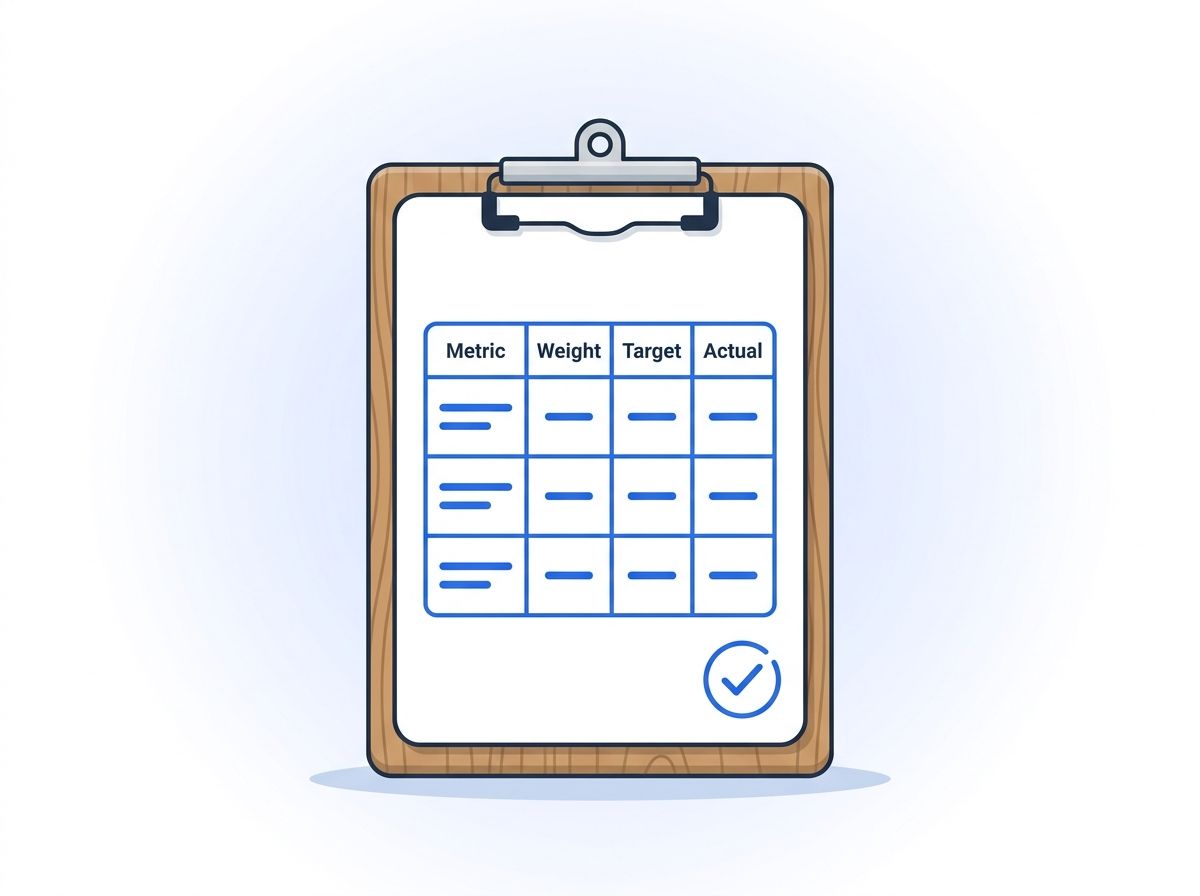
Here's a minimal, four-metric scorecard structure you can drop into a spreadsheet and run against any vendor this quarter. Fill in "Target" from your contract or SLA, "Actual" from your own sampled test, and let the weighted score do the rest of the talking in the renewal conversation.
| Metric | Weight | Target | Actual | Weighted score |
|---|---|---|---|---|
| Accuracy | 40% | ≥ 90% | _____ | _____ |
| Freshness (data ≤ 30 days old) | 25% | ≥ 80% | _____ | _____ |
| Match/fill rate | 20% | ≥ 85% | _____ | _____ |
| Coverage of target ICP | 15% | ≥ 75% | _____ | _____ |
| Total (out of 100) | _____ |
Teams that run this exact four-metric structure against more than one vendor at a time report an unexpected side effect: the scorecard becomes a negotiating tool before it's even a compliance tool. Once two vendors' weighted scores sit side by side in the same spreadsheet, the conversation shifts from "is this vendor good enough" to "why is vendor A eight points behind vendor B on freshness" - a much easier case to make at renewal.
This same logic applies if you're evaluating more than one enrichment source at once. A 2026 independent benchmark found that stacking a second and third data provider in a waterfall lifted right-person match rates from a single best vendor's 51% up to 60-63% (Outbound Kitchen, The 2026 B2B Mobile Data Benchmark, June 2026) - a reminder that a scorecard isn't just for firing underperforming vendors, it's also for deciding whether a single-vendor strategy is even the right call.
Frequently Asked Questions
What is a data quality scorecard?
A data quality scorecard is a recurring report that scores a data vendor against fixed, measurable criteria - typically accuracy, match rate, freshness, and coverage - on a set schedule. It replaces a vendor's self-reported accuracy claim with a number your own team measures and can act on.
What metrics should a data quality scorecard include?
At minimum, include accuracy, match/fill rate, freshness, and coverage of your target market. In 2026, measured accuracy across B2B enrichment vendors ranged from 69.7% to 94.7% in independent testing (Openbenchmarks, 2026), so tracking accuracy alone against a vendor's own claim isn't enough.
How often should you score a data vendor?
Monthly for high-volume contact data feeding active outbound, quarterly at minimum for lower-volume or reference data. B2B contact data decays roughly 2.1% a month (HubSpot, Database Decay Simulation), so an annual review leaves most of the year's decay unmeasured.
Who should own the vendor data quality scorecard?
Ownership typically sits with a data quality or RevOps lead, with input from whoever consumes the data day to day - sales, marketing, or recruiting. The scorecard works best when the same person who feels the pain of bad data also owns the number that holds the vendor accountable for it.
What's the difference between a scorecard and a vendor SLA?
An SLA is the contractual promise; the scorecard is how you measure whether the vendor is actually keeping it. A scorecard without an SLA has no enforcement mechanism, and an SLA without a scorecard has no evidence behind it - you need both working together.
What should you do if a vendor consistently misses its scorecard targets?
Escalate through pre-defined contract tiers: a documented warning, a remediation deadline with re-testing, then termination or non-renewal if the vendor doesn't recover. RevOps and Sales Ops leaders already rate their vendors 5.92/10 on average (DealSignal, 2025), so a documented escalation path protects you from staying with an underperforming vendor by default.
Start Scoring Your Vendors This Quarter
A data quality scorecard turns "our vendor seems fine" into a number you can defend at renewal - accuracy, freshness, match rate, and coverage, weighted and reviewed monthly or quarterly instead of once a year. Write the consequences into the contract before you need them: a warning tier, a remediation deadline, and a termination right tied to a specific score. Compare notes against how Datamagnet's live people and company enrichment measures against a batch vendor's numbers, and see how the underlying data compares directly with Datamagnet vs. ZoomInfo if you're benchmarking a switch. Run the four-metric template above against your current vendor this month - you may find the score tells a different story than the sales deck did.
Sources
- DealSignal, Q2 2025 RevOps Benchmarks: Pipeline, AI & Data Quality, retrieved 2026-08-09, https://www.dealsignal.com/revops-benchmarks-q2-2025-pipeline-ai-data-quality/
- Openbenchmarks.com, Best B2B Company Enrichment API (2026), retrieved 2026-08-09, https://openbenchmarks.com/company-enrichment/best-company-enrichment-api
- HubSpot, Database Decay Simulation, retrieved 2026-08-09, https://www.hubspot.com/database-decay
- Outbound Kitchen, The 2026 B2B Mobile Data Benchmark, retrieved 2026-08-09, https://newsletter.outbound.kitchen/p/the-2026-b2b-mobile-data-benchmark
- Validity, The State of CRM Data Management in 2025, retrieved 2026-08-09, https://www.validity.com/resource-center/the-state-of-crm-data-management-in-2025/
- Datamagnet, Company Profile endpoint, retrieved 2026-08-09, https://docs.datamagnet.co/api-reference/endpoints/company
- Datamagnet, People Profile endpoint, retrieved 2026-08-09, https://docs.datamagnet.co/api-reference/endpoints/people
- Datamagnet, Webhooks, retrieved 2026-08-09, https://docs.datamagnet.co/api-reference/webhooks
