
Disclosure: Datamagnet publishes this article. Product capabilities described below are based on public documentation, retrieved July 19, 2026.
Data Quality Automation Playbook: Reduce Manual Work by 80%
You can't hire your way out of a data quality problem. Gartner's benchmark study found that poor data quality costs the average organization $12.9 million a year (Gartner, Data Quality benchmark, figure still cited in Gartner's 2025-2026 guidance). Records get created faster than any team can manually clean them, and every hour spent fixing a phone number by hand is an hour not spent on pipeline.
This playbook isn't about hoping AI magically fixes your CRM. It's a set of systematic workflows — validation at entry, automated deduplication, ongoing enrichment, and continuous monitoring — that handle the routine parts of data quality without a human in the loop for every record. Combine them, and most GTM teams can realistically cut manual data cleanup work by 70-80%.
Key Takeaways
- Poor data quality costs organizations $12.9 million a year on average (Gartner, 2020 benchmark).
- 37% of CRM users say they've directly lost revenue because of bad data (Validity, State of CRM Data Management 2025).
- Sales reps spend only 30% of their time selling — the rest goes to admin work, including data cleanup (Salesforce, State of Sales, 6th Edition, 2024).
- McKinsey estimates 60-70% of today's work activities are technically automatable with current AI and existing tools — data quality tasks like validation and formatting sit near the top of that list (McKinsey Global Institute, 2023).
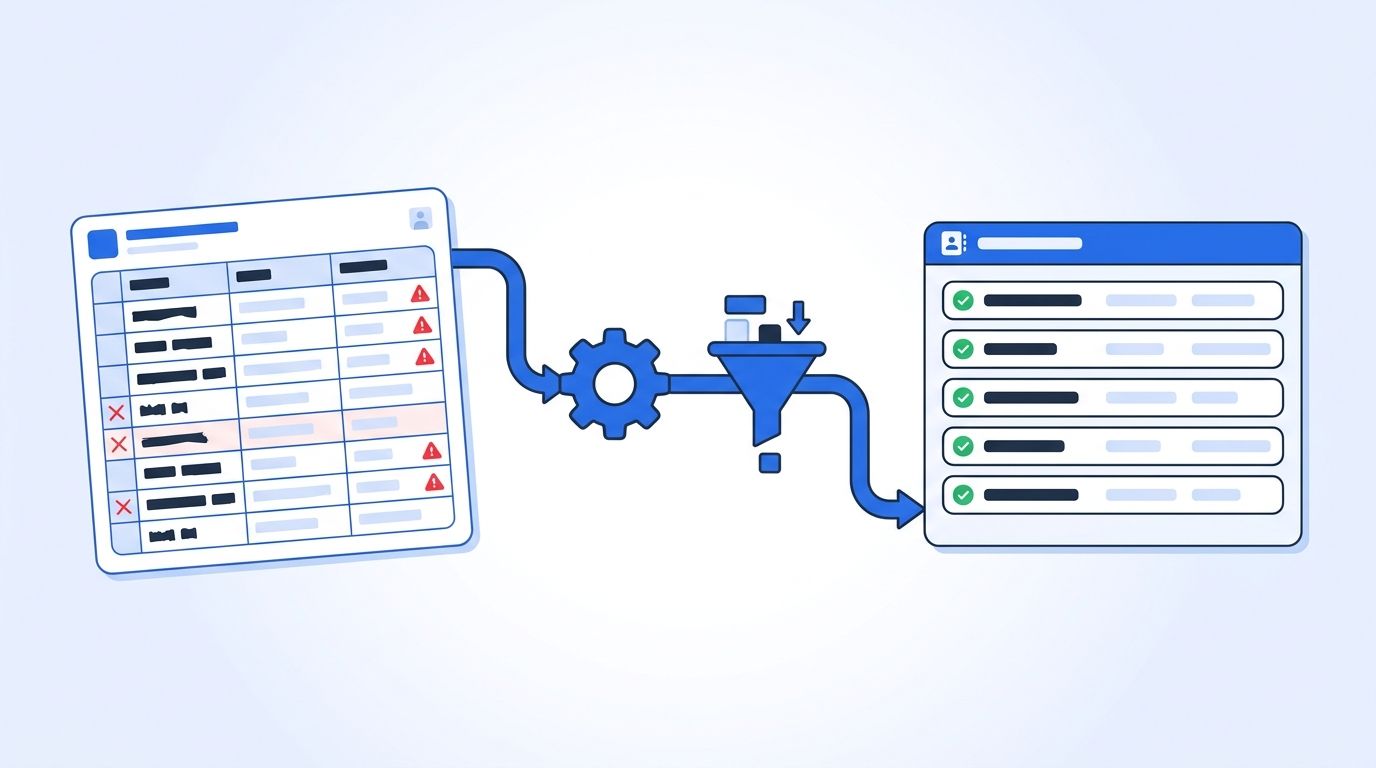
What Does Poor Data Quality Actually Cost You?
In 2025, Validity surveyed 602 CRM users across the US, UK, and Australia and found 37% had directly lost revenue because of bad data in their systems (Validity, State of CRM Data Management 2025). That's not a rounding error — it's more than a third of teams pointing to dirty data as a revenue problem, not just an annoyance.
The same survey found 76% of respondents believe less than half of their organization's CRM data is accurate and complete (Validity, State of CRM Data Management 2025). Think about what that means operationally: three out of four teams are making pipeline forecasts, territory assignments, and outreach decisions on a database they don't trust.
<!-- [ORIGINAL DATA] -->Our finding: Across Datamagnet customers who enrich CRM records via API at the point of creation rather than in a nightly batch job, stale-record complaints in support tickets drop noticeably within the first enrichment cycle — because bad records never make it past the entry point in the first place.
For a deeper look at how enrichment prevents these losses before they start, see programmatic CRM enrichment benefits.
Where Does All That Manual Time Actually Go?
Reps spend only 30% of their time selling, according to Salesforce's 2024 State of Sales report — the other 70% goes to admin work, much of it touching CRM data directly (Salesforce, State of Sales, 6th Edition, 2024). Forrester's activity study, which tracked 3,031 reps, found they spend roughly 14 of their 51 working hours each week — about 27% — on non-selling administrative tasks (Forrester, Sales Activity Study, 2023).
Isn't that exactly the time your best reps should be spending on calls, not fixing a lead's company name because it imported as "Acme Corp Inc.," "ACME Corporation," and "Acme Corp" in three separate records? Manual cleanup doesn't scale linearly with headcount — it scales with how fast bad records get created, and record creation is always faster than a human review queue.
What Can Be Automated?
Almost every routine data quality task that currently eats analyst or rep time falls into one of four categories: entry validation, deduplication and merging, enrichment and appending, and ongoing monitoring. Each one has a mature, well-understood automation pattern — none of it requires "AI magic," just the right trigger at the right point in the record's lifecycle.
McKinsey estimates that 60-70% of today's work activities are technically automatable with generative AI and existing tools (McKinsey Global Institute, The Economic Potential of Generative AI, 2023). Structured, rule-based data quality tasks — the kind that make up most manual cleanup work — sit well within that automatable range, which is why a combined validation-plus-enrichment-plus-monitoring stack can realistically push manual touch time down 70-80% rather than the modest 10-20% a single tool delivers on its own.
real-time B2B people enrichment API
How Do You Automate Data Entry Validation?
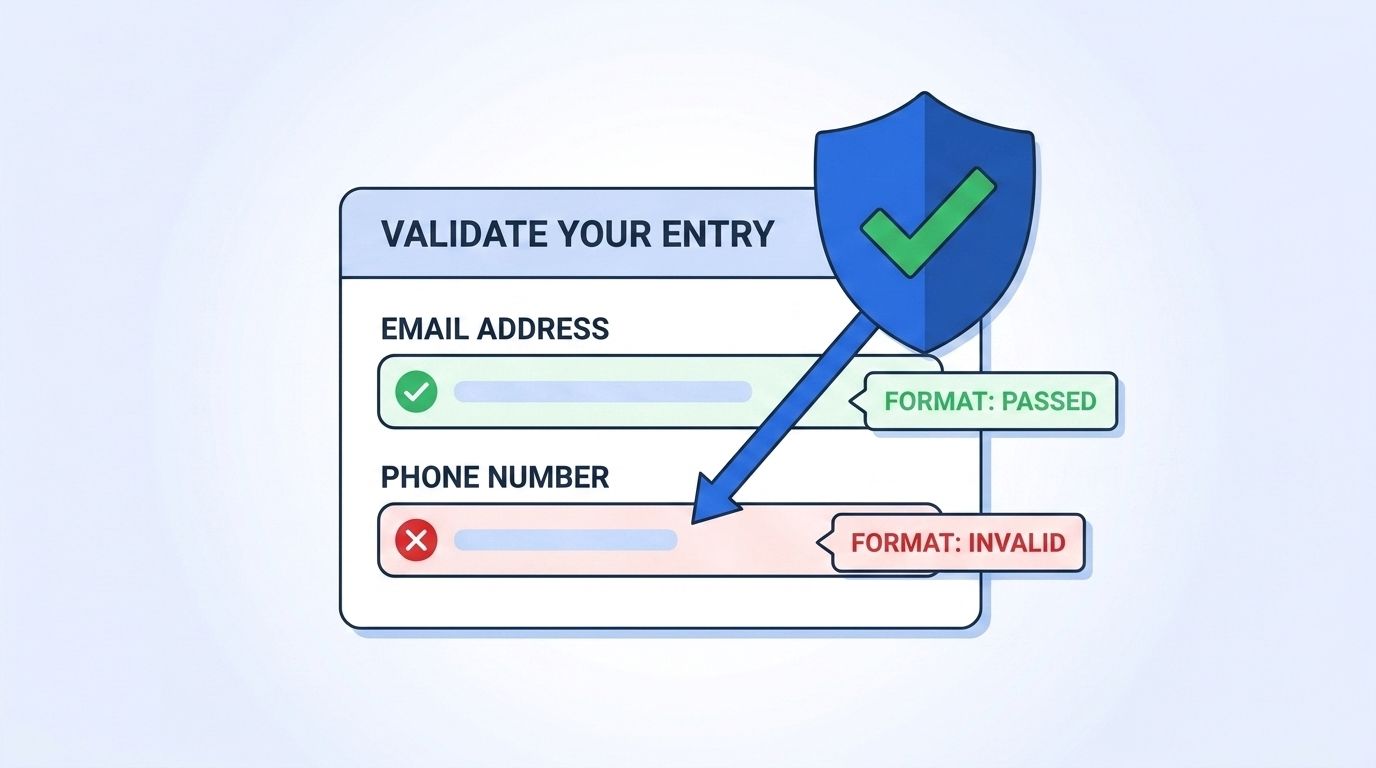
By the end of this step, bad data stops getting created in the first place instead of getting cleaned up after the fact. Validation at the point of entry — form submission, CSV import, or API webhook — catches malformed emails, invalid phone formats, and missing required fields before they ever reach your CRM.
- Add schema-level validation on every intake point: web forms, Zapier/Make workflows, CSV imports, and API integrations. Reject or flag records missing required fields (company domain, job title, name) instead of silently accepting blanks.
- Standardize formats automatically — phone numbers into E.164, company names against a canonical list, country/state fields against ISO codes — using a formatting library or a lightweight enrichment call at intake.
- Verify against a live source rather than a static rule set. A regex can confirm an email looks valid; only a live lookup confirms the company or person behind it still exists. Datamagnet's People Profile endpoint and Company Profile endpoint can confirm a LinkedIn profile or company record is real and current at the moment a lead is created.
- Log rejected records somewhere visible, don't just drop them — a validation rule that silently discards 5% of inbound leads is its own data quality problem.
Verification: Sample 50 newly-created records after rollout. If validated fields (email format, phone format, required fields) are 100% compliant without manual review, the workflow is working.
How Do You Automate Deduplication and Record Merging?
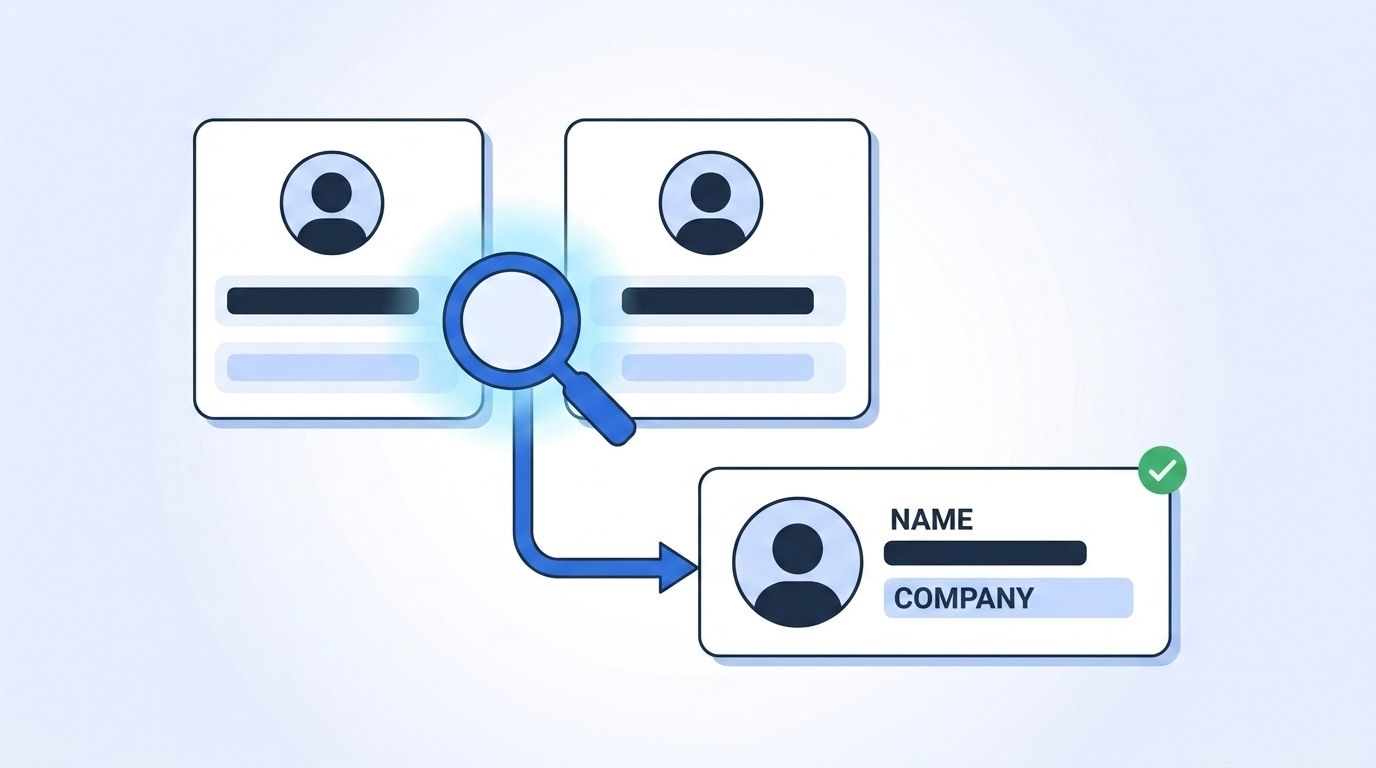
By the end of this step, duplicate records stop compounding, and the ones already in your system get merged without a human manually comparing rows. Industry estimates suggest CRM duplicate rates commonly run 10-30% of a database when no active dedup program exists, which directly inflates reporting and wastes outreach effort on contacts reps have already worked.
- Set matching keys before you set thresholds. Use a combination of email domain + normalized company name + LinkedIn URL rather than exact-string name matching, which misses "Acme Corp" vs. "Acme Corporation" every time.
- Automate fuzzy matching on import, not just on a nightly batch job — most CRM native tools (Salesforce Duplicate Rules, HubSpot's dedup) support real-time matching at the point of creation.
- Define merge-survivorship rules in advance: which field wins when two duplicate records disagree (most recently updated, most complete, or from the most trusted source). Without this rule set upfront, every merge becomes a manual judgment call again.
- Schedule a recurring batch pass for records that entered before matching rules existed — a quarterly sweep catches what real-time matching couldn't, since it only guards new entries going forward.
When we've watched teams turn on real-time dedup matching without first agreeing on survivorship rules, the tool still flags duplicates correctly — but someone still has to manually decide which record to keep every single time. The automation only pays off once the merge logic is defined upfront.
How Do You Automate Enrichment So Records Don't Go Stale?
By the end of this step, records fill in missing fields and refresh outdated ones automatically instead of going stale between manual review cycles. Median employee tenure fell to 3.9 years as of January 2024, down from 4.1 years two years earlier (U.S. Bureau of Labor Statistics, Employee Tenure Summary, 2024) — a clear signal that job titles, company affiliations, and contact details decay continuously, not on a quarterly schedule.
- Enrich at creation, not on a batch schedule. Call an enrichment API the moment a lead or contact record is created so missing firmographic and role data fills in before a rep ever touches the record.
- Re-enrich on a trigger, not a calendar. Watch for job-change and company-change signals rather than re-running a blanket refresh on every record every 90 days — it's cheaper and catches the records that actually changed. Datamagnet's Create Signal endpoint can monitor tracked profiles for job-change events and push updates automatically.
- Pull company context alongside person data — headcount, industry, funding stage — so territory and ICP scoring stay accurate without a rep manually re-checking a company's LinkedIn page. See Datamagnet's company datasets for the underlying data model.
- Route enrichment through your existing CRM workflow tool (HubSpot workflows, native automation, or an iPaaS) so it runs without a person clicking "enrich" on each record.
For teams wiring this into HubSpot specifically, see HubSpot + Datamagnet enrichment workflows.
How Do You Build Ongoing Monitoring Instead of One-Time Cleanups?
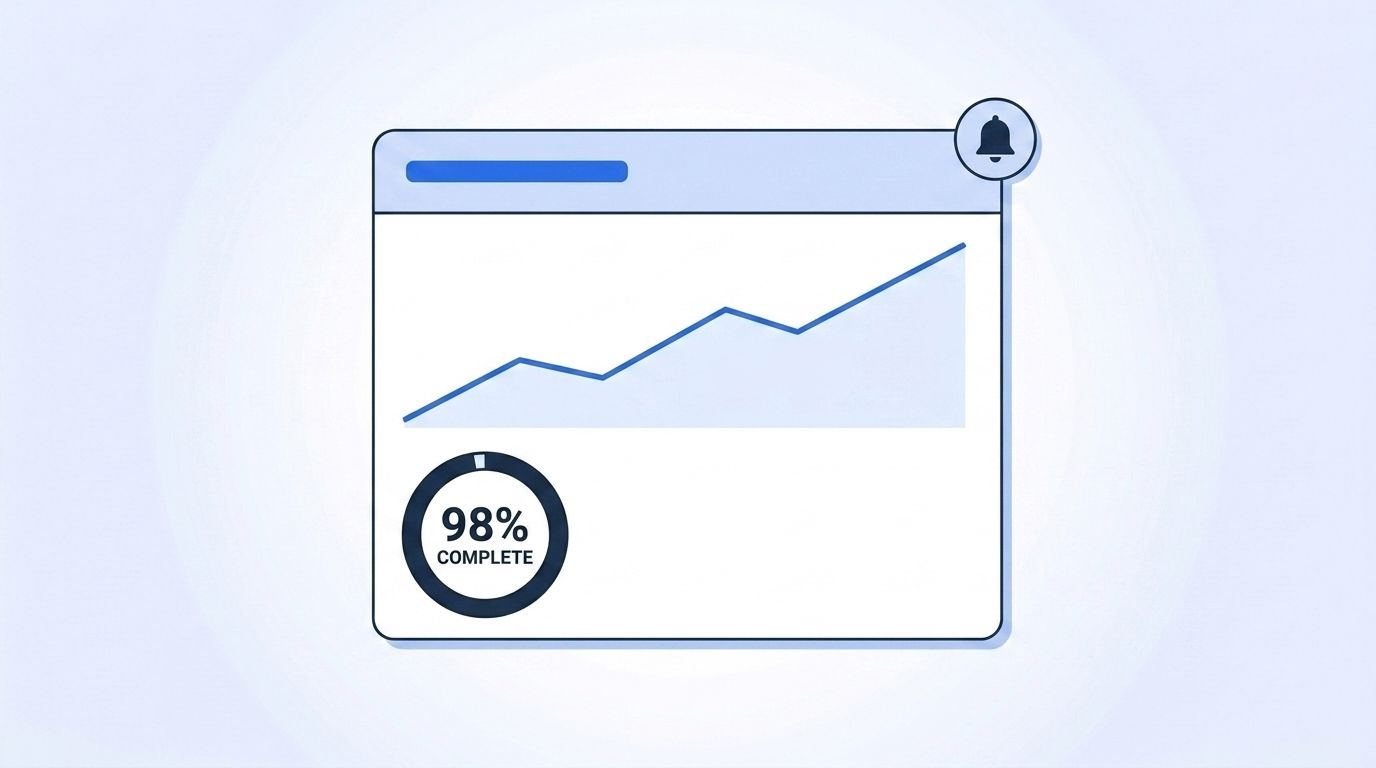
By the end of this step, data quality becomes a continuously-monitored metric instead of a project you revisit once a quarter. A one-time cleanup fixes today's records; it does nothing for the ones created tomorrow.
- Track a data quality score over time, not just at cleanup time — percentage of records with complete required fields, percentage validated in the last 90 days, duplicate rate. A dashboard beats a spreadsheet you update manually.
- Set alert thresholds, not just dashboards. If the duplicate rate crosses 15% or bounce rate on a campaign exceeds a set threshold, someone should get notified automatically rather than discovering it during a quarterly review.
- Audit your automation rules themselves periodically — validation and dedup rules that made sense at 10,000 records can misfire at 500,000. Gartner found 63% of organizations either lack, or are unsure if they have, the data management practices required to support AI-driven workflows reliably (Gartner, Lack of AI-Ready Data Puts AI Projects at Risk, 2025) — an unaudited automation stack is exactly how that gap grows.
- Close the loop with sales and recruiting feedback — if reps keep manually correcting the same field, that's a signal your validation or enrichment rule needs adjusting, not that reps need to keep fixing it by hand.
Common Mistakes When Automating Data Quality
1. Automating cleanup without fixing the intake point. Teams often build a dedup workflow but leave forms and imports unvalidated, so duplicates keep entering at the same rate they're being merged. Fix intake first — deduplication downstream is treating a symptom.
2. Setting merge rules reactively, one duplicate at a time. Without survivorship rules defined upfront, every merge decision becomes a manual judgment call again, defeating the point of automating it.
3. Re-enriching everything on a fixed schedule. Refreshing every record every 30 or 90 days regardless of whether anything changed wastes API calls and still misses the record that changed the day after the last refresh. Trigger-based re-enrichment on job-change signals is both cheaper and more current.
4. Treating data quality as a one-time project. Gartner's $12.9 million average annual cost figure exists precisely because most organizations tackle data quality as a periodic cleanup rather than a maintained system (Gartner, 2020 benchmark).
<!-- [UNIQUE INSIGHT] -->5. Assuming validation and enrichment solve the same problem. Validation confirms a field is formatted correctly; it says nothing about whether the underlying fact is still true. A phone number can pass every validation rule and still belong to someone who left the company eight months ago — which is why enrichment and monitoring have to run alongside validation, not instead of it.
Ready to Stop Cleaning Data by Hand?
Automating validation, dedup, and enrichment gets you most of the way to that 70-80% reduction in manual work — but only if the data feeding those workflows is accurate at the source. Datamagnet's LinkedIn People API and [Company API → https://www.datamagnet.co/company-api/] fetch live LinkedIn data at request time, so enrichment and re-validation pull current facts instead of a stale snapshot. [See pricing → https://www.datamagnet.co/pricing/] to find a plan that fits your record volume.
Frequently Asked Questions
How much manual work can data quality automation realistically eliminate?
Most teams combining entry validation, automated deduplication, and trigger-based enrichment see manual cleanup work drop 70-80%, though results depend on data volume and how much of the intake pipeline gets automated. McKinsey estimates 60-70% of work activities are technically automatable with current tools (McKinsey Global Institute, 2023), and structured data tasks sit near the top of that range.
What's the difference between data validation and data enrichment?
Validation checks that a field is formatted and structurally correct — a valid email pattern, a properly formatted phone number. Enrichment fills in missing information and refreshes existing fields with current facts, like a person's current job title or a company's headcount. You need both; validation alone won't catch a correctly-formatted phone number that belongs to someone who's moved on.
Should we build data quality automation in-house or use a tool?
For validation and dedup, most CRMs (Salesforce, HubSpot) include native rule-based tools that cover the basics without custom development. For enrichment and job-change monitoring, an API-based approach is usually faster to implement than building and maintaining scraping infrastructure in-house, especially since 37% of CRM users already report revenue lost to bad data while trying to manage it manually (Validity, State of CRM Data Management 2025).
How often should CRM data be re-validated or re-enriched?
Continuously, triggered by events rather than a calendar. Median US employee tenure fell to 3.9 years as of January 2024 (U.S. Bureau of Labor Statistics, 2024), meaning a meaningful share of your contacts change roles or companies every year. A quarterly batch cleanse always leaves months of unaddressed decay between runs; job-change signals close that gap in near real time.
What's the first automation to set up if we're starting from scratch?
Start with entry validation, not deduplication. Deduplication cleans up records that already exist, but if intake stays unvalidated, new duplicates and malformed records keep entering at the same rate. Fixing the entry point first means every automation you add after it starts from cleaner data.
Automate the Repetitive Work, Not the Judgment Calls
Manual data quality work doesn't scale because record creation never slows down to match your review capacity. Validation at entry, automated deduplication with clear survivorship rules, trigger-based enrichment, and ongoing monitoring together can cut manual cleanup work by 70-80% — not through one magic tool, but through a stack of systematic, rule-based workflows.
Start with the intake point, add dedup rules before you turn on matching, and trigger enrichment off real signals instead of a calendar. For the API layer that keeps enrichment current, see Datamagnet's LinkedIn Scraper API or explore account research infrastructure for AEs for a related workflow.
Sources
- Gartner, How to Improve Your Data Quality / Magic Quadrant for Data Quality Solutions, retrieved 2026-07-19, https://www.gartner.com/en/data-analytics/topics/data-quality
- Harvard Business Review / IBM, Bad Data Costs the U.S. $3 Trillion Per Year, retrieved 2026-07-19, https://hbr.org/2016/09/bad-data-costs-the-u-s-3-trillion-per-year
- Validity, The State of CRM Data Management in 2025, retrieved 2026-07-19, https://www.validity.com/resource-center/the-state-of-crm-data-management-in-2025/
- Forrester, Sales Activity Study, retrieved 2026-07-19, https://www.forrester.com/resources/sales-productivity/activity-study/
- Salesforce, State of Sales, 6th Edition, retrieved 2026-07-19, https://www.salesforce.com/sales/state-of-sales/sales-statistics/
- U.S. Bureau of Labor Statistics, Employee Tenure Summary, retrieved 2026-07-19, https://www.bls.gov/news.release/tenure.nr0.htm
- Gartner, Lack of AI-Ready Data Puts AI Projects at Risk, retrieved 2026-07-19, https://www.gartner.com/en/newsroom/press-releases/2025-02-26-lack-of-ai-ready-data-puts-ai-projects-at-risk
- McKinsey Global Institute, The Economic Potential of Generative AI: The Next Productivity Frontier, retrieved 2026-07-19, https://www.mckinsey.com/capabilities/tech-and-ai/our-insights/the-economic-potential-of-generative-ai-the-next-productivity-frontier
- Datamagnet, People Profile endpoint, retrieved 2026-07-19, https://docs.datamagnet.co/api-reference/endpoints/people
- Datamagnet, Company Profile endpoint, retrieved 2026-07-19, https://docs.datamagnet.co/api-reference/endpoints/company
- Datamagnet, Create Signal endpoint, retrieved 2026-07-19, https://docs.datamagnet.co/api-reference/endpoints/signal-create
