
Disclosure: This article is published by Datamagnet. Vendor claims are self-reported unless otherwise noted.
Data Enrichment RFP Template: What Actually Separates Good Vendors
Most data enrichment RFPs spend 80% of their pages on procurement boilerplate — payment terms, SLAs copied from a legal template, a vague "describe your company" prompt — and about two questions on whether the data is any good. That's backward. In 2025, poor data quality cost the average organization $12.9 million a year (Gartner), and almost none of that damage shows up in a standard RFP scorecard.
This isn't a legal template. It's the shortlist of questions that actually predict whether a data enrichment vendor will work for your team six months from now, organized around the five things that quietly separate good providers from bad ones: freshness, coverage, reliability, compliance, and pricing fit.
Key Takeaways
- Poor data quality costs organizations $12.9M a year on average (Gartner) — most RFPs never test for it directly.
- In 2026, average B2B email lists decay by 23% annually (ZeroBounce, 2026), so static databases lose value the moment they're delivered.
- API uptime across vendors fell from 99.66% to 99.46% between Q1 2024 and Q1 2025 (Uptrends, 2025) — ask for real numbers, not marketing claims.
- Self-published match-rate benchmarks are conflicted by design; run your own bake-off on your actual account list instead of trusting a vendor's own comparison page.
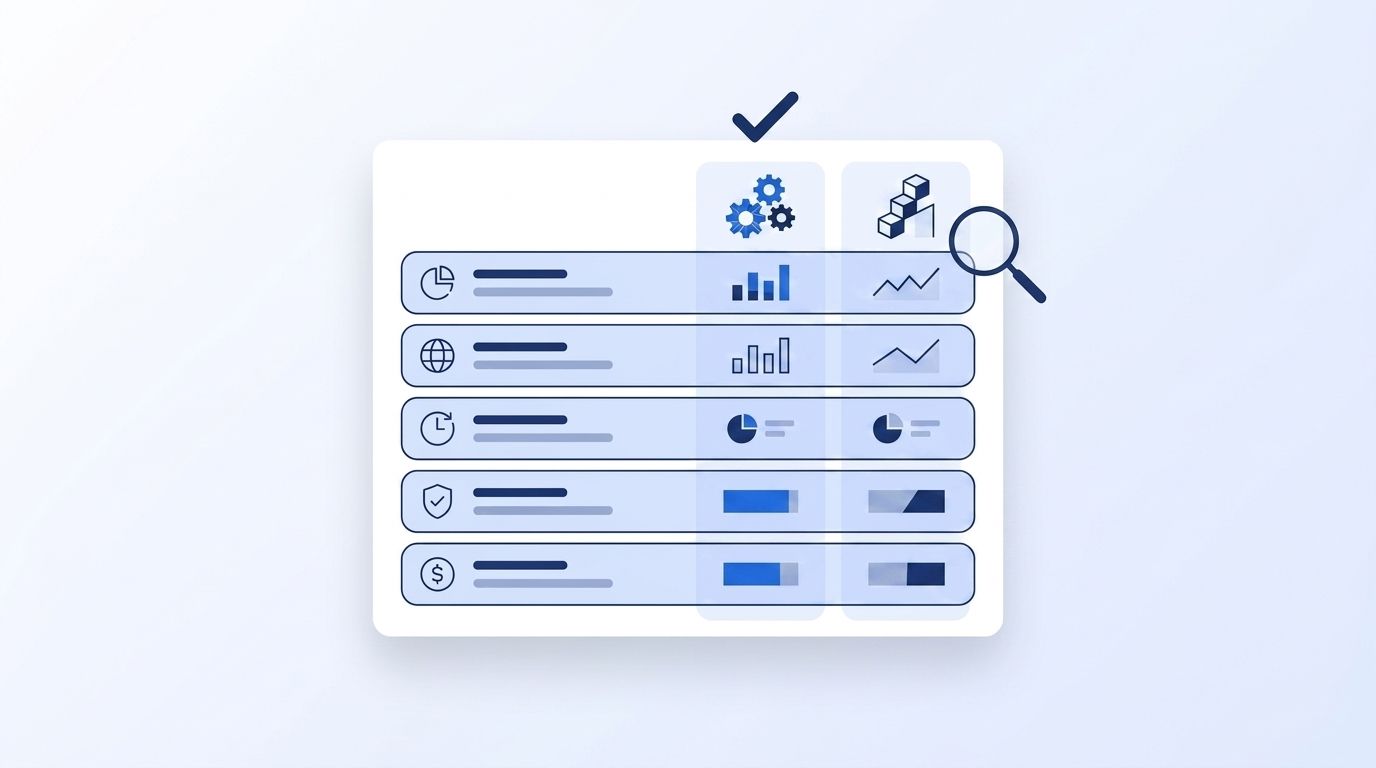
Why Do Most RFP Templates Miss What Actually Matters?
Standard RFP templates are built for procurement, not for data quality. They ask about company size, references, and contract terms, but rarely ask a vendor to prove their data is fresh on the day it's delivered. That gap matters: as of 2026, employee tenure sits at a two-decade low of 3.9 years (U.S. Bureau of Labor Statistics, 2024), which means a meaningful slice of any contact database is already stale.
Skip the sections that ask vendors to describe themselves in prose. Replace them with sections that ask vendors to show you a live sample against your own account list. If a vendor won't run a test enrichment on 50 of your actual target accounts before you sign, that's a signal worth weighing as heavily as any reference call.
how Datamagnet compares to legacy contact databases
How Fresh Is the Vendor's Data, Really?
In 2026, B2B email lists decay by at least 23% a year, based on an analysis of more than 11 billion emails verified across 2025 (ZeroBounce, 2026). That decay rate alone should shape how you score every enrichment vendor on your list — a static snapshot delivered in January is measurably worse by June.
This is the single most important question in the whole RFP: does the vendor fetch data live at request time, or serve records from a periodically refreshed database? Static databases are cheaper to run, which is exactly why so many vendors default to them. Ask directly: what's the median age of a record when it's returned to you, and how is that measured?
how a request-time data model avoids batch-refresh staleness
What Match Rate and Coverage Should You Actually Require?
Here's an uncomfortable truth: most published match-rate benchmarks you'll find in a Google search are written by a vendor comparing itself favorably against competitors, with the test vendor conveniently on top. That's not a knock on any one company — it's just how self-published benchmarks tend to work, and it means you can't take a vendor's own comparison page at face value.
<!-- [UNIQUE INSIGHT] -->The fix isn't to find a "neutral" benchmark — a truly independent, methodology-disclosed third-party test of enrichment match rates barely exists. The fix is to run your own. Pull 100-200 real accounts and contacts from your CRM, send the same list to every vendor on your shortlist, and score the returned match rate, field completeness, and staleness yourself. It costs an afternoon and it's the only comparison you can actually trust.
Write this requirement directly into the RFP: "Vendor must enrich a 100-record sample list provided by us, at no cost, before submitting pricing." A vendor that hesitates on this ask is telling you something about their confidence in their own coverage.
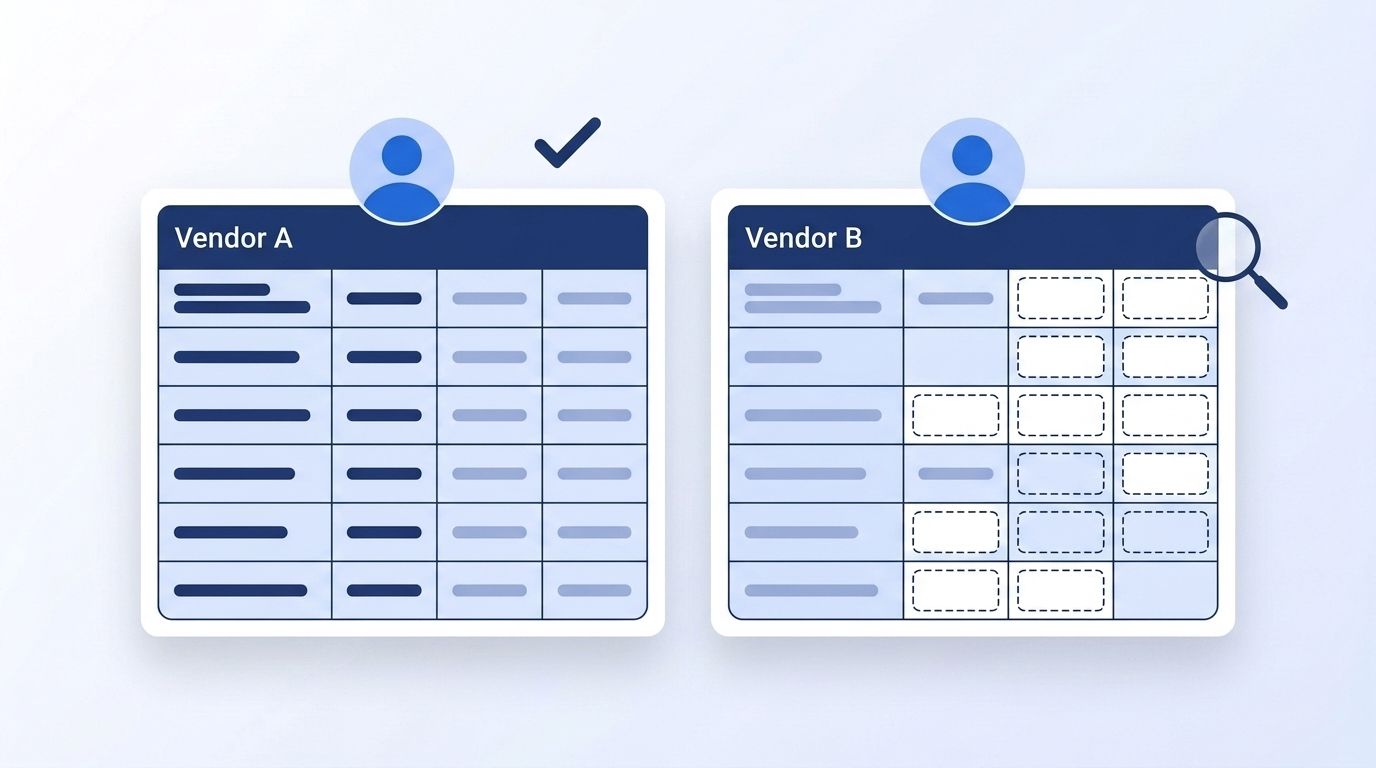
person profile fields returned on a live match company firmographic fields returned on a live match
How Reliable Is the API Under Load?
Average API uptime across vendors fell from 99.66% in Q1 2024 to 99.46% in Q1 2025, based on 2 billion monitoring checks across 400+ companies in 20 industries (Uptrends, 2025). That drop sounds small until you translate it into hours — it's roughly a 60% increase in downtime year over year, landing right when more teams depend on that uptime for real-time workflows.
Ask every vendor for their actual uptime numbers from the last 12 months, not a target SLA number from a sales deck. Ask what happens to a request during an outage: does it queue, fail silently, or return a clear error you can catch and retry? A vendor with a published, versioned error reference is usually a vendor that's been burned by outages before and built for them.
error codes and retry guidance to request from every vendor recent reliability fixes worth asking competitors to match
Does the Vendor's Compliance Program Actually Hold Up?
In 2026, GDPR fines have totaled €7.1 billion since the regulation took effect in May 2018, with €1.2 billion issued in 2025 alone and average daily breach notifications crossing 400 for the first time — up 22% year over year (DLA Piper, 2026). That trend line means a vendor's data sourcing practices aren't a compliance checkbox — they're a real liability you inherit the moment you sign a contract.
Ask exactly where the vendor sources its data (public profiles only, or something murkier), whether it respects robots.txt and platform terms of service, and whether it can produce a data processing agreement on request. Don't accept "we're GDPR compliant" as an answer on its own — ask for the specific mechanism: consent basis, retention limits, deletion request turnaround.
how public-source data collection and compliance practices are documented
What Pricing Model Actually Fits How You'll Use the Data?
Seat-based licensing made sense when enrichment tools were used by a handful of named reps. It makes less sense now that pricing has shifted: 85% of surveyed SaaS companies have adopted some form of usage-based pricing, and 78% of those did it within the last five years (Metronome and Greyhound Capital, 2025). Enrichment volume is naturally usage-shaped — some months you'll enrich 500 accounts, some months 50,000.
Ask each vendor to model your actual expected volume against their pricing tiers, not their advertised entry price. Watch for hidden minimums, annual lock-in disguised as a "discount," and credit expiration windows that penalize slow months. A pay-as-you-go model with no seat minimum is usually the better fit if your usage is lumpy rather than steady.
transparent pay-as-you-go pricing structure to benchmark against
How Much Is Bad Data Actually Costing Your Sales Team?
Sales reps spend only 28-30% of their week on actual selling activity, according to a Salesforce survey of 7,775 sales professionals across 38 countries (Salesforce, 2023). A meaningful chunk of the rest goes to manual research — checking LinkedIn, guessing at a title, verifying an email before it bounces — because the enrichment data on hand wasn't trustworthy enough to act on directly.
That cost compounds. Companies lose an estimated 15-25% of annual revenue to poor data quality, according to research published in MIT Sloan Management Review (Redman, Nagle & Sammon, MIT Sloan Management Review, 2017). Put a number on this in your RFP scoring: ask each vendor how much manual verification time their customers report needing after enrichment, and weight that answer as heavily as the sticker price.
ICP-filtered search built to cut manual prospect research time
Can the Vendor's Data Actually Support AI and Agentic Workflows?
As of late 2025, 52% of professionals cite data quality and availability as the single biggest barrier to AI and agentic AI adoption, based on a survey of more than 200 professionals (PEX Network, 2025). If your roadmap includes an AI SDR or an agent that acts on enrichment data without a human double-checking it first, this question moves from "nice to have" to "load-bearing."
Gartner has predicted that at least 30% of generative AI projects would be abandoned after proof-of-concept by the end of 2025, citing poor data quality among the top reasons (Gartner, 2024). Ask every vendor for their API's structured field consistency and schema stability across releases — an agent that has to guess at field formats will fail quietly, not loudly.
data engine built for AI SDR and agent workflows
Ready to Build Your Own Shortlist?
Turn the questions above into a scoring sheet, run the same 100-record sample list past every vendor on it, and weight freshness and your own measured match rate above marketing claims. See Datamagnet's live enrichment in action with 10 free credits — no procurement call required to start comparing.
Frequently Asked Questions
What should a data enrichment RFP include besides pricing and terms?
Beyond standard terms, include a mandatory sample-enrichment test on your own account list, a request for trailing-12-month uptime numbers, and specific compliance questions about data sourcing. In 2025, poor data quality cost organizations $12.9M annually on average (Gartner, 2025), so testing quality directly matters more than comparing feature lists.
How do I compare match rates across enrichment vendors fairly?
Don't rely on any vendor's self-published benchmark — most are structured to favor the publisher. Instead, send the same 100-200 record sample from your own CRM to every vendor on your shortlist and score the returned match rate and field completeness yourself. It's the only apples-to-apples comparison you control.
Is real-time enrichment actually better than a static database?
Usually, yes, because B2B contact data decays quickly. In 2026, email lists decay by 23% a year based on analysis of over 11 billion emails (ZeroBounce, 2026), so a database refreshed monthly or quarterly is already behind by the time you query it. Real-time, request-time lookups avoid that staleness gap entirely.
What compliance questions should be non-negotiable in an RFP?
Ask exactly where data is sourced, whether the vendor respects robots.txt and platform terms, and whether they can produce a data processing agreement. GDPR fines have totaled €7.1 billion since 2018, with €1.2 billion in 2025 alone (DLA Piper, 2026), making vendor sourcing practices a real liability, not a formality.
Should I choose usage-based or seat-based pricing for enrichment tools?
If your enrichment volume varies month to month, usage-based pricing usually fits better — 85% of SaaS companies have adopted some form of it, and most did so in just the last five years (Metronome and Greyhound Capital, 2025). Model your actual expected volume against each vendor's tiers before signing, and watch for hidden minimums.
Sources
- ZeroBounce, Email List Decay Report 2026, retrieved 2026-07-19, https://www.zerobounce.net/email-list-decay
- U.S. Bureau of Labor Statistics, Median Tenure with Current Employer Was 3.9 Years in January 2024, retrieved 2026-07-19, https://www.bls.gov/opub/ted/2024/median-tenure-with-current-employer-was-3-9-years-in-january-2024.htm
- Gartner, Data Quality Solutions research, retrieved 2026-07-19, https://www.gartner.com/en/data-analytics/topics/data-quality
- Thomas C. Redman, Tadhg Nagle, Dave Sammon, Seizing Opportunity in Data Quality, MIT Sloan Management Review, retrieved 2026-07-19, https://sloanreview.mit.edu/article/seizing-opportunity-in-data-quality/
- Gartner, Gartner Predicts 30 Percent of Generative AI Projects Will Be Abandoned After Proof of Concept by End of 2025, retrieved 2026-07-19, https://www.gartner.com/en/newsroom/press-releases/2024-07-29-gartner-predicts-30-percent-of-generative-ai-projects-will-be-abandoned-after-proof-of-concept-by-end-of-2025
- DLA Piper, GDPR Fines and Data Breach Survey — January 2026, retrieved 2026-07-19, https://www.dlapiper.com/en/insights/publications/2026/01/dla-piper-gdpr-fines-and-data-breach-survey-january-2026
- Uptrends, The State of API Reliability 2025, retrieved 2026-07-19, https://www.uptrends.com/state-of-api-reliability-2025
- Metronome and Greyhound Capital, State of Usage-Based Pricing 2025 Report, retrieved 2026-07-19, https://metronome.com/state-of-usage-based-pricing-2025
- Salesforce, State of Sales, 5th Edition, retrieved 2026-07-19, https://www.salesforce.com/news/stories/sales-research-2023/
- PEX Network, Data Quality and Availability Top List of AI Adoption Barriers, retrieved 2026-07-19, https://www.aidataanalytics.network/data-science-ai/news-trends/data-quality-availability-top-list-of-ai-adoption-barriers
