
Disclosure: This article is published by Datamagnet. Vendor claims are self-reported unless otherwise noted.
Data Enrichment for Agencies: A Playbook for Marketing, PR & Recruiting
Bad contact data doesn't just slow you down — it quietly erodes client trust. In 2025, Validity found that 37% of CRM users lost revenue directly because of poor data quality (Validity, 2025). For an agency juggling five client accounts at once, that's not an abstract stat. It's a renewal conversation you don't want to have.
Agencies face a version of the data-quality problem that in-house teams don't: you're enriching data you don't own, across campaigns that change monthly, on margins that leave no room for wasted spend. This guide breaks down what marketing, PR, and recruiting agencies should prioritize, which tools actually fit the agency model, and how to turn enrichment into a service line clients will pay for.
Key Takeaways
- B2B contact databases decay 2.1% a month — 22.5% a year — so agency data hygiene has to be continuous, not a one-time cleanup (HubSpot, 2025).
- 76% of professionals say less than half their CRM data is accurate and complete (Validity, 2025).
- Recruiting agencies that source outbound convert candidates to hires at 6x the rate of inbound applicants (Gem, 2025).
- Average agency net margin sits at 13%, which is why enrichment tooling has to pay for itself fast (Promethean Research, 2026).
What Is Data Enrichment for Agencies?
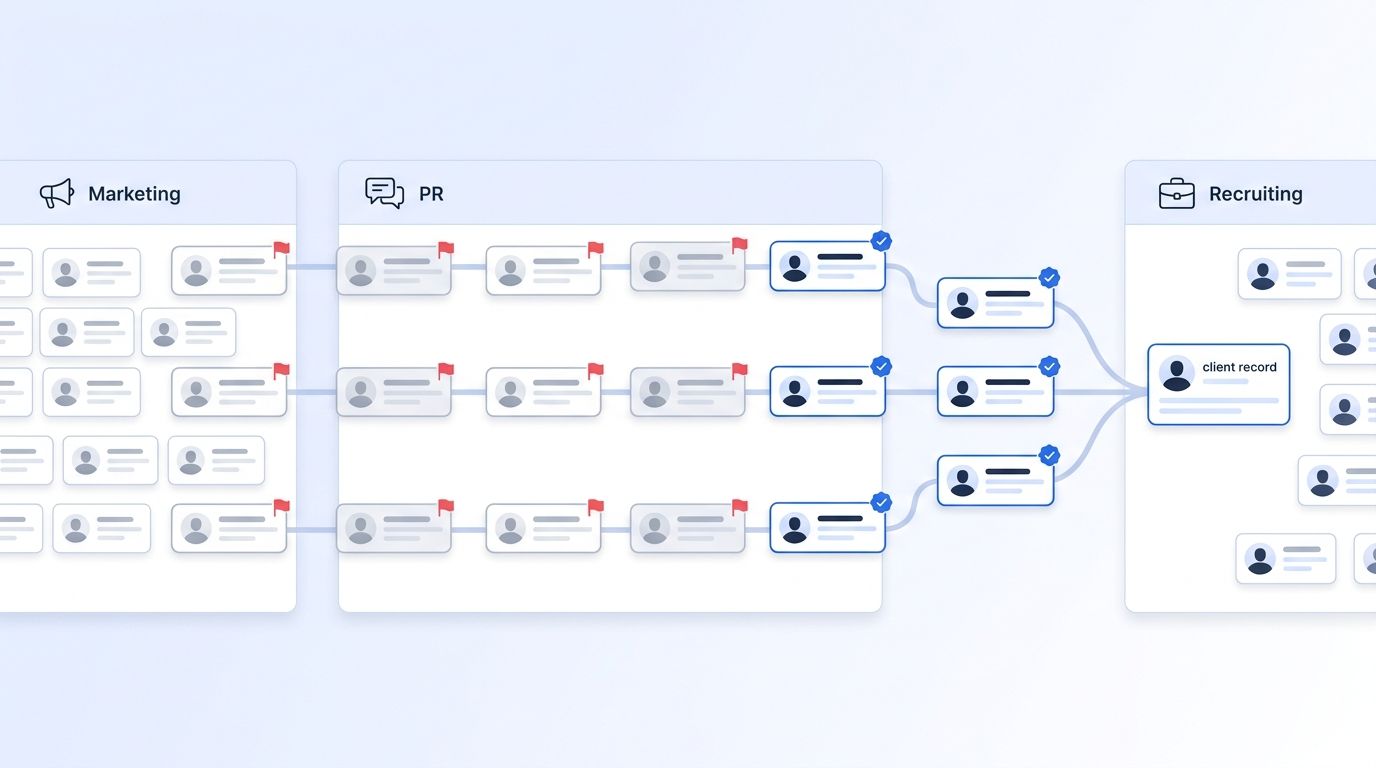
Data enrichment is the process of taking a thin or outdated record — a name, an email, a company domain — and filling it out with verified, current details: job title, company size, funding stage, recent activity, direct contact info. For agencies, the twist is that this happens on someone else's data, inside someone else's CRM, under someone else's brand.
That distinction matters more than it sounds. An in-house marketing team enriches its own pipeline and owns every mistake internally. An agency enriches a client's list, then has to explain — in a client-facing report — why open rates went up or why a sourced candidate slate got a callback. Enrichment quality becomes a visible line item in every account review, not a background process.
It's worth asking: would you sign off on a campaign built from a list you hadn't touched in six months? Most agencies wouldn't, yet plenty still run one because refreshing client data feels like scope creep instead of table stakes.
Why Data Enrichment Matters for Agencies in 2026
In 2026, Promethean Research found the average digital agency runs on a 13% net margin, with specialist marketing and blended shops averaging closer to 13% and larger agencies dropping to 8% (Promethean Research, 2026). Thin margins like that mean wasted spend on bad contacts — undeliverable emails, mistargeted ad audiences, stale candidate lists — comes straight out of profit, not just performance.
Our take: margin compression isn't a reason to skip enrichment — it's the reason to buy it instead of building it. An agency billing 8-13% net margin can't afford a data engineer maintaining a homegrown scraper; a per-record API cost is far easier to fold into a client SOW than a full-time hire.
Beyond margin protection, poor data quality carries a real cost across the industry. Gartner's often-cited benchmark puts the average annual cost of bad data at $12.9 million for the organizations it studied (Gartner, 2020) — a figure still referenced across 2025-2026 industry coverage because nothing has meaningfully replaced it. For a client with a six-figure retainer, even a fraction of that waste shows up fast in wasted ad spend and missed reply rates. For a deeper look at how B2B teams build enrichment into daily workflows, see our guide to real-time B2B people enrichment.
What Data Should Marketing Agencies Prioritize?
Marketing agencies should prioritize firmographic accuracy and recency over volume — a smaller, current list consistently outperforms a larger, stale one. In 2025, HubSpot's decay modeling (built on long-standing MarketingSherpa research) found B2B contact databases decay at roughly 2.1% a month, or 22.5% annualized (HubSpot, 2025). Run a campaign against a list that hasn't been touched in a year, and nearly a quarter of it is already wrong.
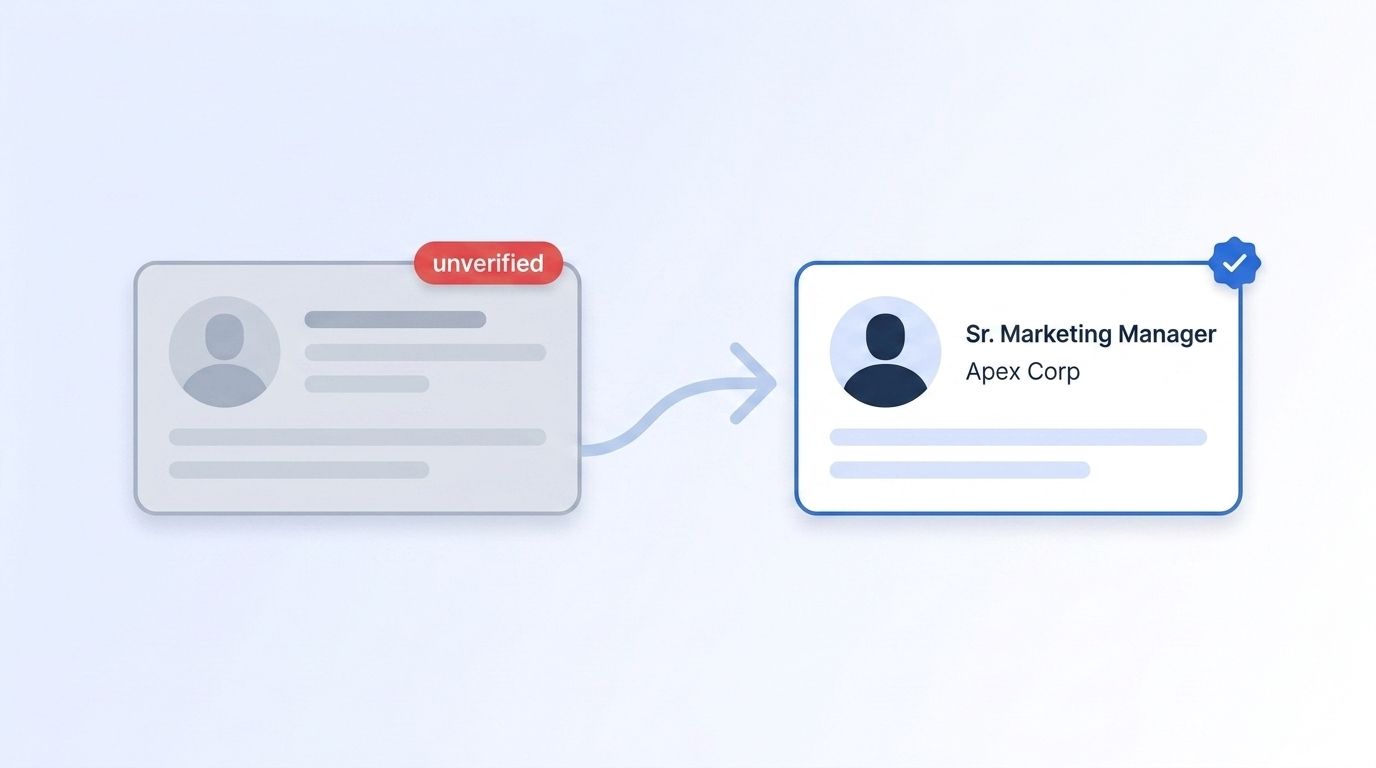
For client-facing marketing work, that means prioritizing three fields above everything else: current employer and title (campaigns targeted at a contact's old company waste the whole send), verified email deliverability, and firmographic signals like headcount and industry that feed segmentation. Datamagnet's Company Profile API pulls headcount, industry, and recent updates live, so agencies aren't segmenting off a snapshot from last quarter.
<!-- [ORIGINAL DATA] -->Agencies running multiple client accounts should also treat enrichment cadence as a deliverable, not an afterthought — building a monthly refresh into the SOW rather than a one-time onboarding cleanup. That's the difference between a list that's accurate at kickoff and one that's still accurate in month six.
Validity's 2025 survey backs up why this matters at the org level: 76% of respondents said less than half of their organization's CRM data is accurate and complete (Validity, 2025). If that's true for companies managing their own data, it's a reasonable bet that client lists handed to an agency start in worse shape, not better.
What Data Should PR Firms Prioritize?
PR firms should prioritize journalist relevance and beat accuracy over contact volume, because misaligned pitches get rejected before they're even read. In 2025, Cision found 86% of journalists say they'll immediately reject a pitch that doesn't align with their beat or audience (Cision, 2025). A media list that's technically "complete" but outdated on beat coverage is worse than no list at all — it burns the one shot you get with that reporter.
Isn't that the whole game in PR — getting the right message in front of the right person before anyone else does? Muck Rack's 2025 research found 72% of PR professionals cite low response rates as their top challenge, and while 70% say they personalize pitches "to some extent," only 11% fully customize each one (Muck Rack, 2025). That gap between "some personalization" and full customization is almost entirely a data problem — you can't personalize what you don't know.
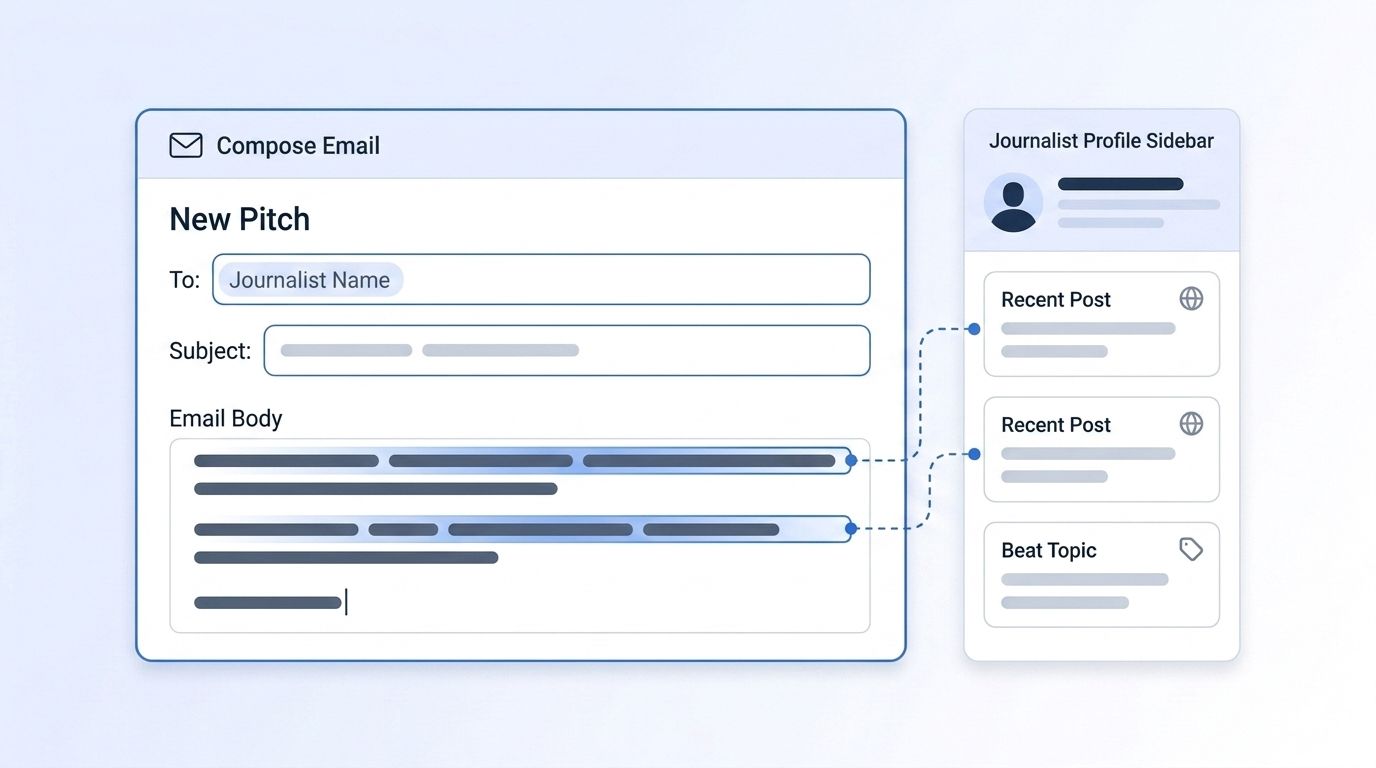
Prioritize recency on two things: what a journalist or influencer has published or posted in the last 30 days, and any recent job or beat change. Datamagnet's Person Activity endpoint surfaces a contact's recent LinkedIn posts and shares, which is a faster relevance check than any static media database snapshot.
What Data Should Recruiting Agencies Prioritize?
Recruiting agencies should prioritize sourced, verified candidate data over inbound applications, because outbound sourcing converts at a dramatically higher rate. Gem's 2025 analysis of over 1,200 customers and 41 million candidates found outbound candidates are roughly 6x more likely to convert to a hire than inbound applicants (Gem, 2025). For an agency paid on placement, that gap is the difference between a profitable search and a write-off.
That data advantage compounds when outreach is personalized well. LinkedIn's Future of Recruiting research reports that AI-assisted recruiter messages see meaningfully higher acceptance rates than generic templated outreach (LinkedIn Talent Solutions, 2025) — another sign that specificity, not volume, wins the reply.
<!-- [PERSONAL EXPERIENCE] -->Agencies running executive search work know the pain of a candidate profile that's three roles out of date by the time an outreach sequence goes out. SHRM's 2025 benchmarking data put median time-to-fill at 44 days — the slowest pace since SHRM began tracking it (SHRM, 2025), which means stale candidate data has more time to go stale before a search even closes. Prioritize current employer, current title, and skills/experience recency above breadth of contact info. Datamagnet's People Profile API pulls current role and seniority data at request time, which matters more in a slower-moving hiring market than in a fast one. See our recruiting intelligence overview for how sourced-data workflows fit into a full search process.
Which Enrichment Tools Make Sense for Agencies?
The right enrichment tool for an agency is one priced and built for request-time lookups across shifting client lists, not a flat-fee seat license built for a single internal team. Static databases charge for access regardless of how fresh the data actually is; agencies juggling five or six client accounts need a model that scales with usage, not headcount.
<!-- [UNIQUE INSIGHT] -->Three questions separate a workable agency tool from one that'll create billing headaches: Can it be resold or embedded in a client deliverable without a data-licensing conflict? Does pricing scale down for a lighter month and up for a heavy one? And does it return data live, or from a database that's already partway through its own decay curve? A static, seat-based contact database is a poor match for an agency model where client lists rotate every quarter.
For agencies weighing platform options, see how a live-lookup model compares against legacy contact databases: Datamagnet vs. ZoomInfo. It breaks down the pay-as-you-go versus seat-license tradeoff that matters most when margins are already thin.
The market itself backs up the shift toward this model. Grand View Research estimated the global data enrichment solutions market at $2.37 billion in 2023, projected to reach $4.58 billion by 2030 — a 10.1% compound annual growth rate (Grand View Research, 2024). Agencies that build enrichment into their toolkit now are riding a market that's still expanding, not one that's plateaued.
How to Structure Enrichment as a Service Offering
Structure enrichment as a standing line item in every retainer, not a one-time onboarding task, so the value shows up in every monthly report instead of only at kickoff. Clients rarely object to paying for cleaner data — they object to paying for it once and then watching it decay silently for the rest of the contract.
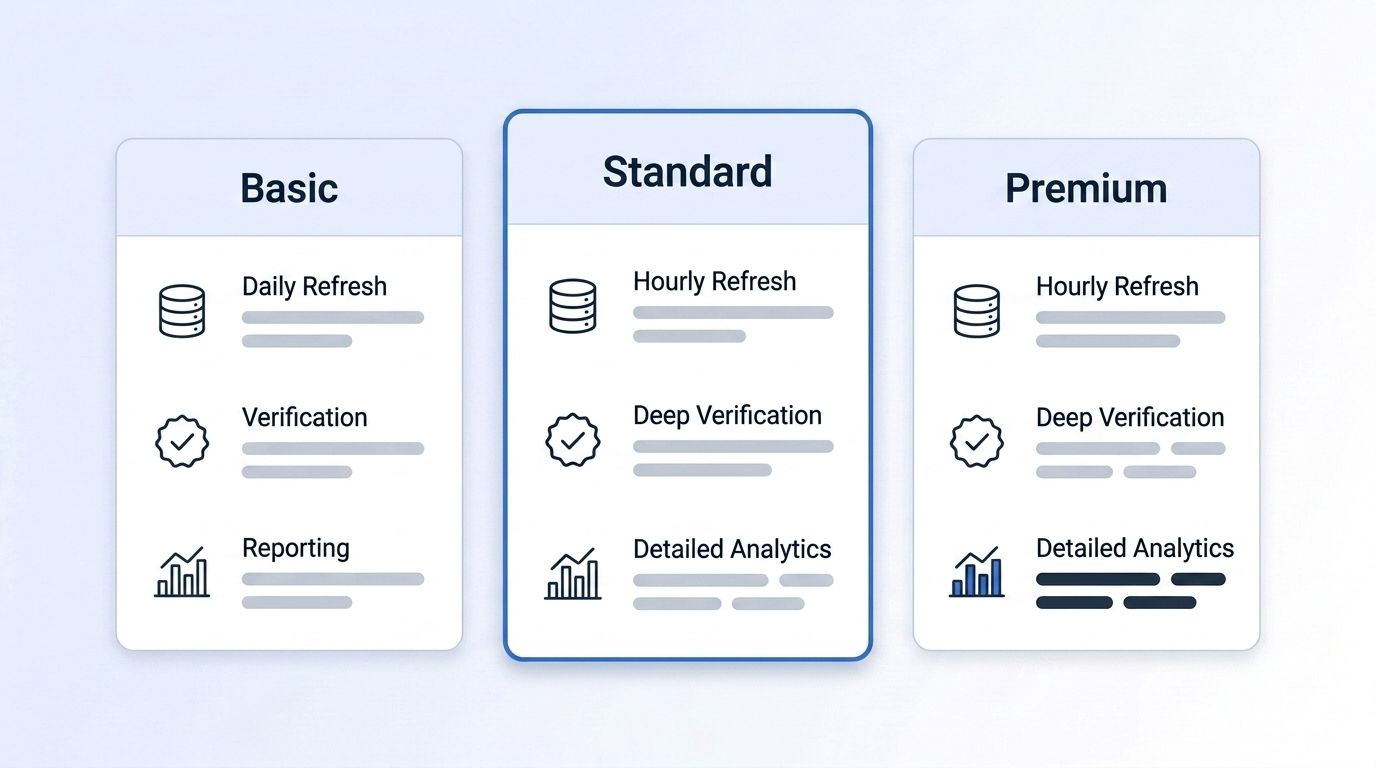
A workable structure looks like three tiers: a baseline monthly refresh (contact and firmographic verification only), a mid tier that adds enrichment-driven segmentation or sourcing, and a premium tier that includes real-time signal monitoring — job changes, funding events, or engagement signals tied directly to campaign or search triggers. Bill the baseline into the existing retainer and price the premium tier as an add-on with its own line item, so it's visible in every renewal conversation rather than buried in "campaign management."
<!-- [UNIQUE INSIGHT] -->The agencies getting the most mileage out of this aren't marking up a data tool line-for-line — they're packaging the outcome (faster time-to-fill, higher pitch acceptance, lower cost-per-lead) and letting the enrichment cost sit quietly inside the delivery cost. Clients pay for results; the API bill is an input cost, not a separate invoice line they need to interrogate. Review Datamagnet pricing for how a pay-as-you-go credit model maps onto a tiered service structure without locking you into a seat count that doesn't match client volume.
Managing Client Data, Compliance & Multi-Client Governance
Agencies handling multiple clients' contact data need governance practices that isolate each client's records, honor each client's own compliance obligations, and avoid cross-contamination between accounts — because a breach or mishandling incident in one account can put every other client relationship at risk. In 2025, IBM's Cost of a Data Breach report put the global average cost of a breach at $4.44 million, with customer PII involved in 53% of breaches studied (IBM Security, 2025). An agency holding PII for six different clients is holding six times the exposure of a single-client team.
Privacy spending is rising to match that risk. Cisco's 2025 Data Privacy Benchmark Study found 38% of organizations now spend $5 million or more annually on privacy, up from 14% the year before (Cisco, 2025). Most agencies can't match that spend directly, but the trend still matters: clients increasingly expect their vendors, including their agency partners, to meet a higher governance bar than they did two years ago.
Practical governance for agencies means: separate credential and access scopes per client account, documented data-retention windows tied to each client's contract end date, and a clear record of where enriched data came from and when it was last verified. That last point isn't just good hygiene — it's the paper trail you need if a client ever asks "where did this contact info come from?" Review Datamagnet's security and data practices for how request-time data collection reduces the retained-data footprint an agency has to defend in the first place.
Tools and Resources
For agencies ready to build enrichment into daily workflows, start with the Champion Tracker cookbook — a ready-made workflow for tracking client contacts and prospects across job changes, useful across all three agency types covered here.
Frequently Asked Questions
Do agencies need their own data enrichment tool, or can they rely on client-provided data?
Client-provided data alone isn't enough — 76% of professionals say less than half their CRM data is accurate and complete (Validity, 2025). Agencies that layer enrichment on top of client lists catch decay the client's own team likely hasn't tracked.
How often should an agency refresh client contact data?
Given a 2.1% monthly decay rate, or 22.5% annualized (HubSpot, 2025), a monthly or per-campaign refresh cadence keeps data usably current. Waiting a full quarter between refreshes means campaigns run against lists that are already 6% stale on average.
Is data enrichment worth it for a small PR agency with a limited budget?
Yes — the cost of a misaligned pitch is high, since 86% of journalists reject pitches outside their beat immediately (Cision, 2025). A single relevant, well-timed pitch built on current beat data outperforms a large blast list that gets ignored.
How should a recruiting agency price enrichment into a placement fee?
Fold enrichment cost into the sourcing phase of the search, since outbound-sourced candidates convert to hires roughly 6x more often than inbound applicants (Gem, 2025). The tooling cost is small relative to the placement fee lost on a search that drags past the 44-day median time-to-fill (SHRM, 2025).
What's the biggest data governance risk for agencies managing multiple clients?
Cross-contamination between client accounts and inconsistent retention practices are the biggest risks, especially given that customer PII is involved in 53% of data breaches globally (IBM Security, 2025). Isolating access and credentials per client limits blast radius if one account is compromised.
Can enrichment actually improve agency profit margins, not just campaign performance?
Yes, indirectly — with average agency net margins around 13% (Promethean Research, 2026), reducing wasted spend on bad contacts protects margin directly, and packaging enrichment as a billable tier turns a cost center into a revenue line.
Conclusion
Agencies don't get a pass on data quality just because the list belongs to a client. If anything, the stakes are higher — a stale record shows up in a client report, a missed placement, or a rejected pitch, and it's your name on the account. Prioritize recency over volume, price enrichment as a standing service instead of a one-time favor, and treat governance as part of the deliverable, not an afterthought.
The agencies pulling ahead in 2026 aren't the ones with the biggest contact lists — they're the ones who can prove, campaign after campaign, that their data was current when it mattered. For a closer look at keeping client champions and prospects on your radar as they move jobs, see our real-time intent signal APIs guide.
Sources
- HubSpot, Database Decay Simulation, retrieved 2026-07-19, https://www.hubspot.com/database-decay
- Gartner, Data Quality Solutions research, retrieved 2026-07-19, https://www.gartner.com/en/data-analytics/topics/data-quality
- Validity, The State of CRM Data Management in 2025, retrieved 2026-07-19, https://www.validity.com/resource-center/the-state-of-crm-data-management-in-2025/
- Cision, 2025 State of the Media Report, retrieved 2026-07-19, https://www.prnewswire.com/news-releases/cisions-2025-state-of-the-media-report-reveals-a-tipping-point-for-trust-technology-and-pr-journalist-partnerships-302448410/
- Muck Rack, The State of PR 2025, retrieved 2026-07-19, https://muckrack.com/resources/research/state-of-pr
- SHRM, 2025 Recruiting Benchmarking Report, retrieved 2026-07-19, https://www.shrm.org/content/dam/en/shrm/research/2025-recruiting-benchmarking-report.pdf
- Gem, Outbound Candidates More Likely to be Hired than Inbound Candidates, retrieved 2026-07-19, https://www.gem.com/blog/outbound-candidates-more-likely-to-be-hired
- LinkedIn Talent Solutions, The Future of Recruiting 2025, retrieved 2026-07-19, https://business.linkedin.com/talent-solutions/resources/future-of-recruiting
- Promethean Research, 2026 State of Digital Services Report, retrieved 2026-07-19, https://prometheanresearch.com/how-profitable-are-digital-agencies/
- Grand View Research, Data Enrichment Solutions Market Size & Share Report, retrieved 2026-07-19, https://www.grandviewresearch.com/industry-analysis/data-enrichment-solutions-market-report
- Cisco, 2025 Data Privacy Benchmark Study, retrieved 2026-07-19, https://www.cisco.com/c/dam/en_us/about/doing_business/trust-center/docs/cisco-privacy-benchmark-study-2025.pdf
- IBM Security, Cost of a Data Breach Report 2025, retrieved 2026-07-19, https://www.ibm.com/reports/data-breach
