
Disclosure: Datamagnet publishes this article. Product capabilities described below are based on public documentation, retrieved July 19, 2026. Collect and process public profile data in line with LinkedIn's terms, GDPR, and CCPA, and confirm your own compliance posture before you run any outreach.
How to Turn a Competitor's Social Engagers Into an Outbound List
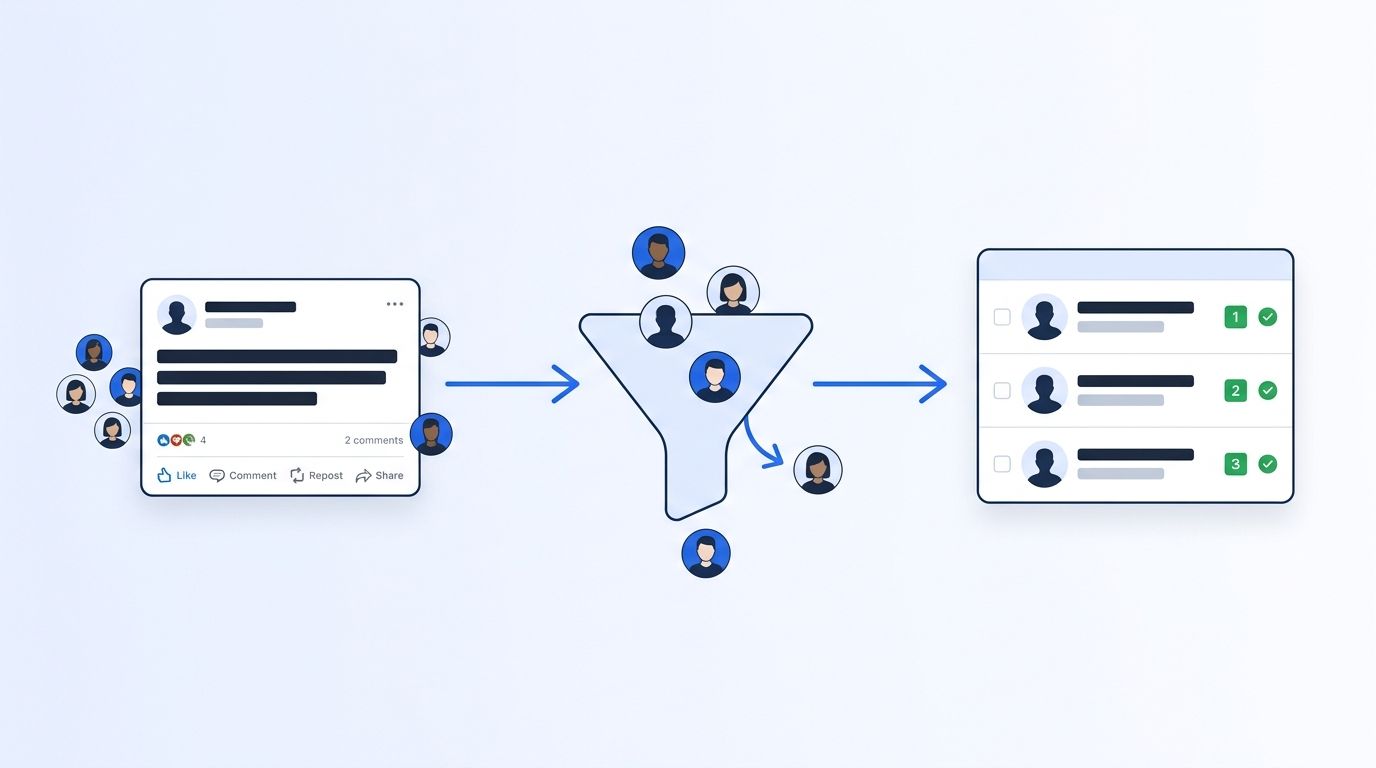
Someone who just liked your competitor's product post is a warmer prospect than a name pulled from a static database. They raised their hand in public. The trick is turning that public engagement into a structured, ICP-filtered outbound list you can actually work — without copy-pasting names off LinkedIn all day.
This guide shows the full pipeline: pull the people who reacted, commented, and reposted a competitor's post, enrich them into real contact records, filter them down to your ideal customer profile, and push the survivors into outbound. Then we'll answer the question every RevOps team asks next — should you build this on a raw data API, or just buy a packaged signal tool?
TL;DR
- The people engaging with a competitor's LinkedIn post are self-identified, in-market buyers — a warmer starting point than cold database exports.
- A four-step API pipeline turns raw engagers into a working list: fetch → enrich → filter to ICP → push to outbound.
- Pull engagers with post reactions, comments, and reposts endpoints; enrich and score them against your ICP.
- A data API gives you full control of the pipeline and the raw records; a signal tool trades control for a prebuilt, always-on monitor.
- Choose the API when you're building custom scoring or wiring data into your own systems; choose the signal tool when you want alerts without engineering.
Why are a competitor's engagers your warmest cold list?
Engagement is a public signal of interest, and interest is what cold lists usually lack. When someone comments on a competitor's launch post or reposts their case study, they've told the whole feed they care about that problem right now. And getting in early matters: in its 2025 buyer research, 6sense found that the winning vendor was already on the buyer's "Day One" shortlist 95% of the time, up from 85% a year earlier (6sense, B2B Buyer Experience Report 2025, retrieved 2026-07-19). Engaging buyers while they're still evaluating is how you get on that list.
Static B2B databases decay fast, too. A widely cited industry benchmark puts contact-data decay at roughly 22.5% a year — about 2% every month — as people change jobs and titles (HubSpot, Database Decay Simulation, retrieved 2026-07-19). A competitor's engagers, by contrast, are timestamped: you know they engaged this week, not last quarter.
There's a second edge most teams miss. Someone reacting to a competitor's post is showing solution-category awareness and a possible reason to switch — they're evaluating, comparing, or venting in the comments. That's a sharper wedge for a first message than "I saw you fit our ICP." You already know what they were looking at when they raised their hand. That timing is worth a lot: 6sense found four out of five B2B deals are still won by the "pre-contact favorite," the vendor buyers reach out to first (6sense, B2B Buyer Experience Report 2025, retrieved 2026-07-19). Reaching an engaged buyer early is how you become that favorite — especially now that 61% of B2B buyers say they'd prefer a rep-free buying experience (Gartner, 2025, retrieved 2026-07-19).
What data can you actually pull from a competitor's post?
A single LinkedIn post exposes three separate engager audiences, and each one is a different intent tier. In 2026, you can retrieve all three as structured JSON instead of scraping the page by hand. The people who react, comment, and repost overlap only partly, so pulling all three gives you the widest qualified top-of-funnel.
Here's what each engagement type tells you:
- Reactions (likes, celebrates, insightful): the broadest, lightest signal — awareness and mild agreement. Retrieve every reactor and their profile with the post reactions endpoint.
- Comments: the strongest signal — people who took the time to write something, often with an opinion, a question, or a complaint you can reference directly. Pull the full thread with the post comments endpoint.
- Reposts and shares: the amplifier signal — people willing to attach their own name to the topic, sometimes with added commentary. Collect them with the post reposts endpoint.
According to Datamagnet's LinkedIn post documentation, each of these endpoints returns the engager's profile alongside the engagement — not just a name, but the LinkedIn URL you need to enrich them into a full contact record (Datamagnet, LinkedIn Posts API, retrieved 2026-07-19). That profile URL is the join key for the entire rest of the pipeline.
How do you build the API pipeline, step by step?
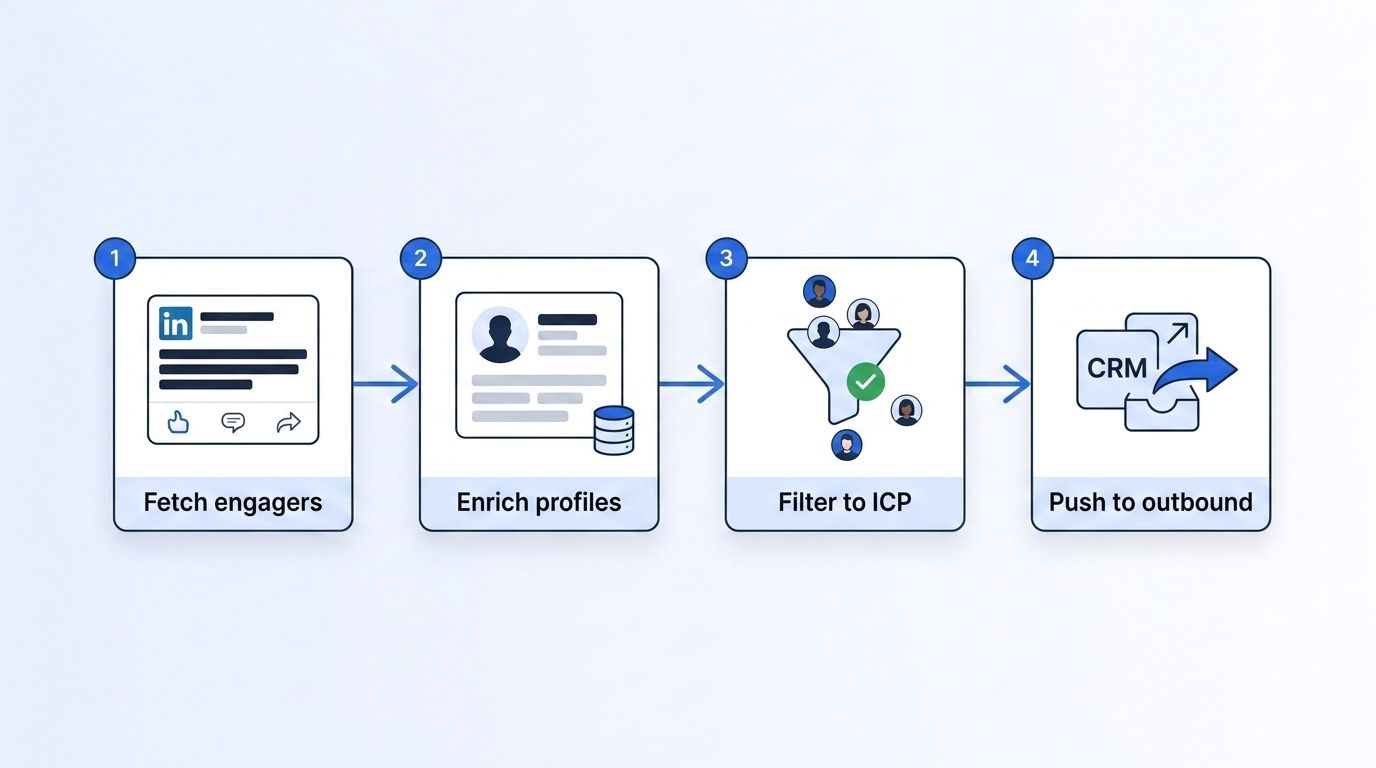
The whole workflow is four API steps you can run on a schedule: fetch, enrich, filter, and push. Each step is a plain HTTP request, so you can wire it into a script, a cron job, or a no-code tool like n8n or Clay. You own every record it produces, which matters when you want to score or route leads your own way.
Here's the flow end to end:
- Pick the posts. Choose 3–10 recent, high-engagement posts from each competitor — launches, hot takes, and case studies pull the most in-market engagers. Grab each post URL.
- Fetch the engagers. Call the reactions, comments, and reposts endpoints for each post. Deduplicate by profile URL, and keep a note of which engagement each person made — you'll reference it in outreach.
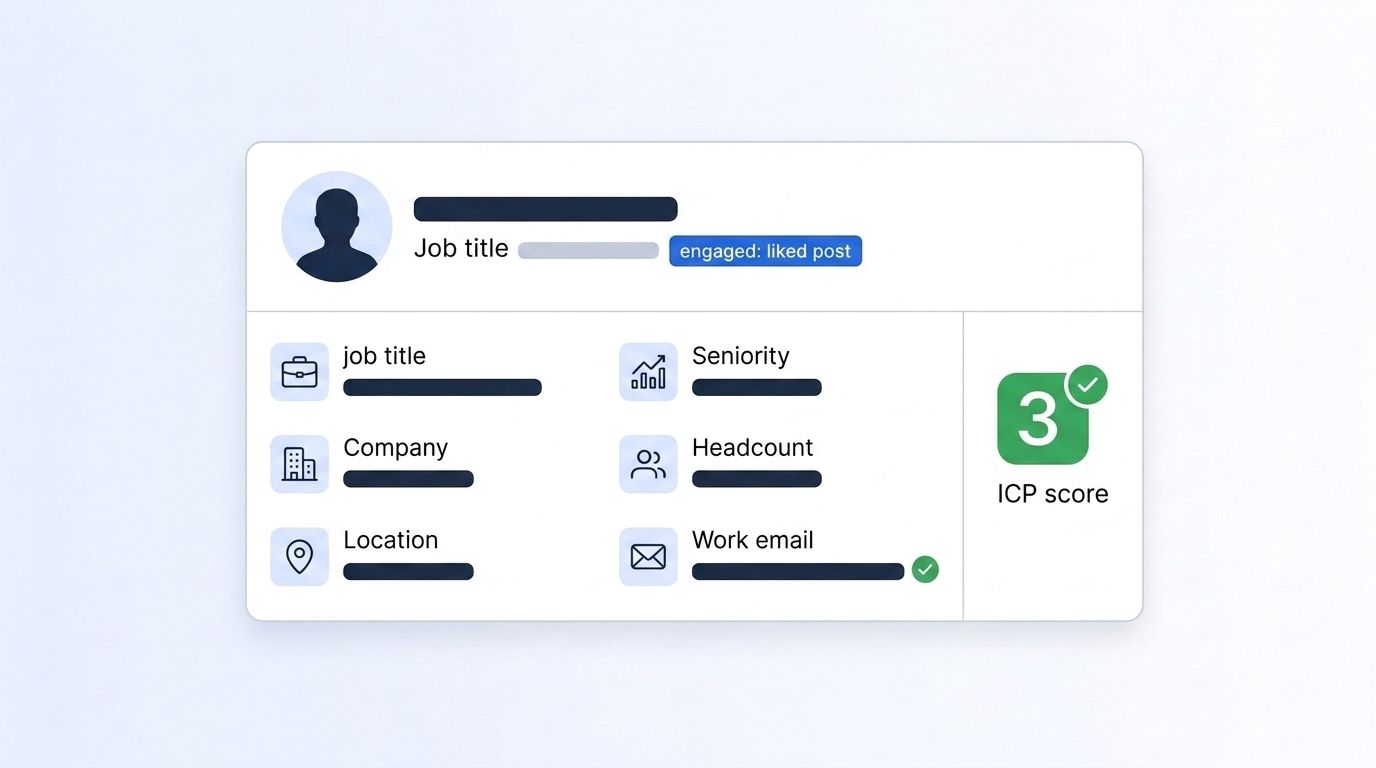
- Enrich each profile. Pass each LinkedIn URL to the People Profile endpoint to get current title, seniority, company, location, and contact fields as structured JSON, fetched live at request time.
- Filter and score against your ICP. Drop anyone who isn't a buyer — wrong title, wrong company size, competitor employee, current customer — and score the rest 1–3 on fit.
- Push to outbound. Send the survivors, with their engagement context, into your CRM or sequencer.
The step teams skip is deduplication. A power user often likes, comments on, and reposts the same competitor thread, so a naive pull triple-counts them and burns three touches on one person. Dedupe on profile URL before you enrich — it saves credits and stops you from looking spammy. Authenticate every request first; see the API authentication guide for token setup.
How do you filter engagers down to a real ICP list?
Raw engagers are noisy — you'll get competitors, job seekers, students, and cheerleaders mixed in with real buyers. The filter step is where a pile of names becomes a list worth working. Enrich first, then apply hard rules, then score what's left.
Apply these filters in order, cheapest to most expensive:
- Hard exclusions: remove competitor employees, your own team, current customers, and obvious non-buyers (students, consultants outside your ICP). These are free rejections on data you already have.
- Firmographic fit: keep only companies matching your ICP on industry, headcount, and region. Match against your target-account list where you have one.
- Persona fit: keep only the titles and seniorities that buy or influence your deal. A VP of Sales engaging matters more than an intern.
- Fit score 1–3: rank the survivors so reps work the strongest fits first.
If you want to skip manual firmographic filtering, run the enriched engagers through the ICP People Search endpoint, which filters by job title, seniority, function, company, and location using plain-English values instead of internal IDs (Datamagnet, ICP Search API, retrieved 2026-07-19). The output is a clean, scored record per person — engagement type, enriched firmographics, and an ICP score — ready to route.
Should you build on a data API or buy a signal tool?
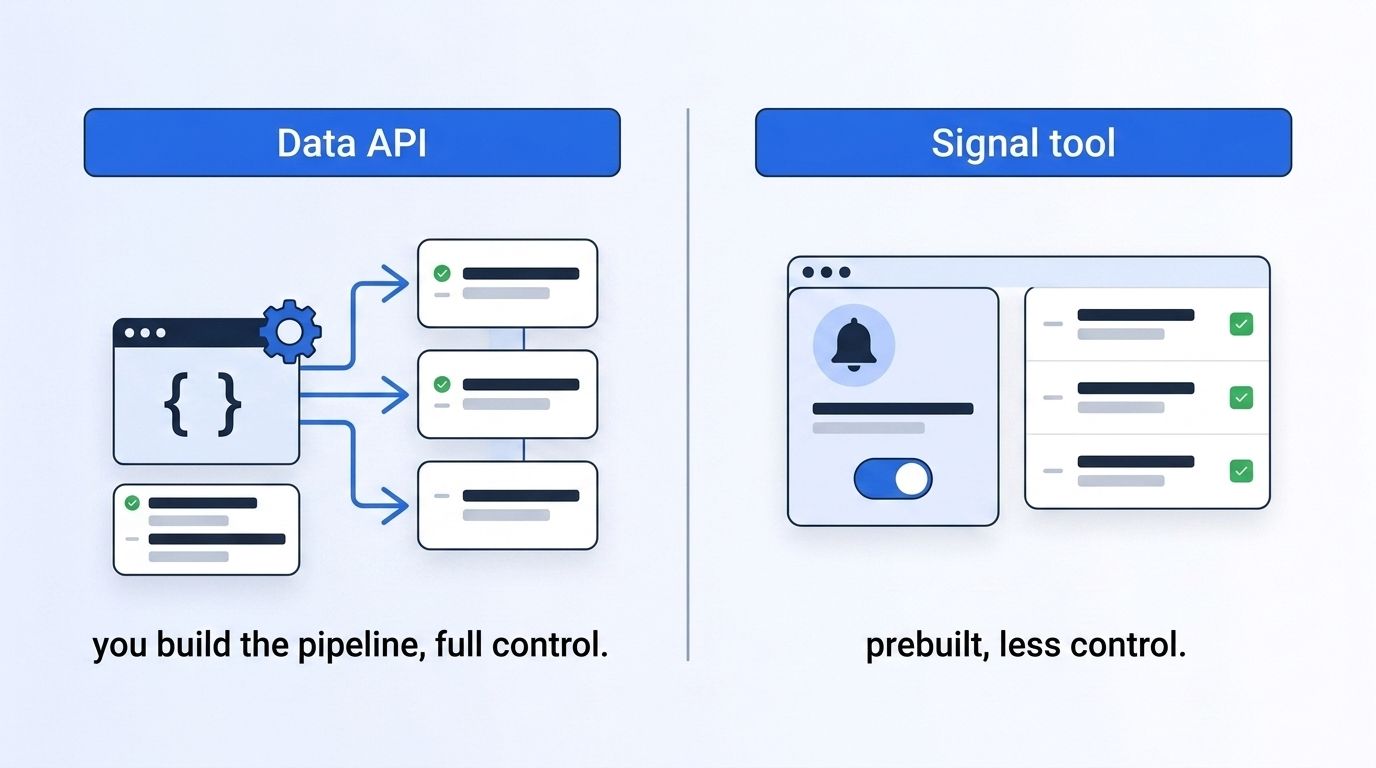
It depends on whether you want control or convenience. A data API hands you raw records to assemble your own pipeline, scoring, and routing. A signal tool is a prebuilt monitor that watches competitor posts for you and delivers qualified engagers on its own — less to build, less to control. Both can produce the same outbound list; the difference is who does the assembly.
The honest trade-off looks like this:
| Dimension | Data API (build) | Signal tool (buy) |
|---|---|---|
| Setup | You write the pipeline | Configure a monitor, done |
| Control | Full — every field, every rule | Bounded by the tool's UI |
| Custom scoring | Yes, your own model | Usually the vendor's scoring |
| Always-on monitoring | You schedule it | Built in, real-time |
| Best owner | GTM engineer / RevOps | SDR / marketer |
| Where data lands | Anywhere you call it from | The tool, then your CRM |
The good news: with Datamagnet you don't have to pick a lane. The same platform exposes both the raw post endpoints for teams that want to build, and a company engagement signal that monitors a target company's posts and surfaces qualified engagers automatically. Start with whichever fits today, and graduate when your needs change.
When does the signal tool clearly win?
The signal tool wins when the cost of not knowing today is higher than the value of custom control. Engagement is perishable — a comment you act on within a day lands far warmer than one you find three weeks later in a batch job. A monitor that alerts you in near real time closes that gap without anyone remembering to run a script.
A prebuilt monitor makes sense when you want continuous coverage of a competitor set without maintaining a pipeline. Datamagnet's engagement signals watch posts by company, keyword, or industry, filter every engager against your ICP, score them, and can deliver straight to Slack or your CRM through webhooks (Datamagnet, Competitor Hijack, retrieved 2026-07-19). For a copy-paste version of this exact play, the Competitor Hijack cookbook walks through the setup.
The build-versus-buy line isn't permanent. Many teams start with the signal tool to prove the play converts, then move to the raw API once they want custom scoring, their own dedupe logic, or data flowing into an internal app the vendor's UI can't reach. The pipeline you sketched by hand becomes the thing you automate.
A quick worked example
Say your competitor posts a customer win on Monday and it pulls 240 reactions, 35 comments, and 18 reposts. Deduped, that's roughly 270 unique engagers. After hard exclusions (their employees, your customers, obvious non-buyers) you might drop to 180. Firmographic and persona filters cut that to, say, 60 real ICP matches, and your 1–3 fit score surfaces the top 20 to work first.
That's 20 warm, context-rich prospects from a single competitor post — each one openable with "I saw your take on [competitor]'s customer story." Run it across 5 posts a week per competitor and the volume compounds fast, without buying a single cold list. The engagement context is the part a bought list can never give you.
How do you stay compliant while doing this?
Work only with public data, and process it on a lawful basis. The engagers, reactions, and comments here are public LinkedIn interactions, but "public" is not the same as "unlimited" — GDPR and CCPA still apply to how you store and use personal data for outreach.
Keep three guardrails in place: collect only public profile fields you have a legitimate business interest in using, honor opt-outs and suppression lists on the first request, and don't retain data you're not actively working. Datamagnet collects from public sources, respects robots.txt, and offers GDPR- and CCPA-aligned handling with signed webhooks and TLS in transit (Datamagnet, Security & Data Practices, retrieved 2026-07-19). Your outreach content and cadence are your responsibility — a warm signal is not a license to spam.
Frequently Asked Questions
Is it legal to build an outbound list from a competitor's post engagers?
Public engagement data can be used for B2B outreach when you process it on a lawful basis and respect opt-outs. GDPR and CCPA still apply to storage and use, so collect only public fields, honor suppression requests immediately, and avoid retaining data you're not actively working. Consult your own legal counsel for your jurisdiction.
Which engagement signal is strongest — likes, comments, or reposts?
Comments are usually the strongest signal because the person wrote something, often revealing intent, a question, or a complaint you can reference. Reposts show willingness to amplify. Reactions are the broadest but lightest signal. Pulling all three from a post gives you the widest qualified audience and lets you tier outreach by signal strength.
How many contacts can one competitor post realistically produce?
It varies with post reach, but a well-engaged B2B post pulling a few hundred reactions plus dozens of comments and reposts commonly yields a few dozen genuine ICP matches after deduplication and filtering. Run it across several posts per competitor each week and the qualified volume compounds without buying cold lists.
Do I need engineering resources to run this pipeline?
Not necessarily. The four-step flow works as HTTP calls in a no-code tool like n8n or Clay, or you can skip the build entirely with a prebuilt engagement signal that monitors competitor posts and delivers scored engagers to your CRM. Choose the raw API when you want custom scoring or data in your own systems.
How is this different from buying an intent-data list?
Intent-data lists infer interest from aggregate web behavior, often anonymized to the account level. Competitor engagers are named individuals showing person-level, timestamped interest in a specific topic you can quote. You know exactly what they engaged with and when, which makes the first message far more relevant than a generic intent spike.
Conclusion
A competitor's social engagers are the closest thing to a warm cold list: named people, timestamped interest, and a built-in reason to reach out. The pipeline to work them is only four steps — fetch the reactions, comments, and reposts, enrich each profile, filter to your ICP, and push the survivors to outbound.
Whether you build that on a raw data API or run a prebuilt signal monitor comes down to control versus convenience — and you can switch as you scale. If you'd rather not maintain the pipeline yourself, see how Datamagnet's Signal API turns competitor engagement into a scored, ICP-filtered list automatically, or wire the LinkedIn Posts API into your own workflow and keep full control.
Sources
- 6sense, B2B Buyer Experience Report 2025, retrieved 2026-07-19.
- Gartner, 61% of B2B Buyers Prefer a Rep-Free Buying Experience, retrieved 2026-07-19.
- HubSpot, Database Decay Simulation, retrieved 2026-07-19.
- Datamagnet, LinkedIn Posts API, retrieved 2026-07-19.
- Datamagnet, Competitor Hijack and Competitor Hijack cookbook, retrieved 2026-07-19.
- Datamagnet, Post Reactions, Post Comments, and Post Reposts endpoints, retrieved 2026-07-19.
- Datamagnet, People Profile and ICP People Search endpoints, retrieved 2026-07-19.
- Datamagnet, Company Engagement Signal and Webhooks, retrieved 2026-07-19.
- Datamagnet, Security & Data Practices, retrieved 2026-07-19.
