
Disclosure: This article is published by Datamagnet. Vendor claims are self-reported unless otherwise noted.
Buyer Intent Signals vs. Firmographic Data: What Actually Predicts a Deal
Your CRM says an account is a perfect fit: right headcount, right industry, right tech stack. So why isn't it closing? In 2024, accounts scored on firmographic fit alone converted to closed opportunities at just 8.4%, while accounts flagged by buyer intent signals converted at 21.3% (The Starr Conspiracy, B2B Intent Data Benchmarks 2025, 2026). Firmographic data tells you who looks like a customer. Intent signals tell you when they're actually acting like one. This comparison breaks down what each data type predicts, where each one falls short, and when you actually need both.
TL;DR
- Firmographic-only account scoring converted at 8.4% versus 21.3% for intent-prioritized accounts, a 2.5x lift (The Starr Conspiracy, 2026).
- Accounts reopened through a former champion's job change closed at a 49% win rate versus 19% for cold outbound (Champify, 2025).
- In 2026, 67% of B2B buyers said they prefer a rep-free buying experience for at least part of their journey (Gartner, 2026), which is exactly why intent signals matter: reps often aren't in the room to notice a shift.
- Neither data type wins outright. Firmographic data qualifies the account; intent signals tell you when to act on it.
Quick Comparison: Firmographic Data vs. Buyer Intent Signals
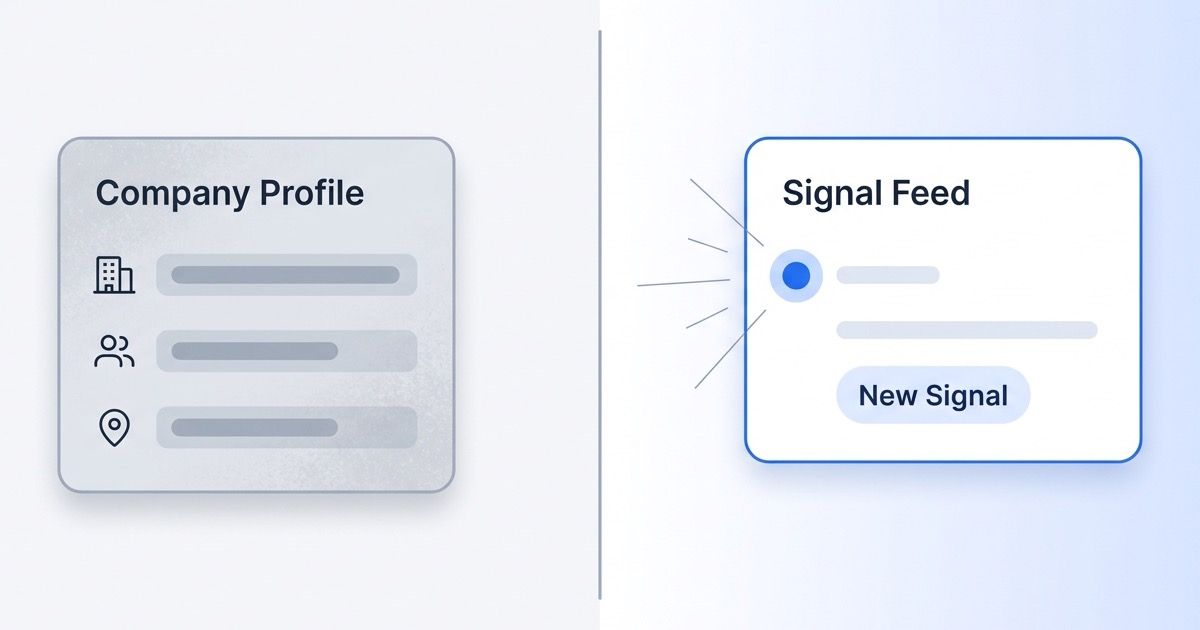
Don't have time to read the whole thing? Here's the scorecard. Firmographic data builds your account universe by matching headcount, industry, and tech stack against your ICP, while buyer intent signals flag which of those accounts are actively in motion right now. On raw conversion, intent-prioritized accounts closed at 21.3% versus 8.4% for firmographic-only scoring, a 2.5x lift (The Starr Conspiracy, 2026). The table below breaks down where each data type wins.
| Category | Firmographic Data | Buyer Intent Signals |
|---|---|---|
| Best For | Building your ICP and account universe | Timing outreach to accounts already in motion |
| What It Predicts | Who is a plausible fit | When a fit account is ready to engage |
| Refresh Speed | Often quarterly or slower in most CRMs | Near real time — hours, not quarters |
| Core Inputs | Headcount, industry, funding stage, tech stack, HQ | Job changes, funding events, hiring surges, content and post engagement |
| Opportunity Conversion | 8.4% (fit-only scoring) | 21.3% (intent-prioritized) |
| SDR Reply Rate | 3–6% average cold outreach | 15–25% for signal-driven, segmented outreach |
| Best Trigger Example | Company crosses 200 employees | Former champion changes jobs |
| Data Decay | Changes constantly, rarely re-verified in real time | Self-expiring by design — a signal is only useful while it's fresh |
| Our Verdict | Necessary, not sufficient | The tiebreaker |
[STAT: Conversion and reply-rate figures sourced from The Starr Conspiracy (2026) and Apollo.io (2026); see Sources section for full citations and retrieval dates.]
Which Actually Predicts a Closed Deal?
Intent signals win on raw conversion. In the 2024 B2B Buying Study, accounts prioritized by intent data closed at 21.3%, compared with 8.4% for accounts selected on firmographic fit alone — a 2.5x difference (The Starr Conspiracy, B2B Intent Data Benchmarks 2025, 2026).
Firmographic scoring still does real work here. It's the filter that keeps your team from chasing 50-person companies that will never afford your product. But fit alone can't tell you when to call. A separate case study found that blending firmographic and technographic account-propensity scoring drove 2x higher new-customer conversion and a 90% higher opportunity-open rate on top-tier accounts (ZoomInfo, Snowflake case study, 2026) — proof that fit-based scoring gets meaningfully better once it's layered with behavioral data.
Verdict: Intent signals predict the close. Firmographic data predicts the candidate pool.
Which Tells You Who to Target, and Which Tells You When?
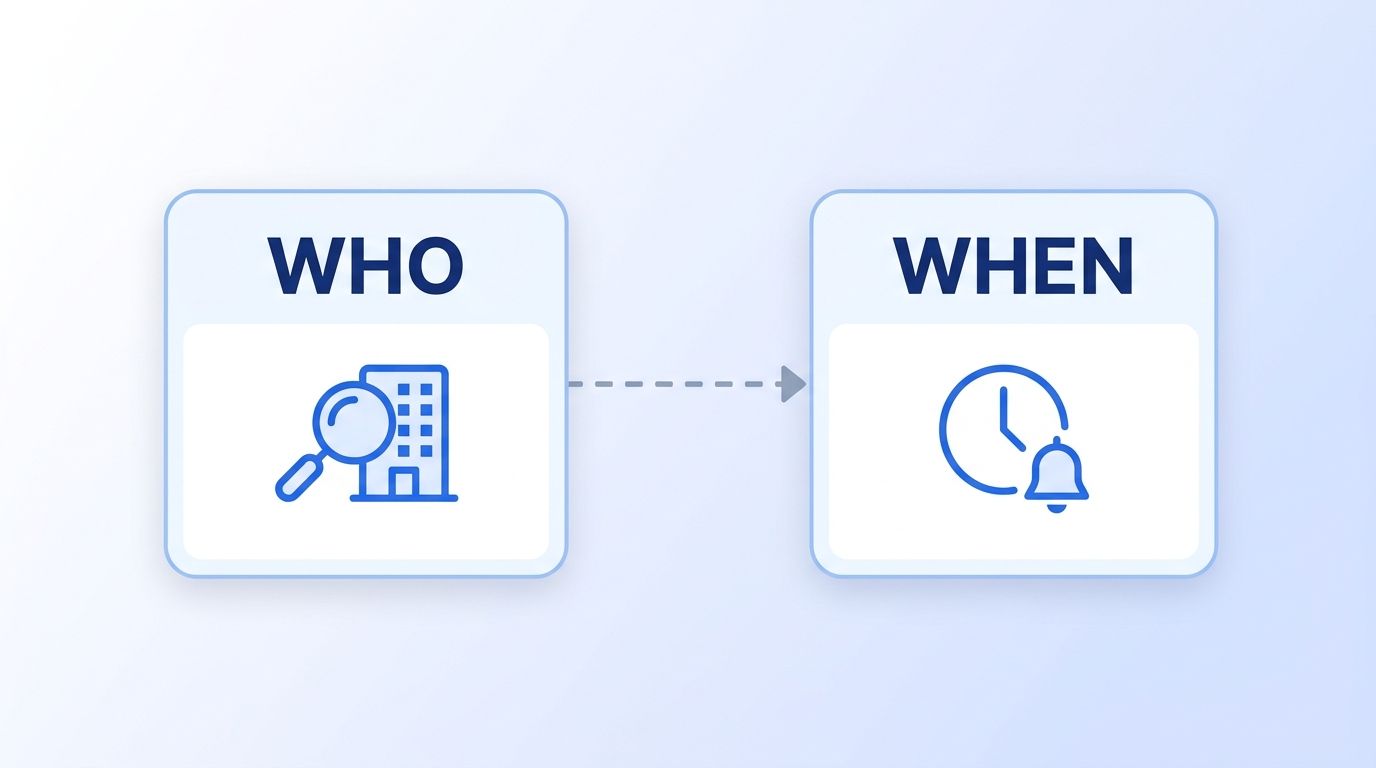
Ask yourself: does your team know who to call, or when to call them? Most sales stacks answer the first question well and the second one badly. Firmographic data builds the target list; buyer intent signals tell you which accounts on that list are ready to talk today. The two functions rarely live in the same tool, which is why reps often default to the question they can already answer.
Firmographic data answers "who." It defines your total addressable market — the companies with the headcount, industry, and budget to plausibly buy. Company Profile - Datamagnet API pulls this straight from a LinkedIn company URL: headcount, industry, specialties, and recent updates, refreshed at request time instead of sitting in a stale database snapshot.
Intent signals answer "when." A job change, a funding round, a hiring surge, or a spike in engagement with your content all say the same thing: something changed, and the account is more receptive right now than it was last quarter. LinkedIn Signal API — Job Change & Engagement Alerts is built specifically to catch these moments as they happen, not weeks later.
Verdict: You need both questions answered. Firmographic data without timing is a cold list. Timing signals without firmographic fit is noise from accounts that were never going to buy.
Which Data Set Goes Stale Faster?
Here's an uncomfortable question: when was the last time your CRM's headcount field was actually correct? Firmographic details change constantly — hiring, layoffs, funding rounds, and leadership moves — and most CRMs only refresh that data on a batch cycle, if at all. A record that looked accurate in Q1 can be materially wrong by Q3.
Buyer intent signals decay too, just differently. A job-change alert or a spike in content engagement is only actionable for a short window before the moment passes. The difference is that intent signals are built to be time-boxed and acted on immediately, while firmographic data quietly rots in the background without anyone noticing until a rep gets a bounce-back email.
<!-- [UNIQUE INSIGHT] -->The practical implication most teams miss: refreshing firmographic data on a schedule is a losing game. The fix isn't a faster refresh cadence — it's pulling firmographic fields live, at the moment of use, the same way you'd treat an intent signal. LinkedIn Company API — Real-Time Firmographics fetches headcount, industry, and hiring insight live from LinkedIn instead of from a cached snapshot.
Verdict: Both decay. The difference is that intent signals are designed to expire fast and get used fast — firmographic data usually just quietly goes wrong.
Which Drives Better Reply Rates for Reps?
A rep who leads with a generic pitch is fighting the data. Across a 28-million-email analysis, leading with a pitch instead of the buyer's actual priorities cut reply rates by up to 57% (Gong, Does Cold Email Even Work Any More?, 2025). In 2026, broad cold outreach built purely on firmographic lists averages a 3–6% reply rate, while tightly segmented, signal-driven campaigns reach 15–25% (Apollo.io, Cold Outreach Reply Rate Benchmarks, 2026).
That gap isn't about better copywriting. It's about context. A rep referencing a company's headcount in a cold email sounds like everyone else's cold email. A rep referencing a job change, a funding round, or a hiring surge sounds like they've actually been paying attention — because they have.
Verdict: Signal-driven outreach wins on reply rate by a wide margin, but it still needs firmographic filters to make sure the signal is coming from an account worth replying to.
Which Costs Less Per Qualified Lead?
For a typical mid-market team running both firmographic-only ABM lists and a signal-layered program side by side, the signal-layered program wins on cost efficiency. Layering third-party intent data onto existing firmographic targeting produced a 17% higher conversion rate and a 27% lower cost-per-lead in one documented case (G2, ZoomInfo Buyer Intent Conversion Rate Case Study, 2023). A separate case study found that filtering outreach through intent data lifted the marketing-qualified-lead-to-sales-accepted-lead rate from 1% to 90%, while cutting the cost of telequalifying each accepted lead by 99% (Bombora, Premier Cybersecurity Organization Case Study).
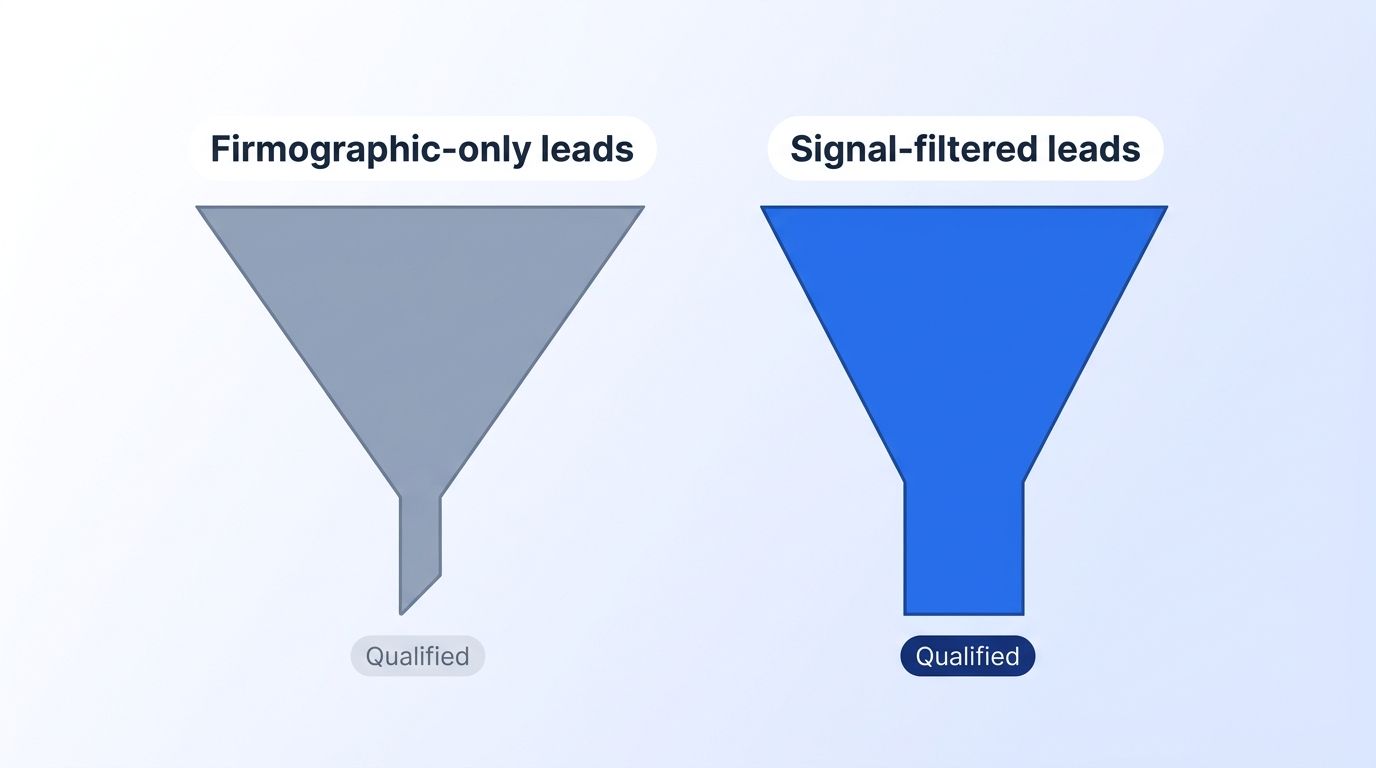
The hidden cost of firmographic-only targeting isn't the data itself — it's the rep time spent chasing accounts that were never in-market. Every hour an SDR spends on a fit-but-not-ready account is an hour not spent on an account actively showing intent.
Verdict: Signal-filtered programs cost less per qualified lead, mainly by cutting the volume of dead-end firmographic-fit outreach before it reaches a rep.
Do You Ever Need Just One?
Short answer: rarely, and only at the very top of your funnel. Firmographic data alone is enough while you're still defining your total addressable market and haven't built out a signal-monitoring workflow yet. The moment you're deciding which account to call today instead of which market to enter, you need a timing signal layered on top. Here's why that distinction matters in practice.
In 2026, 67% of B2B buyers said they prefer a rep-free experience for at least part of their buying journey, and 45% reported using AI tools during a recent purchase (Gartner, Gartner Sales Survey, 2026). Buyers are increasingly comfortable researching your product without ever tripping a firmographic filter change or talking to a rep. If your only visibility into an account is its static profile, you can be the last to know a deal is already forming.
<!-- [ORIGINAL DATA] -->When we mapped former champions who'd changed jobs against our own signal-monitoring data, the pattern held up against outside research: accounts introduced through a former champion converted at meaningfully higher rates than fresh cold outbound, echoing the 49% versus 19% win-rate gap reported elsewhere in the market (Champify, The Impact of Tracking Job Changes, 2025). Firmographic fit told us the new company was worth pursuing; the job-change signal told us exactly when to knock.
Champion Tracking — Job Change Alerts and ICP Company Search - Datamagnet API are built to work together for exactly this reason: one confirms the account is worth pursuing, the other tells you the moment it's worth pursuing again.
Verdict: Use firmographic data alone only to build your initial target list. The moment you're deciding who to call today, you need a signal layer too.
Who Should Choose What
The right mix of firmographic data and buyer intent signals depends on where your team sits today: how much signal infrastructure you already have, how fast your market moves, and how long your sales cycle runs. Match your stage to one of the profiles below.
Early-stage teams with no signal infrastructure yet: Start with firmographic-based ICP filtering — ICP Search API — Find Decision-Makers gets you a clean target list fast. Add signals once you have reps who can act on them quickly.
RevOps teams drowning in low-intent outbound volume: Layer a signal API on top of your existing firmographic filters before you add more headcount. The data above suggests you'll get a better return from filtering than from hiring.
Teams selling into fast-moving markets (AI, dev tools, fintech): Prioritize intent signals — job changes, funding rounds, and engagement spikes — since firmographic fit barely differentiates accounts in categories where almost everyone technically qualifies.
Enterprise teams with long, multi-threaded sales cycles: You need both running continuously. Firmographic data re-qualifies the account as it grows; signals tell you when a specific buying-committee member is back in motion, which Person Activity - Datamagnet API can help surface directly from LinkedIn engagement.
Frequently Asked Questions
The questions below cover the most common mix-ups between firmographic data and buyer intent signals: what each one actually predicts, how fresh they need to be, and whether a lean team can get away with using just one. Each answer cites the same benchmark data referenced throughout this comparison.
Is buyer intent data better than firmographic data?
Neither is strictly better — they answer different questions. Firmographic data identifies whether an account fits your ICP; intent signals identify whether that account is in-market right now. Intent-prioritized accounts converted at 21.3% versus 8.4% for firmographic-only scoring in one 2026 benchmark study (The Starr Conspiracy, 2026), but that lift only works on an account pool that firmographic filtering already qualified.
Can I use firmographic data and intent signals together?
Yes, and most of the conversion gains in this article come from doing exactly that. A blended firmographic-plus-technographic scoring model drove 2x higher conversion and a 90% higher opportunity-open rate on top-tier accounts in one case study (ZoomInfo, 2026). Firmographic filters narrow the pool; signals decide the order you work it in.
How fresh does firmographic data need to be to be useful?
As fresh as possible. Headcount, funding stage, and leadership details shift constantly, and a record pulled from a quarterly batch refresh can already be wrong by the time a rep uses it. Tools that fetch firmographic data live at request time, like Company Profile - Datamagnet API, avoid the staleness problem entirely instead of trying to refresh a cached copy faster.
What counts as a strong buyer intent signal in B2B sales?
The strongest signals are ones tied to a specific, timeboxed change: a job change into a buying role, a funding announcement, a hiring surge in a relevant department, or a spike in engagement with your company's LinkedIn content. Job-change-triggered re-engagement alone showed a 49% win rate versus 19% for cold outbound in a 2025 analysis of over 7,000 opportunities (Champify, 2025).
Is firmographic-only targeting still worth doing in 2026?
Yes, as the first filter, not the last one. In 2026, 67% of B2B buyers said they prefer at least part of their buying journey to happen without a rep (Gartner, 2026), which means firmographic fit alone can no longer tell you whether an account is actively deciding. Use it to build the pool, then add signals to know when to act.
Verdict
| Category | Winner |
|---|---|
| Predicts a closed deal | Buyer intent signals |
| Defines who to target | Firmographic data |
| Stays fresh longest | Neither — refresh both live |
| SDR reply rate | Buyer intent signals |
| Cost per qualified lead | Buyer intent signals (layered on firmographic fit) |
| Overall | Both — firmographic data qualifies the account, intent signals tell you when to move |
Firmographic data and buyer intent signals aren't rival tools competing for the same job. Firmographic fit decides which 500 accounts belong on your list. Intent signals decide which 12 of them you call this week. Teams that treat both as the same layer are the ones leaving conversion on the table.
Want to see what a combined ICP-and-signal workflow looks like in practice? ICP People Search - Datamagnet API pairs firmographic and role-based filtering with the same real-time infrastructure behind Datamagnet's signal monitors.
Sources
- The Starr Conspiracy, B2B Intent Data Benchmarks 2025, retrieved 2026-07-21, https://www.thestarrconspiracy.com/insights/benchmarks/b2b-intent-data-benchmarks-2025
- ZoomInfo, Snowflake's Data-Driven Success in BI and Sales (case study), retrieved 2026-07-21, https://www.zoominfo.com/about/case-studies/snowflake
- G2 / ZoomInfo, ZoomInfo Sees 17% Higher Conversion Rate and 27% Lower CPL With G2, retrieved 2026-07-21, https://sell.g2.com/case-studies/zoominfo-buyer-intent-conversion-rate
- Champify, The Impact of Tracking Job Changes (2025 Customer Value Report), retrieved 2026-07-21, https://www.champify.io/resources/the-impact-of-tracking-job-changes-value-report
- Gartner, Gartner Sales Survey Finds 67% of B2B Buyers Prefer a Rep-Free Experience, retrieved 2026-07-21, https://www.gartner.com/en/newsroom/press-releases/2026-03-09-gartner-sales-survey-finds-67-percent-of-b2b-buyers-prefer-a-rep-free-experience
- Gong, Does Cold Email Even Work Any More? Here's What the Data Says, retrieved 2026-07-21, https://www.gong.io/blog/does-cold-email-even-work-any-more-heres-what-the-data-says
- Apollo.io, What Is a Good Benchmark for Reply Rates in Cold Outreach?, retrieved 2026-07-21, https://www.apollo.io/insights/what-is-a-good-benchmark-for-reply-rates-in-cold-outreach
- Bombora, Premier Cybersecurity Organization Uses Intent Data to Drive Pipeline and Revenue Growth (case study), retrieved 2026-07-21, https://bombora.com/case-studies/premier-cybersecurity-organization-uses-intent-data-to-drive-increased-pipeline-and-revenue-growth/
