
Disclosure: Datamagnet publishes this article. Product capabilities described below are based on public documentation, retrieved August 20, 2026.
How to Build a Boomerang Employee Sourcing List From Alumni Signal Data
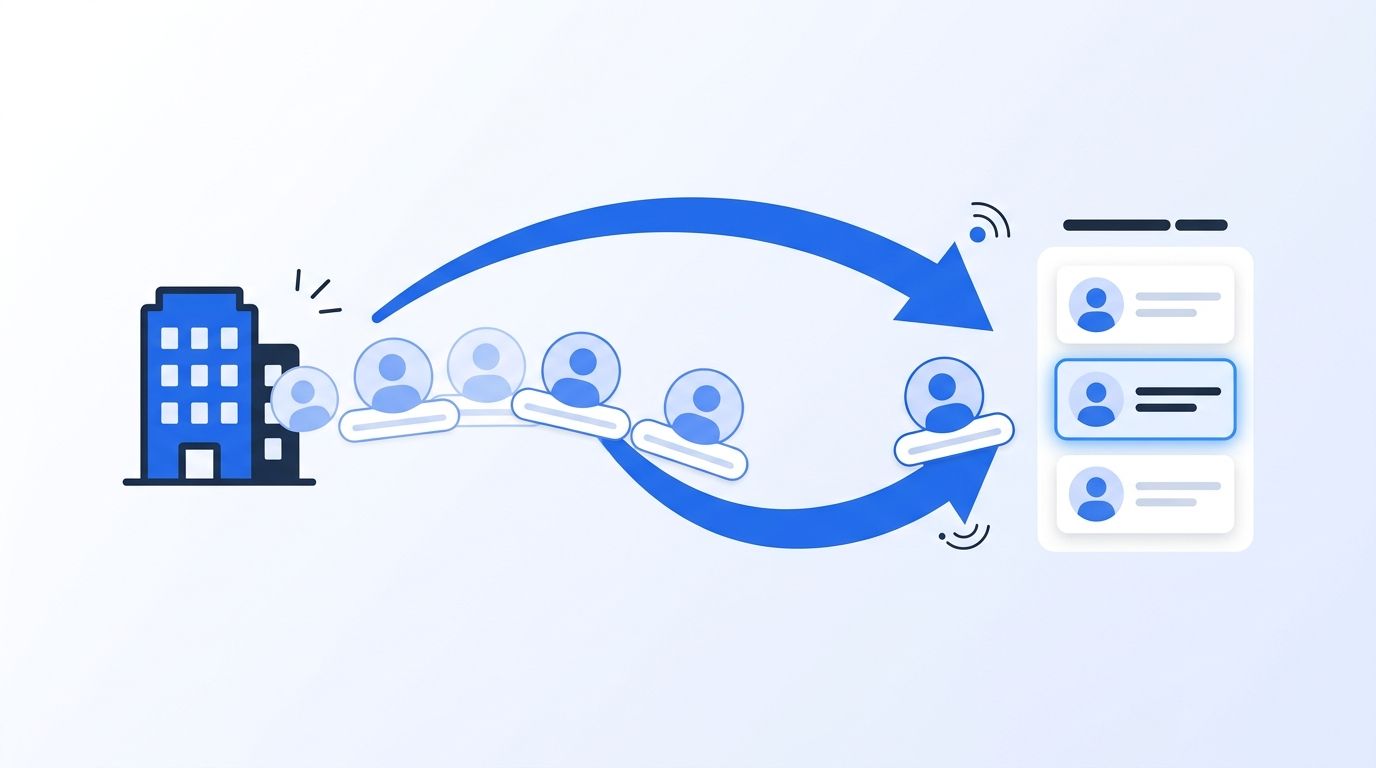
In March 2025, 35% of all new hires were boomerang employees returning to a former employer — the highest share ADP has recorded since it started tracking the metric in 2018 (ADP Research Institute, "Boomerang hiring makes a comeback", 2025). Most recruiting teams still treat their alumni list as a compliance archive, not a sourcing channel.
That's a wasted pipeline sitting in an offboarding folder. This guide walks through building a living, signal-based boomerang sourcing list — one that tells you the moment a former employee is open to a conversation, instead of relying on someone remembering to check LinkedIn.
TL;DR
- In 2025, 35% of new hires were boomerang employees, up from 31% in 2024 and 26% in 2022 (ADP Research Institute, 2025).
- In the tech and information sector, that share hit roughly 67% in March 2025 — about double the rate a year earlier (ADP Research Institute, 2025).
- 48% of U.S. workers say they'd consider returning to a former employer, up 8 points from 2023 (Robert Half, 2024).
- A peer-reviewed study of 12,000 hires found boomerang employees earned stronger performance reviews and were promoted more often than external hires (Academy of Management Journal, via Cornell ILR, 2020).
- A static alumni spreadsheet can't catch any of this — you need a signal layer that flags when a former employee changes roles, gets laid off, or starts posting about being open to work.
What Do You Need Before You Start?
You don't need new headcount to build this — you need access to the right records and a way to keep them current. Budget about half a day for the initial build, then a light ongoing check as signals come in.
What you'll need:
- Export access to your HRIS or ATS termination records (name, last title, department, exit type, exit date)
- Your company's LinkedIn alumni tool, as a cross-check against HR's list
- An enrichment source to append current employer and title to each alumni record, like Datamagnet's People Profile API or People Search DB
- A signal or monitoring tool that flags job changes in real time, not on a quarterly refresh
- A place to route alerts — Slack, your ATS, or a CRM
- Time: ~3-4 hours to build, then 15-20 minutes a week to review flagged signals
- Difficulty: Intermediate
Step 1: How Do You Pull a Complete Alumni Roster, Not Just the Names You Remember?
By the end of this step, you'll have one merged list of every person who's left the company in the last 3-5 years, not just the ones a hiring manager happens to recall fondly. Memory is a bad sourcing database: it skips anyone who left quietly, anyone from a team you don't work with directly, and anyone who left before the current recruiting team started.
Most alumni "lists" live in someone's head or an old spreadsheet that stopped getting updated the day the recruiter who owned it left too. Pull three sources instead of one: your HRIS termination export, your ATS records for anyone who was previously hired through it, and your company's LinkedIn alumni tool. Cross-reference by name and last known title, then dedupe.
Isn't it strange that most companies track every applicant who never worked there but lose track of the people who actually did? Datamagnet's People Search DB endpoint can help fill gaps here — search your own enriched profile database by former company name to catch alumni your HR export missed entirely.
Verify it worked: you should have one spreadsheet or table with a row per former employee, a last-known title, and an exit date — even if current employer is still blank.
Step 2: How Do You Filter Out the Rehires You Actually Don't Want?
By the end of this step, your list shrinks from "everyone who ever left" to "people worth tracking" — and that filtering step is what keeps this from turning into noise. Skipping it is how a promising alumni project turns into three hundred names nobody can actually act on, including people you'd never rehire for legal or performance reasons in the first place.
Not every departure is a rehire candidate. Filter out involuntary terminations for performance or conduct, anyone under an active non-compete, and roles you're structurally not rehiring for. Robert Half's 2024 research found former employees cite a higher title (27%), matching current salary (19%), and more remote flexibility (16%) as the top reasons they'd come back (Robert Half, "How and Why to Embrace Boomerang Hiring", 2024) — tag people you'd realistically be able to offer one of those three things.
Boomerang hiring is climbing fast, and it isn't a one-year blip. ADP's payroll data shows a steady multi-year rise, and the tech sector is running far ahead of the overall labor market.
Step 3: How Do You Enrich Each Alumni Record With Where They Are Now?
By the end of this step, every row on your filtered list has a current employer, title, and tenure attached — the information that tells you whether someone's even reachable, let alone interested. A name and an exit date from three years ago tell a recruiter almost nothing on their own; this step is what turns a static record into something you can actually act on.
A name and an old title tell you almost nothing about whether someone is a live sourcing target. Run each filtered alumni record through an enrichment layer that pulls current employer, current title, and time in role from a live LinkedIn data source, rather than a database that only refreshes every few months.
Most teams treat this as a one-time cleanup pass. It shouldn't be. B2B contact data decays roughly 2% a month — about 22.5% a year — as people change jobs (HubSpot, Database Decay Simulation, retrieved 2026-08-20), and alumni move jobs at least as often as anyone else in your CRM. An alumni list enriched once in January is meaningfully wrong by June.
Datamagnet's People Profile endpoint returns current role, company, and tenure from a LinkedIn URL in a single request, which is exactly the shape of data this step needs. Attach an API key and batch the whole filtered list in one pass.
Step 4: How Do You Set Up Real-Time Monitoring on Your Highest-Value Alumni?
By the end of this step, your top-tier alumni are wired to alert you automatically the moment their situation changes, instead of waiting for you to remember to check. That's the difference between reaching out in the first week someone starts job hunting and reaching out months later after a competitor already has.
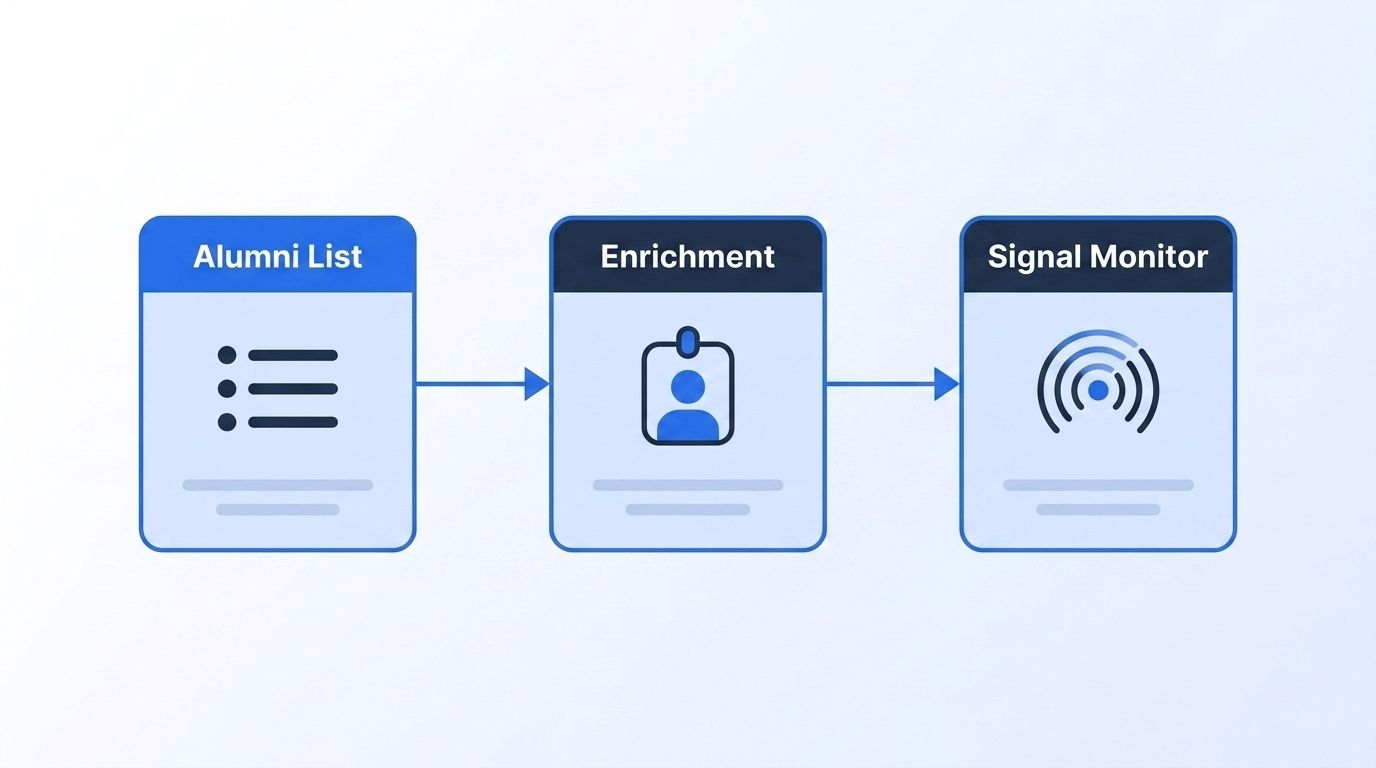
Enrichment gives you a snapshot. Monitoring gives you a trigger. For the alumni you'd genuinely want back, set up a job-change signal so you know the day they leave their current employer — that's the window when they're most reachable and least loyal to where they are now.
Datamagnet's Create Signal endpoint lets you build a monitor on a batch of LinkedIn profile URLs and get notified on job changes, and the same Champion Tracker pattern sales teams use to re-engage former customers who switch companies works just as well for alumni recruiting. Deliver alerts through a webhook so a departure lands in Slack or your ATS within minutes, not at your next quarterly review.
Citation capsule: Median U.S. employee tenure sits at 3.9 years and runs shorter in high-turnover fields like tech and sales (U.S. Bureau of Labor Statistics, Employee Tenure Summary, 2024). A static alumni list checked once a quarter misses most of the job changes that happen in between.
Step 5: How Do You Score Alumni by Rehire Likelihood, Not Just Seniority?
By the end of this step, your list is ranked, so recruiters spend their limited outreach time on the alumni most likely to say yes. A flat, unranked list treats a former star six months into a shaky new role the same as someone who left five years ago and never looked back, and that's a waste of a recruiter's morning.
Rank each record using three inputs: how long they were away when they left versus tenure at their current company (shorter current tenure often signals unrest), whether their current role matches or downgrades their exit title, and whether they hit any of the return incentives from Step 2. A former high performer six months into a lateral move at a company going through layoffs ranks above someone who just got promoted somewhere else.
Should every alumnus get the same outreach cadence? No — treating a recent, high-scoring signal the same as a five-year-old exit record wastes the exact advantage this list gives you. The gap between tech and the broader labor market shows how concentrated this opportunity already is in some industries.
Step 6: How Do You Route Signals to Recruiters and Track Rehire Outcomes?
By the end of this step, a job-change signal on a scored alumnus turns into an actual outreach touch within days, and you're tracking whether it converts. That feedback loop is what tells you whether the scoring model from Step 5 is actually predicting who says yes, not just who looks good on paper.
Connect your webhook to wherever recruiters already work — a Slack channel per req, or a task auto-created in your ATS. Include the signal type, the alumnus's new company and title, and their rehire score in the alert so a recruiter can decide in seconds whether to reach out. [PERSONAL EXPERIENCE] Teams we've worked with initially route every signal to one channel and quickly split it once volume grows — a high-score signal on a former lead engineer shouldn't sit in the same queue as a low-score signal on someone who left two years ago for an unrelated field.
HR Executive reported in 2026 that among HR professionals whose organizations had conducted AI-related layoffs, roughly two-thirds had already rehired some of the people they'd let go, and 36% had rehired more than half. Layoff regret is real, and it's creating an active rehire market right now, not a hypothetical one. Datamagnet's Person Engagement Signal endpoint can layer on top of job-change alerts, flagging when an alumnus starts posting or engaging with content about being open to new roles — often the clearest signal of all.
What Mistakes Should You Avoid?
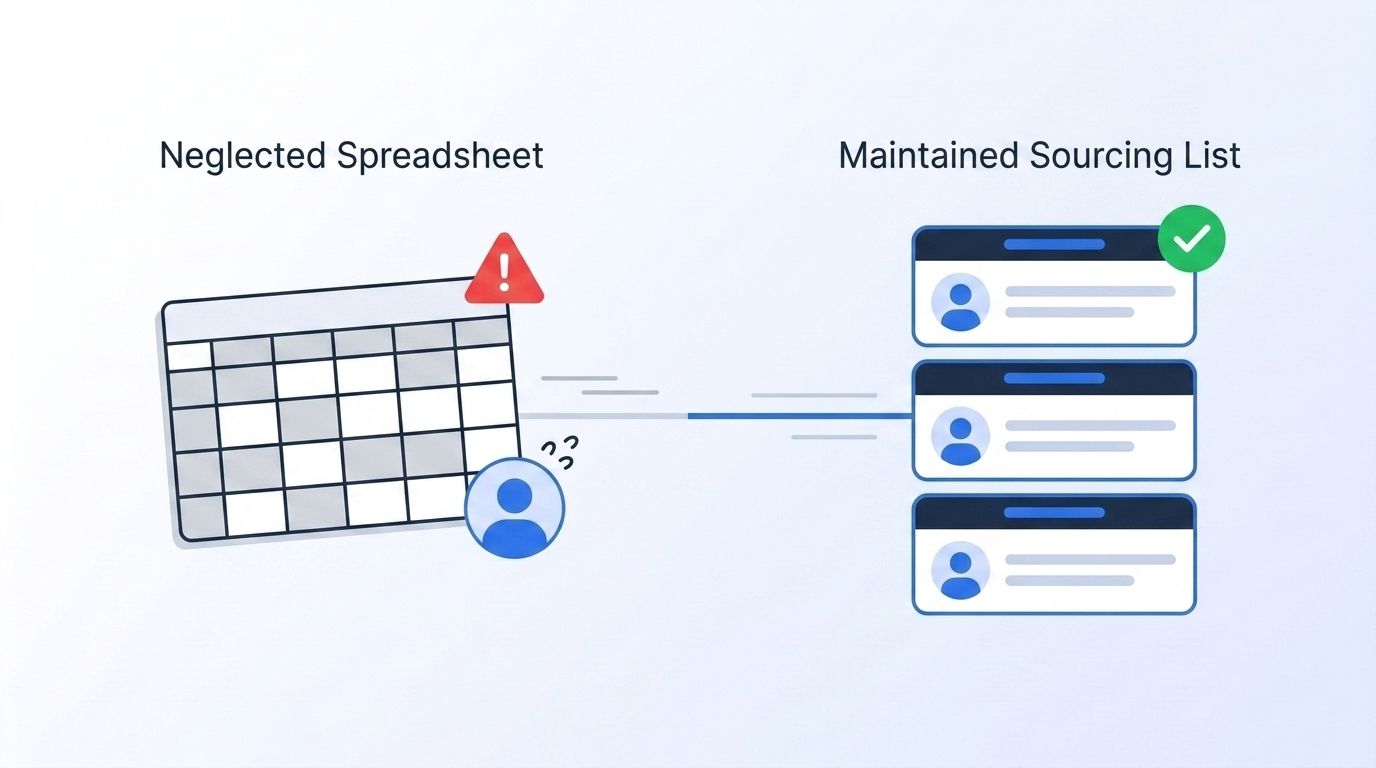
The single most common mistake is treating this as a one-time list-building project instead of an ongoing monitoring system — build it once, check it never, and it's stale again within months. The five mistakes below cover the most common ways a promising alumni list quietly turns back into a stale spreadsheet nobody trusts.
1. Building the list once and never refreshing it. Alumni change jobs like everyone else, and a list enriched in January is measurably wrong by summer. Set a recurring re-enrichment pass, not a one-off.
2. Ignoring exit sentiment entirely. Not every departure is neutral. A quick note in the exit record — laid off vs. resigned for growth vs. left on bad terms — should shape who gets contacted first and how the outreach is worded.
3. Treating every alumnus like a top prospect. [UNIQUE INSIGHT] The instinct is to reach out to everyone who left on good terms. In practice, a scored, tiered list converts better than a flat one, because recruiters stop wasting the first outreach slot of the week on a long shot.
4. Skipping the non-compete and re-hire eligibility check. An enthusiastic outreach to someone under an active restriction wastes goodwill and, in some cases, creates legal exposure. Filter before you contact, not after.
5. Letting one recruiter own the whole list informally. When that person leaves, the list — and the relationships behind it — leaves too. Store it in a shared system, not a personal spreadsheet.
What Does Success Look Like?
If this is working, a job change on a scored alumnus reaches a recruiter's queue within minutes of the signal firing, not weeks later when someone happens to browse LinkedIn. You should see a growing tagged pool of enriched, monitored former employees, a handful of live signals firing every week, and at least a few real conversations restarted with people who already know how your company works.
The stretch goal: pair this with a broader Recruiting Intelligence workflow that tracks not just alumni but referral networks and passive candidates who've engaged with your company's content, so boomerang sourcing becomes one lane in a bigger signal-based pipeline instead of a standalone project.
Frequently Asked Questions
What counts as a "boomerang employee"?
A boomerang employee is someone rehired by a former employer after leaving voluntarily or involuntarily. In March 2025, boomerang hires made up 35% of all new hires — the highest share ADP has tracked since 2018 (ADP Research Institute, 2025).
Do boomerang employees actually perform better than new hires?
Evidence points that way in specific conditions. A peer-reviewed study of roughly 12,000 hires at a large healthcare organization over eight years found boomerang hires received stronger performance reviews and were promoted more often than other new hires, with the biggest edge in relational and coordination-heavy roles (Academy of Management Journal, via Cornell ILR, 2020).
How is this different from just checking LinkedIn's alumni tool occasionally?
LinkedIn's alumni tool shows a static snapshot when you happen to look. A signal-based approach monitors your filtered list continuously and pushes an alert the moment someone's job status changes, so recruiters act on fresh information instead of whatever was true the last time someone checked.
Should I rehire anyone who's willing to come back?
No. Filter out involuntary terminations for cause, active non-competes, and roles you're not rehiring for before you build the monitored list. Robert Half's research shows the top draws for returning are a higher title, matched salary, and remote flexibility — score for fit against those, not just willingness (Robert Half, 2024).
How long does it take to set this up?
Building the initial filtered, enriched list takes about half a day for a mid-sized alumni base. Ongoing signal monitoring runs in the background after that, with recruiters spending roughly 15-20 minutes a week triaging the alerts that come in.
Now Is the Time to Build This
Boomerang hiring isn't a niche tactic anymore — it's over a third of all new hires nationally and nearly two-thirds in tech. Your former employees already know your product, your culture, and your systems, which means they ramp faster than a cold external candidate ever could.
Start with the list, filter it hard, enrich it once, then keep it alive with real-time signals instead of a calendar reminder. Datamagnet's Signal API and champion-tracking tools were built for exactly this kind of "watch and alert" workflow — see how they apply to your alumni pool.
Sources
- ADP Research Institute, "Boomerang hiring makes a comeback," retrieved 2026-08-20, https://www.adpresearch.com/boomerang-hiring-makes-a-comeback/
- Robert Half, "How and Why to Embrace Boomerang Hiring," retrieved 2026-08-20, https://www.roberthalf.com/us/en/insights/management-tips/boomerang-employees-talent-can-come-back-to-you-so-be-ready-to-catch-it
- Academy of Management Journal, "In With the Old? Examining When Boomerang Employees Outperform New Hires," via Cornell ILR, retrieved 2026-08-20, https://www.ilr.cornell.edu/news/research/benefits-hiring-boomerangs
- HR Executive, "As AI layoff regret surges, will boomerang employees make a comeback?", retrieved 2026-08-20, https://hrexecutive.com/as-ai-layoff-regret-surges-will-boomerang-employees-make-a-comeback/
- U.S. Bureau of Labor Statistics, "Employee Tenure Summary," retrieved 2026-08-20, https://www.bls.gov/news.release/tenure.nr0.htm
- HubSpot, "Database Decay Simulation," retrieved 2026-08-20, https://www.hubspot.com/database-decay
