
Disclosure: Datamagnet publishes this article. Product capabilities below are based on public vendor documentation, retrieved July 19, 2026. Ask every shortlisted vendor to validate coverage, pricing, and integrations for your own use case.
Best Sales Tech Stack For 200-Rep SDR Teams in 2026
A 200-rep SDR org doesn't fail because it lacks tools. It fails because the tools don't talk to each other. In 2026, 41% of enterprise B2B teams run at least one AI SDR in production, up from 12% a year earlier (Salesforce, State of Sales 2026). That shift changes what "stack" even means at this scale.
At 200 reps, you're not choosing a tool. You're choosing a system: a data layer that feeds accurate contacts, an engagement layer that runs sequences across channels, a dialer layer that gets reps live conversations, an intelligence layer that coaches and forecasts, and a CRM layer that keeps everything as one source of truth. This guide ranks the 10 platforms that most often make up that system, and shows how they fit together.
TL;DR
- ZoomInfo anchors the data and intent layer for teams that need enterprise-scale contact coverage and buying signals.
- Landbase and Salesforce Agentforce SDR represent the agentic-AI shift: autonomous prospecting and outreach with less manual sequencing.
- Apollo and Outreach cover the two ends of sales engagement: self-service all-in-one versus enterprise-grade sequencing.
- Orum solves the dial-volume problem that a 200-rep floor creates, running up to 10 lines in parallel per rep.
- Gong and Clari close the loop with conversation intelligence and forecast accuracy, while Datamagnet's API layer lets GTM engineering teams build custom workflows on top of it all.
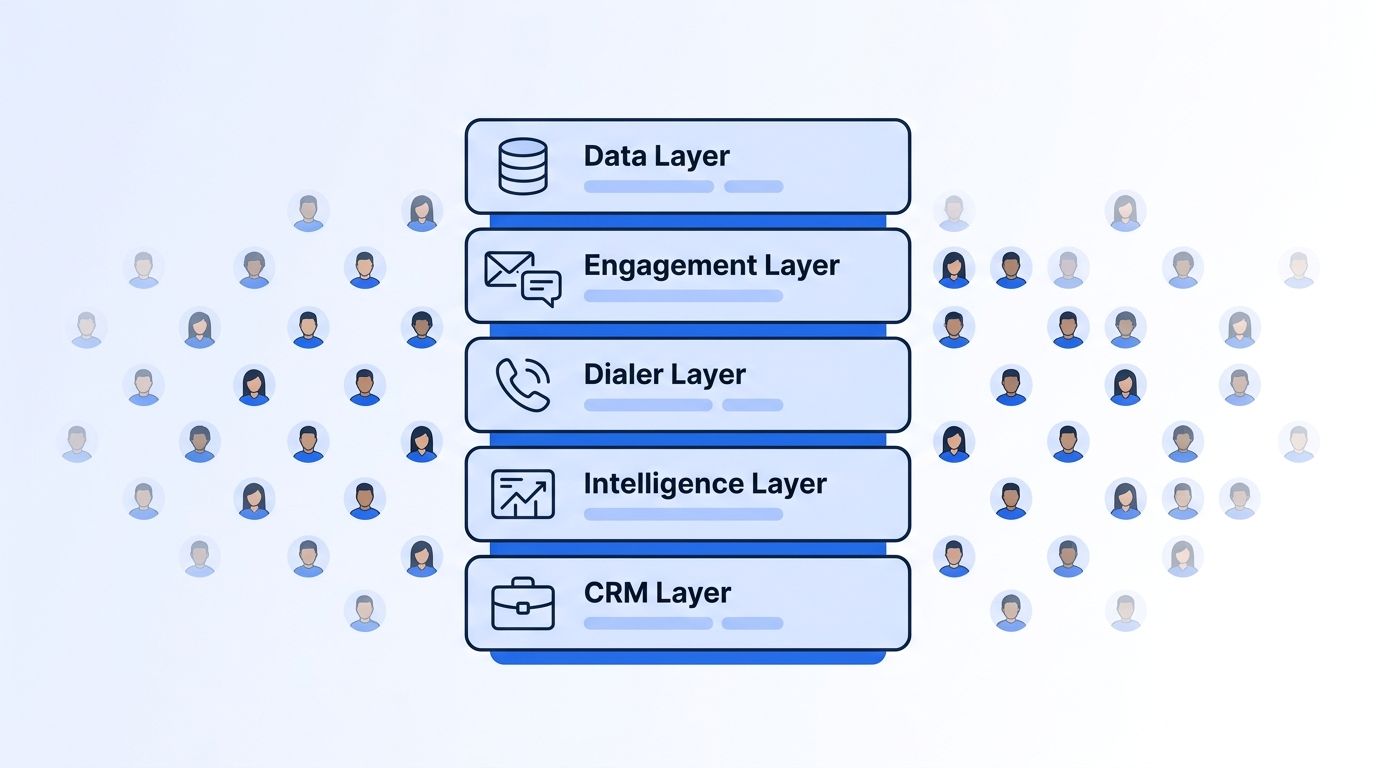
What does a sales tech stack need to do at 200-rep scale?
At small team sizes, one all-in-one tool can cover prospecting, sequencing, and calling. At 200 reps, that same tool usually breaks under load: rate limits, shared sending domains, and dashboards that can't segment by pod. The real evaluation question isn't "does this tool have the feature," it's "does this tool hold up when 200 people use the feature at once."
Score each category against five criteria:
- Data accuracy and refresh rate: Stale contacts waste dial and send capacity fast at this volume.
- Multi-team segmentation: Can admins split reporting, sequences, and quotas by pod or region without building five separate instances?
- API and webhook depth: Does the platform expose data and events so RevOps can automate instead of clicking?
- Deliverability and compliance controls: One shared sending reputation across 200 reps needs domain rotation and warm-up built in.
- Coaching and forecast accuracy: At scale, managers can't listen to every call, so the platform has to surface risk on its own.
In 2026, the average outbound stack runs on five to seven core tools rather than twenty scattered point solutions, and teams that consolidate report far less redundant spend than those that don't (River Editor, Outbound Sales Tech Stack Guide 2026). That's the frame for this list: fewer, deeper tools that cover a clear layer of the stack.
At-a-glance: the 10 best sales tech stack platforms for 200-rep SDR teams
| Platform | Stack layer | Best for | Watch-out |
|---|---|---|---|
| ZoomInfo | Data & intent | Enterprise contact coverage and buying signals | Contract cost scales fast at 200 seats |
| Landbase | Agentic AI outbound | Autonomous prospecting, enrichment, and outreach | Newer platform; validate against your ICP |
| Apollo | All-in-one engagement | Self-service database, sequencing, and dialer | Enterprise governance needs a close review |
| Outreach | Enterprise engagement | Multi-step sequences and agentic deal execution | Steeper admin setup for 200-seat rollout |
| Salesloft | Cadence & prioritization | Multi-channel cadences plus AI daily-action ranking | Custom pricing rises quickly with add-ons |
| Orum | Parallel dialing | Maximizing live conversations per rep hour | Premium, annual-only pricing |
| Gong | Conversation intelligence | Call coaching and deal-risk detection at scale | Best value needs consistent call volume |
| Clari | Forecasting & pipeline | Revenue forecast accuracy and pipeline inspection | Now merged with Salesloft — check overlap |
| Salesforce (Agentforce SDR) | CRM + autonomous SDR | System of record plus 24/7 lead qualification | Needs Data Cloud investment to perform well |
| Datamagnet | Programmable data API | Custom enrichment and signal workflows | Requires engineering or GTM-ops ownership |
1. ZoomInfo: is it still the best data and intent foundation?
ZoomInfo is the platform most 200-rep teams still build around because its scale matches the volume problem directly. In 2026, the platform gives reps access to roughly 500 million contacts and 120 million direct dials, plus intent signals drawn from 210 million IP-to-organization pairings (ZoomInfo, GTM Intelligence Platform). ZoomInfo ranked #1 in 142 separate G2 Spring 2026 reports spanning sales intelligence and buyer intent data categories (ZoomInfo, G2 Spring 2026 rankings).
Why 200-rep teams shortlist it: At scale, unreliable data compounds. Here's the illustrative math, not a published figure: if even 5% of a 200-rep team's contacts are wrong, that's hundreds to thousands of wasted touches every week, before you count the rep hours lost chasing dead numbers. In conversations with RevOps teams comparing data vendors, we've noticed match rate gets most of the attention while duplicate rate quietly does more damage, since duplicates are what actually break pod-level reporting once a team hits this scale. ZoomInfo's Guided Intent feature also flags topics historically correlated with closed deals, rather than requiring RevOps to hand-pick intent topics for every pod.
Best fit: Enterprise outbound orgs with dedicated RevOps admins who can manage segment-level licensing.
Validate in a pilot: Contact match rate by segment, intent-topic relevance, direct-dial connect rate, and how cleanly data syncs into your ICP Search API or CRM without duplicate creation.
2. Landbase: is agentic AI outbound ready for a 200-rep floor?
Landbase represents the newest category in this stack — agentic GTM automation rather than assisted sequencing. In 2026, its platform connects reps to more than 300 million contacts and over 1,500 enrichment fields, with specialized AI agents handling research, identity resolution, and prospect prioritization end to end (Landbase, About Landbase). Landbase reports that campaigns which used to take months now launch in minutes, with conversion rates improving 4-7x over manual approaches (Landbase, Outbound Sales).
Why 200-rep teams shortlist it: A 200-rep floor generates enormous manual research overhead if every SDR builds their own lists. Autonomous agents that qualify and route accounts can free reps to spend more time on live conversations instead of list-building.
Best fit: Outbound-heavy teams ready to hand list-building and first-touch personalization to AI agents, with human reps focused on qualified conversations.
Validate in a pilot: Agent accuracy against your named accounts, personalization quality at volume, and how the platform's signals compare with a dedicated signal API for job-change and engagement events you already track.
3. Apollo: which platform combines database, sequencing, and dialer best?
Apollo remains the default choice for teams that want prospecting, enrichment, sequencing, and calling inside one workspace. Its 2026 database spans over 210 million contacts and 30 million companies, with a built-in parallel dialer, meeting intelligence, and pipeline tools layered on top (Apollo.io, Pricing).
Why 200-rep teams shortlist it: Reps get research, sequencing, and dialing without switching tabs, which shortens ramp time for new hires. Apollo's Organization plan and custom enterprise tiers add the governance controls that a 200-seat rollout needs, including Salesforce and HubSpot sync. From what we've seen with teams migrating off a static contact database, the hard part usually isn't the tool switch itself, it's the overlap period when two data sources disagree on the same account. Plan for a few weeks of reconciliation, not a weekend.
Best fit: Fast-scaling SDR orgs that want one workspace instead of stitching together a database, a sequencer, and a dialer separately. See how Datamagnet compares as a live-data alternative to Apollo for teams that need request-time accuracy over a static database.
Validate in a pilot: Enterprise-tier SSO and permissions, technographic depth for your ICP, dialer call quality at 200-seat volume, and sequence deliverability once every pod is sending simultaneously.
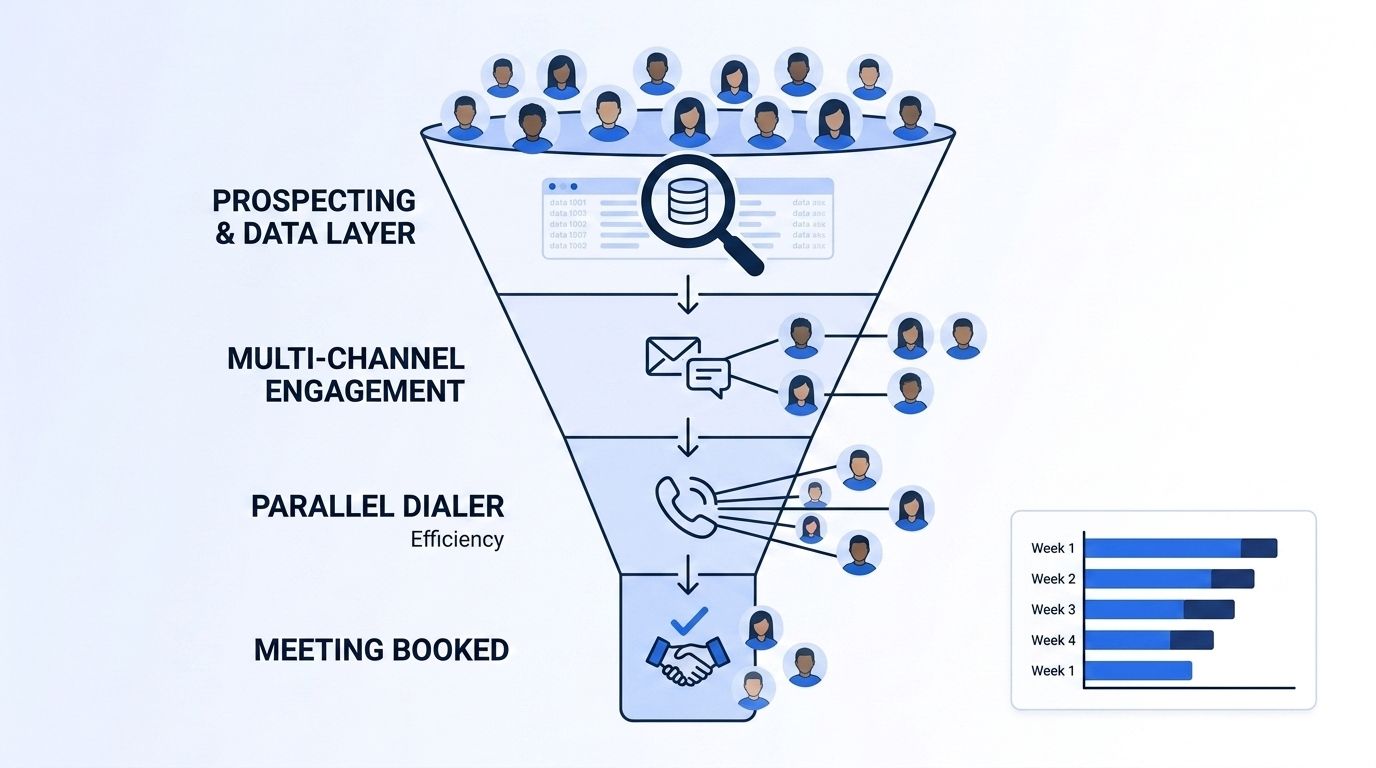
4. Outreach: is it built for enterprise-grade sequencing at scale?
Outreach has repositioned itself as an agentic AI platform for revenue teams, not just a sequencer. In 2026, its Sequences feature supports Auto Email, Manual Email, Phone Call, Generic Task, and LinkedIn Task steps, while Smart Email Assist drafts replies and follow-ups directly from conversation context (Outreach, Agentic AI Platform). The platform also added native ServiceNow Sales CRM integration and in-app SMS this year, extending sequence coverage beyond email and phone.
Why 200-rep teams shortlist it: Outreach's admin controls were built for large, segmented teams: permission sets, sequence templates by pod, and reporting that rolls up cleanly to VP-level dashboards. That matters when 200 reps need consistent messaging without losing local flexibility.
Best fit: Enterprise SDR orgs with a dedicated sales-engagement admin and a multi-step, multi-channel cadence strategy already in place.
Validate in a pilot: Admin overhead for a 200-seat deployment, AI content performance versus human-written sequences, and CRM field mapping for your specific opportunity stages.
5. Salesloft: does it win on cadence design and daily prioritization?
Salesloft still leads on cadence flexibility — branching, multi-channel sequences across email, phone, LinkedIn, and direct mail — but its 2026 story is Rhythm, an AI orchestration layer powered by its proprietary Conductor AI engine. Rhythm tells each rep what to do first each day based on intent signals, timing, and deal risk, rather than leaving prioritization to a rep's gut feel (Salesloft, Rhythm). Salesloft's merger with forecasting platform Clari closed December 3, 2025, tightening the link between engagement activity and pipeline forecasting (Salesloft, Rhythm powered by Conductor AI).
Why 200-rep teams shortlist it: At 200 reps, "what should I do next" is the highest-leverage question a platform can answer. Rhythm turns scattered signals into one ranked action list per rep, which cuts the coaching burden on frontline managers.
Best fit: Teams that already run complex, branching cadences and want an AI layer that ranks daily priorities across the whole funnel.
Validate in a pilot: Rhythm's signal accuracy against your actual close data, total pricing once add-ons stack onto Salesloft's custom quote, and overlap with any Clari licenses you already hold.
6. Orum: how do you maximize live conversations per rep hour?
Dial volume is the bottleneck that shows up hardest at 200 reps, and Orum is built specifically to solve it. Its AI dials up to 10 lines simultaneously per rep, detects 20+ languages, and tells the difference between a human, a screener, a voicemail, and a dial tree before bridging the rep into a live call (Orum, Dialer). Parallel dialing can multiply the live conversations a single rep reaches in an hour compared with dialing one number at a time by hand.
Why 200-rep teams shortlist it: Orum's AI Coaching Suite adds call scorecards and 24/7 AI roleplay on top of the dialer, which the company positions as a way to shorten ramp time for new reps. That matters when you're onboarding cohorts of new SDRs every quarter. In pilots we've watched teams run, the biggest surprise with parallel dialing usually isn't the connect-rate lift, it's how fast it exposes stale phone numbers sitting in the data layer that feeds the dialer. A parallel dialer is only as good as the numbers it's calling.
Best fit: High-volume outbound floors where connect rate, not list size, is the binding constraint.
Validate in a pilot: Line-detection accuracy for your target geographies, integration with your existing sequencer, and total cost under Orum's premium, annual-only pricing across 200 seats.
7. Gong: which platform leads on conversation intelligence?
Gong turns raw call and email activity into structured signals a 200-rep manager could never track by hand. Its February 2026 "Mission Andromeda" release added Gong Assistant, an AI Call Reviewer that grades reps against your own sales methodology, and an AI Trainer for roleplay practice (Gong, Revenue Intelligence). Objection-detection accuracy reached roughly 91% in 2026, up from 76% two years earlier, and competitor-mention extraction now works across English, Spanish, French, and German.
Why 200-rep teams shortlist it: One manager can't sit in on 200 reps' calls. Gong's talk-time ratios, sentiment analysis, and automated deal-risk scoring surface which conversations need coaching without a manager listening to every recording.
Best fit: Orgs with consistent call volume across the floor and a dedicated enablement function to act on the coaching data.
Validate in a pilot: Transcription accuracy for your accents and industries, integration with your dialer and CRM, and whether AI Call Reviewer scoring matches your own methodology closely enough to trust.
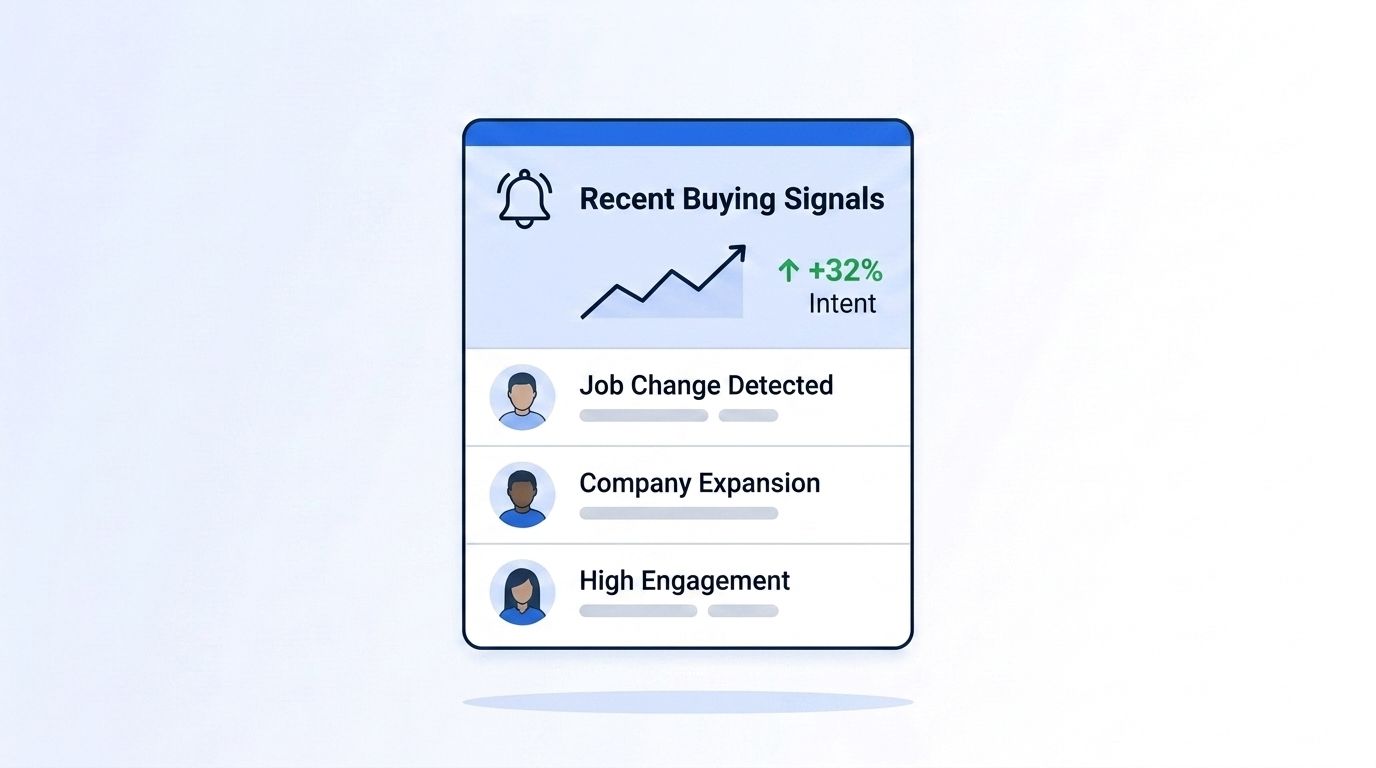
8. Clari: what gives you forecast accuracy and pipeline inspection?
Clari answers a different question than the tools above: not "who should we call" but "will we hit the number." Its Forecast product combines historical deal data with AI models to reach what the company describes as 98% forecast accuracy by the second week of the quarter, pulling signals from CRM, email, and calendar data automatically instead of relying on manual pipeline updates (Clari, Product Overview). Clari has also been extending how that pipeline data connects into AI assistants and agent workflows, so RevOps can query the forecast without living inside the Clari UI.
Why 200-rep teams shortlist it: At scale, pipeline inspection by spreadsheet breaks down fast. AI-driven health scores flag which deals and which pods need attention before a forecast call, instead of after a miss.
Best fit: RevOps-led orgs that need a single, defensible forecast number across many pods and managers.
Validate in a pilot: Forecast accuracy against your last two quarters of actuals, data capture coverage across your CRM fields, and licensing overlap now that Clari and Salesloft operate under one roof.
9. Salesforce Agentforce SDR: can a CRM run autonomous lead qualification?
Salesforce remains the system of record for most 200-rep orgs, and its Agentforce SDR agent turns that CRM into an active outbound participant rather than a passive database. The agent sends personalized outbound emails, threads replies, shares calendar links, and books meetings on its own, staying in an email thread until a lead books, opts out, or goes quiet past a configured cadence (Salesforce, Agentforce Lead Nurturing). It also updates BANT qualification fields in real time as conversations progress, using Salesforce's Atlas reasoning engine and Data Cloud for context.
Why 200-rep teams shortlist it: Every lead your human SDRs can't reach immediately still gets a first response. That closes the gap between marketing hand-off and human follow-up, which is often where inbound leads go cold at scale.
Best fit: Salesforce-native orgs willing to invest in Data Cloud to give the agent accurate, trusted context.
Validate in a pilot: Agent qualification accuracy against your actual BANT criteria, handoff quality from agent to human rep, and Data Cloud setup cost before you count on agent performance.
10. Datamagnet: how do you add programmable enrichment and signals?
Datamagnet fills the layer none of the platforms above fully own: a programmable API that GTM engineering teams can wire directly into custom workflows instead of a fixed UI. Its endpoints cover LinkedIn people profiles, company firmographics, and ICP-based people search with human-readable filters instead of opaque IDs, returning structured JSON at request time rather than from a static snapshot (Datamagnet, API documentation).
Why 200-rep teams shortlist it: The tools above are strongest as UIs reps log into. A 200-rep org also needs a data layer that other systems can call (a lead-routing app, an internal Slack bot, or a custom scoring model) without exporting CSVs between platforms. Datamagnet's signal endpoints can trigger on job changes or engagement events and push straight into whatever system your team already runs. Teams evaluating a live-data alternative to a fixed database often compare it directly with ZoomInfo.
Best fit: RevOps or GTM engineering teams building internal tools, custom scoring, or enrichment jobs on top of their existing stack rather than adding another seat-based UI.
Validate in a pilot: Required endpoints for your workflow, rate limits at 200-rep query volume, and how signal latency compares with the intent data you already pull from your data layer.
How should you sequence a 200-rep sales tech stack rollout?
Don't roll out all ten layers at once. Teams that try a full-stack cutover in one quarter usually spend the next two quarters untangling duplicate records and conflicting sequences. Start with the layer that's actually broken today, usually data quality or dial volume, then prove it on one pod before you expand.
| Rollout order | Layer | What to measure before expanding |
|---|---|---|
| 1 | Data & intent | Match rate and duplicate rate on a 5,000-account sample |
| 2 | Engagement | Reply rate and deliverability across one full pod |
| 3 | Dialer | Connect rate per rep-hour before and after |
| 4 | Intelligence | Coaching adoption and forecast variance |
| 5 | CRM automation | Field accuracy and handoff time from agent to rep |
A four-week pilot on one pod, with clear before/after numbers, will tell you more than any vendor's feature comparison chart.
How we selected these platforms
This is an editorial shortlist, not a paid ranking. We selected platforms with public documentation showing a meaningful role in outbound sales at scale — data, engagement, dialing, conversation intelligence, forecasting, or CRM automation — and grouped them by the stack layer they serve best, since no single platform in 2026 credibly covers all five layers alone.
We did not rank by database size, review score, or a single universal price point, because those numbers vary by region, plan tier, and contract length. Confirm current pricing and coverage directly with each vendor before you buy.
Frequently Asked Questions
What's the best sales tech stack for a 200-rep SDR team?
There's no single-vendor answer. Most 200-rep teams combine a data and intent platform like ZoomInfo, an engagement platform like Outreach or Salesloft, a parallel dialer like Orum, a conversation-intelligence tool like Gong, and a CRM like Salesforce — often layered with an API like Datamagnet for custom workflows.
How many tools should a large SDR team actually run?
In 2026, the modern outbound stack runs on five to seven core tools rather than twenty scattered point solutions, and teams that consolidate report far less redundant spend than teams running an unmanaged sprawl of overlapping subscriptions (River Editor, Outbound Sales Tech Stack Guide 2026).
Is agentic AI replacing human SDRs in 2026?
Not yet, but it's changing the job. In 2026, 41% of enterprise B2B teams run at least one AI SDR in production, up from 12% a year earlier, mostly for first-touch outreach and lead qualification while human reps handle live conversations and closing (Salesforce, State of Sales 2026).
How should we budget for a 200-rep sales tech stack?
Budget per rep, not per tool, since seat prices vary widely by vendor and tier. Price each stack layer separately — data, engagement, dialer, intelligence, CRM — and run a paid pilot on one pod before committing to a 200-seat contract for any single platform.
Conclusion
The best sales tech stack for a 200-rep SDR team isn't the one with the most logos. It's the one where each layer — data, engagement, dialing, intelligence, and CRM — does its job well and hands off cleanly to the next. Start with your most broken layer, pilot it on one pod, and measure before you expand.
If your bottleneck is programmable access to fresh people and company data rather than another seat-based UI, see how Datamagnet's real-time API fits into a custom-built outbound workflow.
Sources
- Salesforce, State of Sales 2026, retrieved 2026-07-19.
- River Editor, Outbound Sales Tech Stack Guide 2026 for SMBs, retrieved 2026-07-19.
- ZoomInfo, GTM Intelligence Platform and G2 Spring 2026 Reports, retrieved 2026-07-19.
- Landbase, About Landbase and Outbound Sales, retrieved 2026-07-19.
- Apollo.io, Pricing, retrieved 2026-07-19.
- Outreach, Agentic AI Platform for Revenue Teams, retrieved 2026-07-19.
- Salesloft, Rhythm and Rhythm powered by Conductor AI, retrieved 2026-07-19.
- Orum, Dialer, retrieved 2026-07-19.
- Gong, Revenue Intelligence, retrieved 2026-07-19.
- Clari, Product Overview, retrieved 2026-07-19.
- Salesforce, Agentforce Lead Nurturing Overview, retrieved 2026-07-19.
- Datamagnet, API documentation, People Profile, Company Profile, and Create Signal, retrieved 2026-07-19.
