
Disclosure: Datamagnet publishes this article. Product capabilities below are based on public vendor documentation, retrieved July 19, 2026. Ask every shortlisted vendor to validate coverage, permissions, integrations, and commercial terms for your own use case.
8 Best B2B Data Tools for Enterprise Sales Teams in 2026
Enterprise sellers do not need more records. They need a dependable way to identify the right buying group, recognize a timely change, verify contactability, and put that context in the CRM before a rep acts.
That is why this list does not crown a winner by database size. It compares eight tools by the jobs enterprise teams actually have: account and contact discovery, intent and signals, CRM enrichment, workflow control, and governance. The strongest stack is often a combination—not a single vendor.
TL;DR
- ZoomInfo is a strong fit for large teams that want sales intelligence, enrichment, and engagement in one commercial platform.
- LinkedIn Sales Navigator is the relationship and professional-network layer, with buyer-intent and job-change alerts.
- 6sense is built for account prioritization and buying-stage intelligence across first- and third-party signals.
- Clay is the flexible orchestration layer for multi-provider enrichment and custom GTM workflows.
- Cognism is worth shortlisting when compliant, phone-verified coverage—especially in Europe—is a core requirement.
- Apollo suits teams that want self-service prospecting, enrichment, and sequencing in one workspace.
- HubSpot Data Enrichment (formerly Clearbit) is a practical choice for HubSpot-centric enrichment and form shortening.
- Datamagnet fits teams that need API-first access to people, company, funding, and activity data inside custom workflows.
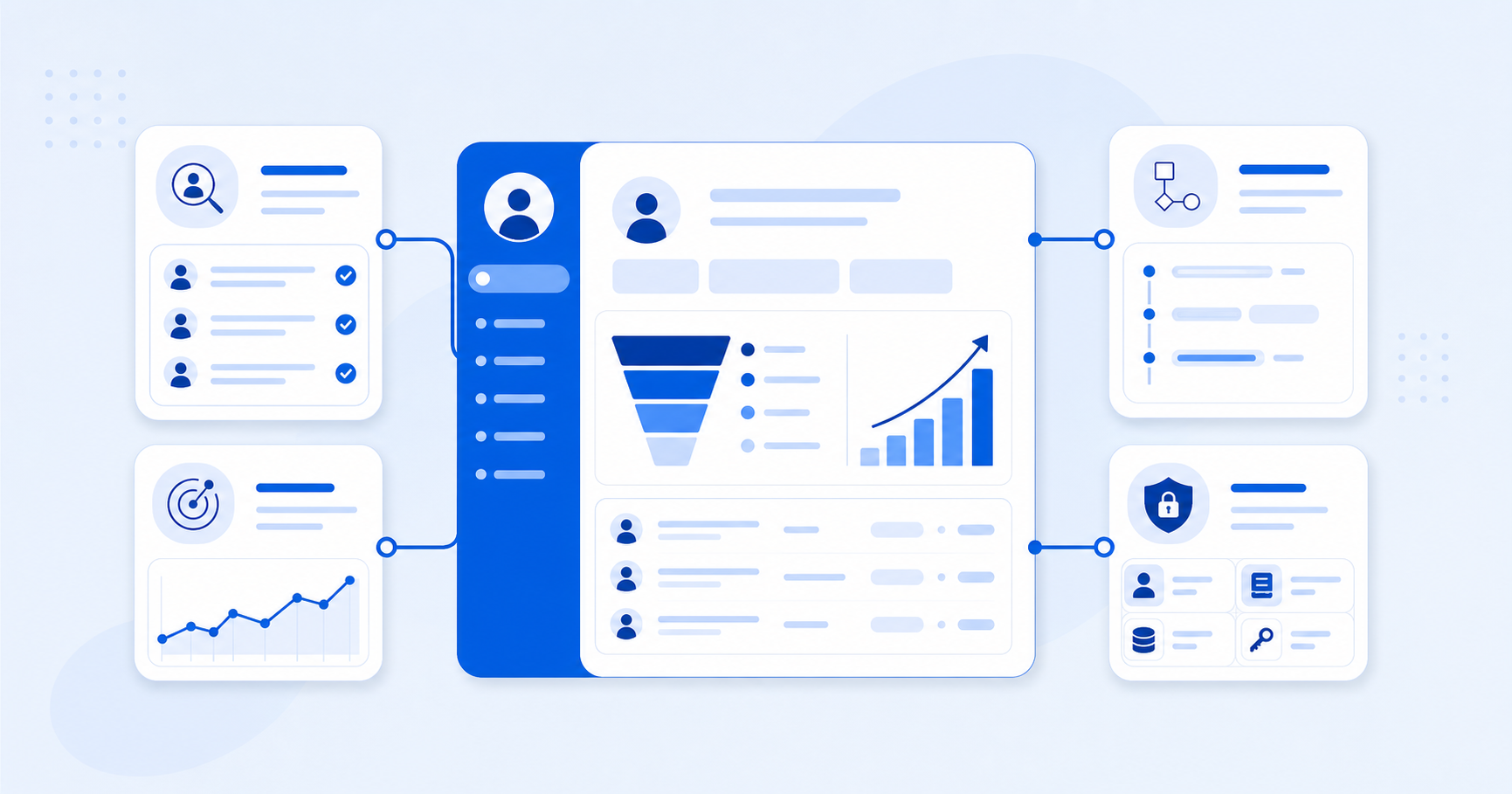
What should enterprise sales teams evaluate in a B2B data tool?
The buying decision should start with a workflow, not a vendor demo. Enterprise teams need reliable identity resolution, explainable signals, controlled write-back to CRM, and an operating model for consent, retention, and access. A platform can look impressive in a search screen yet fail when it must refresh 500,000 accounts without creating duplicates.
Use these five evaluation areas:
- Fit and coverage: Can the provider find your ICP across the countries, functions, seniority bands, and company types you sell to?
- Freshness and verification: Does it say when fields were refreshed, distinguish verified from inferred values, and support a correction loop?
- Signal quality: Can reps see why an account is prioritized, rather than receiving an unexplained score?
- Workflow fit: Does it integrate with your CRM, warehouse, sales engagement platform, and security model without CSV handoffs?
- Governance: Can admins control users, fields, exports, auditability, and regional compliance requirements?
One practical rule: sample your own named accounts and contacts before you score any vendor. Measure match rate, field completeness, bounce or connect outcomes, duplicate creation, and the time it takes to turn a signal into a rep task. Vendor-wide coverage claims do not predict performance in your territory.
At-a-glance: the best B2B data tools for enterprise sales
| Tool | Best for | Core strength | Watch-out |
|---|---|---|---|
| ZoomInfo | Consolidated enterprise sales intelligence | Broad sales-data, intent, enrichment, and workflow suite | Validate data quality by segment and contract flexibility |
| LinkedIn Sales Navigator | Relationship-led prospecting | Professional-network context and alerts | Not a replacement for CRM enrichment or outbound data operations |
| 6sense | Account prioritization | Buying-stage intelligence and first-/third-party signal resolution | Requires alignment across sales, marketing, and ops |
| Clay | Flexible enrichment operations | Multi-provider waterfalls and custom workflows | Needs thoughtful build, monitoring, and credit controls |
| Cognism | Compliant EMEA prospecting | Phone-verified data and compliance posture | Validate coverage outside your priority regions |
| Apollo | Self-service all-in-one prospecting | Database, enrichment, and sequencing | Enterprise governance needs a close review |
| HubSpot Data Enrichment | HubSpot-first data enrichment | Native marketing and CRM data workflows | Best value is concentrated in the HubSpot ecosystem |
| Datamagnet | API-driven data workflows | Programmable people, company, funding, and activity data | Requires engineering or GTM-ops ownership |
1. Is ZoomInfo the best all-in-one enterprise sales-data suite?
ZoomInfo is a fit when sales operations wants one primary commercial platform for account and contact research, enrichment, buyer signals, and seller workflows. It is most useful for organizations that value a unified operating layer over assembling multiple point products.
Why enterprises shortlist it: Centralizing these functions can make it easier to standardize prospecting and enrichment across regions. The proof point to demand is not the size of a displayed database; it is whether the tool’s account, contact, technographic, and intent fields match your named-account strategy and write cleanly into your CRM.
Best fit: Mature outbound or account-based sales organizations with dedicated RevOps administration.
Validate in a pilot: Segment-level data accuracy, international coverage, intent definitions, Salesforce or Dynamics field mapping, duplicate handling, and export controls.
2. Is LinkedIn Sales Navigator the best tool for professional context and relationship signals?
LinkedIn Sales Navigator gives sellers a direct way to research people and accounts within LinkedIn’s professional graph. LinkedIn says its current product offers 50+ search filters, lead and account alerts—including job or role changes—and CRM capabilities on eligible plans (LinkedIn, Sales Navigator).
Why enterprises shortlist it: It helps reps work from current professional context, identify warm paths, and act on role changes that can reshape a buying committee. Its Buyer Intent feature is available to Advanced and Advanced Plus users and can surface engagement with a company page or website, depending on setup (LinkedIn, Buyer Intent help).
Best fit: Enterprise account executives and SDR teams running relationship-led or named-account motions.
Validate in a pilot: Plan entitlements, CRM integration scope, alert relevance, and how your team will translate social context into governed CRM data.
3. Is 6sense the best tool for account prioritization and buying-stage intelligence?
6sense is designed to connect first-party data, third-party signals, identity resolution, and predictive models so revenue teams can prioritize accounts. Its platform describes keyword-level intent, website deanonymization, buying-group resolution, and activation through applications, APIs, MCP, and data warehouses (6sense, Revenue AI Platform).
Why enterprises shortlist it: It is a strategic layer for teams that want marketing, SDRs, and AEs to use the same account-priority logic. The key advantage is not merely detecting activity; it is connecting activity to an account and explaining why the account is moving now.
Best fit: ABM programs with meaningful web traffic, established CRM hygiene, and cross-functional ownership.
Validate in a pilot: Account identification rate, model explainability, signal-to-opportunity correlation, regional privacy treatment, and whether reps actually use the prioritized actions.
4. Is Clay the best tool for multi-provider enrichment and workflow orchestration?
Clay is an orchestration platform for teams that do not want to accept one data provider’s match rate as their ceiling. Clay documents CRM enrichment workflows that can waterfall across 150+ integrations and AI research, then sync enriched records back to a CRM (Clay, CRM Enrichment).
Why enterprises shortlist it: It lets GTM engineers build precise logic: try a trusted provider first, use a fallback for a missing field, verify before write-back, then alert a rep only when a relevant change appears. That flexibility matters when one vendor is strong for North American contacts and another is better for EMEA phone data or firmographics.
Best fit: RevOps or GTM engineering teams with clear data contracts and the capacity to own workflows.
Validate in a pilot: Provider costs per successful field, retry and fallback behavior, enrichment provenance, error handling, CRM upsert rules, and controls against uncontrolled workflow sprawl.
5. Is Cognism the best tool for compliance-conscious EMEA prospecting?
Cognism positions its product around phone-verified B2B data, compliance processes, and context from intent and business signals. Its documentation says director-level-and-above records are continually refreshed on a 30-day cycle and describes additional manual and automated verification for phone-verified records (Cognism, Our Data).
Why enterprises shortlist it: EMEA prospecting demands closer attention to lawful use, data provenance, and the operational cost of bad phone records. A provider that foregrounds verification and compliance is a sensible candidate when connection quality and regional governance are more important than sheer volume.
Best fit: Enterprise teams selling into Europe, especially motions that rely on compliant mobile contact data.
Validate in a pilot: Coverage in your target countries, lawful-basis documentation, suppression processes, phone connect results, and country-by-country field availability.
6. Is Apollo the best tool for self-service prospecting, enrichment, and sequencing?
Apollo combines prospecting and enrichment with sales-engagement workflows. Its product documentation describes searching and enriching B2B lead data, then syncing tasks, sequences, and opportunities; its enrichment API returns demographic and firmographic data alongside an enrichment status (Apollo, Prospect and Enrich; Apollo, People Enrichment).
Why enterprises shortlist it: It reduces handoffs for teams that want research, list building, data refresh, and sequence enrollment in a self-service workspace. That can make adoption faster for distributed sales teams.
Best fit: Sales teams that want an all-in-one, self-serve workflow and can establish clear operating rules around data imports and sequencing.
Validate in a pilot: Data fit for enterprise personas, enrichment fallbacks, sequence governance, admin permissions, SSO needs, and deliverability safeguards.
7. Is HubSpot Data Enrichment (formerly Clearbit) the best tool for HubSpot-centered enrichment?
Clearbit’s capabilities are now part of HubSpot’s data-enrichment offering. HubSpot says the product can enrich contact and company records, support automatic and continuous enrichment, and let admins control mappings and overwrite behavior (HubSpot, how data enrichment works; HubSpot, enrichment settings).
Why enterprises shortlist it: The best data workflow is often the one operators can govern without adding a brittle integration. For teams already standardized on HubSpot, native enrichment can keep marketing and sales working from the same fields and lifecycle definitions.
Best fit: HubSpot enterprise customers that need simpler enrichment, routing, and personalization inside their core platform.
Validate in a pilot: Available enrichment properties, credits and limits, data overwrite rules, regional coverage, and whether your sales organization needs capabilities outside the HubSpot ecosystem.
8. Is Datamagnet the best tool for programmable people, company, and activity data?
Datamagnet is an API-first option for teams that want to embed people and company research into their own sales or recruiting workflows. Its documentation covers HTTP endpoints for people profiles, company profiles, funding rounds, and person activity, with structured responses suitable for downstream systems (Datamagnet API documentation; People Activity endpoint).
Why enterprises shortlist it: Rather than forcing reps into another interface, an API approach can support custom triggers, account research tools, enrichment jobs, and internal sales applications. It works best when engineering and GTM operations jointly own the workflow and its data-use rules.
Best fit: Product-led, technical sales, or GTM engineering teams building custom prospecting and signal workflows.
Validate in a pilot: Required endpoints, latency and rate limits, field coverage, identity matching, user permissions, retention expectations, and your intended use of activity data.
How to build the right enterprise B2B data stack
The practical answer is usually a layered stack. Use a system of record for account and contact data, a relationship layer for human context, a signal layer for prioritization, and an orchestration layer to govern how fields move between them. Do not let every tool write every field to your CRM.
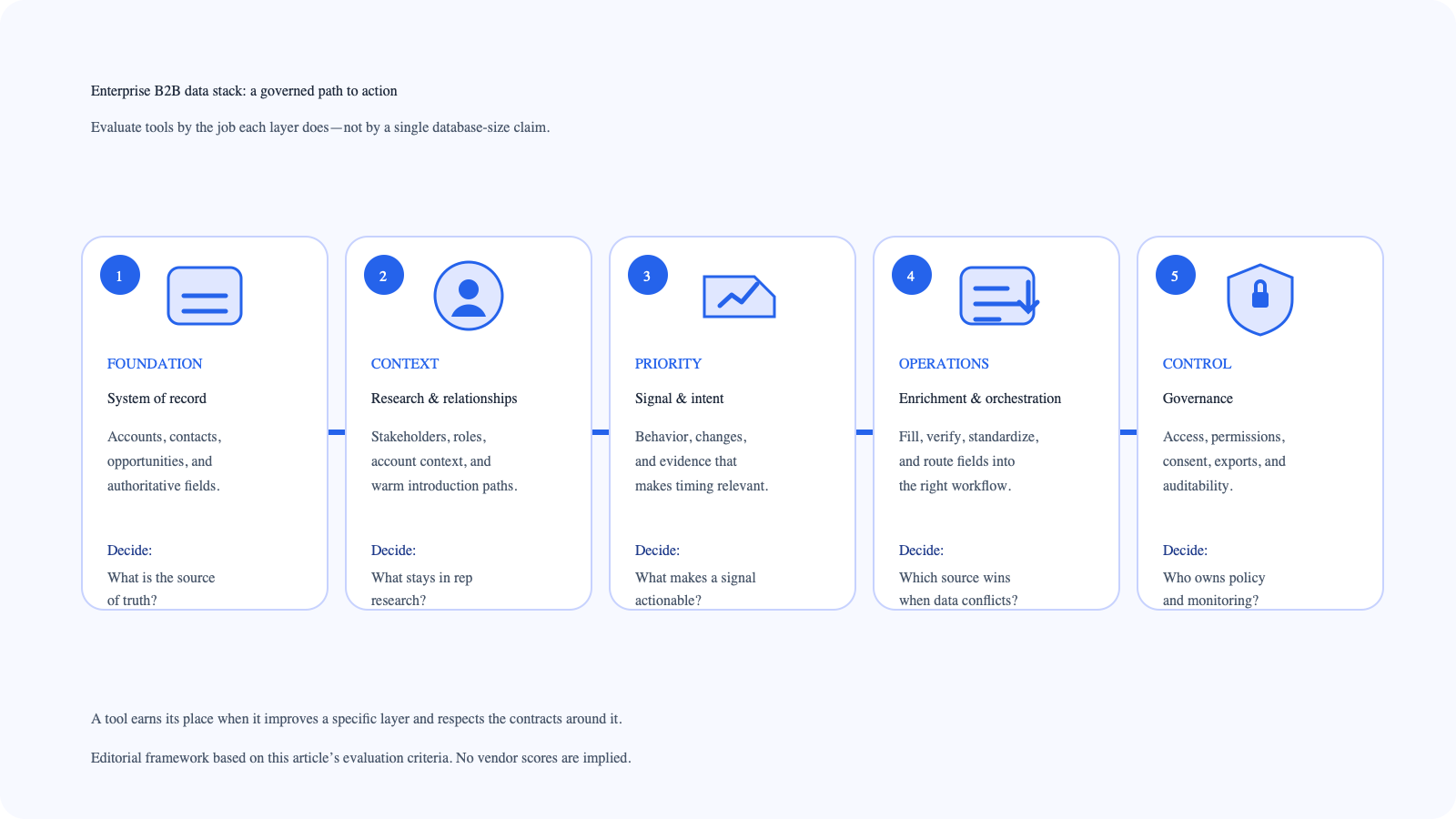
| Layer | Example job | Decision to make |
|---|---|---|
| System of record | Store accounts, contacts, opportunities | Which fields are authoritative? |
| Research and relationships | Find stakeholders and warm paths | What may reps use without writing to CRM? |
| Signal and intent | Prioritize accounts by changing behavior | What evidence makes a signal actionable? |
| Enrichment and orchestration | Fill, verify, standardize, and refresh fields | Which provider wins when sources disagree? |
| Governance | Control access, consent, exports, and audit trails | Who owns policy and monitoring? |
Start with three fields that sales genuinely uses—such as role, direct dial, and a meaningful buying signal. Define a source-of-truth rule for each field. Then run a four-week pilot on a representative slice of accounts. That gives you a cleaner decision than comparing a dozen glossy feature grids.
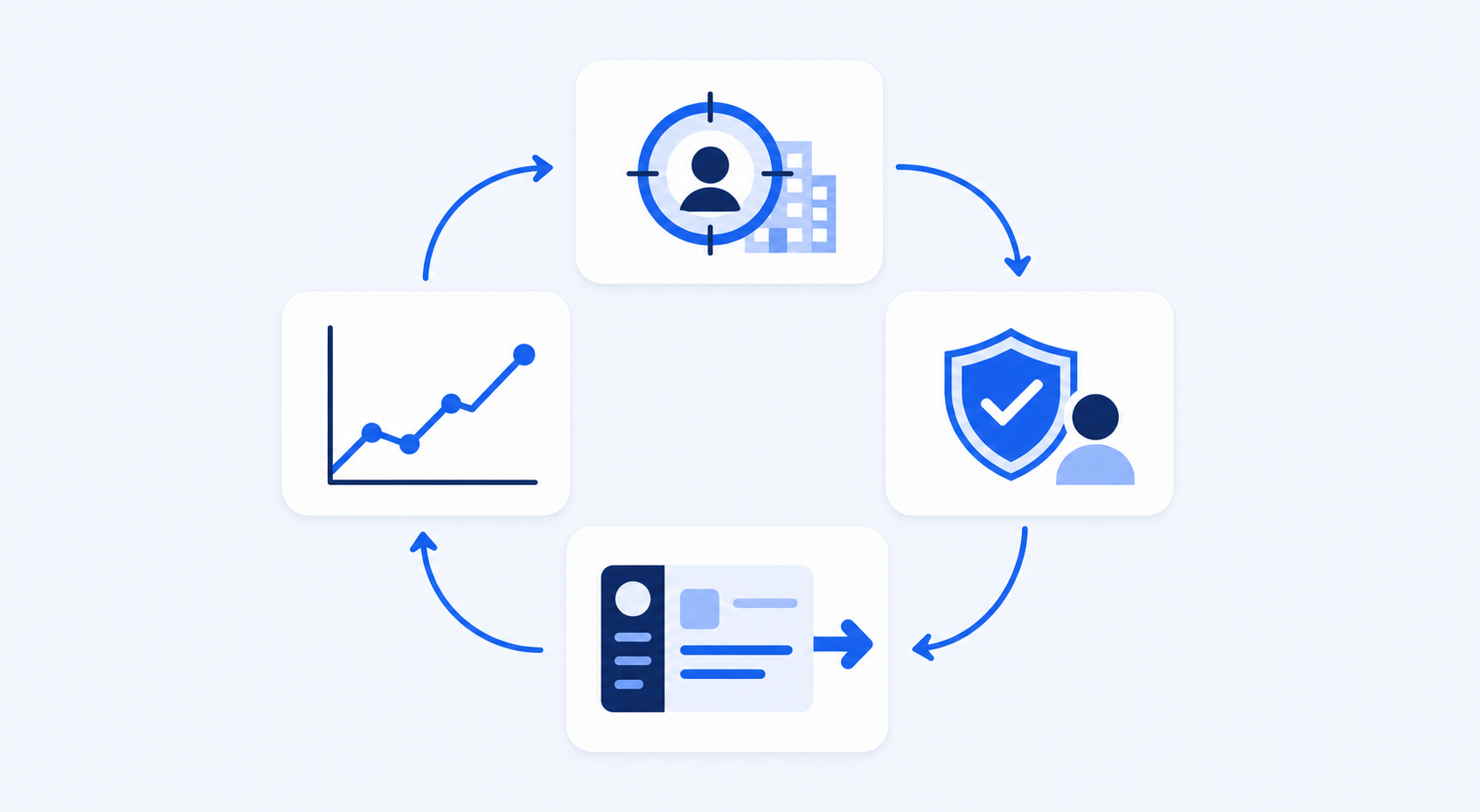
How we selected these tools
This is an editorial shortlist, not a paid ranking. We selected products with public documentation showing a meaningful role in enterprise sales data: research, enrichment, intent, relationship intelligence, or data orchestration. We prioritized tools that can connect to enterprise workflows and described each by its strongest fit rather than pretending every platform solves the same problem.
We did not rank tools by database size, public review score, or a universal price point. Those figures are hard to compare across regions, data types, plan entitlements, and annual contracts. Before buying, obtain a current written proposal and test the provider against your ICP.
Frequently Asked Questions
What is the best B2B data tool for enterprise sales teams?
There is no universal best tool. Choose ZoomInfo for a consolidated sales-intelligence suite, LinkedIn Sales Navigator for relationship context, 6sense for account prioritization, Clay for orchestration, Cognism for compliance-conscious EMEA coverage, and an API option when you need custom workflows. Test each against your named accounts.
What is the difference between sales intelligence and data enrichment?
Sales intelligence helps a seller understand whom to contact and why now. It can include firmographics, contacts, technographics, signals, and relationship context. Data enrichment is the operational process of appending, validating, standardizing, or refreshing those fields in a record. Most enterprises need both.
Should enterprise sales teams use more than one data provider?
Often, yes. No provider is uniformly strongest across every country, persona, field type, and signal. A governed waterfall can use the best source for each task. The trade-off is complexity, so teams need clear source-of-truth rules, credit controls, and monitoring before adding providers.
How should we test B2B data quality before buying?
Use a representative sample of named accounts and contacts, then measure match rate, completeness, verified-field coverage, outcomes such as email bounces or phone connects, duplicate creation, and write-back behavior. Review results by region and persona. A demo list is not a substitute for your actual territory.
Conclusion
The best B2B data tool is the one that reliably turns a relevant change into a governed next step for a seller. For enterprise teams, that means checking fit, freshness, signal evidence, workflow ownership, and compliance before making a platform commitment.
Run a real pilot, keep the data contract narrow at first, and expand only when the data proves useful in pipeline creation and conversion.
Sources
- LinkedIn, Sales Navigator and Buyer Intent in Sales Navigator, retrieved 2026-07-19.
- 6sense, Revenue AI Platform, retrieved 2026-07-19.
- Clay, CRM Enrichment, retrieved 2026-07-19.
- Cognism, Our Data, retrieved 2026-07-19.
- Apollo, Prospect and Enrich and People Enrichment, retrieved 2026-07-19.
- HubSpot, How data enrichment works and Manage data enrichment settings, retrieved 2026-07-19.
- Datamagnet, API documentation and People Activity endpoint, retrieved 2026-07-19.
