
Disclosure: This article is published by Datamagnet. Vendor claims are self-reported unless otherwise noted.
How to Evaluate B2B Data Freshness and Quality in 2026
Most vendor pitches lead with a number: "700 million profiles," "1.5 billion contacts," "the largest B2B database on the market." None of that tells you whether the record you pull tomorrow morning is accurate today. Size is the easiest metric to advertise and the least useful one for judging whether a data provider will actually work for your team.
The better questions are less flashy: how often does this data refresh, what percentage of lookups actually resolve to a verified match, and how deep does the record go once you find it? This guide walks through the evaluation criteria that matter more than raw record counts, and why real-time enrichment closes a gap that even large static databases can't.
Key Takeaways
- B2B contact data decays roughly 22.5% a year - about 2% a month (HubSpot, Database Decay Simulation, retrieved 2026-07-20), so a database's size at purchase says nothing about its accuracy six months later.
- Poor data quality costs organizations an average of $12.9 million a year (Gartner, 2021, still widely cited industry-wide).
- Evaluate vendors on four criteria, not one: refresh cadence, match rate, verified contact accuracy, and dataset depth across firmographics, technographics, and intent signals.
- Real-time, query-time lookups avoid the staleness problem entirely, because they check the source at the moment you ask instead of trusting a stored snapshot.
- Ask every vendor how they define "verified" before you trust their accuracy number - self-reported and independently audited are not the same thing.
Why Doesn't Record Count Tell You Anything About Data Quality?
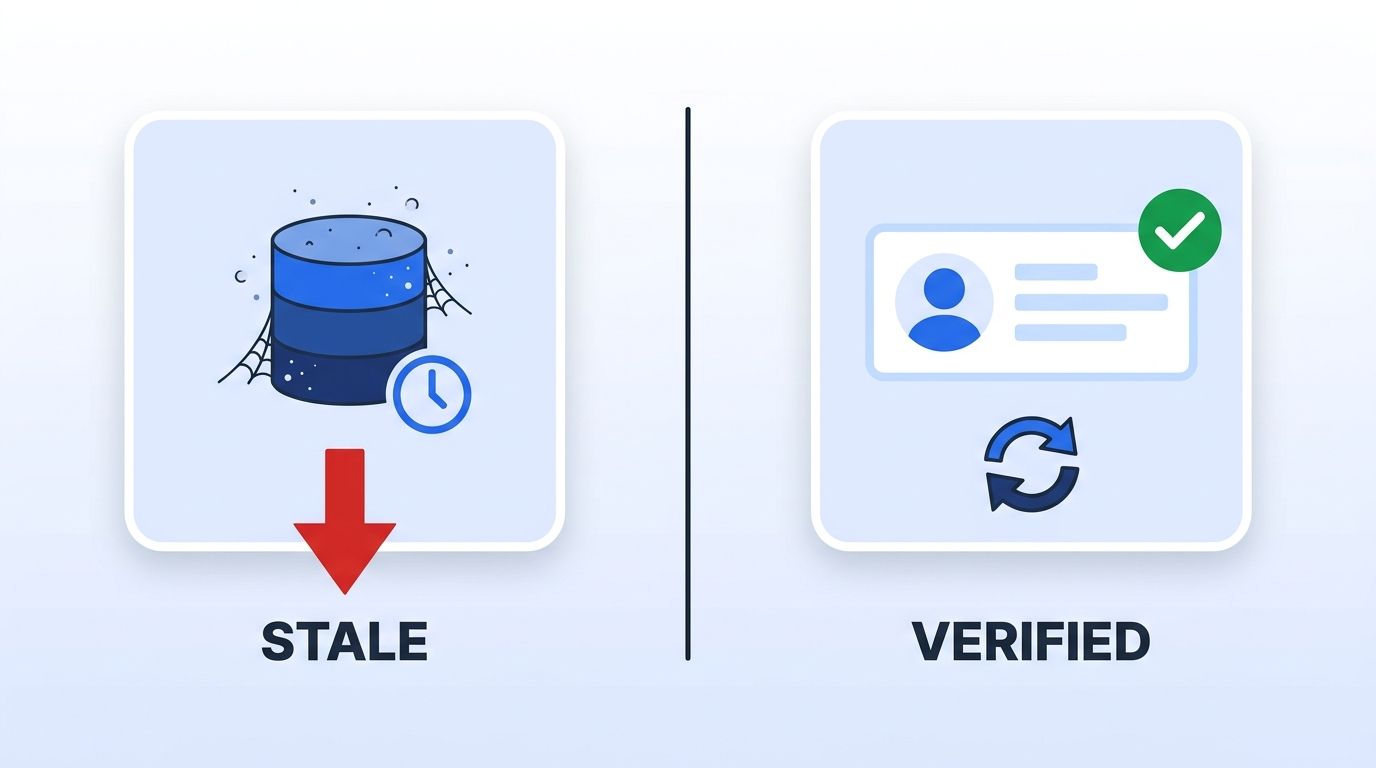
Record count measures how much data a vendor collected at some point, not whether that data is still true. A database with 2 billion records built from a one-time scrape in 2023 is a worse asset today than a database with 200 million records that refreshes on every query, because the first one is guessing and the second one is checking.
<!-- [UNIQUE INSIGHT] -->Vendors advertise record count because it's the easiest number to make impressive and the hardest one for a buyer to verify before signing a contract. You can't audit "1.5 billion profiles" in a sales call. You can, however, ask four sharper questions - refresh cadence, match rate, verified accuracy, and dataset depth - and get answers that actually predict whether the data will hold up in production.
A large static database is really a snapshot with a growing gap between what it says and what's true. The bigger the snapshot, the more expensive it becomes to keep current, which is exactly why most static providers refresh on a schedule instead of continuously.
How Fast Does B2B Contact Data Actually Decay?
B2B contact data decays fast enough that a list validated in January is meaningfully wrong by April. Contact records lose accuracy at roughly 2% a month - about 22.5% a year (HubSpot, Database Decay Simulation, retrieved 2026-07-20), driven by people changing roles, companies, titles, and contact details continuously, not on a predictable schedule.
Compounding that 2% monthly rate shows the curve isn't linear in a way that makes a quarterly cleanse feel safe - it bends upward. A record has already lost roughly 5.9% accuracy by the end of month three, well before most teams schedule their first cleanup pass, and over a fifth of a database's contacts are stale by the one-year mark.
Citation capsule: B2B contact data decays roughly 2% every month, compounding to about 22.5% annual staleness. A database validated in January is already measurably wrong by April and substantially wrong by December, which is why a one-time or quarterly cleanse can never fully catch up with a continuously moving target.
What Is Match Rate, and Why Does It Matter More Than Database Size?
Match rate is the percentage of your input records - a name, an email, a company domain - that a vendor can successfully resolve to a real, current profile. It matters more than database size because a vendor can hold a billion records and still return nothing useful if your query doesn't match any of them cleanly.
Isn't it strange that match rate gets so little attention in vendor comparisons, given that it's the number that determines whether you get an answer at all? A 95% "accuracy" claim is meaningless if the vendor only matches 40% of your queries in the first place - the other 60% never even reach the accuracy check.
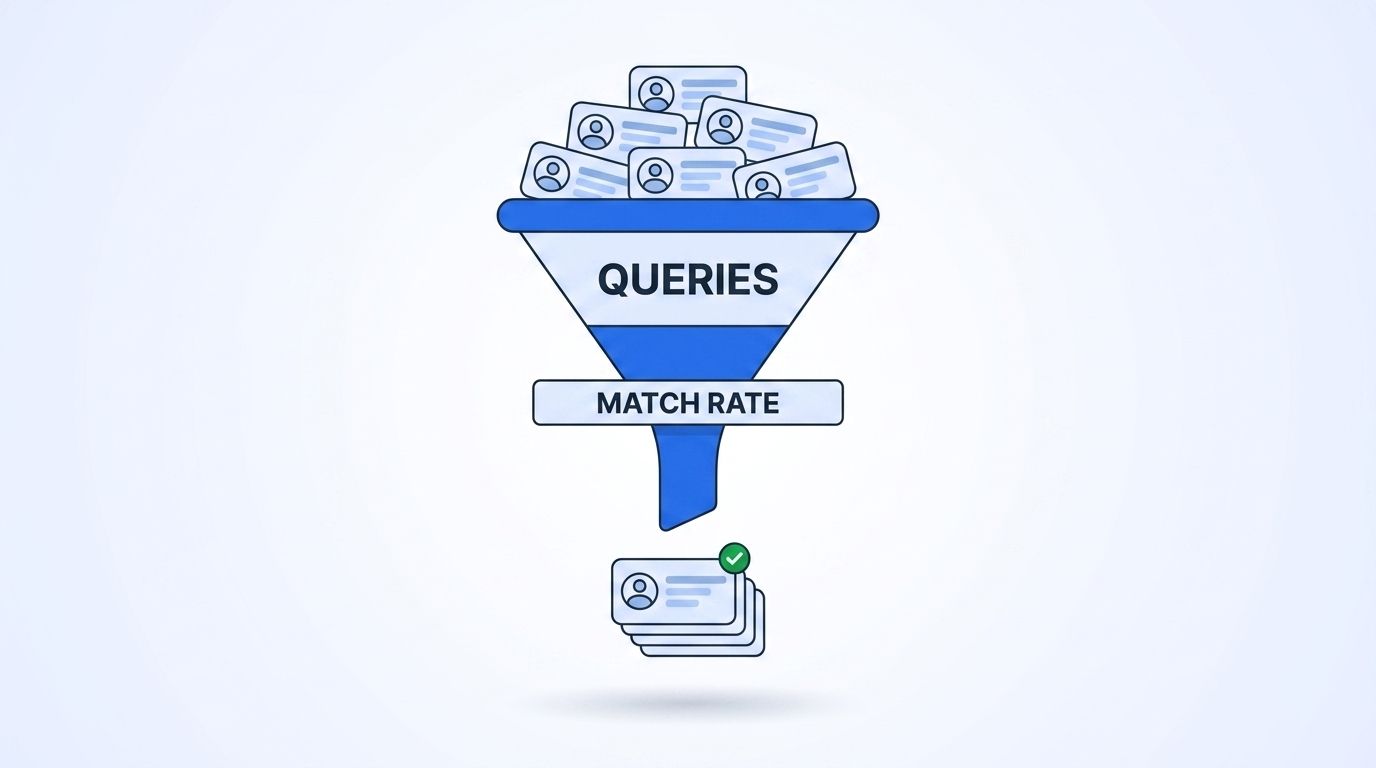
Match rate depends heavily on identity resolution - the process of confirming that a "John Smith at Acme Corp" in your CRM is the same person as a specific LinkedIn profile, not one of a dozen people with that name. Datamagnet's ICP People Search resolves identity using job title, seniority, company, and location filters together instead of matching on name alone, which is where most single-field matching approaches break down.
How Do You Verify Contact Accuracy Instead of Trusting Self-Reported Numbers?
You verify contact accuracy by checking how a vendor defines and tests its own claim, not by taking the headline percentage at face value. "95% accurate" means something different if it's measured against a live LinkedIn lookup at request time versus a database snapshot the vendor hasn't re-tested since it was built.
Ask three questions before trusting any accuracy figure: What's the sample size? Is it tested against a live source or an internal audit? And is the number refreshed periodically, or is it the same claim the vendor has used for two years? Datamagnet reports 95% accuracy across its real-time person and company lookups, self-reported and tested against live LinkedIn data at request time (Datamagnet, product pages, retrieved 2026-07-20) - the distinction that matters is that the check happens at query time, not against a stored copy.
Citation capsule: An accuracy claim only means something if you know what it was tested against. A vendor checking its data against a live source at the moment of the query is making a different claim than one reporting accuracy from an internal audit run against its own stored database - ask which one you're being sold before you compare numbers across vendors.
<!-- [PERSONAL EXPERIENCE] -->Talking to GTM teams evaluating data vendors, the same mistake comes up repeatedly: they compare the accuracy percentages on two pricing pages side by side as if they were measured the same way. They almost never are. The number worth asking for isn't the accuracy claim itself - it's the methodology behind it.
For a direct look at how a live-lookup approach compares to a large static database, see Datamagnet's comparison against People Data Labs, one of the larger static providers in the category.
Why Does Real-Time Enrichment Beat a Quarterly Refresh Cycle?
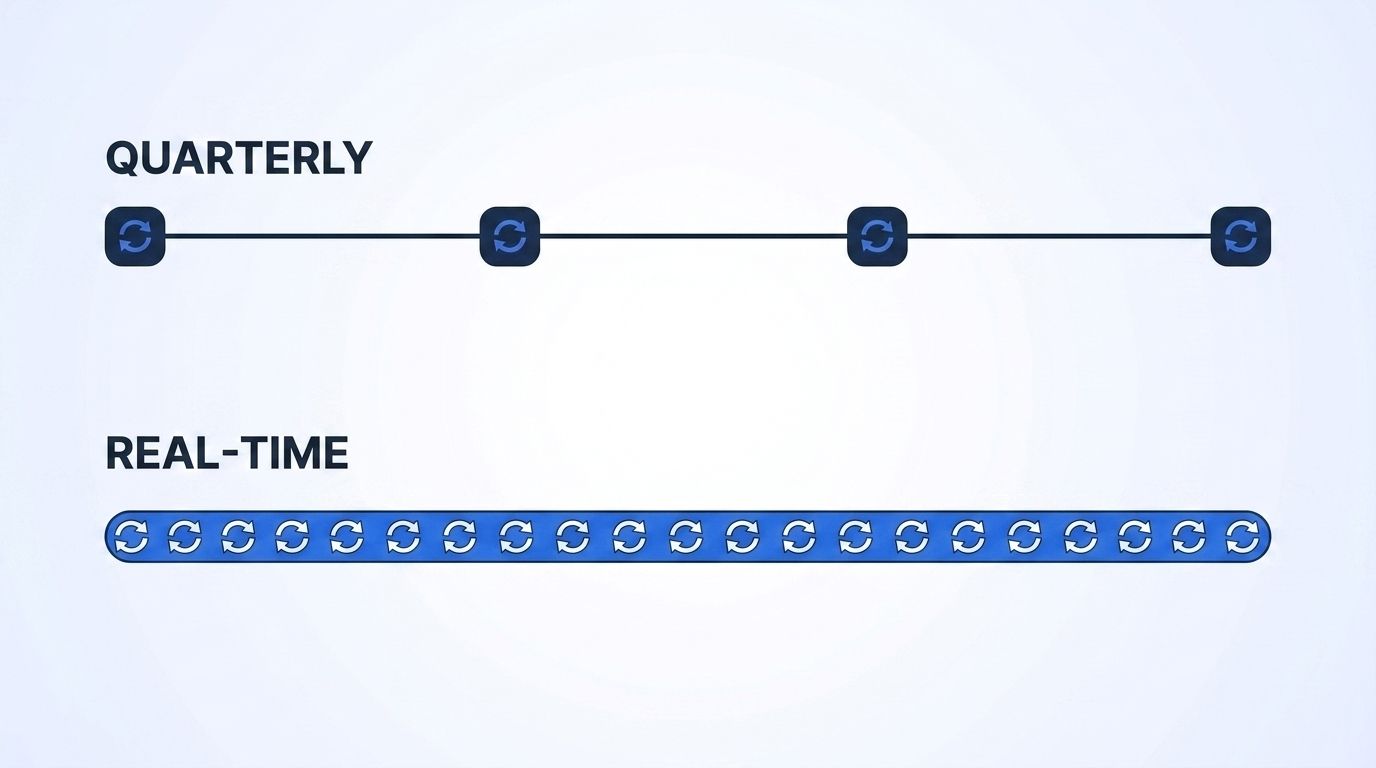
Real-time enrichment beats a quarterly refresh cycle because it checks the current state of a record at the moment you need it, instead of trusting a snapshot that started aging the day it was captured. A quarterly refresh means a vendor re-checks its database four times a year against decay that happens continuously, every day, in between.
The gap this leaves is predictable: by the time a scheduled refresh runs, roughly three months of job changes, title updates, and company moves have already accumulated unnoticed. Datamagnet's People Profile endpoint queries a person's current role, headline, and company directly from their live LinkedIn profile at request time, so a lookup today reflects today, not whenever the vendor's last batch job ran.
The same principle applies to company data. Datamagnet's Company Profile endpoint pulls headcount, industry, and recent updates from a company's live LinkedIn page instead of a firmographic field that hasn't been re-checked since the initial import - useful when a "500-person company" tag in your CRM is two funding rounds and a headcount out of date.
How Do Firmographics, Technographics, Intent Signals, and Job-Change Detection Fit Together?
These four data categories fit together as layers of context, and evaluating a vendor on only one of them misses how GTM teams actually use the data. Firmographics tell you who a company is, technographics tell you what it runs, intent signals tell you what it's currently paying attention to, and job-change detection tells you when the people inside it move.
| Category | What it answers | Where staleness hurts most |
|---|---|---|
| Firmographics | Headcount, industry, HQ, funding | Territory sizing, deal scoring |
| Technographics | Tech stack, tools in use | Competitive displacement timing |
| Intent signals | What accounts are engaging with | Outreach timing, lead scoring |
| Identity resolution | Confirming who a record actually is | Every downstream field depends on this |
| Job-change detection | When a contact moves roles or companies | Champion tracking, re-engagement |
A vendor that's strong on firmographics but weak on job-change detection will size your territories correctly and then miss the moment your champion leaves. Datamagnet's signal monitors track job changes, new posts, and engagement events together, and deliver them through webhooks so the detection layer feeds directly into a CRM instead of sitting in a separate report nobody checks.
Champion tracking is a good stress test for this: a signal that only flags a title change six weeks after it happened is barely more useful than a quarterly refresh. See how real-time intent signal APIs apply the same live-detection principle to job-change alerts specifically.
What Should You Actually Ask a B2B Data Vendor Before You Buy?
You should ask a vendor to show its work, not just quote its headline numbers. Request the refresh cadence in writing, ask how match rate is calculated, ask what "verified" means in their accuracy claim, and ask for a sample query against a real account list before you commit to a contract.
A vendor that refreshes continuously and matches at query time can answer these questions specifically, because the check is happening live, not from memory of a database build. A vendor running on a stored snapshot will often answer in ranges or point to a database size instead, because that's the number they actually control.
Try the Evaluation Framework Yourself
Record count is the metric every vendor wants you to lead with because it's the easiest one to make look impressive. Refresh cadence, match rate, verified accuracy, and dataset depth are the ones that actually predict whether a contact record will be right when your rep opens it. Run these four questions against your current data vendor and against Datamagnet's real-time people enrichment side by side - the gap usually shows up in the first query, not the sales deck.
Frequently Asked Questions
What does "data freshness" mean for B2B contact data?
Data freshness measures how recently a record was confirmed against its live source, not when it was first collected. A database can be large and still have poor freshness if records aren't re-checked - B2B contact data decays roughly 2% a month, so freshness has to be measured continuously, not at the time of purchase.
How is match rate different from accuracy?
Match rate is the percentage of your queries that successfully resolve to any profile at all. Accuracy is whether the profile that comes back is correct once matched. A vendor can have high accuracy on the records it matches while still returning nothing useful for a large share of your list if the match rate is low.
Why does dataset depth matter beyond basic contact info?
Dataset depth determines whether a match gives you enough context to act on - firmographics, technographics, and intent signals layered on top of a verified identity. A record with a correct name and email but no current role or company context still leaves a rep guessing at how to open the conversation.
Is a bigger database always better for identity resolution?
Not necessarily. Identity resolution depends on how a vendor confirms a match - job title, seniority, company, and location together - not on how many total profiles sit in storage. Datamagnet's ICP People Search resolves identity by combining several filters rather than matching on name alone, which cuts down false matches that raw size doesn't prevent.
How much does bad data actually cost a company?
Gartner estimates the average financial impact of poor data quality at $12.9 million a year per organization (Gartner, 2021), driven by wasted rep hours, mis-routed leads, and outreach that never reaches a real, current contact. The cost compounds the longer stale records go unchecked.
Sources
- HubSpot, Database Decay Simulation, retrieved 2026-07-20, https://www.hubspot.com/database-decay
- Gartner, How to Improve Your Data Quality, retrieved 2026-07-20, https://www.gartner.com/smarterwithgartner/how-to-improve-your-data-quality
- Datamagnet, product pages, retrieved 2026-07-20, https://www.datamagnet.co/
- Datamagnet, People Profile endpoint, retrieved 2026-07-20, https://docs.datamagnet.co/api-reference/endpoints/people
- Datamagnet, Company Profile endpoint, retrieved 2026-07-20, https://docs.datamagnet.co/api-reference/endpoints/company
- Datamagnet, ICP People Search endpoint, retrieved 2026-07-20, https://docs.datamagnet.co/api-reference/endpoints/icp-people-search
- Datamagnet, Create Signal endpoint, retrieved 2026-07-20, https://docs.datamagnet.co/api-reference/endpoints/signal-create
- Datamagnet, Webhooks, retrieved 2026-07-20, https://docs.datamagnet.co/api-reference/webhooks
