
Disclosure: Datamagnet publishes this article. Product capabilities described below are based on public documentation, retrieved July 20, 2026.
How to Architect a Scalable B2B Data Enrichment Pipeline
You bolt on a third enrichment provider, and by month two your integration owns four different retry strategies, three schemas, and one very tired on-call engineer. That's not really a data problem - it's an architecture problem, and it shows up the moment you scale past a single provider.
This guide walks through the developer-facing decisions that hold up under real production load: authentication, sync vs. async processing, normalization, error handling, and multi-provider failover - not the theory, the parts that actually break.
Key Takeaways
- In 2025, Postman's State of the API Report found webhook adoption at 50% among the 5,700+ developers surveyed, up from a REST-only default - async delivery is now a mainstream pattern, not an edge case (Postman, 2025).
- Average API uptime fell from 99.66% to 99.46% between Q1 2024 and Q1 2025 (Uptrends, 2025) - retry and failover logic isn't optional at scale, it's table stakes.
- Layer authentication, queueing, normalization, and retries as separate concerns. Conflating them into one "call the API" step is what makes integrations brittle.
- A normalization layer that maps every provider to one canonical schema saves more engineering time than any single provider's API design ever will.
- Real-time and bulk enrichment need different architectures: synchronous calls for one, async queues and webhooks for the other.
What Does a Developer Integration Architecture Actually Need to Handle?
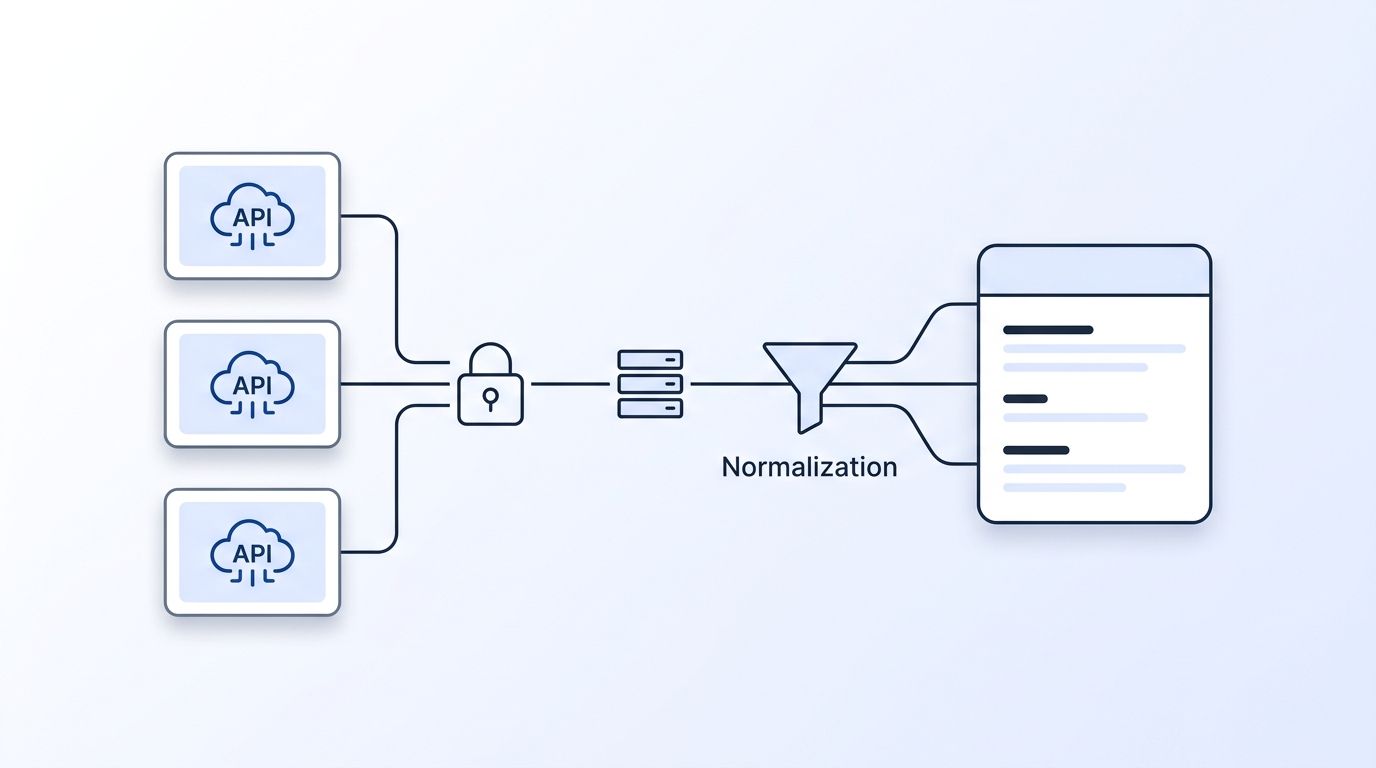
A production-grade enrichment integration needs six separate concerns working together, not one script that does everything. Authentication, request queueing, sync-versus-async routing, schema normalization, retry logic, and provider failover each fail in different ways, and each needs its own layer of the stack.
Most teams start with a single fetch call to one provider, and that's fine - until it isn't. The moment you add a second provider, or your first provider hits a rate limit during a campaign push, the missing layers show up all at once. Isn't it strange how an integration can work perfectly in a demo and then fall over the first week it sees real traffic?
According to Postman's 2025 developer survey, REST still anchors 93% of API traffic even as newer paradigms grow (Postman, 2025), which means most enrichment architecture decisions are really about what you build around a REST call - not about replacing REST itself.
A production-grade enrichment integration needs six separate concerns working together: authentication, request queueing, synchronous-versus-asynchronous routing, schema normalization, retry logic, and provider failover. Treating these as one monolithic "call the API" step is why so many integrations break the first time traffic spikes or a single provider has a bad day.
For a full reference of what a well-documented enrichment API looks like end to end, see Datamagnet's API documentation introduction, which covers base URLs, authentication, and quota handling in one place.
How Should You Handle Authentication for Third-Party Data APIs?
Server-to-server enrichment calls almost always use bearer-token or API-key authentication instead of full OAuth, because there's no end user delegating consent in the loop. Reserve OAuth flows for cases where your app acts on behalf of a specific user's account - a CRM integration reading someone's inbox, say - and use static, rotatable keys for backend-to-backend calls.
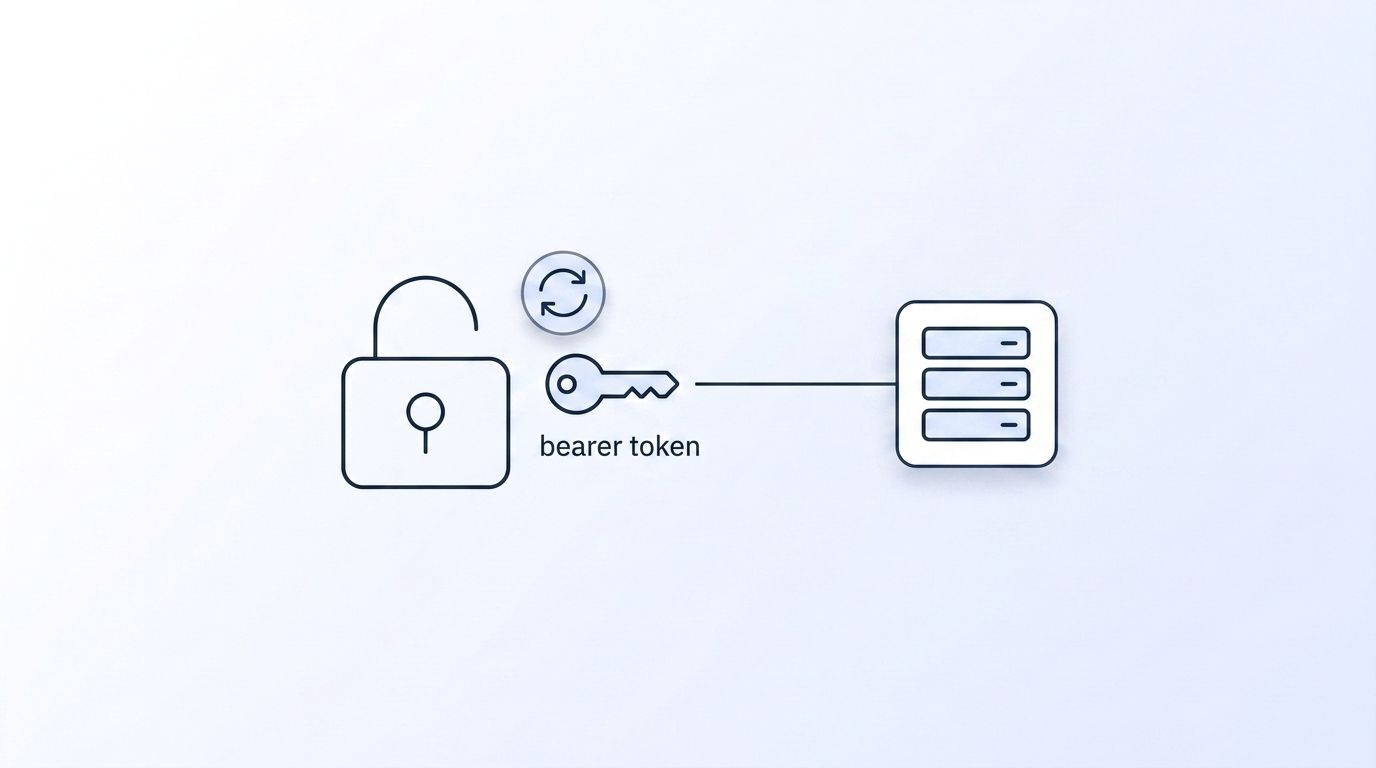
Store the key in a secrets manager, not an environment file committed to a repo, and rotate it on a fixed schedule regardless of whether you suspect a leak. Datamagnet's authentication reference documents the bearer-token pattern most REST enrichment APIs use today: attach the token to every request header, and treat a 401 as a signal to refresh credentials, not to retry blindly.
Server-to-server enrichment calls almost always use bearer-token or API-key authentication instead of full OAuth, because there's no end user delegating consent - the integration itself is the client. Reserve OAuth flows for cases where you're acting on behalf of a specific user's account, and rotate static keys on a fixed schedule regardless.
Don't skip credential scoping either. A key that can only read People and Company endpoints does less damage if it leaks than a master key that can also delete signal monitors or webhooks. Scope keys to the narrowest permission set the integration actually needs.
Should Your Enrichment Pipeline Be Synchronous or Asynchronous?
Synchronous calls make sense when a rep needs a fresh profile the moment they open a record - the delay of one HTTP round trip is invisible to them. Asynchronous processing, delivered through a queue and a webhook, makes sense for bulk backfills or continuous monitoring, where nobody is watching a loading spinner waiting for the response.
In 2025, Postman's State of the API Report found webhook adoption reached 50% among surveyed developers, alongside WebSockets at 35% and GraphQL at 33%, while REST remained dominant at 93% of API traffic (Postman, 2025). Half of API-driven systems now push data instead of waiting to be polled, and enrichment pipelines are a natural fit for that shift.
Datamagnet's People Profile endpoint is built for the synchronous case - a live LinkedIn lookup at the moment a rep opens a record. For the async case, a job-change signal monitors a contact list continuously and delivers events through a webhook when something changes, so your app reacts instead of polling.
Synchronous calls make sense when a rep needs a fresh profile the moment they open a record - the delay of one HTTP round trip is invisible. Asynchronous processing, delivered through a queue and a webhook, makes sense for bulk backfills or continuous monitoring, where nobody is staring at a loading spinner waiting for the response.
Picking the wrong one in either direction costs you. Sync calls for a 50,000-record backfill will time out your request handler. Async delivery for a single-record lookup adds latency a user can feel. Match the pattern to the workload, not the other way around.
How Do You Normalize Data From Multiple Providers Into One Schema?
A normalization layer maps every provider's fields - however they name headcount, seniority, or company size - into one canonical schema before the record ever reaches your CRM. Skip this step and every downstream filter, segmentation rule, and dashboard has to account for three different definitions of the same field.
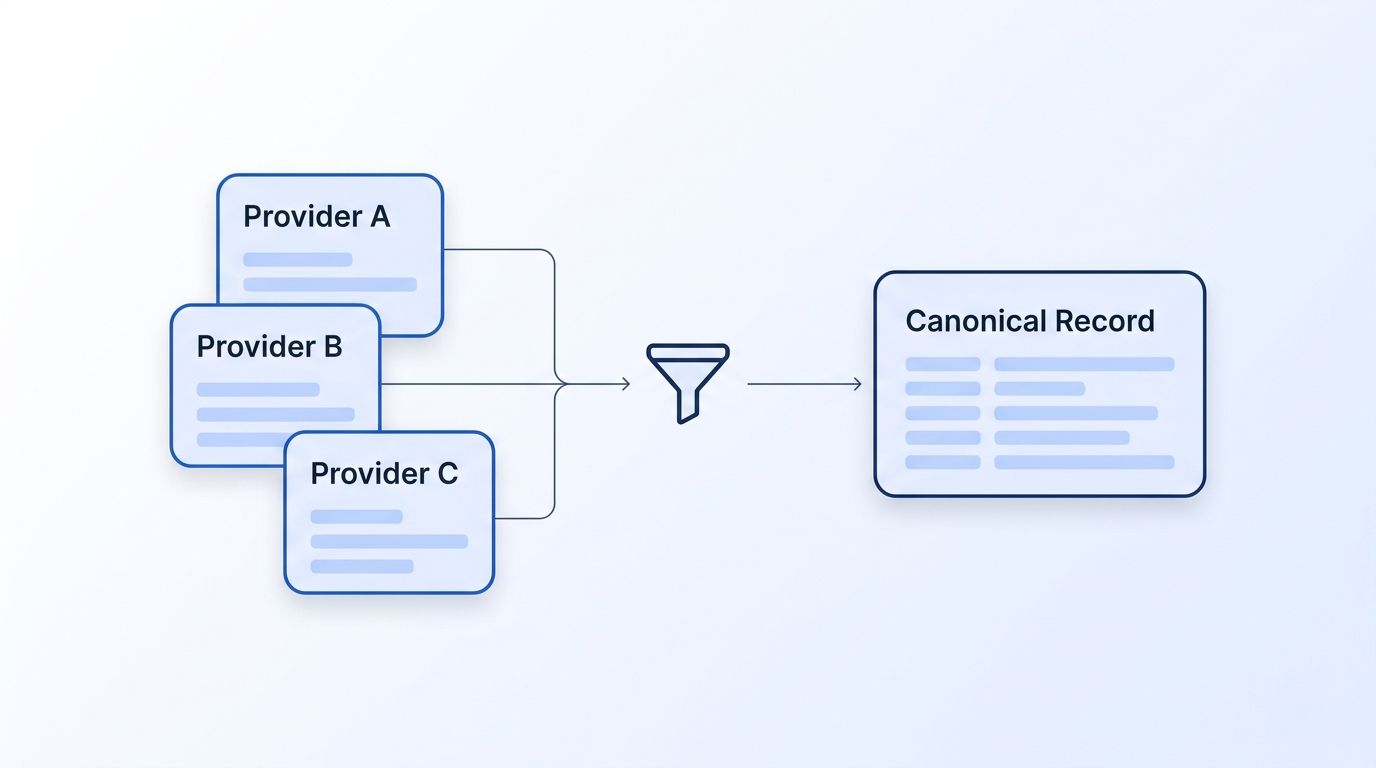
Most teams treat normalization as a one-time mapping exercise: write the transform, ship it, move on. But provider schemas drift quietly - a field gets renamed, a new enum value appears - and a normalization layer that isn't versioned breaks silently instead of loudly. Treat your canonical schema like an API contract with its own version history, not a script you wrote once and forgot.
A normalization layer maps every provider's fields - however they name headcount, seniority, or company size - into one canonical schema your application actually uses. It sits between the raw provider response and your database, so downstream code never has to know which provider a record came from.
Datamagnet's Company Profile endpoint returns a consistent set of firmographic fields - headcount, industry, headquarters, specialties - regardless of which LinkedIn page generated them, which is the pattern a normalization layer should replicate across every provider you connect. That consistency is exactly why programmatic CRM enrichment depends on standardized schemas rather than raw provider dumps.
Validate at the input boundary too, not just at the output. Reject a malformed LinkedIn URL or an empty required field before it ever reaches a provider call - it's a wasted API credit and a wasted retry cycle otherwise.
What's the Right Way to Handle Errors, Retries, and Rate Limits?
Not every failed request deserves a retry. A 429 or 503 usually means try again with backoff; a 400 means the request itself is wrong, and retrying just repeats the failure. Idempotency keys make retries safe by ensuring a repeated request can't accidentally create the same record twice.
Average API uptime fell from 99.66% in Q1 2024 to 99.46% in Q1 2025, and weekly downtime across the surveyed companies rose from 34 minutes to 55 minutes - a 60% increase (Uptrends, 2025). Retry logic isn't defensive coding for a hypothetical outage. It's coding for what already happens most weeks.
Watching integrations fail in production almost always comes down to the same root cause: someone treated a 429 rate-limit response the same way they treated a 500 server error, retried both instantly in a tight loop, and turned a brief provider hiccup into a self-inflicted outage.
Build a shared rate-limiting layer in front of every provider call, so one noisy job can't starve the rest of your integration's traffic. Datamagnet's errors reference documents which status codes are retryable and which mean the request needs fixing before you send it again, and checking your credit balance before a large batch job runs beats finding out you're out of quota mid-run.
Exponential backoff with jitter - not fixed-interval retries - keeps a thundering herd of retrying clients from re-hitting a recovering provider at the exact same moment. That small randomization is the difference between a provider that recovers cleanly and one that gets knocked over twice.
How Do You Design for Multi-Provider Failover and Latency Budgets?
A latency budget forces an explicit decision: how long will you wait for a provider before falling back to a second one or returning a partial result? Real-time lookups typically budget under a second per provider; bulk enrichment jobs can budget minutes, because nobody's watching a spinner during a queued backfill.
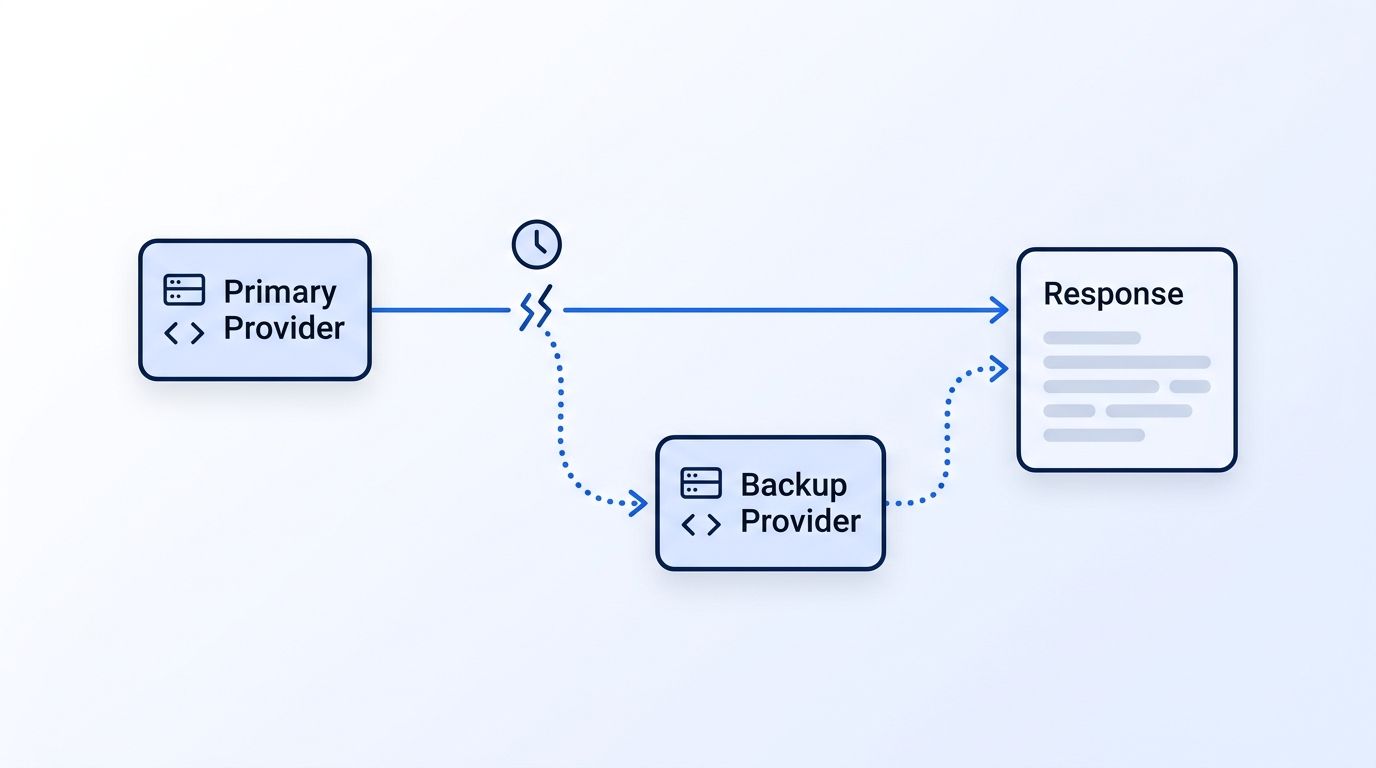
Teams that build failover as a first-class routing decision - not a manual runbook step - report cutting incident response time from hours to minutes, because the system reroutes to a backup provider automatically instead of waiting for someone to notice and intervene.
A queue is what makes failover practical at scale. Route each enrichment job through a queue with per-provider workers, and a failing provider just means that worker's jobs pile up and wait, instead of the whole pipeline stalling. Datamagnet's ICP People Search endpoint is designed to run as a batch job against a queue exactly this way - pull a filtered list, enqueue each record for enrichment, and let workers process it without blocking the request that kicked things off.
Log which provider actually served each record. Fallback rate is a health signal worth tracking on its own dashboard - a provider that silently starts serving 20% of your traffic through its backup is telling you something before it ever shows up as a formal outage. For more on treating live data as a continuously running system rather than a one-time pull, see how real-time B2B people enrichment applies the same principle beyond just failover.
Build the Integration Once, Then Stop Rebuilding It
The pattern underneath all six layers is the same: separate the concern that's likely to change - which provider, which schema, which retry policy - from the concern that shouldn't - the shape of data your application actually consumes. Get that separation right, and adding a fourth provider next year looks like configuration, not a rewrite.
Check Datamagnet's live people and company data against your own integration this week - the quickstart guide gets a first authenticated request running in minutes, so you can see the schema before committing architecture decisions around it.
Frequently Asked Questions
What's the difference between synchronous and asynchronous enrichment APIs?
Synchronous calls return data in the same request that asked for it - right for real-time lookups where a rep or app is waiting on the response. Asynchronous calls queue the job and deliver results later via webhook or polling, which fits bulk enrichment and continuous monitoring where nothing needs an immediate answer.
How do you handle rate limits when calling multiple provider APIs?
Respect each provider's published rate limit, queue excess requests instead of dropping them, and apply exponential backoff with jitter when you hit a 429 response. A shared rate-limiting layer in front of all provider calls prevents one noisy job from starving the rest of your integration's traffic.
What is a normalization layer in a data enrichment pipeline?
A normalization layer is the code that maps every provider's response - different field names, formats, and enum values - into one canonical schema your application actually uses. It sits between the raw provider response and your database, so downstream code never has to know which provider a record came from.
Should you build enrichment pipelines with a message queue?
Yes, once volume goes past a handful of records per request. A queue decouples the request that triggers enrichment from the work of calling providers, retrying failures, and normalizing results, which keeps a slow or failing provider from blocking the rest of your application.
How do you fail over between multiple data providers?
Set an explicit latency budget per provider, and if that budget expires without a response, route the request to a backup provider automatically rather than waiting indefinitely. Log which provider actually served each record, so you can track fallback rate as a health signal over time.
Sources
- Postman, State of the API Report 2025, retrieved 2026-07-20, https://www.postman.com/state-of-api/2025/
- Uptrends, State of API Reliability 2025, retrieved 2026-07-20, https://www.uptrends.com/state-of-api-reliability-2025
- Datamagnet, API Documentation Introduction, retrieved 2026-07-20, https://docs.datamagnet.co/api-reference/introduction
- Datamagnet, Authentication, retrieved 2026-07-20, https://docs.datamagnet.co/api-reference/authentication
- Datamagnet, Webhooks, retrieved 2026-07-20, https://docs.datamagnet.co/api-reference/webhooks
- Datamagnet, Errors, retrieved 2026-07-20, https://docs.datamagnet.co/api-reference/errors
