
Disclosure: This article is published by Datamagnet. Vendor claims are self-reported unless otherwise noted.
How Fast Does B2B Contact Data Decay in 2026? Accuracy Benchmarks That Matter
In 2026, a typical B2B contact database loses 2.1% of its records a month, compounding to roughly 22.5% a year (HubSpot, Database Decay Simulation, retrieved 2026-07-20). That means a fifth of the list you bought or built in January is wrong by December — wrong titles, dead emails, disconnected phone numbers. The harder question isn't whether your data decays. It's which fixes actually hold up.
TL;DR
- B2B contact data decays about 22.5% a year (HubSpot/MarketingSherpa), and 23% of email addresses specifically go bad annually (ZeroBounce, 2026).
- Manual research is accurate but slow: one vendor test took 143 hours to hand-verify 10,000 contacts at 91% accuracy.
- Layered validation — SMTP plus carrier lookup plus human review — consistently beats single-method checks, but "accuracy" claims from vendors often measure a narrower thing than they sound like.
- Reverifying data on a trigger (a job change, a bounce) beats reverifying on a calendar, because decay isn't evenly distributed.
How Fast Does B2B Contact Data Actually Decay?
In 2026, HubSpot's Database Decay Simulation — built on the long-running MarketingSherpa decay research — puts monthly B2B contact decay at 2.1%, which compounds to about 22.5% a year (HubSpot, "Database Decay Simulation," retrieved 2026-07-20). That's the most consistently cited industry baseline, and it lines up closely with fresher, narrower data on email specifically.
As of its 2026 Email List Decay Report, ZeroBounce found that 23% of email addresses in a typical list go bad every year — down slightly from 28% in 2024 — based on processing more than 11 billion verified addresses (ZeroBounce, "2026 Email List Decay Report," retrieved 2026-07-20). Only 62% of those addresses were valid on first pass, and over 1 billion were catch-all domains, which look valid but can still bounce.
Decay estimates in the wild range anywhere from 22% to over 40%, and a widely repeated "70.3% a year" figure attributed to Gartner doesn't actually trace back to any Gartner report we could locate. Anchor your planning on the two sourced numbers above, not the scariest number in a vendor's sales deck.
Why does this matter beyond a single number? Decay isn't a slow, even leak — it's concentrated in a few fields. Job titles and phone numbers move faster than physical addresses, because people change roles and carriers far more often than they move cities. If you're building an outreach plan around real-time B2B people enrichment, budget for that unevenness rather than a flat annual write-off.
Why Does Manual Research Fall Behind at Scale?
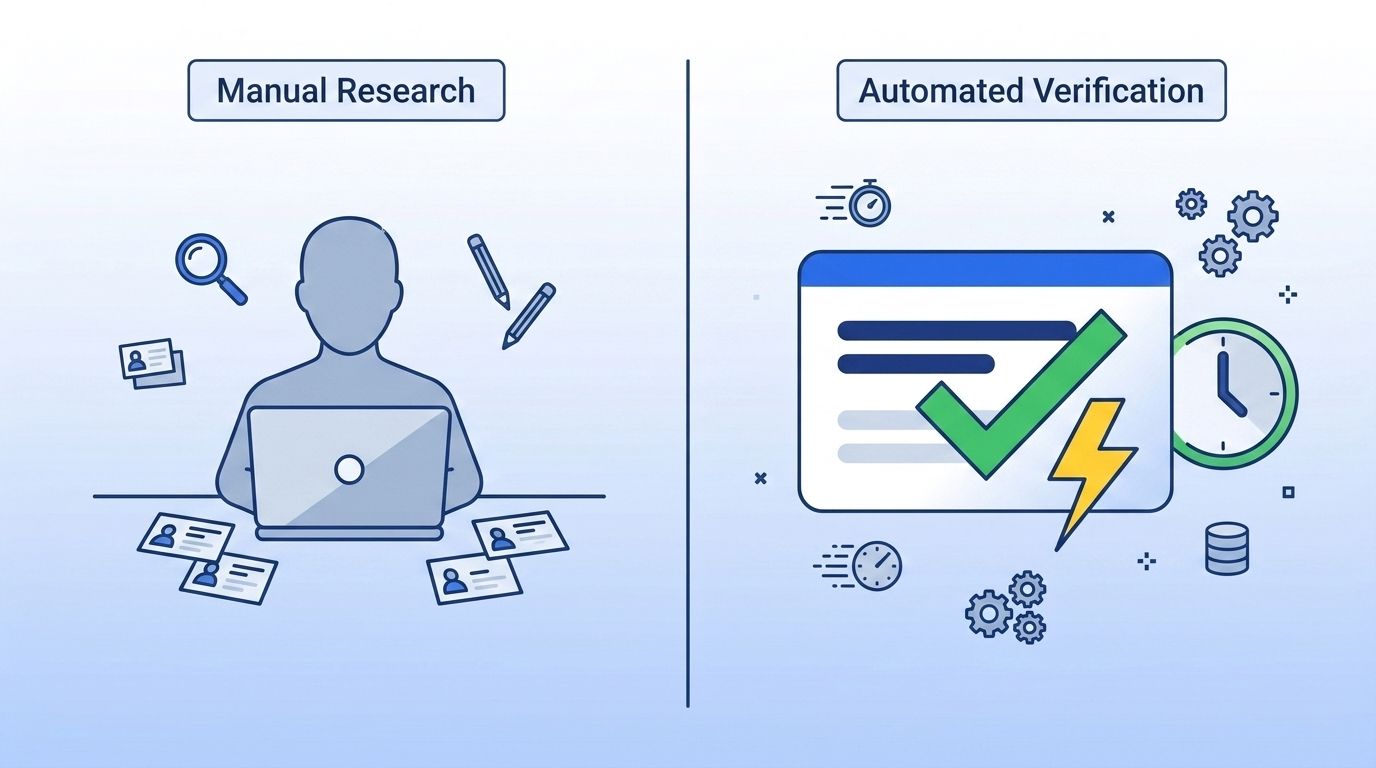
In a January 2026 internal test, data-quality vendor Cleanlist had two researchers manually enrich 10,000 contacts pulled from a HubSpot export. It took 143 hours to reach 91% accuracy (Cleanlist, "B2B Data Enrichment: How It Works, Types & Tools," retrieved 2026-07-20). That's a full researcher-week for one list — and it's already stale by the time the project wraps.
The same test found a single-source enrichment API returned usable data on just 68.2% of records, while running the list through a 15-provider waterfall hit 96.4% verified emails in under 11 minutes (Cleanlist, retrieved 2026-07-20). That's a self-run vendor benchmark, not an independently audited study, so treat the exact percentages as directional rather than gospel. Still, the shape of the result — manual work is accurate but slow, single-source lookups are fast but shallow, and layered lookups beat both — shows up consistently across the industry.
Isn't 91% accuracy from manual research pretty good? It is, until you count the cost. At roughly two verified prospects an hour once research, verification, and data entry are included, a rep spending 18 hours a week on manual account research is burning nearly half their week to keep one list current. That's time not spent selling.
What this means for your team: manual research still has a place for high-stakes accounts, but it doesn't scale as a hygiene strategy. Pair it with an API that pulls current data at request time, like Datamagnet's People API, so reps spend their manual hours on judgment calls, not data entry.
What Do SMTP-Only Checks Actually Miss?
SMTP-only email verification — pinging a mail server to check if an address exists — can't reliably resolve catch-all domains, because those servers return a generic "accepted" response even for invalid mailboxes (EmailVerifierAPI, "Greylisting and Email Verification," retrieved 2026-07-20). That's not a bug in any one tool. It's a structural limit of the protocol itself.
That limit shows up at scale. In ZeroBounce's 2025 dataset of more than 11 billion processed addresses, over 1 billion were catch-all domains — the exact category SMTP pings can't safely score (ZeroBounce, "2026 Email List Decay Report," retrieved 2026-07-20). An SMTP-only tool will mark a meaningful slice of any real B2B list "valid" when it genuinely doesn't know.
The catch-all problem is why "we verify with SMTP" reads as reassuring but tells you almost nothing about accuracy on its own. The useful question to ask a vendor isn't "do you check SMTP?" — nearly everyone does. It's "what do you do when SMTP comes back inconclusive?"
Multiple validation vendors report that stacking syntax, MX record, SMTP, and catch-all detection together brings bounce rates down from a single-source range of 8-12% to under 2%, versus 15-25% for lists relying on one verification pass alone (aggregated from MyEmailVerifier and BillionVerify vendor data, retrieved 2026-07-20). No single peer-reviewed study confirms that exact spread, so read it as a consistent industry pattern rather than an audited figure — but the direction matches what layered validation should do on paper.
For context on healthy targets: a clean B2B marketing list typically bounces under 2%, while cold outreach lists average closer to 7.5%, and anything above 3% starts triggering deliverability penalties at Gmail, Outlook, and Yahoo (aggregated 2025-2026 cold-email benchmark data, retrieved 2026-07-20).
Does Carrier Validation Really Improve Phone Accuracy?
Format-only phone validation — checking that a number has the right digit count and country code — catches an estimated 70-80% of bad numbers on its own, according to industry vendor comparisons (Cleanlist, "10 Best Phone Validation Tools," retrieved 2026-07-20). That leaves a real gap: numbers that are correctly formatted but disconnected, reassigned, or never valid to begin with.
Layering in carrier lookup — checking whether a number is actually assigned and active on a network — adds roughly 10-15 percentage points to the catch rate, and combining carrier data with HLR (Home Location Register) lookups pushes the catch rate for bad numbers to an estimated 95-99% (Cleanlist, retrieved 2026-07-20). These figures come from vendor benchmarking rather than an independent audit, so treat them as directional industry consensus, not a certified accuracy rate.
Practical implication: if a data provider only mentions "format validation" or "carrier check" for phone numbers, ask directly whether HLR is part of the stack. The gap between 75% and 97% is the difference between a list that mostly works and one your SDRs stop trusting after a week of dead-end dials.
What Does "95% Accuracy" Actually Mean in Vendor Marketing?
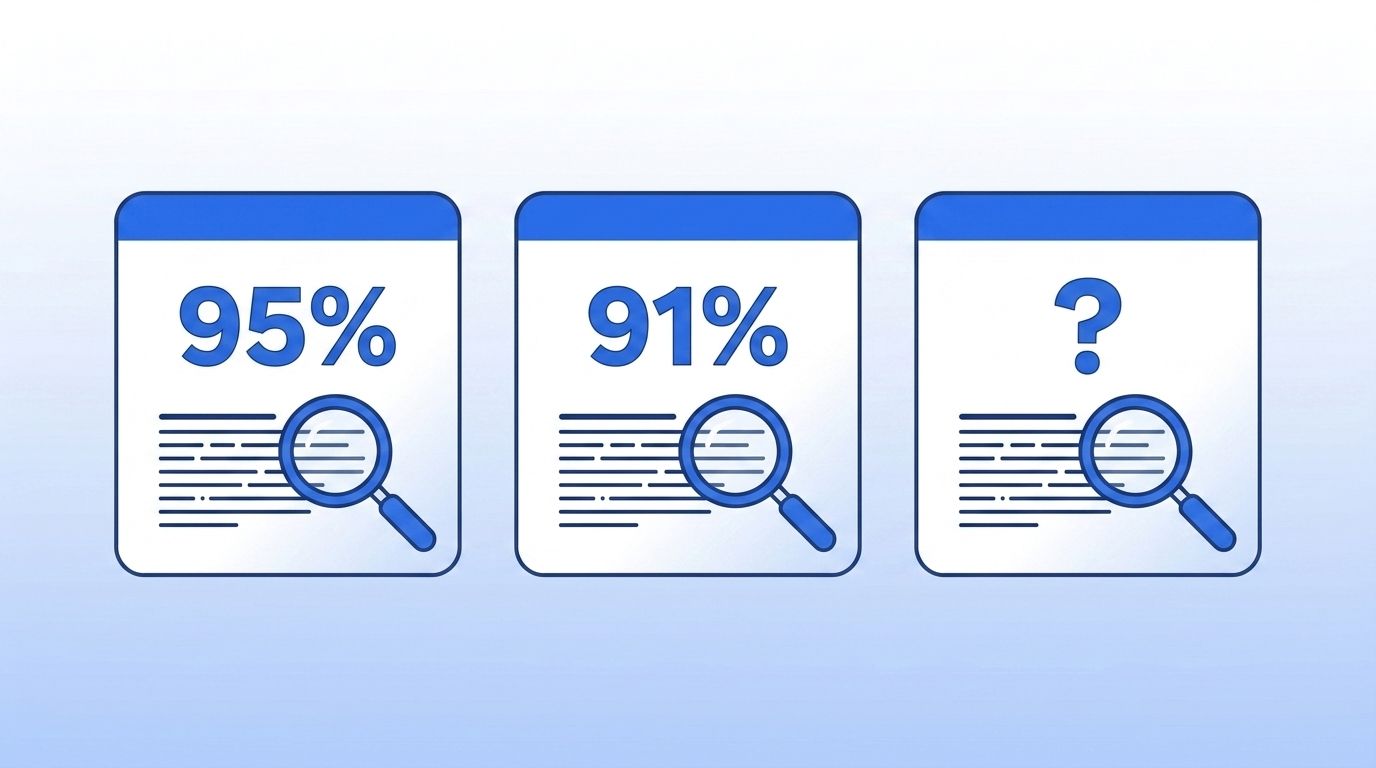
ZoomInfo states it achieves "up to 95% accuracy on first-party data," using ML models layered with a 20+ step SMTP cleaning process and more than 300 in-house human researchers (ZoomInfo, "Data Demystified: Email Accuracy & Verification," retrieved 2026-07-20). Read the fine print, though — ZoomInfo itself scopes that 95% figure to company-affiliation data, not raw email deliverability, which it separately notes runs closer to 75-85% on third-party lists.
Apollo's own documentation draws a similar distinction: an 84% "match rate" (it can find some email for the contact) versus a 91%+ "accuracy rate" that only applies to the subset it separately tags "Verified." A third-party re-test by Prospeo found real-world accuracy for Apollo-sourced emails closer to 65-85%, with bounce rates of 7-25% depending on how many catch-all domains were in the sample (Prospeo, "Apollo.io Accuracy: Real Data vs. 91% Claims," retrieved 2026-07-20).
Not every vendor publishes a number at all. People Data Labs explicitly declines to state a single field-level accuracy percentage, describing instead a QA process that rejects roughly three candidate sources for every one it keeps (People Data Labs, "Data Accuracy" documentation, retrieved 2026-07-20). Coresignal takes the same approach, marketing itself on data freshness and deduplication rather than a headline accuracy figure (Coresignal, FAQ, retrieved 2026-07-20).
Look across enough vendor accuracy pages and a pattern emerges: providers either publish a number with a footnote narrowing what it actually measures, or they skip the number and describe a process instead. Neither is dishonest — but "95% accurate" and "95% accurate on company-affiliation data, not deliverability" are different promises. Ask which one you're getting before you sign.
This is part of why Datamagnet fetches LinkedIn people and company data live at request time instead of serving from a stored database: a number pulled fresh from the source page can't decay between snapshots the way a cached record can. If you're comparing that approach against a static-database vendor, our breakdowns of Datamagnet vs. ZoomInfo and Datamagnet vs. Apollo cover the tradeoffs in more depth.
How Should You Build a Continuous Reverification Cadence?
As of its July 2025 survey of 602 CRM users and admins, Validity found that 37% of respondents had lost revenue directly because of poor data quality, and 76% said less than half of their organization's CRM data was accurate or complete (Validity, "The State of CRM Data Management in 2025," retrieved 2026-07-20). The same survey found workers spending 13 hours a week just hunting for basic CRM information.
Gartner's 2020 Magic Quadrant for Data Quality Solutions, based on 154 reference customers, put the average cost of poor data quality at $12.9 million a year per organization (Gartner, "Magic Quadrant for Data Quality Solutions," retrieved 2026-07-20). That figure is still the standard citation across the industry in 2026, though it's worth noting the underlying survey is more than five years old and skewed toward enterprises already investing in data-quality tooling.
Because decay concentrates in specific fields — job titles and phone numbers more than physical addresses — a blanket "reverify everything every 90 days" policy wastes effort on records that haven't moved and misses ones that changed last week. A trigger-based cadence, refreshing a record when a job-change or engagement signal fires rather than on a fixed calendar, tracks the actual shape of the decay curve instead of a flat average.
That's the logic behind signal-based monitoring: instead of bulk reverification sweeps, you can set up a job-change signal that refreshes a contact's record the moment they move roles, or use champion tracking to catch a departing buyer before the deal quietly goes cold. Combine that with quarterly bulk checks on lower-movement fields like company headquarters, and you're spending reverification budget where the decay actually happens.
Ready to stop guessing which records are stale? See what Datamagnet's real-time People API returns on a live LinkedIn profile — first 10 lookups are free.
Frequently Asked Questions
How often should I reverify B2B contact data?
There's no single right interval, since decay isn't uniform — job titles and phone numbers change faster than company addresses. In 2026, a 22.5% annual baseline decay rate (HubSpot/MarketingSherpa) suggests quarterly bulk checks at minimum, layered with trigger-based refreshes on job-change or engagement signals for high-value accounts.
What's the difference between a "match rate" and an "accuracy rate"?
A match rate measures how often a vendor can find any data point for a contact, while an accuracy rate measures how often that data point is correct once found. Apollo, for example, cites an 84% match rate but reserves its 90%+ accuracy claim for the narrower subset of addresses it marks "Verified" (Apollo documentation, retrieved 2026-07-20).
Does fetching data live instead of from a database solve decay?
Fetching data at request time avoids the specific problem of a stored record going stale between updates, since each lookup pulls from the current source rather than a cached snapshot. It doesn't eliminate every accuracy issue — source data can still be wrong or incomplete — but it removes the "how old is this record" question entirely.
Is manual LinkedIn research still worth doing at scale?
Manual research can reach high accuracy — one 2026 vendor test hit 91% after 143 hours on 10,000 contacts (Cleanlist, retrieved 2026-07-20) — but that time cost doesn't scale as a hygiene strategy. It's better reserved for a short list of high-stakes accounts than for keeping an entire CRM current.
How accurate is carrier or HLR phone validation compared to format checks alone?
Format-only validation catches an estimated 70-80% of bad phone numbers, while adding carrier and HLR (Home Location Register) lookups pushes that catch rate to roughly 95-99%, according to 2026 vendor benchmarking (Cleanlist, retrieved 2026-07-20). If a provider only mentions format checks, ask what happens to the remaining 20-30%.
Conclusion
B2B contact data decays fast and unevenly — 22.5% a year on average, faster for job titles and phone numbers, slower for company addresses. No single validation layer catches everything: SMTP checks miss catch-all domains, format-only phone checks miss reassigned numbers, and even a well-earned "95% accuracy" claim usually describes a narrower slice of data than the headline suggests.
The fix isn't one tool — it's a stack (SMTP plus carrier plus HLR plus, where it matters, human review) paired with a reverification cadence that follows where decay actually concentrates instead of a flat calendar. Start by auditing what your current provider's accuracy number actually measures, then compare that against a real-time enrichment approach that pulls current data instead of a stored copy.
