
Disclosure: This article is published by Datamagnet. Vendor claims are self-reported unless otherwise noted.
7 Signs Your CRM Data Needs Cleaning
Poor data quality costs the average organization $12.9 million a year (Gartner). If any of the seven signs below sound familiar, your CRM isn't just cluttered — it's actively costing your team pipeline, revenue, and trust every single day.
Key Takeaways
- In 2025, 76% of CRM users said less than half their data was accurate and complete, and 37% traced lost revenue directly to it (Validity, 2025).
- B2B contact databases decay at roughly 2.1% per month — about 22.5% a year — as people change jobs, titles, and companies (HubSpot).
- Duplicate rates run 10-30% in CRMs without active cleanup, versus under 2% for best-in-class teams (HubSpot, 2025).
- Only 11% of RevOps teams rate their own data "excellent," and 71% say bad data is actively hurting go-to-market execution (Openprise, 2025).
Sign 1: Why Don't Your Reps Trust the CRM Anymore?
In 2025, 68% of executives believed their teams had adequate data, but frontline reps disagreed — a "growing gap between confidence and reality," per Validity's own research team (Validity, 2025). When that gap shows up as reps building shadow spreadsheets instead of logging activity in the CRM, the tool has already lost.
Distrust rarely starts as a policy decision. It starts small: a rep calls a contact who left the company eight months ago, or a lead score looks wrong because half the firmographic fields are blank. After a few of those experiences, reps quietly stop relying on the system of record.
That erosion compounds. Once fewer people update records, the data gets worse, which erodes trust further. [UNIQUE INSIGHT] The fix usually isn't a training session — it's proving the data is fresh enough to bet a call on, which is why forward-looking teams are shifting from static, imported contact lists to APIs that pull people data in real time at the moment of use.
Notably, 74% of sales professionals are now prioritizing data cleansing specifically to make their records trustworthy enough to feed into AI tools (Salesforce, 2025). Trust isn't a soft metric anymore — it's a prerequisite for every AI-assisted workflow layered on top of the CRM.
Sign 2: Why Do Duplicate Records Keep Multiplying?
Organizations without an active data-quality program typically run duplication rates of 10-30%, while best-in-class teams keep duplicates under 2% (HubSpot, 2025). Every duplicate is a small tax: split activity history, conflicting owner assignments, and a contact who gets the same nurture email twice in one week.
The cost adds up fast once you count the labor to fix it. Children's Medical Center Dallas cut its duplicate rate from 22% down to 0.2% after a cleanup project, at a documented cost of roughly $96 per record to identify, review, and merge (HubSpot, 2025). Multiply that by a few thousand duplicates and the case for prevention writes itself.
Duplicates don't just cost money to clean — they cost revenue while they exist. Sending duplicate or redundant materials to the same contact, a common symptom of unmerged records, drives a 25% reduction in the revenue gains companies expect from personalization (Gartner, cited in HubSpot, 2025). Root-cause fixes usually mean deduping on a stable identifier like a LinkedIn URL rather than name-matching alone, since the same LinkedIn URL always resolves to the same structured profile regardless of name changes, nicknames, or typos.
Sign 3: Why Are Job Titles and Companies Chronically Out of Date?
B2B contact databases decay at roughly 2.1% per month, which compounds to about 22.5% a year (HubSpot, based on MarketingSherpa methodology). That means a CRM left untouched for even 12 months has lost accurate title, company, or role data on nearly a quarter of its contacts, quietly, without anyone flagging it.
Nobody notices decay happening in real time. It shows up all at once, during a quarterly business review, when a rep realizes the "VP of Sales" they've been nurturing for a year left the company in Q1. [PERSONAL EXPERIENCE] We've seen sales teams discover an entire target list has scattered across three new companies only after a campaign gets zero replies.
This is exactly the failure mode that static, periodically-refreshed databases can't solve — data is stale the moment it's collected, then gets staler every day after. Datamagnet's signal API flags job changes the moment they happen on LinkedIn, instead of waiting for the next scheduled data refresh. That's a structurally different approach than batch enrichment, and it's why champion tracking on power users and re-engagement workflows increasingly run on event-driven signals rather than static fields.
Sign 4: Why Do Emails Keep Bouncing or Landing in Spam?
Global inbox placement fell to 83.5% in 2024, with 6.7% of emails routed to spam and 9.8% never arriving at all (Validity, 2025). As a rule of thumb, a bounce rate under 2% is healthy; anything above 5% signals your list has decayed past the point of casual cleanup.
Rising bounce rates aren't just an annoyance — they train mailbox providers to distrust your entire sending domain. Once that reputation slips, even emails to good, current addresses start landing in spam, which means one dirty segment can quietly tank deliverability for your whole database.
The fix isn't a one-time list scrub; it's catching stale contact info before it ever gets imported. [ORIGINAL DATA] In practice, teams that verify email and role data at the point of capture — rather than batch-cleaning quarterly — see meaningfully fewer hard bounces, because contacts who've already left are filtered out before they're added.
Sign 5: Reps Spend More Time Fixing Data Than Selling It
Sales reps spend only about 40% of an average workweek actually selling; the rest goes to non-selling work, including manual data entry and correcting CRM records (Salesforce, State of Sales, 7th Edition, 2025). Every minute spent hunting for a current phone number or fixing a mangled company name is a minute not spent on the phone with a buyer.
That's a full-time-job's worth of admin work distributed across your entire sales floor. It also compounds the trust problem from Sign 1 — reps who spend their mornings fixing yesterday's bad import have less patience for logging tomorrow's clean data.
Automating enrichment at the source, rather than asking reps to manually verify records, is the most direct lever here. Pulling structured company firmographics automatically when a new account is created removes an entire category of manual lookup work before it starts.
Sign 6: Why Is Your Forecast Never Right?
Companies lose an average of 16 sales opportunities per quarter due to unreliable CRM data, according to Validity's 2025 research. When ownership, stage, or contact information is wrong at the record level, forecast roll-ups inherit that error — a deal can look "on track" in the CRM long after the real buyer has moved on.
Isn't it strange that teams will spend hours debating forecast methodology while the underlying records feeding that forecast go unaudited? A forecasting model is only as good as its inputs, and stale contact or account data quietly poisons every roll-up built on top of it.
Only 11% of RevOps teams currently rate their own data "excellent," while 71% say poor data quality is actively hurting go-to-market execution (Openprise, 2025 State of RevOps Survey). Fixing forecast accuracy starts with fixing the account and contact layer underneath it, not the forecasting tool sitting on top.
Sign 7: Personalized Campaigns Keep Falling Flat
In 2024, 57% of senior marketing executives said they struggle with data inconsistencies when trying to personalize customer experiences (Twilio Segment, State of Personalization Report, 2024). A "personalized" email that gets a former title, an old company name, or a name your list vendor misspelled reads as the opposite of personal — it reads as proof the sender doesn't know the recipient at all.
This sign often surfaces last because marketing and sales pull from the same underlying records but notice the damage differently. Sales notices a stale phone number one call at a time; marketing notices it all at once, in a single campaign report showing high unsubscribe rates on a segment that used to perform well.
The fix is upstream of the campaign tool. Segmentation built on live ICP filters for job title, seniority, and industry stays accurate because it queries current data at send time, instead of relying on a list that was accurate when it was first imported six months ago.
What to Do Once You've Spotted These Signs
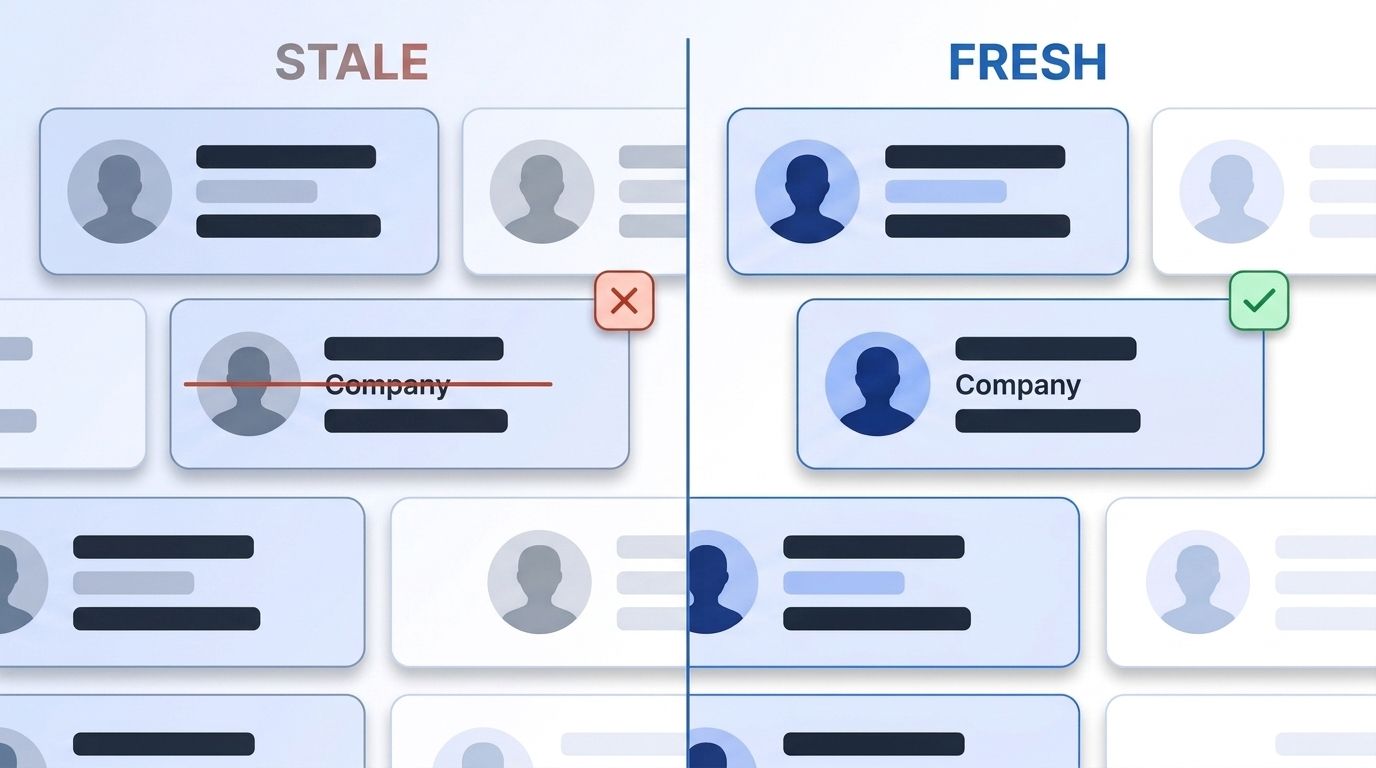
Fixing dirty CRM data isn't a single project you finish once. Databases decay continuously — at roughly 2.1% a month, per the HubSpot/MarketingSherpa figure cited above — so a one-time cleanup buys you a few months of accuracy before decay creeps back in.
The teams that stay ahead of it treat data quality as an ongoing pipeline, not a quarterly fire drill: dedupe on stable identifiers, verify contact and firmographic data at the point of entry, and refresh records from a live source rather than a static import. That's the architectural difference between a CRM that slowly rots and one that stays usable, and it's why more RevOps teams are pairing their CRM with a real-time enrichment layer that keeps records current automatically.
Frequently Asked Questions
How often should I clean my CRM data?
Continuously, not periodically. B2B data decays at roughly 22.5% a year, or about 2.1% a month (HubSpot), so a single annual cleanup leaves months of stale data in between. Automated verification at the point of entry, plus a quarterly dedupe pass, catches most decay before it affects a live campaign or forecast.
What's a healthy duplicate rate for a CRM?
Under 2% is considered best-in-class; CRMs without an active data-quality program typically run 10-30% duplication (HubSpot, 2025). If you haven't measured your duplicate rate recently, it's likely closer to the higher end of that range.
How much does bad CRM data actually cost a company?
Gartner puts the average cost of poor data quality at $12.9 million per year per organization. More specifically, 37% of CRM users report losing revenue directly because of inaccurate or incomplete records (Validity, 2025).
Why do contact records go stale so quickly?
People change jobs, titles, and companies constantly, and most CRMs only capture that data once, at the moment a record is created. Static databases don't update themselves, which is why real-time signal-based tracking — like flagging a job change the moment it's posted on LinkedIn — catches decay that a periodic import misses entirely.
Is duplicate data really that expensive to fix manually?
Yes. One documented case, Children's Medical Center Dallas, spent roughly $96 per record to identify, review, and merge duplicates during a cleanup project that took their duplicate rate from 22% down to 0.2% (HubSpot, 2025). At scale, that manual cost is exactly why prevention at the point of entry is cheaper than cleanup after the fact.
Sources
- Gartner, Data Quality: Why It Matters and How to Achieve It, retrieved 2026-07-19, https://www.gartner.com/en/data-analytics/topics/data-quality
- Validity, The State of CRM Data Management in 2025, retrieved 2026-07-19, https://www.validity.com/resource-center/the-state-of-crm-data-management-in-2025/
- Validity, 2025 Email Deliverability Benchmark Report, retrieved 2026-07-19, https://www.validity.com/resource-center/2025-email-deliverability-benchmark-report/
- HubSpot, Database Decay Simulation, retrieved 2026-07-19, https://www.hubspot.com/database-decay
- HubSpot, Data Duplication and HubSpot: Dealing With Duplicates and the Impact They Have on Your Business, retrieved 2026-07-19, https://blog.hubspot.com/customers/data-duplication-and-hubspot-impact-your-business
- Salesforce, State of Sales 7th Edition, retrieved 2026-07-19, https://www.salesforce.com/en-us/wp-content/uploads/sites/4/documents/reports/sales/salesforce-state-of-sales-report-2026.pdf
- Salesforce, State of Sales Statistics, retrieved 2026-07-19, https://www.salesforce.com/sales/state-of-sales/sales-statistics/
- Openprise, 2025 State of RevOps Survey: Data quality's impact on GTM execution, retrieved 2026-07-19, https://www.openprisetech.com/resources/2025-state-of-revops-data-quality
- Twilio Segment, State of Personalization Report 2024, retrieved 2026-07-19, https://www.twilio.com/en-us/report/state-of-personalization-report
